By the time someone searches for the best serums for oily skin, they’re often already frustrated. Their face feels slick by noon, makeup slides off, pores look more obvious than they did in the morning, and every product seems to swing to an extreme. One cleanser leaves skin tight and stingy. One moisturizer feels greasy. One “acne serum” works for a week, then irritation shows up.
That cycle usually starts with the same mistake. People treat oil as the enemy, so they try to scrub, strip, and dry it away. Skin rarely rewards that approach for long.
A better strategy is more precise. Oily skin usually responds best when you use lightweight, targeted formulas that help regulate shine, keep pores clearer, and support the skin barrier instead of picking a fight with it.
Why Your Oily Skin Needs the Right Serum
By midafternoon, your forehead may already look shinier than it did an hour after washing, while your cheeks feel oddly tight. That combination confuses a lot of people. Skin can produce excess oil and still need better hydration support and a more precise treatment step.

A serum often fills that gap because it is the part of a routine built to deliver targeted ingredients in a light layer. Cleansers rinse off too quickly to do every job well. Moisturizers are designed mainly to reduce water loss and keep skin comfortable. A serum gives you a more exact tool.
For oily skin, precision matters. Sebum is part of your skin’s protective system, like a thin coat that helps reduce water loss and defend the surface. Trouble shows up when that coat becomes too thick, mixes with dead skin cells, and lingers in pores. The result can be shine, congestion, breakouts, or makeup that slips by noon.
Using the right serum helps you address those problems without turning your routine into a tug-of-war. A well-matched formula can help regulate the look of oiliness, keep pores clearer, and support a calmer barrier so skin feels more stable from morning to night.
Climate changes that decision more than many guides admit. A serum that feels excellent in a dry winter apartment can feel sticky in a humid summer. A gel serum may be enough in hot, damp weather, while a lightly hydrating fluid can make more sense in a cold, dry season when oily skin still loses water. That is why choosing a serum by skin type alone is incomplete. Oily skin behaves differently in Arizona than it does in Miami.
If you have been stuck in the cycle of stripping, overcorrecting, and getting even shinier later, expert advice for balancing shine can help clarify what your skin is responding to.
A smart starting serum for oily skin usually has a few traits:
- Light texture that spreads easily and dries down without a heavy film
- Targeted purpose such as reducing visible shine, supporting clogged pores, fading post-acne marks, or adding hydration without heaviness
- Formula fit for your environment, especially your humidity level and season
- Compatibility with the rest of your routine, so it does not pile on with rich creams or overly harsh acne steps
One practical rule helps here. If the product feels like a thick cream or facial oil, it is usually not the easiest entry point for oily skin, especially in warm or humid conditions.
The right serum gives oily skin direction, not extra weight.
Understanding How Serums Work on Oily Skin
You wash your face in the morning, it feels clean for an hour, and by lunch your T-zone is shiny again. That pattern does not always mean your skin needs stronger products. It often means your routine is missing a treatment step that can guide oily skin more precisely.
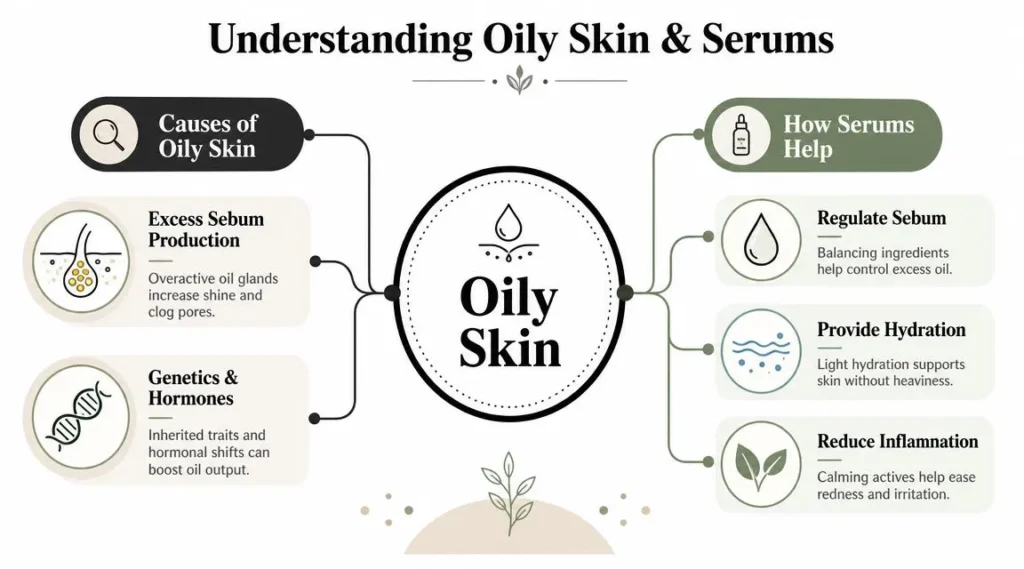
What oily skin is actually doing
Oily skin is driven by sebaceous glands, which produce sebum. Sebum is not the enemy. It helps soften and protect the skin. The issue starts when your skin makes more oil than you comfortably wear through the day, especially when that oil mixes with dead skin cells, sunscreen, makeup, sweat, and air pollution. That mixture can sit in pores and make them look larger or more congested.
Genetics and hormones set much of that baseline. Climate changes how it shows up. In high humidity, oil tends to sit more heavily on the surface. In a dry winter or heavily air-conditioned room, oily skin can still lose water from the outer layer and feel tight even while looking shiny. That is why serum choice should match both your skin behavior and your environment.
Why serums can be so useful
A serum is a treatment layer. It is usually lighter than a cream and built to deliver ingredients for a specific job, such as keeping pores clearer, reducing the look of excess shine, calming post-breakout redness, or adding water without a greasy finish.
That distinction matters for oily skin.
Many moisturizers are designed mainly to seal in comfort. Serums are better suited to targeted correction. If your skin is oily in August but feels dehydrated in January, the serum is often the product you adjust first. A watery gel may be enough in hot, damp weather. A slightly more hydrating fluid can make better sense in a cold, dry season, even if your skin type is still oily.
You can think of the routine in layers of function:
- Cleanser removes oil, sweat, sunscreen, and debris from the surface
- Serum delivers concentrated treatment ingredients where you need precision
- Moisturizer helps slow water loss and support the barrier
- Sunscreen protects skin from UV damage and post-acne marks getting darker
Why oily skin can still need hydration
This point confuses people all the time. Oil and water are not the same thing.
Your skin can produce plenty of sebum and still have too little water in its outermost layer. When that happens, the skin may feel taut after cleansing, become irritated more easily, and then look shinier later in the day. A well-formulated serum helps by addressing the actual gap. Sometimes that means exfoliation. Sometimes it means lightweight hydration. Sometimes it means both, depending on the formula.
A simple example helps. If your skin feels slick but also uncomfortable after washing, a harsh drying product can make the barrier less steady. A light hydrating serum, especially one suited to humid or dry conditions, often leaves the skin looking more even because it is functioning more normally.
If your skin also gets flushed or reactive, gentle supporting ingredients can help. Some people like pairing their routine with rose water benefits for calmer-feeling skin as a soothing extra step, though it should not replace a treatment serum that addresses oil, congestion, or dehydration directly.
Balance gives better results than force
Oily skin usually responds best to consistency. Serums help because they let you treat one problem without making the whole routine heavier or harsher than it needs to be.
The best formulas do not just chase a matte finish for a few hours. They help skin stay clearer, more comfortable, and easier to manage across different seasons, humidity levels, and daily conditions.
Decoding the Best Ingredients for Oily Skin
If serum shopping feels confusing, it’s usually because product labels mix marketing language with half-familiar ingredients. The easiest way to judge a serum is to ask one question first. What job do I need this formula to do?
Board-certified dermatologists commonly recommend ingredients such as retinol, AHAs, and BHAs to reduce oil production and minimize pores, while niacinamide is frequently highlighted for oil control and hyaluronic acid for hydration without heaviness, as summarized by Healthline’s routine guidance for oily skin.
Think of ingredients as specialist workers
One ingredient doesn’t do every task well. Oily skin usually benefits most when you match the ingredient to the problem in front of you.
| Ingredient | Primary Function | Best For Targeting |
|---|---|---|
| Niacinamide | Helps balance visible oil and supports skin comfort | Shine, enlarged-looking pores, post-breakout redness |
| Salicylic acid | Exfoliates inside the pore because it’s suited to oily congestion | Blackheads, clogged pores, acne-prone oily skin |
| AHAs | Exfoliate the skin’s surface | Rough texture, dullness, uneven feel |
| Retinol | Encourages cell turnover and helps keep pores clearer over time | Persistent congestion, acne-prone skin, texture concerns |
| Hyaluronic acid | Adds lightweight hydration without heaviness | Dehydrated oily skin, tightness after cleansing |
| Vitamin C | Supports brightness and antioxidant protection | Dullness, post-acne marks, daytime support |
Niacinamide for oil balance
Niacinamide is one of the most useful starting points for oily skin because it’s versatile. It can help skin look less shiny, support the barrier, and pair well with other ingredients.
If your main complaint is, “My skin gets greasy fast, but I don’t want to irritate it,” niacinamide is often a sensible place to begin.
Salicylic acid for congested pores
Salicylic acid is a BHA, and oily skin tends to do well with it because it’s especially relevant when oil and debris are trapped in pores. This is the ingredient I think of when someone says their forehead feels bumpy, their nose develops blackheads, or breakouts keep forming in the same areas.
It’s less about making skin feel squeaky clean and more about helping pores stay less crowded.
If your skin is shiny but smooth, niacinamide may be enough. If it’s shiny and bumpy, salicylic acid usually deserves a closer look.
AHAs and retinol for texture and turnover
AHAs work more at the skin’s surface. They can be useful when oily skin also looks dull or feels rough. Retinol works differently. It’s often chosen when clogged pores, uneven texture, and recurring acne are part of the picture.
Both can be effective, but they require restraint. Oily skin can tolerate more than some other skin types, but that doesn’t mean it benefits from stacking every strong active at once.
Hyaluronic acid for oily skin that’s secretly thirsty
Many people skip hydrators because they think hydration equals grease. It doesn’t. Hyaluronic acid is included in many oily-skin serums because it helps with water content, not oil content.
That’s particularly useful if your skin gets shiny after using acne treatments, or if your face feels tight after washing but oily later in the day. Even simple supporting products, such as rose water in a basic skincare routine, can make more sense once you understand the difference between adding water and adding oil.
How to Select the Right Serum Texture and Formula
Ingredients matter, but texture decides whether you’ll keep using the serum. A brilliant formula that feels sticky, greasy, or suffocating won’t survive a humid commute, a long day under makeup, or a hot office with recycled air.
Most guides stop at ingredient lists. That misses real life. Oily skin doesn’t behave the same way in tropical humidity, winter wind, heavy air conditioning, or a dry indoor climate.
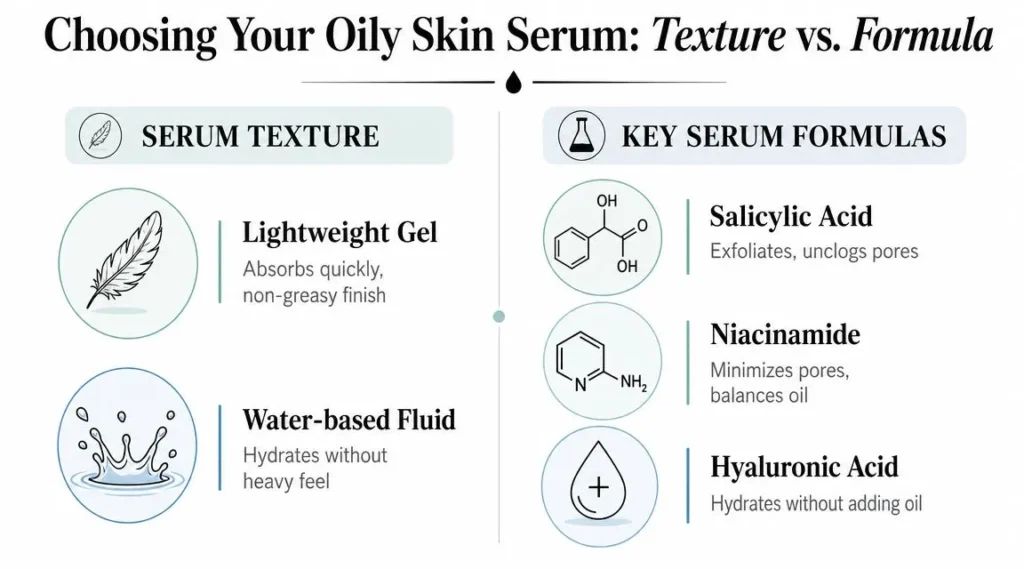
Texture is part of treatment
A serum can contain the “right” actives and still be wrong for you if the base formula feels too heavy. For oily skin, useful labels often include water-based, gel-serum, oil-free, and non-comedogenic.
Those terms don’t guarantee perfection, but they usually point in the right direction.
Here’s a practical way to sort textures:
- Water-based fluid works well if you want the lightest possible layer and fast absorption.
- Gel serum often suits oily skin that wants hydration without a greasy after-feel.
- Gel-cream serum can help if your skin is oily but also exposed to drying indoor air or seasonal irritation.
- Rich or oily serum is usually a poor match if you’re dealing with visible shine and congestion.
Choose by environment, not just skin type
A major gap in oily-skin advice is the lack of guidance on climate and season. As OSVI Dermatology’s discussion of oily-skin serums points out, most guides don’t explain how serum choice should change in hot, humid conditions versus drier environments.
That matters more than people think.
Hot and humid places
If you live somewhere muggy, sweat mixes with sebum and many products feel heavier than they looked in the bottle. In that setting, the best serums for oily skin are often the leanest ones.
Look for:
- Fast-drying fluids that disappear quickly
- Salicylic acid or niacinamide if congestion and shine build up fast
- Gel sunscreen after serum rather than layering many dense products
Dry weather or constant air conditioning
It’s easy to be misled; skin may still be oily, but the environment increases water loss and irritation. In that case, a formula with a bit more hydration can work better than an ultra-stripping treatment.
That might mean:
- A gel serum with niacinamide and hyaluronic acid
- Using fewer exfoliating nights
- Keeping a light moisturizer in the routine instead of skipping it
If you’re already thinking about simple cleansing choices too, glycerin soap and skin hydration basics can help you understand why some cleansers leave oily skin calmer than others.
The best serum isn’t just matched to your face. It’s matched to the air around your face.
A quick decision framework
Choose your serum by answering these questions:
- Is your main issue shine or clogging? Lean toward niacinamide or salicylic acid.
- Does your skin also feel tight? Add lightweight hydration.
- Is your environment humid? Go lighter in texture.
- Is your environment dry or heavily air-conditioned? Pick a slightly more cushioning gel formula.
- Do you break out when products feel rich? Avoid creamy, occlusive serum bases.
How to Layer Serums in Your Skincare Routine
The best serum won’t do much if you apply it in the wrong order or combine too many active products at once. Oily skin routines work best when they’re simple enough to repeat and thoughtful enough to avoid irritation.
Start with the order first.
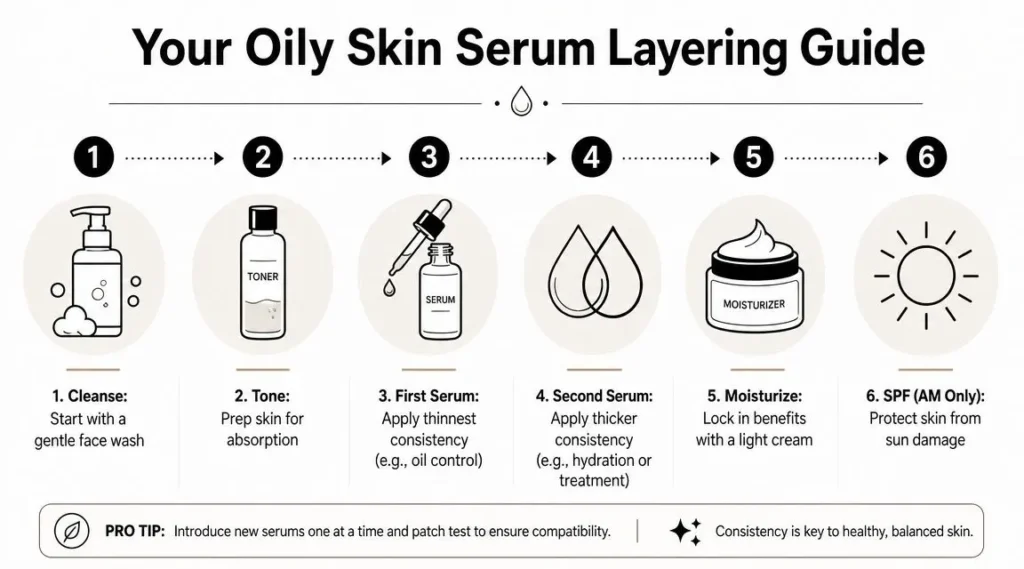
The basic layering rule
For oily skin, serum sits in the treatment slot after cleansing and before moisturizer. Expert-oriented guidance also supports salicylic acid plus niacinamide as a common combination, and it stresses that lightweight moisturizer still matters, especially at night, to help prevent rebound oiliness from over-stripping, as explained in Squigs Beauty’s guide to choosing a serum for oily skin.
If you use more than one serum, apply from thinner to thicker.
A practical morning routine
Morning is usually about oil management, comfort, and sun protection.
- Cleanse with a gentle face wash suited to oily skin.
- Tone if you use toner and if it agrees with your skin.
- Apply serum such as niacinamide, vitamin C, or a lightweight balancing formula.
- Use moisturizer if needed. Some very oily skin types may prefer to go straight to sunscreen if their skin is comfortable and the sunscreen is gel-based.
- Finish with sunscreen every morning.
For another plain-English take on sequencing products, BotoxBarb skincare advice gives a helpful overview of serum layering logic.
A quick visual can make the order easier to remember:
A practical evening routine
Night is where stronger treatment steps usually fit better.
- Cleanse well to remove sunscreen, oil, and debris
- Apply your treatment serum such as salicylic acid, niacinamide, or retinol depending on your needs
- Follow with a lightweight, non-comedogenic moisturizer
- Keep the routine steady, rather than rotating too many actives impulsively
Mistakes that make oily skin harder to manage
Some of the most common problems are simple application errors:
- Using every active together. Salicylic acid, AHAs, retinol, and strong acne treatments can overwhelm skin when layered carelessly.
- Skipping moisturizer out of fear. This often backfires and leaves skin feeling both irritated and oilier.
- Changing products too quickly. Oily skin needs consistency more than drama.
- Choosing thick formulas at night because they sound “repairing”. Texture still matters after dark.
Your serum should feel like a treatment step, not like a second moisturizer and not like a liquid peel unless it was specifically designed to be one.
Your Path to Balanced and Healthy Skin
Finding the best serums for oily skin gets easier once you stop asking, “What’s the strongest product?” and start asking, “What does my skin need, where do I live, and what will I use consistently?”
For some people, that answer is a light niacinamide serum in a humid climate. For others, it’s a salicylic acid formula for congestion, or a hydrating gel serum during winter and office-heavy months. The product category matters less than the match between ingredient, texture, and environment.
That’s the part many routines miss. Oily skin is not one fixed condition. It changes with weather, indoor heating, air conditioning, sweat, sunscreen use, and the rest of your routine. If you account for those shifts, your serum choice becomes much more logical.
If breakouts are part of your oily-skin picture, broader education on body acne treatment and related skin habits can also help you spot patterns that go beyond the face.
Stay patient with the process. Choose a lightweight formula, give it a fair trial, protect your barrier, and resist the urge to attack every bit of shine. Skin usually responds better to calm consistency than to harsh correction.
If you like clear, practical articles that turn complicated health and skincare topics into useful everyday guidance, visit maxijournal.com. It’s a good place to find fresh writing across health, science, technology, fashion, travel, entertainment, and more.
Discover more from Maxi Journal
Subscribe to get the latest posts sent to your email.