The Bureau of Labor Statistics reports a median annual wage of $159,670 for lawyers, while NALP reports a $200,000 median first-year associate base salary. Those figures answer different questions: one covers lawyers at every career stage, and the other measures entry-level private-practice associates.
That gap is why the phrase average starting salary lawyer can produce a misleading search result. A national occupation-wide median blends new graduates with experienced attorneys, partners, and senior counsel. A first-year associate survey focuses on a narrower group, but its result is strongly influenced by large-firm hiring.
The practical answer depends on firm size, location, practice area, and employer type. A new associate in a major legal market may receive a compensation package far above a graduate entering a small firm, government office, or civil legal services organization. The useful question isn’t “What does the average lawyer make?” It’s “Which salary tier matches this offer?”
What the Average Starting Salary Lawyer Actually Means in 2026
Salary data becomes useful only after you identify who the dataset measures. The Bureau of Labor Statistics lawyer profile reports an occupation-wide median of $159,670 in May 2025. That figure describes lawyers across the profession, not just people entering their first legal job.
NALP answers a narrower question. Its first-year associate data reports an overall median base salary of $200,000 as of January 1, 2025, covering entry-level private-practice associates. The sample is heavily weighted toward large firms, with offices in firms employing more than 250 lawyers representing about 87% of survey respondents, according to the same NALP data.
Why the two medians cannot be substituted
The BLS median is broad and occupation-based. It helps describe the earning level of lawyers as a whole, but it isn’t an appropriate direct benchmark for a first offer. A first-year attorney is being compared with people who have built years of experience, developed specialized practices, or moved into senior positions.
NALP’s figure is closer to a new graduate’s reality, but it still isn’t universal. It measures associates in private firms, not every person who earns a law degree and accepts a legal job. Public service, government, small-firm, contract, and other roles sit in different segments.
Practical rule: Before using any salary figure, identify the job population first. “Lawyer” is an occupation. “First-year associate at a large private firm” is a much narrower market.
| Metric | BLS Occupational Median | NALP First-Year Associate Median |
|---|---|---|
| Population | Lawyers at all career stages | First-year private-practice associates |
| Reported figure | $159,670 | $200,000 |
| Best use | Occupation-wide pay context | Entry-level private-firm benchmarking |
| Main limitation | Mixes experience levels | Strongly weighted toward large firms |
The phrase average starting salary lawyer therefore hides a methodological choice. If you’re evaluating a private-firm offer, NALP is generally the more relevant starting point. If you’re asking about the profession’s long-term earning level, BLS provides the broader reference.
How Firm Size Reshapes the Starting Pay Ladder
Firm size creates one of the clearest salary divides in the entry-level market. The NALP survey reports an overall first-year associate median of $200,000, but that headline figure reflects a respondent pool dominated by large-firm offices. It shouldn’t be treated as the expected offer for every new attorney.
The firm-size distribution is wide. NALP reports starting pay from about $70,000 in firms with 2 to 25 lawyers to $160,000 in firms with more than 1,000 lawyers, while firms with 25 or fewer lawyers had a median of $67,000. That range turns “average starting salary” into a classification problem.
Reading the ladder correctly
Large firms often use formal salary scales, which makes offers more predictable. Smaller firms may have greater discretion and may set compensation according to local revenue, practice mix, client base, and the candidate’s experience. Two graduates with similar academic records can therefore receive very different offers because they join different operating models.
The high-end figures also don’t mean that most first-year lawyers earn the top amount. A large-firm benchmark can dominate the public conversation while leaving small-firm graduates with a very different financial reality.
| Firm size | First-year base salary | What the figure tells you |
|---|---|---|
| 2 to 25 lawyers | About $70,000 | Small-firm entry pay can be modest |
| 25 or fewer lawyers | $67,000 median | The smallest-firm segment sits well below the national private-firm median |
| More than 1,000 lawyers | $160,000 | NALP’s firm-size data shows a major size-based gap |
| All surveyed firms | $200,000 median | The overall figure is not representative of every firm tier |
The NALP results also show why an “average” can be less informative than a median by peer group. A graduate joining a small regional practice should compare the offer with similarly sized firms in that market, not with a headline number shaped by large-firm respondents.
The right benchmark isn’t the most visible salary. It’s the salary paid by employers that resemble the one making your offer.
Use firm size as the first filter. Then add geography and practice area. Without those filters, the national number can create an expectation that the local market never intended to meet.
The Geography Premium and Where Entry Pay Clusters
Location is not a minor adjustment to starting pay. It can define the market tier. NALP’s 2025 survey reports a $225,000 median first-year salary in six major markets: Austin, Boston, Houston, New York City, San Francisco, and Washington, DC. The same source reports regional medians of $181,900 in the West, $170,000 in the Northeast, and $160,000 in both the South and Midwest.
Those numbers show why a national figure can obscure local reality. A candidate comparing a major legal hub with a smaller city isn’t comparing two versions of the same market. They’re comparing different concentrations of client demand, firm scale, billing economics, and competition for graduates.
Major markets versus regional medians
NALP also reports a $215,000 median at firms with more than 700 lawyers, with 45% of those firms paying $225,000. By contrast, firms with 100 or fewer lawyers reported a $155,000 median, and 44% of firms with 250 or fewer lawyers paid $150,000 or less. The geography premium therefore interacts with firm size rather than operating independently.
| Market or region | First-year median | Premium versus the $200,000 national private-firm median |
|---|---|---|
| Austin, Boston, Houston, New York City, San Francisco, Washington, DC | $225,000 | $25,000 higher |
| West | $181,900 | $18,100 lower |
| Northeast | $170,000 | $30,000 lower |
| South | $160,000 | $40,000 lower |
| Midwest | $160,000 | $40,000 lower |
The table needs careful interpretation. The regional figures aren’t a promise that every firm in a region pays the same amount. They show where entry-level salaries cluster across broader geographies, while individual offers still depend on employer size and specialty.
A graduate should therefore ask three questions before accepting a salary benchmark:
- Is the employer in a major legal market or a broader regional market?
- How many lawyers does the firm employ?
- Does the practice require specialized expertise that commands a higher market rate?
A location-based benchmark is more honest than a national average because it reflects the labor market competing for that specific role.
Practice Areas That Break the Headline Average
“Lawyer” doesn’t describe one compensation market. Intellectual property, corporate transactions, general litigation, family law, criminal defense, and public service work can expose new attorneys to different client economics and employer budgets.
The verified NALP data identifies intellectual property associates at a $225,000 median first-year salary, above the $200,000 overall first-year associate median. That difference matters because it shows that specialty can push entry pay above the general private-firm benchmark.
Why specialty changes the offer
IP work often depends on technical knowledge that narrows the pool of qualified candidates. Patent-related practices may value backgrounds in engineering, computer science, or another technical discipline. Employers can price that scarcity into recruiting when clients pay for specialized legal analysis.
Corporate transactional work and specialized litigation can also sit toward the upper end of private-practice compensation, particularly when firms compete for candidates who can support complex client work. That doesn’t mean every corporate or litigation offer reaches the top of the market. Practice labels are useful filters, not guarantees.
The available data supports a precise conclusion: IP is a documented specialty premium, while broader practice-area assumptions require caution. The sources provided don’t establish verified national starting ranges for family law, criminal defense, immigration, or solo personal-injury work, so those roles shouldn’t be assigned invented figures.
| Practice area | Verified entry-level signal | Comparison with national private-firm median |
|---|---|---|
| Intellectual property | $225,000 median | $25,000 above |
| Other private-practice areas | Varies by firm and market | Must be benchmarked against comparable offers |
| Government and public service | Separate, lower segment | Not comparable to private-firm associate data |
The analytical mistake is to treat a specialty premium as proof that every lawyer in that field earns more. The stronger conclusion is narrower: practice area can move an offer into a different salary tier, and IP provides a documented example.
BigLaw vs Small Firm vs Government vs In-House
The entry-level market works better as four distinct career paths than as one smooth salary curve. BigLaw and small firms compete for different clients, use different staffing models, and offer different forms of training. Government and public-interest employers pursue different missions and budget under different constraints. In-house legal departments commonly hire according to experience needs rather than the same first-year associate pipeline.
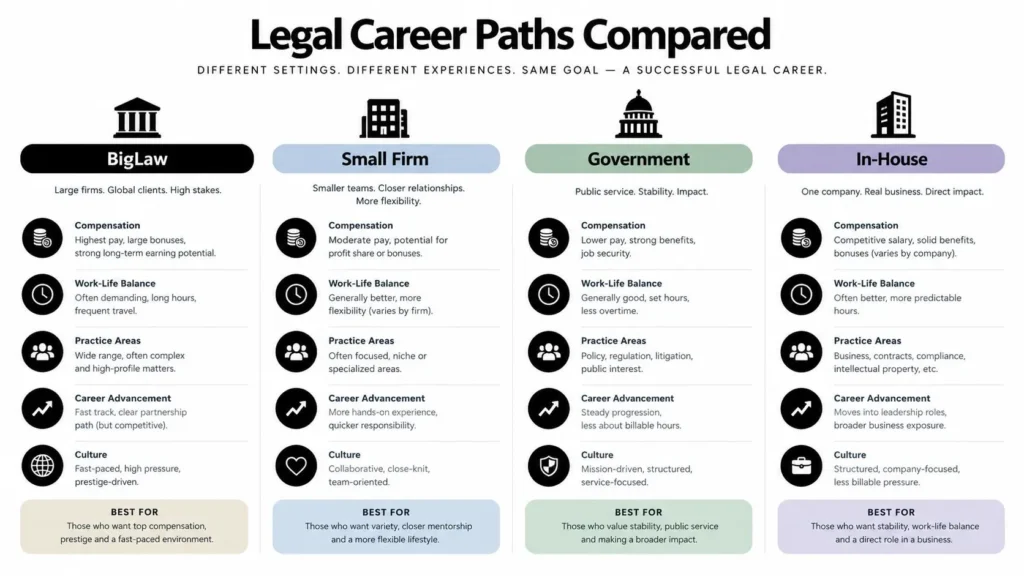
NALP’s private-practice benchmark is $200,000, while NALP’s public service survey reports a $64,200 median entry-level salary for civil legal services lawyers in 2023. That contrast captures the spread between two legitimate legal careers, not a mistake in the data.
Four tiers with different trade-offs
BigLaw sits at the high end of the private-practice market. NALP reports $215,000 at firms with more than 700 lawyers, while selected major markets reach $225,000. The salary may be attractive, but the offer should be evaluated alongside workload, promotion expectations, bonus rules, and the type of training provided.
Mid-sized firms and boutiques need a separate comparison. Their pay can be materially below the largest-firm benchmark, yet a specialized boutique may offer direct exposure to technical or courtroom work that a larger organization assigns through several layers.
Small firms may offer less base pay but earlier responsibility. A new attorney might interact with clients or appear in court sooner, although the quality of supervision and the firm’s financial stability require careful review.
Government and public service usually operate on a lower compensation scale than large private firms. The NALP civil legal services median provides a verified reference for one part of that segment, but it doesn’t represent every government role.
In-house work deserves special caution. It isn’t automatically a better-paid entry-level alternative, and the provided data doesn’t establish a verified starting salary for in-house lawyers. Many candidates should compare the role’s training, responsibility, benefits, and future mobility rather than assuming that “corporate” means higher pay.
For practical preparation, candidates can also use this legal job interview preparation guide to turn the comparison into questions for recruiters and hiring managers.
A compensation comparison video can help candidates visualize the differences among career paths:
The best offer depends on the outcome you’re optimizing for. If you need immediate income, the high end matters. If you want early courtroom responsibility, supervision quality may matter more. If public service is the objective, the lower salary must be assessed alongside mission, loan strategy, benefits, and long-term fit.
How to Read Salary Data Without Getting Misled
Start with the population, not the number. The BLS figure of $159,670 describes lawyers across career stages, so it gives occupation-wide context rather than a clean first-job benchmark. NALP’s first-year associate survey is more targeted, but its result reflects a sample with substantial large-firm representation.
That difference doesn’t make either source unreliable. It makes them useful for different decisions. A broad government occupational statistic and a private-firm salary survey should never be presented as interchangeable measurements.
A five-question source check
Before quoting an average starting salary lawyer figure, ask:
- Who was included? Are the respondents all lawyers, first-year associates, public-interest attorneys, or graduates with any legal job?
- What year does it cover? Compensation changes, and an old graduate cohort may not describe a current offer.
- What does “starting” mean? It may mean first-year associate, first post-graduation job, or a role measured after employment begins.
- How was the sample collected? Voluntary reporting can overrepresent employers willing to disclose salaries.
- Does the figure include bonuses? A base salary and total compensation aren’t the same benchmark.
| Source | Cohort | Strength | Weakness |
|---|---|---|---|
| BLS lawyer wage data | Lawyers across career stages | Broad occupational coverage | Doesn’t isolate new graduates |
| NALP associate salary data | First-year private-practice associates | Separates entry-level firm pay | Large-firm representation shapes the result |
| Graduate employment surveys | Graduates reporting legal employment | Can show school or cohort outcomes | Definitions and response patterns vary |
| Self-reported salary sites | Users who submit compensation | Can reveal offer detail | May not represent the full market |
For deeper evaluation, consult this guide to finding credible sources for research. The same discipline applies to salary pages: check the methodology before trusting the headline.
A salary number without a cohort definition is an anecdote wearing a decimal point.
The most defensible comparison uses the narrowest available peer group. Match employer type, firm size, market, and practice area first. Only then should you compare the offer with a national figure.
Negotiating and Maximizing Your First Offer
Entry-level negotiation works best when you understand which part of the market you’re entering. A salary at a formal large-firm scale may leave limited room on base pay, while an offer from a smaller or regional employer may have more flexibility in compensation structure and timing.
Three levers shape your position:
- Market tier. A large-firm offer aligned with a published scale is usually less flexible than a smaller firm’s discretionary proposal.
- Competing offers. A genuine alternative gives the employer a reason to act, but only if you present it professionally.
- Specialty fit. A candidate whose technical background matches an IP practice may have a stronger case than a general applicant competing for a broad role.
What to request
Anchor your conversation in comparable data, not personal expenses. If your offer differs from the relevant NALP peer group, ask whether the firm can adjust the base, provide a signing payment, cover relocation, or guarantee an early compensation review.
A precise request is easier to evaluate than “Can you do better?” You might ask for a defined review date, clarification of bonus eligibility, or written confirmation of bar-related reimbursement. Don’t claim that the employer owes you the top market number. Explain why your peer comparison is relevant.
Other terms can matter substantially:
- Review timing: Ask when the first formal salary review occurs and what criteria apply.
- Bonus mechanics: Clarify whether the bonus is discretionary, formula-based, prorated, or dependent on hours or firm performance.
- Professional costs: Ask about bar dues, continuing legal education, licensing expenses, and required memberships.
- Relocation support: When base pay is fixed, a relocation payment may be easier for the employer to approve.
- Written terms: Request that material promises appear in the offer letter or a separate written agreement.
This salary negotiation guide can help you prepare the conversation without turning it into an ultimatum.
A strong negotiation protects the relationship. Recruiters and partners remember whether a candidate used evidence, honored deadlines, and asked reasonable questions. You don’t need to accept the first number, but you also shouldn’t present an unsupported demand as a market fact.
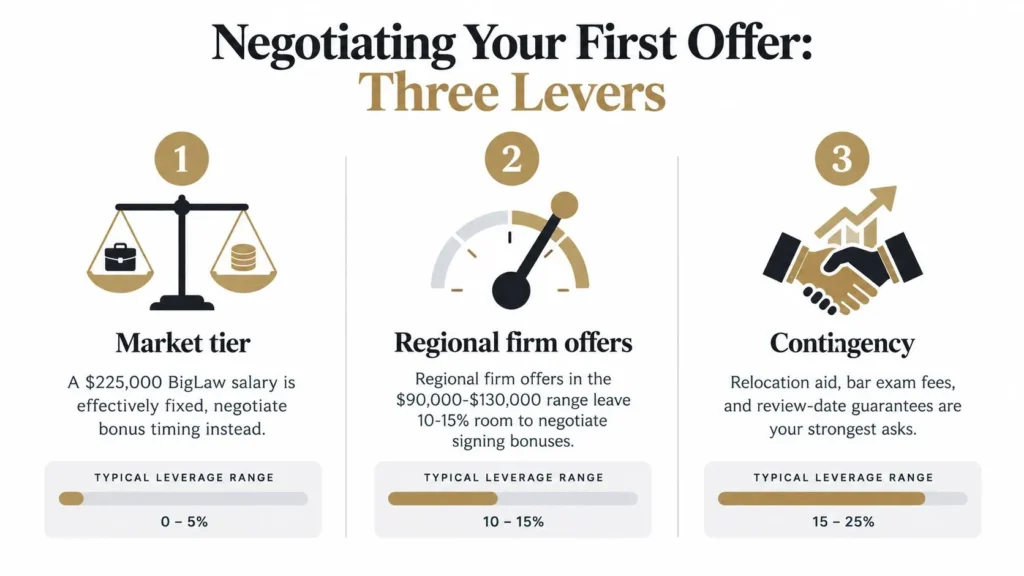
The central lesson is simple: negotiate the terms the employer can genuinely change. Base salary may be fixed at one firm and flexible at another. Review dates, bonuses, expenses, and written guarantees can provide more practical value.
Key Takeaways and Frequently Asked Questions
The best answer to the average starting salary lawyer question is a tiered benchmark, not one national figure. Begin with the job category, then filter by firm size, geography, and specialty.
Use this checklist when reviewing an offer:
- Classify the employer: Private firm, government, public interest, contract, or in-house.
- Match firm size: Compare the offer with employers of similar scale.
- Locate the market: Use the relevant major-market or regional benchmark.
- Check specialty: Treat documented premiums, such as IP’s $225,000 median, as a signal rather than a universal promise.
- Separate base from total compensation: Confirm what bonuses and benefits include.
- Decide whether to negotiate: Focus on terms that fit the employer’s compensation system.
Frequently asked questions
Does the NALP $200,000 median include bonuses?
The verified NALP figure is a first-year associate base salary median. It shouldn’t be treated as total compensation or assumed to include bonuses.
How does student debt change the comparison?
Debt doesn’t change the salary benchmark, but it changes the offer’s personal value. Compare take-home pay, repayment obligations, benefits, workload, and career sustainability rather than using gross salary alone.
Do federal honors programs pay as much as BigLaw?
The provided data doesn’t establish a verified federal honors-program salary or support a direct comparison with the private-firm median. Candidates should consult the specific agency’s current offer and pay schedule.
What about contract or temporary attorney work?
The verified sources provided here don’t establish a single starting figure for contract or temporary attorney roles. Those jobs should be benchmarked separately by assignment, employer, location, and whether the quoted amount includes benefits.
How accurate are self-reported graduate surveys?
They can be useful directional evidence, but accuracy depends on response quality, cohort definition, and participation patterns. Treat them as supplementary evidence, not a substitute for a source that clearly identifies its population and method.
The most important conclusion is also the easiest to miss: a $200,000 median doesn’t mean every new lawyer is close to $200,000. It describes a particular private-practice sample shaped by firm size and market concentration. A credible benchmark makes those conditions visible instead of hiding them behind the word “average.”
Maxijournal.com publishes approachable analysis and practical writing across business, education, technology, and other fields, making it a useful destination for readers who want clear context rather than headline claims. Visit maxijournal.com to explore more independent articles and fresh perspectives.
Discover more from Maxi Journal
Subscribe to get the latest posts sent to your email.