Only about 3% of applicants were invited to interview in 2024, while the interview-to-hire ratio was roughly 27%, according to job interview statistics compiled here. That changes how you should think about job interview preparation.
An interview isn’t a casual conversation you can “wing.” It’s a conversion point inside a narrow funnel. By the time you’re speaking to a hiring manager, the company is no longer asking, “Who applied?” It’s asking, “Who can prove fit, communicate clearly, and reduce hiring risk?”
That’s why generic tips fail. “Be confident.” “Research the company.” “Practice common questions.” None of that is wrong. It’s just incomplete. Strong candidates prepare like strategists. They align their resume to the role, build a clear narrative, rehearse examples, adapt to virtual and AI-mediated formats, and follow up with intent.
Why Strategic Preparation Is Non-Negotiable
A hiring process this selective rewards candidates who prepare with intent.
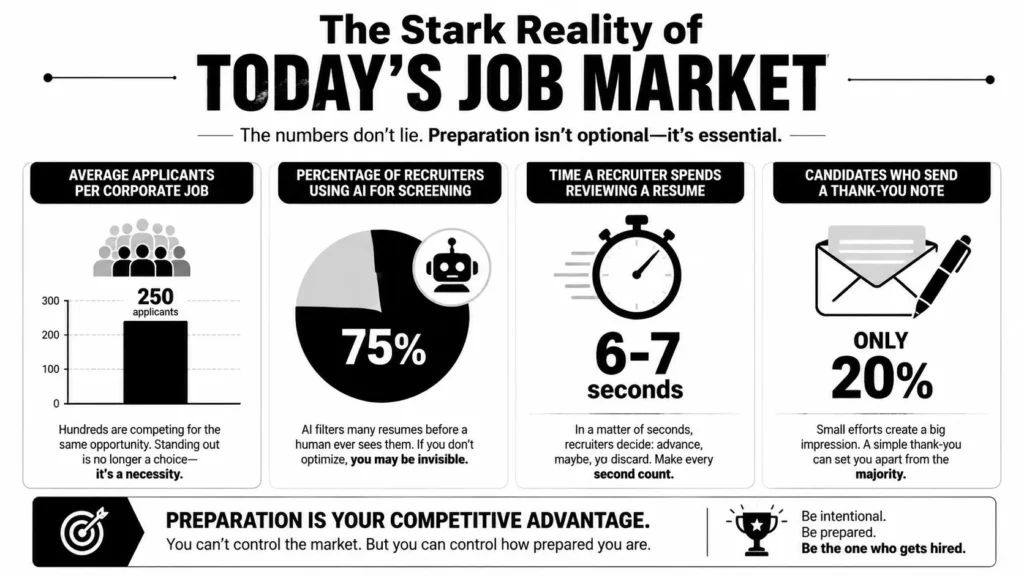
By the time you reach an interview, the company is not trying to learn everything about you. It is trying to reduce risk fast. The interviewer wants enough proof to say, “This person can step into our environment, handle the work, and communicate clearly with the team.” Candidates who understand that show up differently. They prepare evidence, not talking points.
That matters even more now because the interview often starts before the live conversation. Recruiters may screen for title match and career progression. AI tools may parse your resume for alignment. Video platforms change how presence and clarity come across. If your preparation only covers common interview questions, you are training for an older version of the process.
What strategic preparation actually does
Good preparation makes you easier to hire.
That sounds simple, but it changes how you practice. Strong candidates do not try to sound impressive in every answer. They make it easy for an interviewer to connect four points: what the company needs, what the role demands, what they have done before, and how they are likely to perform here. That is the standard I used when hiring, and it is the standard I coach candidates to meet now.
A useful rule is this:
Prepare to prove fit with clear evidence the interviewer can remember and compare.
That usually means showing up with a small set of assets you can use across different formats, including phone screens, live panels, virtual interviews, and AI-mediated steps.
- A sharp value proposition tied to the role, not a generic self-summary
- Three to five work examples that show results, judgment, and collaboration
- A consistent answer structure so pressure does not wreck clarity
- A reason for this role and this company that goes beyond compensation or convenience
- A polished application story across your resume, LinkedIn, and even your cover letter for a targeted application
If you want a concise outside resource that fits this approach, Proficiently’s interview success blueprint is a useful companion.
Where candidates lose ground
I see the same failure patterns again and again.
Some candidates overprepare volume. They memorize dozens of answers, sound rehearsed, and struggle the moment an interviewer changes the wording. Others underprepare the basics. They can describe a project in detail but cannot explain why they want this role, why this company makes sense, or what problem they are being hired to solve.
Another common mistake is treating confidence as proof. Energy helps. Charisma helps. Neither one replaces specifics. In a competitive market, especially with structured interviews and recorded virtual rounds, vague answers are expensive. They are hard to score, hard to defend in a hiring discussion, and easy to pass over.
Strategic preparation fixes that. It gives you a repeatable way to present your experience so it holds up whether you are speaking to a recruiter, a hiring manager, or a panel comparing several strong candidates side by side.
The Foundation Research and Resume Alignment
Most interview mistakes start before the interview. The candidate applies with a generic resume, reads the About page the night before, and assumes they can “speak to their experience” in the room. That approach creates friction immediately. The interviewer sees a weak match on paper, asks broader questions, and leaves with a fuzzy picture.
StandOut CV’s summary of interview guidance says candidates typically spend 5 to 10 hours preparing for an interview, including reviewing the CV, researching the company, and practicing answers, as noted in their interview preparation statistics page. That range makes sense. Good preparation takes time because it requires decisions.
Use a three-part research checklist
Company deep dive
Start with the employer’s public materials, then go one layer deeper. Read the company website, but don’t stop there. Look at leadership pages, product pages, recent announcements, social channels, and employee profiles on LinkedIn. If it’s a public company, skim investor-facing language. If it’s a smaller firm, look for customer language and hiring patterns.
You’re trying to answer:
| Question | What to look for |
|---|---|
| What problem do they solve? | Product pages, homepage copy, customer use cases |
| How do they describe success? | Mission, values, leadership messaging, team goals |
| What seems hard right now? | New product launches, expansion, operational complexity, role openings |
| How do they talk about people? | Culture pages, team bios, manager posts, employee content |
Don’t collect facts for trivia. Collect signals you can use in answers. If the company repeatedly emphasizes speed, reliability, compliance, collaboration, or customer experience, expect those themes to show up in the interview.
Role dissection
Print the job description or paste it into a document. Then mark it up. Separate it into four buckets:
- Core responsibilities. The work they need done regularly.
- Required skills. The abilities they’ll screen for directly.
- Preferred skills. Useful, but not always decisive.
- Context clues. Words that reveal team pressure, maturity, pace, or scope.
Now translate each bullet into a likely interview question. If the role says “cross-functional collaboration,” expect questions about conflict, alignment, or influencing without authority. If it says “own projects end to end,” expect questions about prioritization and accountability.
If a requirement appears high in the posting and is described in concrete language, assume the interviewer cares about it more than the item buried at the bottom.
Align your resume and materials to that reality
Your resume should make the interviewer’s job easier. That means moving the most relevant evidence up, tightening weak bullets, and using the language of the role where it truthfully fits. Don’t rewrite your career history. Reframe it around what matters for this opening.
A simple alignment pass looks like this:
- Match headline strength to the role. Your summary, top bullets, and recent experience should reflect the target role’s priorities.
- Swap generic verbs for specific contribution. “Helped with projects” says nothing. “Coordinated vendor onboarding” or “built reporting workflows” gives shape.
- Cut distractions. If a bullet won’t help in the interview, it’s taking up space.
- Pull supporting materials together. Portfolio, work samples, writing samples, GitHub, presentation deck, or case studies. Use whatever is normal for your field.
If you need help tightening your application package before the interview stage, this guide on how to write a cover letter pairs well with resume tailoring because it forces you to articulate fit in plain language.
A fast alignment test
Before the interview, ask yourself one question: if the interviewer skimmed my resume for less than a minute, would they know why I’m here?
If the answer is no, fix that first. Good job interview preparation starts on paper, not in the practice room.
Crafting Your Narrative with Answer Frameworks
Candidates usually fail behavioral questions in one of two ways. They answer too vaguely, or they bury the useful part under a long setup. Both make it hard for the interviewer to score what they heard.
The fix is structure. The U.S. Department of Labor recommends a 30 to 60 second self-summary, direct answers tied to relevant achievements, and a bank of behavioral examples, as outlined in its interview tips guidance. That advice holds up because it forces discipline.
Start with your self-summary. Then build a story bank. Then use a framework that keeps answers focused.
Build a 30 to 60 second self-summary
Your opening summary sets the tone for the interview. It should answer three things in sequence:
- Who you are professionally
- What you’ve done that matters for this role
- Why this opportunity fits now
A strong version sounds like this:
I’m a project coordinator who’s spent the last few years supporting cross-functional teams in fast-moving environments. Most of my work has centered on scheduling, stakeholder communication, and keeping deliverables on track when priorities shift. I’m now targeting roles where I can take broader ownership of operations and contribute more directly to team execution.
That works because it’s short, relevant, and easy to build on. It doesn’t retell your entire resume.
Use STAR without sounding robotic
The STAR method remains the best default framework for behavioral questions because it prevents drift. It also gives interviewers what they need to evaluate: context, responsibility, action, and outcome.
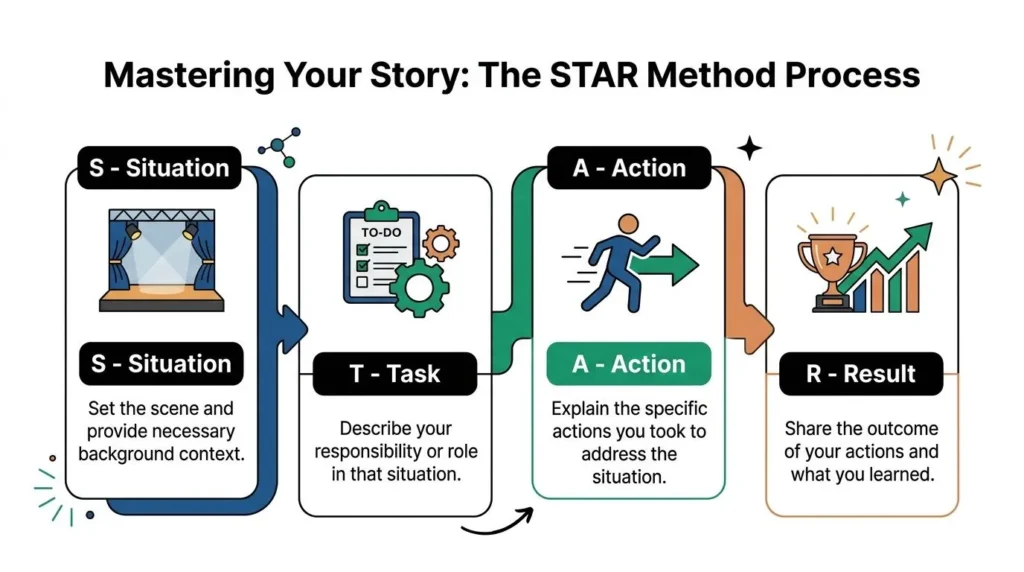
Here’s the simple version:
| Part | What to say | What to avoid |
|---|---|---|
| Situation | Brief context | A long backstory |
| Task | Your responsibility | Vague team ownership |
| Action | What you specifically did | Generic “we worked on it” language |
| Result | Outcome and learning | Ending without impact or reflection |
A weak answer sounds like this:
We had a difficult client project, and there were communication issues. I worked hard, collaborated with the team, and made sure things got done. In the end the client was happy and we learned a lot.
That answer is too thin. It gives the interviewer no grip.
A stronger answer sounds like this:
We were delivering a client implementation that started slipping because requests were coming in through multiple channels and the team was working from different versions of the same plan. I was responsible for coordinating timelines and keeping the stakeholders aligned. I created one shared tracker, moved all requests into a single review path, and set a short weekly update with both the internal team and the client lead. That reduced confusion, surfaced blockers earlier, and gave everyone one source of truth. The project stabilized, and I took away the importance of tightening communication before timeline pressure builds.
Notice what changed. The answer still fits in about a minute, but now the interviewer can assess ownership, judgment, communication, and learning.
To see another explanation of structured answering in action, this short video is worth watching before you rehearse:
Create a story bank instead of memorizing dozens of answers
Most candidates prepare question by question. That’s backward. Good candidates prepare story by story.
Build a small story bank with examples you can adapt across many prompts. Include different themes so you’re not forcing the same story into every answer.
The five stories to prepare first
- A win under pressure. Deadlines, complexity, or ambiguity.
- A difficult collaboration. Misalignment, conflict, or competing priorities.
- A mistake or setback. Accountability matters here.
- A process improvement. Show initiative and practical thinking.
- A leadership moment. Formal manager or not, show influence.
For each story, write short notes under these headings:
- Situation
- Task
- Actions you took
- Result
- What it says about you
That last line matters. If a story shows calm decision-making, stakeholder management, resilience, or attention to detail, label it. You’ll start seeing which examples match which competency themes.
A polished answer doesn’t sound memorized. It sounds organized.
Common answer mistakes
Candidates often sabotage good experience with poor delivery. Watch for these:
- Too much setup. If it takes a minute to reach the actual problem, the answer is too slow.
- No clear ownership. Interviewers need to know what you did.
- Buzzwords without evidence. “Strategic,” “cutting-edge,” and “cross-functional” mean nothing unless the example proves them.
- No reflection. The result matters, but so does what you learned.
Strong job interview preparation turns your experience into usable evidence. That’s the difference between “I’ve done good work” and “I can show you exactly how I work.”
Acing the Modern Interview Virtual and AI Screening
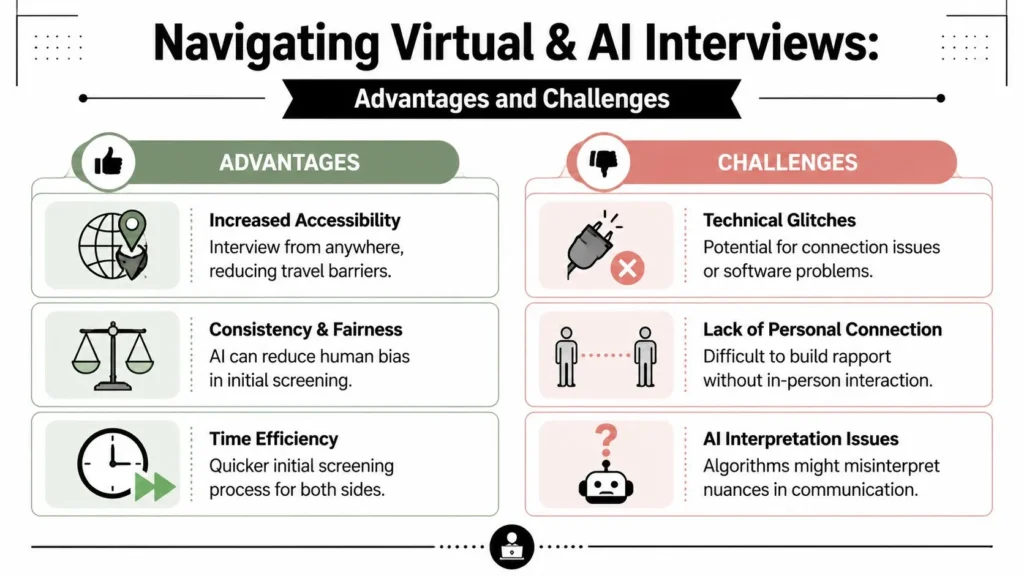
Many candidates still prepare for interviews as if the process starts with a live conversation. For a growing share of roles, it starts with a screen, a recording prompt, or software that decides whether your application gets a closer look. That changes how strong candidates prepare.
The practical goal is simple. Reduce friction for both the technology and the human reviewer. Clear audio, stable video, tight answers, and role-specific language all make it easier for your strengths to come through. Research on technology-mediated hiring helps explain why digital formats change candidate evaluation in the first place.
Virtual interviews reward setup discipline
In a virtual interview, production quality affects credibility. A weak connection, bad lighting, or muffled audio forces the interviewer to work harder. That cost usually comes out of your evaluation, even when the content of your answer is solid.
Set up the basics before interview day, then test them again 30 minutes before the call:
- Camera at eye level. Looking down at a laptop camera makes you seem disengaged or underprepared.
- Front-facing light. A window or lamp in front of you works well. Backlighting makes facial expressions harder to read.
- Clean audio. Use the best microphone available to you and close noisy apps and notifications.
- Neutral background. Keep the frame tidy and free of movement.
- Platform readiness. Log in early, check your display name, and confirm screen-sharing permissions if the role may require a presentation.
I tell candidates to treat this like client-facing work. The goal is not a perfect studio. The goal is a smooth conversation with no avoidable distractions.
If you need to look polished on camera, your clothes matter more than many candidates expect. Busy patterns, shiny fabrics, and poor fit can be distracting on video. A quick guide on building a polished professional look can help if that part still feels uncertain.
Live video and one-way interviews test different skills
Candidates often underperform because they prepare for both formats the same way. That is a mistake.
A live virtual interview still rewards rapport. The interviewer is watching how you listen, how you recover from interruptions, and whether you can hold a clear conversation through a screen. Keep notes brief. Put them beside your camera, not across your monitor. Look into the camera when you deliver your main point, then glance back to the screen to read reactions.
One-way interviews are different. There is no feedback loop, no small talk, and no rescue if your answer starts slowly. You need a sharper structure and cleaner stopping point.
| Format | Best approach |
|---|---|
| Live virtual interview | Prioritize eye contact, pacing, and direct engagement with the interviewer |
| One-way recorded response | Answer in a tight structure, give one clear example, then stop |
| Keyword-sensitive screening | Use the role’s language where it accurately matches your experience |
| Timed prompts | Spend a few seconds outlining, then deliver one complete answer calmly |
Complete thoughts beat long thoughts.
How to handle AI-assisted screening without sounding robotic
You do not need to outsmart the software. You need to make your experience easy to classify correctly.
Start with the job description. Pull out the repeated nouns and verbs. If the posting keeps naming stakeholder management, forecasting, SQL, policy writing, customer retention, or calendar management, those terms should appear in your resume and in your answers when they are true to your background. Candidates get screened out when they describe the right work with language the system was not set up to detect.
Then adjust your delivery. AI-assisted review and rushed human review punish the same weakness. Rambling. A simple structure works well across both:
- Answer the question first
- Give one specific example
- Close with the result or lesson
That pattern is also useful in recorded prompts, where every extra sentence increases the risk of losing clarity.
For one-way interviews, practice with a timer. Record yourself. Watch for two things. First, whether your answer reaches the point in the first sentence or two. Second, whether your pace speeds up once you start talking. Candidates usually speak faster on camera than they realize.
A few modern mistakes that cost interviews
These are common failure points in competitive processes:
- Reading from notes. Your eyes give it away immediately.
- Using generic language. “I’m a people person” and “I’m passionate” do not survive screening well.
- Ignoring the platform. Dead links, wrong usernames, and software updates create avoidable stress.
- Over-answering recorded prompts. If the answer is done, stop.
- Sounding optimized for software instead of people. Keywords should fit naturally inside real examples.
For question prep before the live rounds, StoryCV’s strategic interview guide is a useful resource because it focuses on questions that reveal team quality, decision-making, and role expectations rather than generic filler.
Strong candidates prepare their content. Stronger candidates prepare for the format that delivers that content. In a crowded hiring market, that difference shows up fast.
Final Polish Attire Body Language and Smart Questions
Interviewers often make an initial judgment in the first few minutes, then spend the rest of the conversation testing whether that judgment holds. That is why final polish matters. In a crowded process, small signals affect whether your strong answers feel credible.
Clothing, posture, and the questions you ask all shape that read. They do not replace preparation. They sharpen it.
Dress for the company, not for a generic idea of professionalism
The right outfit is context-specific. A bank, a SaaS startup, a hospital system, and a design studio will read the same clothes differently. Candidates lose points when they dress for a vague idea of “professional” instead of the employer in front of them.
Use a simple standard. Match the company’s norm, then go slightly more polished.
A quick check usually gives you enough signal:
- Review team photos on LinkedIn, the company site, and event posts
- Notice what leaders wear in public-facing videos or presentations
- Choose clothes that stay put and do not need adjusting
- Prioritize fit, grooming, and clean lines over statement pieces
If you need help building a look that feels intentional instead of borrowed, this guide on how to develop a fashion sense is a practical starting point.
For virtual interviews, apply the same rule to the frame. Busy patterns, harsh lighting, and a distracting background can undercut an otherwise strong presence. AI-assisted screening tools and recorded interview platforms may not “judge” your outfit, but the recruiter reviewing that recording still will.
Body language that reads calm and credible
Candidates usually worry about saying the wrong thing. A more common problem is looking scattered while saying the right thing. Poor eye contact, fidgeting, slumped posture, and rushed delivery create doubt fast.
Use a short checklist before every round:
- Eye contact. In person, hold it naturally. On video, look at the camera when making a key point.
- Posture. Sit upright and grounded. If your chair swivels, lock it or stop it from moving.
- Hands. Keep them visible and controlled. Repeated face-touching and hidden hands read as tension.
- Facial expression. Show attention while listening. A flat expression can make strong answers feel rehearsed.
- Entry and exit. Greet clearly, settle in before answering, and close with a composed thank-you.
I tell candidates to practice the first thirty seconds of the interview, not just the answers to hard questions. Your greeting, your pace, and the way you settle into the conversation create the baseline impression.
Ask questions that show judgment
The final minutes matter because your questions reveal how you think. Good ones show that you understand priorities, team dynamics, and what success will require. Weak ones tell the interviewer you prepared for interviewing in general, not for this role.
Three categories work well.
Questions about success
These questions show that you care about outcomes, not just responsibilities.
- What would strong performance look like in the first six months?
- Which priorities would you want the person hired to take ownership of first?
Questions about context
These uncover why the role exists and what pressures surround it.
- What is making this hire important right now?
- How does this team work with the groups it depends on most?
Questions about management and process
These are especially useful once you are speaking with the hiring manager or a future teammate.
- How do you usually give feedback to someone in this role?
- What tends to separate people who perform well here from people who struggle?
StoryCV’s strategic interview guide is a useful reference because it focuses on questions that surface decision-making, expectations, and team quality instead of generic filler.
Skip questions that a job description, company website, or quick search already answered. Save compensation, benefits, and flexibility questions for the right stage unless the interviewer raises them first. Good candidates ask smart questions. Strong candidates ask questions that help them evaluate the job with the same discipline the employer is using to evaluate them.
Closing the Loop The Follow-Up and Your Printable Checklist
Many candidates treat the interview as over once the call ends or they leave the building. That misses a final chance to reinforce fit. A good follow-up won’t save a poor interview, but it can sharpen a strong one and keep you memorable for the right reasons.
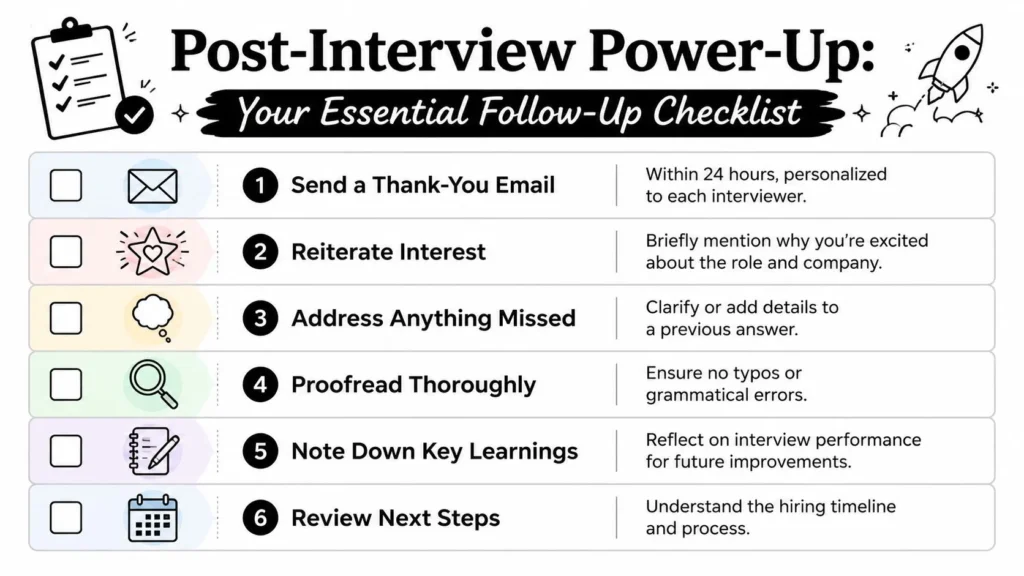
The simplest rule is this: send a concise thank-you note, personalize it, and don’t turn it into a second cover letter.
A thank-you note that actually works
A strong follow-up email does four things:
- Thanks the interviewer for their time
- References a specific part of the conversation
- Reaffirms interest in the role
- Adds a brief point of value, if useful
Use this template:
Subject: Thank you
Hi [Name],
Thank you for taking the time to speak with me today. I appreciated the conversation, especially your comments about [specific topic discussed]. It gave me a clearer picture of what the team needs and how this role contributes.
Our discussion reinforced my interest in the position. The combination of [relevant responsibility] and [relevant context] is a strong match for my background in [relevant experience].
Thank you again. I’d be glad to provide anything further if helpful.
Best,
[Your Name]
That’s enough. Keep it clean.
For candidates who want examples before drafting their own, this collection of impressive interview thank you notes can help you see the tone and structure without overcomplicating it.
What to do while you wait
Waiting is where candidates often lose discipline. They replay answers, send unnecessary extra messages, or go silent and stop momentum in the rest of their search.
Use the waiting period productively:
- Write down what happened. Which questions came up, which answers landed well, where did you drift?
- Note names and roles. This helps if you move to the next round.
- Capture concerns early. If you missed a point you should have addressed, a short clarification can go into the thank-you note.
- Keep interviewing elsewhere. Until there’s a signed offer, keep your pipeline alive.
If the process reaches the offer stage, this guide on how to negotiate a salary offer is a practical next step so you don’t handle compensation reactively.
Your printable job interview preparation checklist
Use this before every interview.
| Stage | Check |
|---|---|
| Role match | I can explain why my background fits this specific role |
| Company research | I understand the business, team context, and likely priorities |
| Resume alignment | My resume highlights evidence relevant to the opening |
| Self-summary | I have a clear 30 to 60 second introduction |
| Story bank | I can tell examples about wins, setbacks, collaboration, improvement, and leadership |
| Format prep | I know whether this is in person, live virtual, or one-way recorded |
| Tech setup | Camera, lighting, audio, background, and platform are checked |
| Presentation | My outfit fits the company context and feels comfortable |
| Delivery | I’ve practiced eye contact, pacing, and concise answers |
| Questions | I have thoughtful questions for the interviewer |
| Follow-up | I’m ready to send a tailored thank-you note |
| Reflection | I’ll document what to improve for the next round |
The best candidates don’t rely on motivation. They rely on a repeatable process.
Job interview preparation works the same way. Once you build the system, each new interview becomes easier to prepare for, easier to adapt to, and easier to evaluate.
If you enjoy practical guides like this and want more approachable writing across business, technology, education, health, travel, fashion, arts, and culture, explore maxijournal.com. It’s an independent magazine and blog built for readers who want useful ideas without the noise.
Discover more from Maxi Journal
Subscribe to get the latest posts sent to your email.