You stand in front of a full closet, pull out five outfits, reject all five, and end up wearing the same safe combination again. That moment is often read as a style failure. It isn’t. It’s a feedback problem.
Fashion sense isn’t a gift some people are born with. It’s a skill you build by noticing patterns, testing choices, and editing what doesn’t serve you. If you can learn what cuts flatter you, which colors make you feel sharp, and which outfits you reach for on busy mornings, you can learn how to develop a fashion sense.
That matters even more now because style is increasingly learned through observation and curation. In a 2023 CivicScience dataset, 68% of Gen Z said they follow fashion trends, with social media as their top source of inspiration at 42%, and a separate survey found that 64% of all Americans and 3 in 4 Gen Z respondents say social media influences their fashion sense (CivicScience fashion trend data). So if your taste has been shaped by saved outfits, screenshots, creators, and street-style clips, that’s not shallow. That’s how style learning works now.
The key is to stop consuming inspiration passively. Start using it deliberately. If you want extra help translating vague taste into something you can wear, this guide on how to discover your personal style is a useful companion to the process below.
Your Starting Point for Building Great Style
The first shift is simple. Stop asking, “Do I have style?” Start asking, “What do my choices tell me?”
People who seem naturally stylish usually aren’t guessing. They’ve built an internal reference library. They know which necklines they avoid, which shoes make an outfit feel finished, and which purchases looked exciting in theory but never left the hanger. You can build that same library.
Treat style like a learnable practice
Fashion sense develops the way any visual skill develops. You observe. You compare. You copy selectively. You adjust. Then you repeat.
That means your next step probably isn’t shopping. It’s paying closer attention to what already works in your real life.
You don’t need a brand-new wardrobe to become better dressed. You need better information about your current one.
A lot of generic style advice jumps straight to mood boards and trend lists. That can be fun, but it often creates a wardrobe full of isolated pieces. A stronger approach starts with diagnosis first, inspiration second.
What usually works and what doesn’t
Here’s what I see repeatedly:
- What works is studying your habits. Which trousers do you wear on your best days? Which jacket gets compliments and still feels easy?
- What doesn’t is buying for a fantasy schedule, fantasy body, or fantasy confidence level.
- What works is refining one variable at a time, such as swapping the shoe, changing the hem, or trying a cleaner silhouette.
- What doesn’t is overhauling everything at once and losing track of why an outfit succeeds.
The rest of this process follows that logic. We’ll use your wardrobe as evidence, not as a guilt trip.
Start by Auditing Your Current Wardrobe
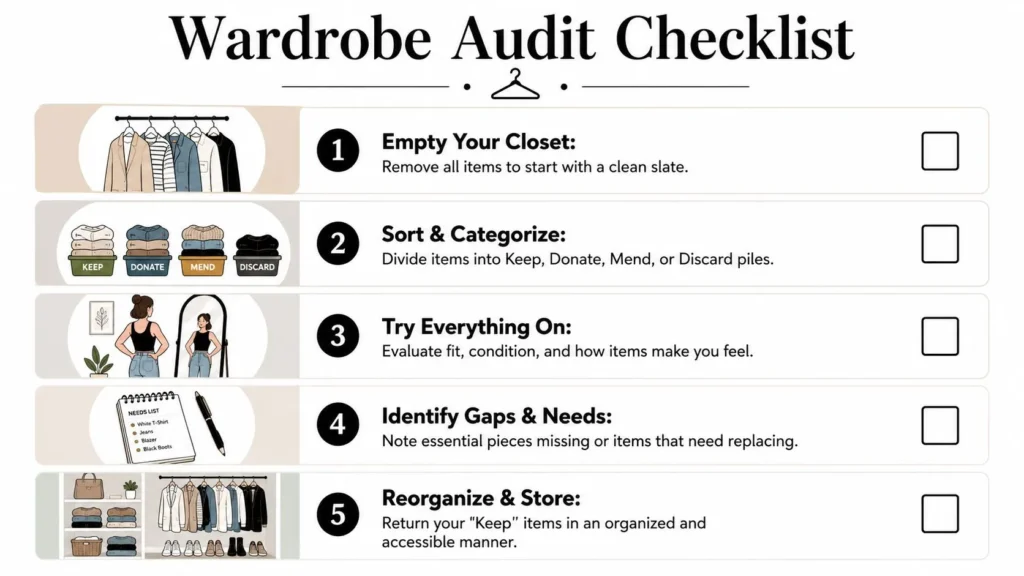
A closet audit sounds boring until you realize it solves most style confusion. If you don’t know what you own, what you repeat, and what consistently disappoints you, every new purchase is a guess.
Style educators recommend treating your wardrobe like a diagnostic dataset. The method is straightforward: identify your most-worn pieces and classify them by fit, silhouette, and color to detect patterns in what works for you (Anuschka Rees on developing style from scratch).
Sort by behavior, not by category
Don’t begin with “tops,” “pants,” and “jackets.” Begin with use.
Create these groups:
- Love and wear often
- Wear, but something feels off
- Never wear
- Needs tailoring, repair, or better styling
- Immediate exit
That second group matters most. Those pieces usually reveal the underlying issue. Maybe the color suits you but the fabric wrinkles too fast. Maybe the blazer is good, but the shoulder line feels stiff. Maybe the jeans are technically fine but always need tugging and adjusting.
Read the patterns inside the keep pile
Take the items you wear on repeat and examine them like evidence. Write down what they have in common.
Look for:
- Fit details like cropped length, high rise, relaxed shoulder, straight leg, close fit through the waist
- Silhouette choices like column dressing, oversized top with slimmer bottom, or soft drape instead of structure
- Fabric behavior like crisp cotton, fluid knit, substantial denim, matte wool
- Color habits like low contrast neutrals, earthy tones, dark monochrome, or one accent color
- Finish level like polished, rugged, minimal, sporty, or romantic
A useful next step is building a tighter core wardrobe from what survives the audit. If you want a practical framework for that, this piece on starting a capsule wardrobe gives you a clean way to turn patterns into repeatable outfits.
Questions that reveal more than trends do
Ask blunt questions while trying pieces on:
| Question | What it tells you |
|---|---|
| Would I buy this again today? | Whether the item still matches your taste |
| Do I adjust this while wearing it? | Whether fit or comfort is wrong |
| Can I style this three ways from memory? | Whether it integrates with your wardrobe |
| Do I like this item, or just the idea of it? | Whether it belongs to your real life |
Practical rule: Your most-worn clothes are rarely random. They’re clues.
When people skip this step, they keep buying duplicates of their mistakes. The audit interrupts that cycle.
Define Your Three Core Style Words
Once your wardrobe has given you real evidence, you can describe your style with more precision. At this point, vague taste turns into a usable filter.
Style experts often recommend a rule-based system: define 3 style words, connect them to how clothes make you feel, and use them to guide outfit choices. That approach helps prevent outfits from feeling too flat or too chaotic, while giving you a feedback loop for refining taste over time (style words and outfit balance guidance).
Choose words that guide decisions
Good style words are specific enough to steer choices but broad enough to let you evolve.
Useful examples:
- Polished, relaxed, modern
- Creative, clean, comfortable
- Sharp, understated, feminine
- Bold, structured, easy
Less useful examples tend to be either too generic or too aspirational. “Nice,” “cool,” or “expensive” won’t help you shop. Neither will choosing words that belong to someone else’s life.
Translate each word into clothing language
Each word needs a physical expression.
If your word is polished, that might mean structured outerwear, smoother fabrics, darker shoes, and fewer distressed details.
If your word is relaxed, that might mean softer silhouettes, room through the leg, unforced layering, and breathable fabrics.
If your word is creative, that might mean unusual color combinations, sculptural jewelry, interesting texture, or one unexpected item per outfit.
That’s the point. Style words aren’t decorative. They’re operational.
Here’s a simple working table:
| Style word | It should feel like | It may look like |
|---|---|---|
| Polished | Composed | Clean lines, pressed fabric, defined shape |
| Relaxed | Unforced | Softer fit, open layers, comfortable shoes |
| Creative | Distinctive | Texture, color contrast, unusual accessories |
Use your words as a filter, not a cage
When you’re considering a purchase, test it against your three words. If it only fits one weakly, pause. If it supports all three, it has a stronger chance of earning wear.
This is especially helpful during seasonal shopping. For instance, if you’re browsing trend-heavy palettes, a visual reference on autumn colors in fashion can help you decide whether a color trend strengthens your words or distracts from them.
An outfit usually fails for one of two reasons. It has no point of view, or it has too many competing ones.
Three words solve both problems. They create just enough structure to make style decisions faster.
Master the Fundamentals of Fit and Proportion
If your clothes don’t fit well, your style won’t read clearly. People often try to fix this with more shopping, bolder trends, or expensive labels. That rarely works. Fit is what makes an outfit look intentional.
According to SmartBuyGlasses’ data, 48.8% of people describe their personal style as “comfortable,” compared with 20.3% who chose “trendy”, which is a useful reminder that style gets stronger when it supports your body and lifestyle rather than fighting them (SmartBuyGlasses fashion data hub).
Learn what fit actually means
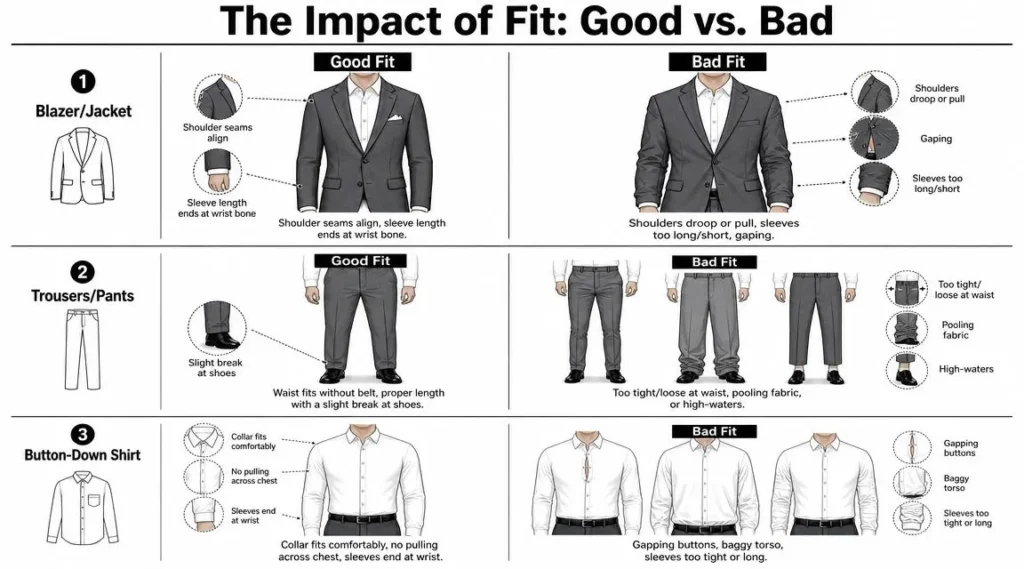
Fit isn’t about squeezing into the smallest size. It’s about how fabric sits, moves, and balances with your frame.
Check these first:
- Shoulders on jackets and shirts. If the shoulder is wrong, the whole garment fights you.
- Waist placement on trousers and skirts. Rise changes proportion more than often appreciated.
- Length in sleeves, hems, and jacket lines. A small hem change can sharpen an outfit instantly.
- Ease through the torso and thigh. You need enough room to move without losing shape.
A good fit often feels boring in the fitting room because nothing is screaming for attention. That’s exactly why it works.
Use proportion to create balance
Proportion is the relationship between pieces. It allows even simple clothes to look stylish.
Try these combinations:
- Volume with restraint. Wide-leg trousers with a cleaner top. Oversized shirt with a slimmer bottom.
- Short over long. Cropped jacket over longer trousers or a longer skirt.
- Defined waist with ease elsewhere. Belted layer, tucked knit, or shaped blazer with softer lower half.
If you’re experimenting with shape, a guide on how to style an oversized blazer can help you see how proportion changes the whole outfit, not just the jacket.
A quick visual lesson helps here:
Tailoring is not optional for key pieces
Most strong wardrobes rely on a few adjusted pieces. Hemmed trousers, shortened sleeves, a cleaner waist, a corrected taper. These aren’t luxury moves. They’re clarity moves.
For suiting specifically, this gentleman’s guide to suit trousers gives a practical breakdown of what to check when the line of the leg looks off.
Clothes should support your posture and movement. If you spend the day pulling, hiding, or adjusting, the garment is costing you more than it’s worth.
When you learn fit and proportion, shopping becomes calmer. You stop asking, “Is this stylish?” and start asking, “Does this sit right on me?”
Build a Functional and Versatile Wardrobe
The strongest wardrobes aren’t the biggest. They’re the easiest to use.
Once you know your patterns, style words, and fit preferences, you can build with much more discipline. That means buying fewer pieces, but making sure each one earns its place. Many people improve fast by shifting their focus. They stop shopping for novelty and start shopping for function.
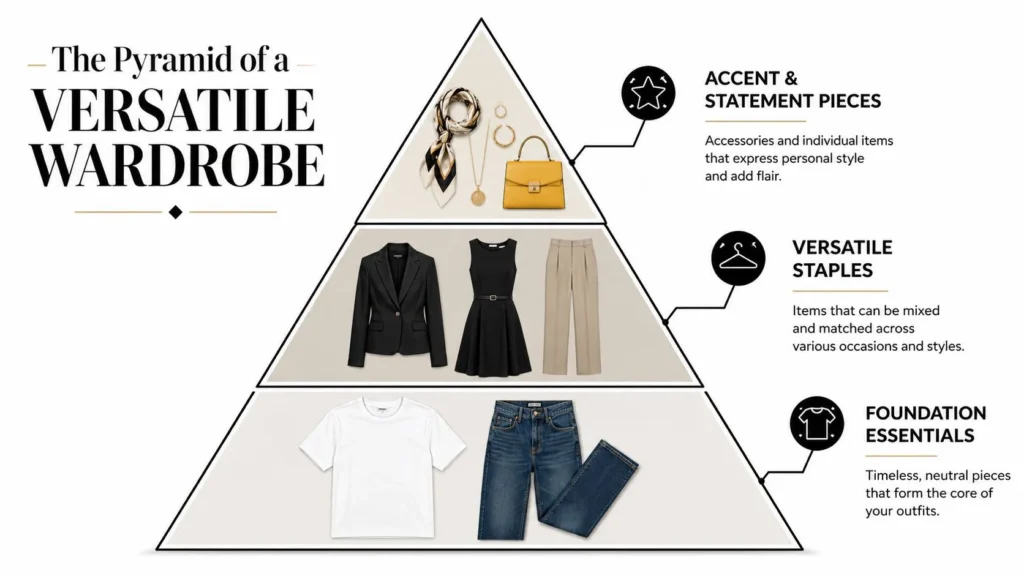
Think in layers, not single items
A practical wardrobe has three levels.
| Layer | What belongs here | Why it matters |
|---|---|---|
| Foundation essentials | Reliable tees, knits, jeans, trousers, shirts, simple shoes | These do the daily work |
| Versatile staples | Blazer, coat, dressier trouser, leather loafer, polished bag | These expand where the wardrobe can go |
| Accent pieces | Printed scarf, standout shoe, bold bag, textured jacket, statement jewelry | These give personality |
People often overbuy the top layer because it feels exciting. Then they complain nothing goes together. The fix is usually the opposite of what they expect. Buy the stable base first.
Shop from a written list
Before buying anything, keep a short list with three columns:
- Need soon
- Would improve many outfits
- Only if I find the right version
This keeps you from mistaking urgency for usefulness. A dramatic top may feel like the answer, but if your real problem is that your everyday trousers don’t fit well, your wardrobe won’t improve.
Here’s a better buying test:
- Can I wear it with at least three things I already own?
- Does it match at least two of my style words?
- Does it work for my actual week, not a made-up one?
- Am I excited about wearing it, not just purchasing it?
Separate personality from clutter
You do need pieces that feel like you. The mistake is making every purchase the personality piece.
A useful way to think about it is this:
- Keep your base wardrobe calm and repeatable.
- Add identity through texture, color, accessories, and one focal item.
- Let your wardrobe evolve through replacement, not random accumulation.
That “less but better” mindset also makes getting dressed faster. When your shoes work with your trousers, your outerwear supports your outfits, and your basics fit, style starts to feel easy instead of performative.
A versatile wardrobe isn’t bland. It’s edited.
Experiment Safely and Cultivate Confidence
Confidence doesn’t arrive after you finally buy the perfect wardrobe. It grows when you prove to yourself that you can make good decisions, recover from bad ones, and refine your eye over time.
That’s why experimentation matters. But it should be low-risk.
Test one variable at a time
If you want to try something new, don’t change everything at once. Add one unfamiliar element to an otherwise reliable outfit.
Good low-risk experiments include:
- A new color in a knit, shoe, or scarf
- A different silhouette such as a wider trouser or longer jacket
- A stronger accessory like metal jewelry, a structured bag, or a belt
- A trend detail in one piece rather than a full trend-based outfit
This lets you isolate the result. If the outfit feels wrong, you’ll know which variable caused the friction.
Use outfit photos as training data
Take quick mirror photos. Not for posting. For analysis.
Review them later and ask:
- Where does my eye go first?
- Does the outfit look balanced?
- Do I look comfortable or restricted?
- Would a different shoe, hem, or layer improve it?
This habit is one of the fastest ways to sharpen judgment because it creates distance. In the mirror, you experience the outfit. In a photo, you evaluate it.
Confidence comes from repetition
The most stylish people usually repeat formulas. They don’t reinvent themselves every morning. They know which shapes, combinations, and finishing details create the version of themselves they want to present.
Try building a few personal uniforms:
- straight-leg trouser + fitted knit + loafer
- relaxed denim + crisp shirt + structured jacket
- column dress + simple earring + clean boot
Once a formula works, repeat it without apology. Confidence often looks like originality from the outside, but from the inside it’s usually pattern recognition.
Answering Your Top Fashion Sense Questions
Real style problems aren’t abstract. They show up when your budget tightens, your body changes, your office gets vague about dress code, or your old wardrobe stops matching your life. Recent fashion-content guidance reflects that people want specific, readable, friction-free advice for decisions, and that developing fashion sense is often less about trend-chasing and more about learning to edit and repeat what works for your actual life (fashion content guidance from Salt.agency).
How do I develop a fashion sense on a budget
Use restraint, not speed.
Prioritize fit fixes first. A hemmed trouser or altered sleeve often improves more outfits than a random new top. Shop with a list, focus on high-repeat categories, and compare every purchase against your style words. If money is tight, avoid “special” items that only solve one outfit.
A useful budget question is, “Will this reduce friction in my week?” If the answer is no, skip it.
What if my body changes often
Build around adaptable pieces. Think wrap shapes, elastic waist where appropriate, relaxed tailoring, knitwear with structure, and layers that still look intentional when sizing shifts slightly.
Don’t keep punishing yourself with a wardrobe calibrated to an old body. Fit the body you have now. Style gets easier the minute you stop treating change like failure.
Dress the current version of your life. That’s where good style becomes visible.
How do I handle a confusing workplace dress code
Start by decoding the room, not by making a statement on day one. Notice the polish level, footwear choices, fabric formality, and how leaders dress on ordinary days.
Then add personality in controlled ways:
- cleaner silhouette
- better texture
- stronger accessory
- distinctive color in a classic shape
That lets you look like yourself without looking out of step.
How do I know whether something is “me” or just exciting
Pause before buying. Save the item, leave the store, or wait a day if you can.
If you still want it, ask whether it connects to your style words, whether it works with what you own, and whether you can picture yourself wearing it in a real setting. Excitement is useful. It just needs editing.
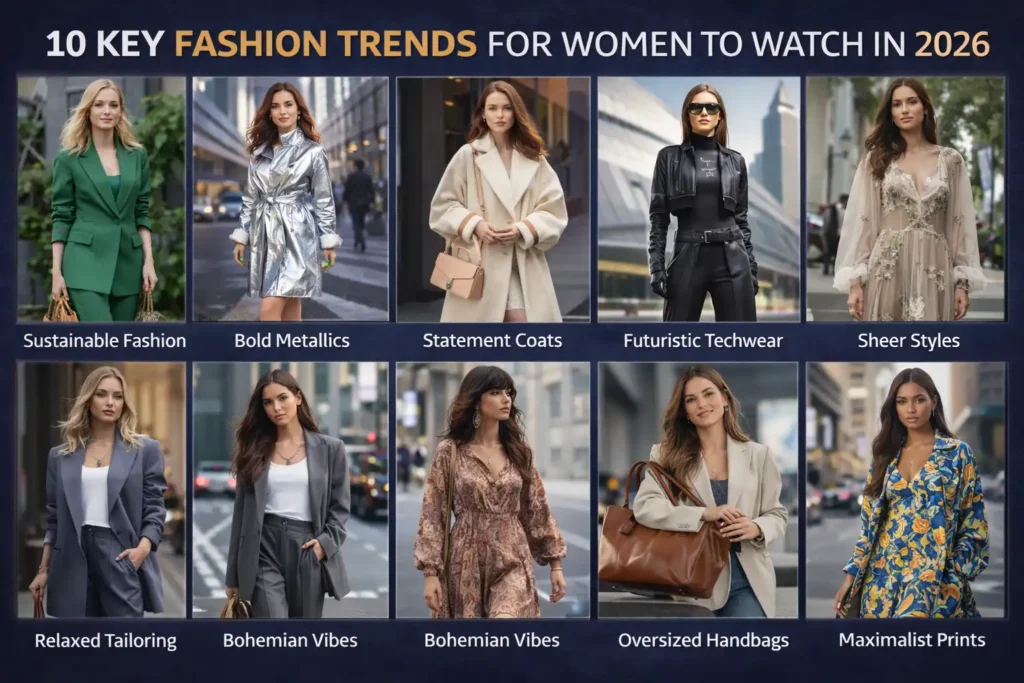
Can I still follow trends
Yes, but selectively.
Trends are tools, not instructions. Use them when they support your proportions, your wardrobe, and your taste. Ignore them when they require a whole new identity to make sense. Good style isn’t about refusing trends. It’s about refusing trends that don’t serve you.
If you enjoy clear, practical guides like this, explore more fashion, lifestyle, and culture writing at maxijournal.com. It’s a strong place to keep learning through approachable articles that value clarity over hype.
Discover more from Maxi Journal
Subscribe to get the latest posts sent to your email.