The best hotel booking approach is to compare the full stay cost, confirm the cancellation terms, check recent reviews and practical fit, then compare direct and third-party offers before paying. Don’t assume the lowest nightly rate is the best deal, because booking channel and flexibility can materially change the risk: one study of 233,000 hotel bookings found an overall cancellation rate of 8%, compared with 17% for online bookings, 12% for offline bookings, and 4% for travel-agency bookings (Worldmetrics).
A reliable reservation is less about finding a dramatic headline discount and more about matching the booking to the trip. Timing, total cost, room suitability, cancellation tolerance, property quality, loyalty benefits, transport, safety, accessibility, technology, and sustainability all belong in the decision.
Use these eight hotel booking tips as a repeatable workflow. Before searching, write down your destination and dates, maximum all-in budget, must-have amenities, tolerance for a non-refundable rate, and any loyalty or promotional benefits you might use. That short preparation prevents a cheap-looking room from becoming an expensive or unsuitable stay.
1. Book Direct With Hotel Websites for Better Rates and Perks
Start with an OTA if you need to discover properties, but always open the hotel’s official website before paying. A direct booking may include a different cancellation window, breakfast, room choice, loyalty recognition, or a more straightforward route to customer service. The direct rate isn’t automatically lower, so compare the same room type, dates, occupancy, inclusions, and payment conditions.
A hotel’s official website can also show inventory that third-party platforms don’t display. That matters when you need an accessible room, adjoining rooms, a specific bed arrangement, a quiet location, or a late arrival. A short call can clarify whether the property can meet that request, although a request should be treated as unconfirmed until the hotel records it in writing.
Practical rule: Use booking platforms for breadth, then use the hotel website to verify the rate, room, terms, and special requests.
Compare value, not just the number
Join a hotel loyalty program before checking out if it’s free and relevant to your trip. Marriott Bonvoy, Hilton Honors, IHG One Rewards, and World of Hyatt can attach recognition or earning opportunities to eligible direct bookings, but program rules vary by rate and property. Read the terms instead of assuming every promotional rate earns benefits.
For a group stay, extended visit, business trip, or special occasion, contact the property’s sales or reservations team. Ask whether a corporate, government, association, or group rate applies, and request details about breakfast, parking, upgrades, early arrival, and late departure in writing.
The same comparison habit works for vacation rentals. Travelers planning a trip to Orlando without booking fees should compare the owner or property manager’s official terms with the platform listing, including cleaning charges, deposits, and cancellation rules.

2. Use Price Comparison Tools and Meta-Search Engines Strategically
Price comparison tools are best used as a discovery and verification layer, not as the final decision-maker. Google Hotels, Kayak, Trivago, and Momondo can gather availability from multiple channels, helping you spot differences in room categories, inclusions, and cancellation conditions. Search engines can save time, but the first price you see may not include every tax, service charge, resort fee, or payment condition.
Run the same search with identical inputs. Keep the dates, guests, currency, room type, and refundability consistent, then open the booking page behind each result. A cheaper listing that changes to a non-refundable rate or excludes breakfast isn’t a like-for-like comparison.
Build a clean comparison
Use a simple note with these fields:
- Total payable amount: Record the final price shown before payment, not only the nightly figure.
- Cancellation deadline: Capture the exact date, time, and time zone.
- Included benefits: Check breakfast, Wi-Fi, parking, resort access, transfers, and loyalty earning.
- Supplier identity: Confirm whether the reservation is with the hotel, a major OTA, or a lesser-known intermediary.
- Room conditions: Compare bed type, occupancy, size, view, accessibility, and location within the property.
Price alerts can help when your dates are flexible, but an alert is not a guarantee that the same room will remain available. If the property is popular or your dates are fixed, set a personal ceiling and book once the total cost and terms meet it rather than chasing an uncertain future drop.
For broader trip planning, travel apps for planning can help organize accommodation research alongside transport and activities. Keep the final hotel confirmation separate and easy to retrieve, especially if the booking platform redirects you to another seller.
3. Leverage Travel Loyalty Programs and Credit Card Points
Rewards can change the best-value choice, but only after you calculate what you’re giving up. A room that costs slightly more through a qualifying direct channel may be preferable if it earns useful status credit or includes a benefit you’d otherwise pay for. Conversely, a points redemption can be poor value when the cash rate is low, the required points balance is high, or the booking loses flexibility.
Begin with the hotel groups you already use. Marriott Bonvoy, Hilton Honors, IHG One Rewards, and World of Hyatt each have different rules for earning, redeeming, transferring points, receiving late checkout, and qualifying for elite benefits. Don’t spread spending across every program without a reason. Concentration is often easier to manage when you’re trying to reach a specific benefit.
Treat points as a payment method
Credit cards can add rewards, travel protections, or statement credits, but the annual fee, foreign transaction policy, and redemption restrictions matter. A card linked to a hotel brand may suit someone who repeatedly stays with that group. A transferable-points card may provide more choice, although transfers can be irreversible and award availability can change.
Use points strategically rather than automatically. A high-demand date may make a redemption attractive, while a low cash rate may favor paying and saving points for another stay. Check whether taxes, resort charges, parking, and incidentals remain payable even when the room is booked with points.
For a broader approach to how to get travel deals, compare the benefit of a reward with the rate you could book elsewhere. Readers evaluating transferable card points for hotels should also check transfer timing, expiration rules, blackout conditions, and whether the program allows cancellations without losing value.
4. Book During Off-Peak Seasons and Shoulder Seasons
Timing is useful, but generic advice such as “book early” misses the more important question: when does this destination experience demand? Holidays, school calendars, festivals, conventions, weather, sporting events, and business travel can all reshape availability. A city hotel may be quieter at a weekend, while a coastal property may fill quickly during a favorable-weather period.
Look at the destination calendar before choosing dates. Search a few nearby date combinations, then compare not only the rate but also the experience you’ll receive. A cheaper stay during severe weather, a major local closure, or a transport disruption may not deliver better value.
Use shoulder season deliberately
Shoulder season can offer a useful middle ground. You may find more room choice and a calmer atmosphere without accepting the conditions associated with the destination’s quietest period. The trade-off is that some tours, restaurants, facilities, or transport routes may operate on reduced schedules, so verify what will be open.
A practical scenario illustrates the decision. If a traveler wants to visit a historic city, moving the trip away from a major event may reduce pressure on availability and make the neighborhood easier to explore. If the traveler needs guaranteed beach weather or a particular outdoor activity, a lower rate outside the preferred season may be false economy.
Expedia’s 2026 Hotel Price Index reports a different timing pattern from traditional advance-booking advice. It identifies 8 to 14 days before travel as a potential sweet spot and says last-minute bookers saved an average of 23% compared with booking four or more months out; the same report says Sunday check-ins saved about 15% compared with Friday in the U.S. (Expedia). Treat those findings as guidance, not a promise. Limited inventory, long weekends, and fixed events can make waiting a bad gamble.
5. Negotiate and Request Special Rates Through Direct Contact
A published rate isn’t always the only option, especially when your stay has commercial value to the property. Hotels may have different packages or concessions for groups, extended stays, corporate travel, weddings, conferences, and repeat guests. The appropriate contact is often the sales department rather than the general booking inbox.
Make the request easy to answer. State the dates, number of rooms or guests, expected pattern of use, budget range, and what matters most. You might prefer breakfast over a nominal rate reduction, parking over an upgrade, or a later checkout over a welcome amenity. Clear priorities give the hotel room to create a useful offer.
Ask for the package, not just the discount. A slightly higher rate with breakfast, parking, or flexible changes can cost less overall than a lower room-only price.
Get every condition recorded
Negotiation works best when both sides can verify the agreement. Ask for a written quote that names the room category, occupancy, taxes, inclusions, deposit, cancellation terms, and any promised upgrade or amenity. Save the email with the reservation confirmation and bring it to check-in.
Special requests still depend on availability. An anniversary note may encourage thoughtful service, but it doesn’t guarantee a suite. A quiet room, accessible bathroom, ground-floor location, crib, pet accommodation, or connecting room should be confirmed directly with the specific property before you commit.
Direct contact also helps when a booking platform presents ambiguous information. A reservations agent can explain whether a “special rate” is refundable, whether a package includes all guests, and whether the hotel can deliver the advertised benefit. That clarity is often more valuable than a small headline saving.
6. Read Reviews Strategically and Verify Property Quality
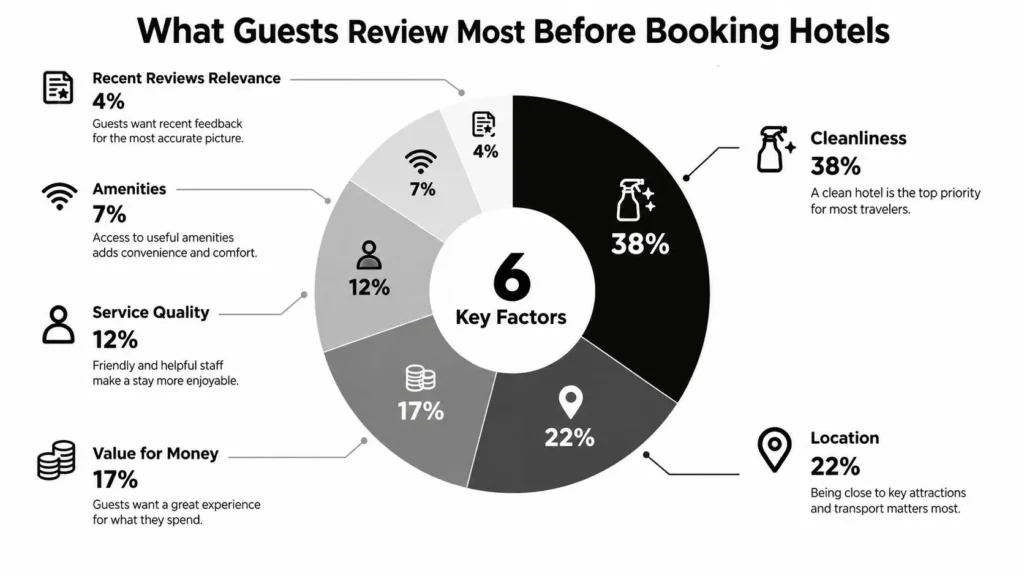
Reviews are most useful when you read them as evidence about your own priorities. A traveler who works remotely needs different signals from a family traveling with a stroller, a light sleeper, or someone who needs step-free access. Don’t treat a single complaint as proof of a universal problem, but don’t dismiss repeated comments about noise, cleanliness, maintenance, location, or unresponsive management.
Start with recent reviews, then compare them with older feedback to identify change. A property may have renovated rooms, changed management, or altered facilities. Look for patterns across Google Reviews, TripAdvisor, Booking.com, and Expedia rather than relying on one platform’s average score.
Separate taste from risk
Comments such as “small room” may describe an expected feature of a historic center. Repeated reports of mold, broken locks, missing accessibility features, or unresolved safety concerns are different. Read the hotel’s responses too. A specific, respectful response can show active management, while repeated generic replies may tell you little.
Use photos and maps to verify the practical setting. Check the walking route from the station, nearby traffic, nightlife, hills, construction, and the distance to the places you plan to visit. A property advertised as central may still require transport if the neighborhood is poorly connected or difficult to move through with luggage.
Before an international trip, use guidance on planning a trip abroad to consider local requirements and logistics, then confirm hotel-specific details with the property. Travelers seeking to browse real vacation feedback should still judge whether each review describes the same room category and travel context.
If accessibility or safety is essential, ask direct questions and request written confirmation. Verify entrance access, elevator dimensions, bathroom layout, emergency procedures, lighting, and reception hours. “Accessible” can mean different things to different properties, so specificity protects you better than a label.
7. Understand Hidden Fees and Calculate Total Cost Accurately
The nightly rate is only one line in the budget. Taxes, resort or destination charges, parking, transfers, breakfast, facility access, deposits, payment fees, and extra-person charges can change the final cost. Compare properties using the amount you’ll pay for the stay, not the attractive number displayed at the beginning of the search.
Open the full price breakdown before entering payment details. Some charges are collected by the platform, while others are payable at the property. A refundable security deposit or card preauthorization may not be part of the final room price, but it still affects available funds during the trip.
Use a total-cost worksheet
For each serious option, record:
- Room and taxes: Confirm the final amount and currency.
- Required property charges: Identify resort, destination, facility, or service fees.
- Transport costs: Add parking, airport transfers, local transit, or rides to attractions.
- Food and access: Check whether breakfast, lounge entry, pool use, or other facilities cost extra.
- Payment exposure: Note deposits, preauthorizations, exchange-rate risk, and when the card will be charged.
A hotel farther from the center may have a lower room rate but higher daily transport costs. A breakfast-inclusive rate may be better for a family with early excursions, while a room-only rate may suit someone who wants to eat at local cafés. The answer depends on the pattern of the stay.
Call the hotel when the fee display is unclear. Ask for a complete written breakdown and confirm whether charges are mandatory, optional, per room, per person, or per night. This step also reveals whether the booking site and the property describe the same offer.
8. Book Flexible Rate Options and Monitor Cancellation Policies
Flexibility is an insurance decision. A non-refundable rate can suit fixed plans, but a lower price doesn’t compensate for a lost payment if your schedule changes. A flexible rate may cost more upfront while protecting you from uncertain flights, work commitments, health issues, or changing plans.
Read the policy at the room-rate level, not only the hotel’s general terms. One property can sell several rates with different cancellation deadlines, deposits, modification rules, and refund methods. Check whether the deadline is based on local hotel time, whether the first night is charged after the window closes, and whether changing dates creates a new price.
Put the cancellation deadline in your calendar when you book. Don’t rely on memory or assume that “free cancellation” lasts until arrival.
Match the rate to the trip
Choose a flexible rate when the itinerary is still developing or the booking is far ahead. Choose a non-refundable rate only when the dates, guests, room, and transport are sufficiently certain, and when the saving is worth the risk. For a high-value stay, consider whether travel insurance covers the specific reason you might need to cancel. Insurance won’t repair a policy that excludes your situation.
Once booked, monitor the same room and conditions. If the price falls while cancellation remains free, you may be able to cancel and rebook, but verify the new reservation first and keep the original confirmation until the replacement is secure. Never cancel a confirmed room based only on a search result.
Cancellation risk varies by channel. A 2024 distribution report cited in hospitality coverage found direct bookings in Europe canceled at about 18%, compared with 31% for Expedia and 42% for Booking Holdings; in Asia, it reported 40% for Booking Holdings and 24% for Expedia (Reservation Strategy). The figures don’t determine what you should book, but they reinforce the need to inspect channel terms and choose the supplier you can manage confidently.
8-Point Hotel Booking Tips Comparison
| Strategy | Implementation complexity | Resource requirements | Expected outcomes | Ideal use cases | Key advantages |
|---|---|---|---|---|---|
| Book Direct with Hotel Websites for Better Rates and Perks | Low–Moderate (site checks, calls) | Time to compare sites; loyalty enrollment | Slightly lower rates (≈5–15%), perks, direct support | Single-property stays, loyalty members, special requests | Loyalty benefits, direct customer service, flexible policies |
| Use Price Comparison Tools and Meta-Search Engines Strategically | Low (tool use) | Internet access; multiple platforms; cross-checking | Fast identification of competitive rates and fee visibility | Broad market searches; bargain hunting | Quick comprehensive comparison, price alerts, aggregated reviews |
| Leverage Travel Loyalty Programs and Credit Card Points | Moderate–High (account management) | Time, consistent spending, potential card fees | Free/discounted nights, upgrades, elite benefits | Frequent travelers, brand-loyal guests, high spenders | Large savings via points, elite status perks |
| Book During Off-Peak Seasons and Shoulder Seasons | Low (date planning) | Flexibility in travel dates; destination research | Significant cost reductions (30–70%), fewer crowds | Flexible itineraries, budget-conscious travelers | Lower prices, more availability, better service |
| Negotiate and Request Special Rates Through Direct Contact | Moderate–High (negotiation effort) | Time for calls/emails; group/contract details | Customized rates, packages, possible 10–25% savings | Group bookings, extended stays, corporate travel | Tailored offers, added perks, payment flexibility |
| Read Reviews Strategically and Verify Property Quality | Low–Moderate (research) | Time to read multiple platforms and photos | Better-informed choices; reduced risk of misrepresentation | New or unfamiliar properties, quality-sensitive travelers | Identifies recurring issues, authentic guest insight |
| Understand Hidden Fees and Calculate Total Cost Accurately | Moderate (detailed checking) | Time to read fine print and confirm fees | Accurate total cost estimation; fewer surprises | Cost-sensitive bookings, high-fee destinations | Prevents unexpected charges, enables true comparisons |
| Book Flexible Rate Options and Monitor Cancellation Policies | Low–Moderate (policy tracking) | Potentially higher upfront cost; calendar monitoring | Protection against changes; ability to rebook/cancel | Uncertain plans, long lead times, high-value trips | Reduced financial risk, booking flexibility |
Turn These Tips Into a Booking Routine
A good reservation follows a sequence rather than a single trick. Start by fixing the destination, dates, purpose of the trip, must-have amenities, and maximum all-in budget. Decide how much uncertainty you can tolerate before you look at prices, because that makes the choice between flexible and non-refundable rates much clearer.
Next, search broadly through a meta-search tool or OTA, then compare the same room on the hotel’s official website. Check the property’s location, transport connections, recent reviews, room layout, accessibility, safety arrangements, and practical fit. If a request matters, contact the hotel and get a written answer before paying.
Calculate the complete cost. Include taxes, mandatory fees, parking, breakfast, transport, deposits, and any charges due at arrival. Then apply relevant loyalty benefits, promotional codes, corporate rates, or points. Don’t let a reward label distract you from the cash expenses and conditions attached to the booking.
Choose the room and rate together. A cheaper room may lack the bed arrangement, workspace, view, bathroom access, or quiet location you need. A flexible rate may be worth more than a small discount when your plans could change. If you select a non-refundable rate, treat the payment as committed and confirm that the rest of the trip supports it.
Before departure, save the confirmation offline and in your email. Record the hotel’s direct phone number, address, check-in hours, cancellation deadline, payment status, and any negotiated inclusions. Mobile alerts can help you monitor price changes or transport disruptions, but don’t depend on an app alone if you need to prove what was agreed.
Accessibility and safety deserve direct verification. Ask the property about step-free routes, lifts, bathroom features, emergency access, lighting, reception coverage, and secure arrival arrangements. For pet travel, confirm the specific hotel’s policy and room availability rather than relying only on a platform filter. Where comparable properties meet the same needs, consider sustainability factors such as local ownership, responsible water and energy practices, public-transport access, and credible environmental information.
The strongest hotel booking tips lead to the same conclusion: the best reservation isn’t always the cheapest rate. It’s the booking whose total cost, cancellation conditions, room fit, accessibility, safety, benefits, and reliability match the trip you are taking.
maxijournal.com publishes approachable travel guidance alongside writing on science, technology, health, business, arts, education, and other everyday interests. Visit the site for more practical trip-planning articles, including hotel policy and pet-friendly lodging guidance, and use its travel coverage to sharpen your next booking decision.
Discover more from Maxi Journal
Subscribe to get the latest posts sent to your email.