Most advice on how to get travel deals is too simple to be useful. “Book early” clashes with “wait for last-minute deals.” “Always fly on Tuesday” gets repeated as if airfare were a vending machine with fixed settings. “Use points” sounds smart until someone transfers rewards to the wrong program and gets stuck with a bad redemption.
Cheap travel isn’t random, and it isn’t one trick. It’s a system. You decide how much uncertainty you can tolerate, how fixed your trip is, and which tools match that trip. Then you work the search in the right order.
That matters because travel shopping now happens in a digital market at huge scale. The global online travel market reached over 640 billion U.S. dollars in 2024, and online channels generated about 70% of total travel and tourism revenue, according to Statista’s overview of the online travel market. That scale creates opportunity, but it also creates noise. You’ll see endless “deals,” urgency messages, fake markdowns, and recycled booking myths.
The travelers who consistently save money don’t chase luck. They build repeatable habits.
Stop Hunting for Deals and Start Building a System
A good deal hunter doesn’t ask, “Which site has the cheapest flight?” first. The better question is, “What kind of trip am I booking, and how much flexibility do I have?” That single shift cuts out a lot of wasted motion.
For rigid trips, the job is price control. You monitor fares, compare direct and indirect routes, and book when the offer is acceptable for your dates. For flexible trips, the job is opportunity capture. You let the market tell you where to go. Those are different games, and most bad advice comes from mixing them together.
What a real system looks like
I think about travel deals as a sequence, not a search:
- Define the trip constraints. Fixed wedding date, school holiday, conference, open-ended long weekend, mileage run, beach break.
- Choose a timing strategy. Conservative, balanced, or opportunistic.
- Use the right search tools. Discovery first, tracking second, booking third.
- Check the direct booking option before paying.
- Protect the booking so a cheap fare doesn’t turn into an expensive mess.
That approach is more reliable than bouncing between tabs hoping one price suddenly collapses.
Practical rule: A deal is only a deal if it matches the trip you actually want to take, with fees, baggage rules, and change terms you can live with.
Why randomness fails
Most travelers burn time in two places. They search too narrowly, or they search without a decision framework. Narrow searches hide cheaper airports, better day combinations, and useful one-way pairings. Random searching creates the illusion of effort without producing a plan.
That’s why I prefer systems over hacks. Hacks expire. Systems adapt.
If you travel with a lighter, more flexible style, some of the same principles show up in route planning, accommodation trade-offs, and timing choices for longer trips. A practical companion read is this guide on planning a backpacking trip, especially if your destination is less fixed than your budget.
The mindset that actually saves money
The best deals usually come from one of three advantages:
- Flexibility advantage. You can shift dates, airports, or even destination.
- Information advantage. You’re tracking prices and seeing changes before others act.
- Currency advantage. You’re using points or miles instead of cash when the math works better.
People who save the most rarely rely on only one of those. They combine them.
Mastering the Art of Timing and Flexibility
The worst booking advice is also the most popular. “Always book early” is wrong for some trips. “Always wait” is worse for most trips. The right booking window depends on your risk tolerance and how replaceable the trip is.
Use a simple framework. If the trip is important and date-locked, buy predictability. If the trip is flexible and optional, you can wait longer and hunt harder. If it’s somewhere in the middle, use a blended approach.
The booking window that matters
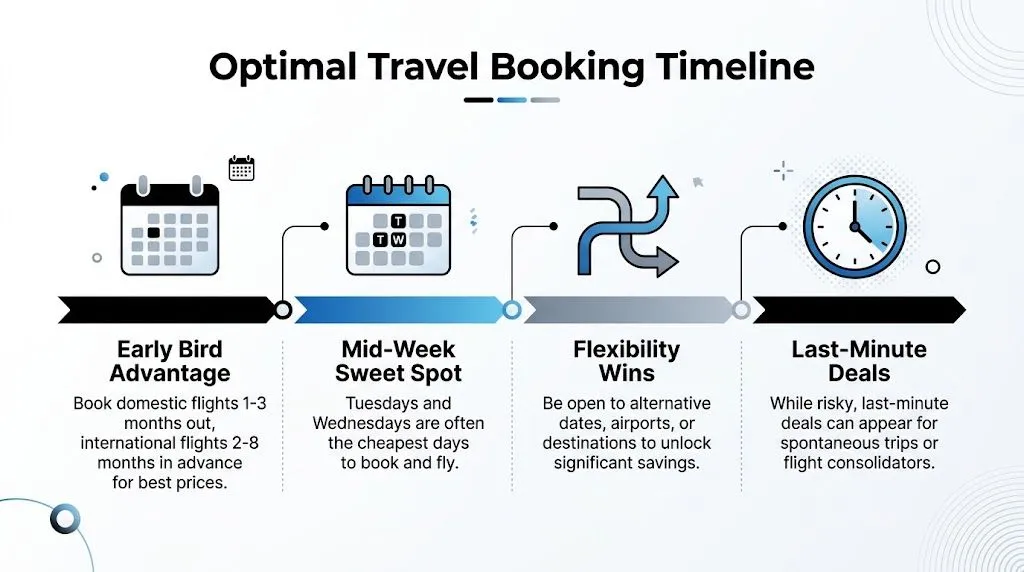
There is useful data here, but people often flatten it into slogans. NerdWallet’s travel deal guidance notes that exploiting flexible dates and bundling can achieve 30-50% savings, with a 65% success rate in off-peak windows. The same source says Tuesdays or Wednesdays are often 15-25% cheaper than weekends, and that the 1-3 month “Goldilocks window” typically sees prices drop 20% compared with booking further out.
That doesn’t mean every Tuesday is magic. It means flexibility around day-of-week and booking window often matters more than loyalty to one exact itinerary.
Here’s the framework I use.
| Trip type | Best timing posture | Why |
|---|---|---|
| Must-take trip | Conservative | Lock in acceptable pricing and avoid panic-booking later |
| Important but somewhat flexible trip | Balanced | Track fares and buy within the useful booking window |
| Optional getaway | Opportunistic | Wait for bundles, odd routings, and softer off-peak pricing |
Choose based on risk tolerance
If you’re booking a honeymoon, a family reunion, or a school-break trip, last-minute strategy is usually a mistake. You’re not buying a seat. You’re buying certainty. The lower stress often matters more than squeezing out the final bit of savings.
If you’re planning a solo city break or a quick beach trip and don’t care whether you leave this month or next, the market gives you more room to maneuver. That’s where date flexibility, nearby airports, and package bundling start paying off.
Don’t ask when the cheapest time to book is in the abstract. Ask how much uncertainty this trip can absorb.
How to search dates the right way
Travelers often search one set of dates, dislike the result, and stop. That’s too narrow.
A better sequence:
- Start with a calendar view. On Google Flights, look at the fare calendar before locking dates.
- Check adjacent days. Even a small shift can change the fare structure.
- Test midweek departures and returns. The data above is broad enough to make this worth checking every time.
- Open the airport radius. Nearby airports can completely change the fare.
When you use Google Flights or Kayak, don’t think of them as booking sites first. Think of them as market scanners. Their job is to reveal patterns. Your job is to decide which pattern is good enough to buy.
A common move that works well is pairing one airline outbound with another airline inbound. Standard round-trip pricing isn’t always the cheapest structure. Separate one-ways can create better combinations, especially if one carrier is strong in one direction and weak in the other.
The early versus late debate
There isn’t one answer because there are really three strategies.
Early booking strategy
This is for people who value control over upside. You set alerts early, track the route, and buy once the fare lands in a range you’re comfortable with. You may not hit the absolute floor. You also won’t be forced into ugly schedules later.
This works best for high-stakes travel. Families, groups, and travelers with little flexibility should lean this way.
Mid-window strategy
This is the sweet spot for many normal trips. You’re not buying absurdly early, and you’re not gambling on a late collapse. You’re watching the route during the useful booking window and acting when a solid fare appears.
For most readers, this is the best default.
Before you keep scrolling, this walkthrough adds a useful visual overview of search timing and flexibility:
Last-minute strategy
This can work, but only under specific conditions. You need flexibility on destination, timing, or both. You also need to be emotionally fine with not traveling if the right price never appears.
Bundled vacations are where last-minute value often shows up. Unsold inventory behaves differently from a single nonstop airfare. If I’m booking late, I’m much more interested in packages and alternate airports than in forcing one perfect nonstop.
Flexibility that actually matters
“Be flexible” is lazy advice unless you define the kind of flexibility.
- Date flexibility matters first. Shift the departure or return by a few days.
- Airport flexibility matters second. Search nearby airports in both directions.
- Destination flexibility matters most for pure deal trips. Let price decide the city.
If you’re serious about how to get travel deals, stop treating flexibility as a personality trait. Treat it like a search input.
Your Digital Toolkit for Finding Hidden Fares
Tools matter, but not because one website always wins. No tool sees the whole market perfectly. The value comes from using the right tool at the right stage.

I group the toolkit into three jobs: discovery, tracking, and opportunistic pouncing. If you collapse those into one step, you’ll miss things.
Discovery tools for finding the shape of the market
Google Flights is my starting point most of the time because it’s fast, clear, and excellent for date and airport experimentation. The Explore function is useful when your budget matters more than your exact destination. Kayak is strong as a cross-check, especially when you want to compare structures after you’ve identified a likely route.
Metasearch engines are not final truth. They are directional tools. I use them to answer questions like these:
- Is one airport consistently cheaper than another?
- Is nonstop carrying a heavy premium?
- Do one-way combinations beat standard round-trip pricing?
- Are nearby dates materially different?
Once you have that pattern, then you move to booking options.
For readers building out a broader planning stack, this roundup of travel apps for planning pairs well with the fare-search tools here.
Tracking tools for trips you actually care about
Price alerts remove emotion from the process. Instead of checking manually every day and convincing yourself a bad fare is “close enough,” you let the tools report movement.
I like alerts for trips with fixed intent. If I know I want Tokyo, Lisbon, or Denver on a rough timetable, I set the route and let the trackers do some of the work. This prevents two common errors: booking too early out of fear, or waiting too long out of greed.
What alerts do well
| Tool type | Best use | Weak spot |
|---|---|---|
| Fare alerts | Monitoring a known route over time | They don’t make the booking decision for you |
| Flexible search calendars | Spotting better day combinations | They can tempt you into over-optimizing |
| Metasearch cross-checks | Verifying that one result isn’t an outlier | Results can differ from final checkout reality |
The goal of a tracking tool isn’t to tell you the perfect moment. It’s to keep you from making a rushed, uninformed one.
Opportunistic tools for mistake fares and short-lived deals
This is the category people romanticize. It’s also where they waste the most energy.
Mistake fares and unusually low sale fares can be excellent, but they reward a specific kind of traveler. You need flexibility, speed, and a willingness to book first and sort details second. If your life doesn’t allow that, don’t build your whole strategy around it.
Sites and communities focused on sudden fare drops can still be useful. I treat them as idea generators. They’re best when your destination is open and your goal is to go somewhere great for less.
A few rules keep this sane:
- Act fast, but verify basics. Check baggage rules, airport, and schedule before buying.
- Prefer bookable reality over screenshots. A fare that won’t survive checkout isn’t a deal.
- Don’t force a trip because the percentage looks dramatic. A discounted route to a place you didn’t want, at a bad time, is still wasted money.
- Know when to stop searching. After booking, constant comparison just creates regret.
A practical search sequence
When I’m trying to find hidden fares, I don’t bounce around randomly. I usually work in this order:
- Google Flights for route pattern, calendar, and airport variation.
- Kayak for a second read on the same market.
- Direct airline site to compare the final fare and terms.
- Alert setup if I’m not ready to buy.
- Deal feeds and fare communities only if the trip is flexible enough to benefit.
That sequence works because it separates broad market discovery from actual purchase logic. Many reverse it. They start on an online travel agency, chase whatever badge says “deal,” and end up with a brittle booking they regret the minute they need to make a change.
Unlock Tremendous Value with Loyalty Programs and Credit Cards
Cash deals are only half the game. Some of the best travel deals never look cheap at checkout because you’re not paying the normal cash price at all. You’re using points and miles.

When pursuing travel deals, many travelers either get outsized value or make avoidable mistakes. The mistake is chasing every card, every airline, and every blog-post “sweet spot” without understanding the underlying system. The value comes from keeping it simple and using flexible currencies.
Start with transferable points
For many travelers, the strongest setup is a bank points program that transfers to multiple airline or hotel partners. That flexibility matters because award availability changes. If you lock yourself into one airline too early, you reduce your flexibility.
According to Chris Hutchins’ award travel guide, experts report 70-90% success rates for securing international business-class awards using points and miles optimization. The same guide notes that travelers often build balances through sign-up bonuses of 60,000-90,000 points, and that targeting redemption sweet spots can save 60-80% compared with cash prices.
Those are big gains, but only when the redemption is thoughtful.
The simple workflow that actually works
I’d reduce the whole points game to four moves.
Earn flexible currency first
Cards that earn transferable points are more useful than cards that trap you in one niche ecosystem. They let you wait until you find the award, then move points only when you know where they need to go.
That one habit avoids a lot of bad redemptions.
Build your balance intentionally
Welcome bonuses do most of the heavy lifting early. Category bonuses on travel and everyday spending add to the pile, but the large balance jumps often come from signing up for the right card at the right time and meeting the requirements responsibly.
That doesn’t mean opening cards recklessly. It means treating points as a planned asset, not an impulse hobby.
Search for the award before transferring
This is the mistake I see most often. People get excited by a transfer partner list, move the points, then discover the seat they wanted isn’t there. Once transferred, flexibility is gone.
Hard lesson: Never fall in love with your points balance. Fall in love with bookable awards.
Redeem where the value is concentrated
Premium-cabin international flights are where points often shine, especially when cash fares are painful. That doesn’t mean every business-class redemption is smart. Sometimes economy gives better practical value. But when award charts, partner pricing, and availability line up, points can secure flights that would feel irrational to book with cash.
What works and what wastes time
Here’s the candid version.
| Worth doing | Usually a waste |
|---|---|
| Focusing on one or two flexible points ecosystems | Spreading spend across too many weak programs |
| Checking partner availability before moving points | Transferring speculatively |
| Using points for redemptions with clearly strong value | Burning points on poor-value portals out of impatience |
| Researching routing options | Assuming the most obvious nonstop is the best award |
A practical example without getting lost in the weeds
Suppose you’ve built a healthy transferable-points balance and want to book a long-haul trip that’s expensive in cash. The disciplined process looks like this:
- Search the route across partner programs.
- Check nearby departure gateways if your home airport is weak.
- Confirm that the seat is available.
- Transfer only the amount needed.
- Book immediately after the transfer lands.
That’s the core of travel hacking. Not social media screenshots. Not hoarding points forever. Not bragging about aspirational redemptions you never found in real life.
The trade-off nobody mentions enough
Points require organization. Cash fares require less brainpower.
If you hate account management, loyalty logins, transfer rules, and award searches, keep your points strategy simple. A mediocre points plan is worse than a clean cash plan. But if you’re willing to learn the mechanics, points create a second market where “expensive” travel can become surprisingly accessible.
That’s why I think loyalty programs aren’t just a bonus layer. For many trips, they are the deal.
Go Beyond the Obvious to Book Flights and Hotels
Once you know how to search well, the next gains come from booking structure. It is through booking structure that the distinction between “cheap on screen” and “good in real life” becomes apparent.

A lot of travelers assume the lowest initial price is the winner. It often isn’t. Terms, support, and fee structure matter. So does where you book.
Direct booking versus OTA booking
I use online travel agencies mainly as research and comparison tools. For flights, I prefer booking direct with the airline whenever the price is close enough. That gives you cleaner change management and fewer layers when something goes wrong.
Consumer-focused guidance in the verified material supports this approach qualitatively. Booking directly can help travelers avoid third-party complications and manage changes more smoothly.
Here’s the side-by-side view:
| Booking path | Strength | Weakness |
|---|---|---|
| Direct with airline or hotel | Better support when plans change | Sometimes not the absolute lowest initial price |
| Online travel agency | Useful for comparison and occasional package value | Can become painful during schedule changes or disputes |
For hotels, I often do the same thing. I’ll use aggregators to compare options, then check the hotel’s own website. Independent hotels sometimes run better direct offers, include breakfast, or give a more flexible cancellation policy. Even when the listed room rate is similar, the direct booking can be the better total value.
What actually works for flights
There are a few flight booking tactics that are worth the effort.
- Mix one-way tickets when the outbound and return are priced better on different carriers.
- Check nearby airports before giving up on a route.
- Watch basic economy rules carefully so a “deal” doesn’t unravel once you add carry-on, seat choice, or change needs.
- Use package pricing selectively if you’re booking late and need both flight and hotel.
What doesn’t work well is blind faith in flashy discount labels. A big markdown percentage can be meaningless if the original price was inflated or the fare excludes what you need.
Hotels need a different mindset
Hotel deal hunting is less about timing myths and more about filtering out bad signals.
I trust genuine review patterns more than urgency messages. If a page tells me dozens of people booked in the last hour, I ignore it. If the property has consistent recent feedback, a location that fits the trip, and reasonable terms, then I compare the channels.
Good hotel hunting habits
- Read recent reviews for consistency. Don’t just chase the headline rating.
- Check the direct hotel site after finding the property on an aggregator.
- Look for real included value like breakfast, parking, or flexible cancellation.
- Consider independent hotels and rentals when chain loyalty isn’t giving you much.
A hotel deal that leaves you stranded far from the part of the city you came to enjoy isn’t savings. It’s cost shifted into transport, time, and aggravation.
High-risk tactics that sound better than they are
Hidden-city ticketing gets a lot of attention because it can undercut normal route pricing. It also comes with real downsides. Checked bags can ruin the plan, irregular operations can reroute you, and airlines don’t love the practice. I see it as a specialist move, not a mainstream recommendation.
The same goes for ultra-fragmented itineraries with multiple separate tickets and self-transfers. They can save money. They can also blow up fast when one delay breaks the chain.
If you use those tactics, use them knowingly. They’re not “secret hacks.” They’re risk trades.
Protecting Your Deal and Traveling Smarter
A low fare is only the start. The finish line is a trip that still works after schedule changes, baggage rules, and real-life disruptions show up.
That matters even more in a pricier environment. U.S. summer travel budgets have risen 27% compared to pre-pandemic levels, according to Generali Travel Insurance survey findings. When travel costs are high, protecting a good booking becomes part of saving money, not a separate concern.
Use the safety valves you already have
One of the most useful protections is the 24-hour rule referenced in the verified material. If you’re booking a qualifying flight and need a short window to double-check dates, talk to a travel companion, or confirm time off, that can take a lot of pressure out of the decision.
That short pause is valuable for one reason: it helps you avoid buying the wrong “deal” in a rush.
I use that window to confirm four things:
- Airport and terminal reality. Especially important in multi-airport cities.
- Fare rules. Basic economy, bags, seat assignment, and change limits.
- Connection logic. Enough time, sensible routing, no accidental overnight surprises.
- Accommodation alignment. Flight price means less if the hotel market is ugly for those dates.
Read the cheap fare like a contract
Budget fares are fine. I book them. The mistake is pretending they’re all the same.
A cheap ticket can be excellent if you’re traveling light and your plans are firm. The same fare can be terrible if you need flexibility or carry more than a small bag. The headline price won’t tell you that. The fare rules will.
Fast audit before you click buy
| Check | Why it matters |
|---|---|
| Bag allowance | Cheap fares can become expensive after add-ons |
| Seat policy | Random seating may be fine solo, bad for groups |
| Change rules | Some savings disappear the moment plans shift |
| Booking channel support | Direct support is often cleaner when disruptions happen |
Insurance is not only for disasters
A lot of people buy travel insurance after a bad experience. That’s understandable, but late.
Insurance matters most when the trip has large prepaid costs, complex routing, or international exposure that you wouldn’t want to absorb on your own. If you’re comparing policies, this guide to the best travel insurance for international trips is a useful starting point.
I don’t think every short hop needs the same level of protection. I do think every traveler should make the decision consciously. “I skipped it because I forgot” isn’t a strategy.
Deal-hunter mindset versus bargain-chaser mindset
The bargain chaser sees a low number and stops thinking. The deal hunter keeps going.
A real deal survives these questions:
- Does the schedule still make sense?
- Are the fees acceptable?
- Can I manage changes without chaos?
- Is the hotel in the right area?
- Would I still feel good about this booking tomorrow?
That last question is underrated. Regret is expensive. It leads to rebooking, upgrades you didn’t plan on, and side costs that wipe out the initial savings.
The best travelers aren’t the ones who find the flashiest discount. They’re the ones who know which cheap options are safe to ignore.
What I’d skip entirely
Some habits look productive but usually don’t pay off.
- Refreshing the same search obsessively after you already know the market.
- Trusting urgency banners instead of reading fare terms.
- Booking complicated itineraries without a backup plan.
- Transferring points before confirming award space.
- Assuming the biggest advertised markdown is the best value.
If you avoid those mistakes alone, your travel costs usually get easier to manage.
The framework to keep
If I had to condense the whole process, it would be this:
- For fixed trips, prioritize timing discipline and direct-booking strength.
- For flexible trips, prioritize search breadth and fast action.
- For expensive trips, look at points before cash.
- For every trip, protect the booking like part of the deal itself.
That’s the answer to how to get travel deals. Not one perfect day to book. Not one website. Not one trick. A repeatable system, matched to the trip and to your tolerance for risk.
If you want more practical travel writing, clear how-to guides, and approachable commentary across tourism and other topics, visit maxijournal.com.
Discover more from Maxi Journal
Subscribe to get the latest posts sent to your email.