Your first big trip often goes wrong before you even leave home. You book a cheap flight, feel productive for twenty minutes, then realize you have not checked the airport transfer, baggage rules, entry requirements, card fees, or what happens if that fare cannot be changed. That is how beginner travel gets expensive and stressful.
The problem is rarely a lack of enthusiasm. It is a lack of system.
First-time travelers usually lose time and money in predictable places. They pack for every possible scenario, book rooms in inconvenient areas, rely on mobile data that fails on arrival, skip insurance because the trip seems simple, and build itineraries that collapse the moment a train is delayed or the weather turns. None of those mistakes are dramatic on their own. Stack three or four together and the trip starts to feel harder than it should.
Costs have also stayed high in recent years, so small mistakes hit harder. For a 2026 guide, the useful takeaway is not one older inflation stat. It is the pattern many travelers have already felt. Flights, lodging, and day-to-day expenses leave less room for careless decisions, especially on a first trip.
A good beginner guide should do more than hand out generic advice. It should help you make decisions in the right order.
That is the approach here. These travel tips for beginners are organized as a practical framework you can use: what to sort out first, what to ignore, where the trade-offs are, and how to build simple backups before problems show up. Each section gives you clear actions, mini-checklists, and a workable way to think through the decision, so the whole trip feels manageable instead of scattered.
You do not need expert-level travel instincts on day one. You need a repeatable process.
Use this guide the way experienced travelers use a pre-departure routine. Check the basics. Reduce avoidable risks. Keep your packing, spending, bookings, and daily plans under control. If something goes wrong, and something eventually will, you will have enough structure to recover quickly and keep enjoying the trip.
1. Start with Thorough Research and Planning
Beginners often make one of two mistakes. They either plan nothing, or they try to script every hour.
Both approaches fail for different reasons. No plan leaves you solving basic problems while tired. Overplanning leaves no room for delays, weather, or better ideas once you arrive.
Build a one-page trip brief
Start with a simple document. A notes app, Google Doc, or spreadsheet works fine. Put the basics in one place:
- Entry requirements: Passport validity, visa rules, and any arrival forms
- Local logistics: Airport transfer options, public transport apps, and hotel address
- Safety checks: Government advisories, neighborhood notes, and common scams
- Daily anchors: Must-do bookings, opening hours, and backup indoor options
If you’re heading to a city you’ve never seen, open Google Maps before the trip and study the area around your hotel. Look at the nearest train station, pharmacy, grocery store, and ATM. That ten-minute habit removes a lot of first-day confusion.
The same goes for transport. Don’t wait until you land to figure out whether a city runs on metro cards, tap-to-pay, buses, or ride-hailing. A little pre-work saves a lot of airport stress.
Practical rule: Research enough to avoid preventable mistakes, not so much that you kill your curiosity.
Use multiple sources, then cross-check them
Use multiple sources, then cross-check them. Many beginners slip here. They rely on one YouTube video or one blog post and treat it like gospel. Travel changes fast. Restaurant hours shift. Transit lines close. Hotel neighborhoods feel different at midnight than they do at noon.
Use a mix of sources. Check an official travel advisory, recent traveler reviews, current map data, and a few recent videos. If all four line up, you can trust the pattern.
Social platforms are useful here, too. According to travel tourism marketing statistics compiled by Champ Digital, 81% of travelers use platforms like Instagram, Facebook, and Pinterest for destination research before booking. That doesn’t mean you should trust every viral recommendation. It means social content is useful for spotting patterns, visuals, and current conditions.
A practical way to use it: search your destination plus terms like “public transport,” “where to stay,” “airport arrival,” and “mistakes.” You’ll learn more from that than from a polished “perfect itinerary” video.
2. Pack Light and Smart
Beginners pack for fantasy versions of themselves. They pack for outfit changes, “just in case” scenarios, and the hope that they’ll suddenly become the kind of traveler who uses six different shoe options.
Then they drag a heavy suitcase up stairs, into trains, across cobblestones, and through small hotel rooms.

Pack for movement, not for possibility.
Build a repeatable packing formula
A good beginner setup is simple: versatile clothes, a limited color palette, and gear you can carry without resentment.
Use this approach:
- Choose one base palette: Neutral tops and bottoms that all work together
- Pack layers: Light sweaters, shirts, and a compact outer layer instead of bulky single-use pieces
- Limit shoes: One walking pair, one backup if needed
- Keep a day bag: A foldable backpack or sling for water, documents, and a light layer
Rolling clothes helps, but what really changes the game is editing. Lay everything out before it goes into the bag. Then remove the duplicates and weak choices. If an item only works with one outfit or one imaginary event, leave it home.
Packing cubes from brands like Peak Design or Away can help keep categories separate. They don’t make you a better packer, but they do make it easier to find things quickly and repack without chaos.
The trade-off matters more than the trick
There’s no prize for fitting everything into one tiny bag if you’re miserable. But there’s also no benefit in carrying extra weight you never use.
What works for most beginners is a carry-on sized suitcase or backpack plus one personal item. That setup forces better decisions and reduces the odds of baggage delays.
A practical example: for a two-week city trip, you’re better off repeating clothes and doing a quick laundry stop than hauling a giant checked bag through every transfer.
This short walkthrough shows the kind of mindset that helps:
One more thing. Wear your bulkiest items on travel days if they are necessary. Jackets and heavier shoes eat space fast, and your bag should be reserved for the things that don’t fit anywhere else.
3. Secure Travel Insurance and Emergency Contacts
Travel insurance feels boring right up until the moment you need it. Then it becomes the smartest thing you bought.
Beginners often skip it because nothing has gone wrong on previous trips nearby, or because the policy details look tedious. That’s understandable, but it’s still a mistake. A missed connection, urgent clinic visit, or lost bag gets expensive quickly. Insurance doesn’t prevent problems. It limits how hard they hit.
Buy coverage for the risks you have
The point isn’t to buy the most expensive policy. The point is to match the policy to your trip.
If you’re taking a simple city break, focus on medical coverage, trip interruption, and baggage issues. If you’re doing hiking, scooter rentals, or anything active, read the exclusions closely. A cheap policy with the wrong exclusions is worse than no policy because it gives false confidence.
Providers and comparison tools such as SquareMouth, World Nomads, or major insurer offerings can help you compare terms. The important part is reading what counts as a covered event and what documents you’d need to make a claim.
Create a low-tech backup system
Phones die. Signals drop. Apps lock you out when you can’t receive a text message. That’s why your emergency setup needs a paper layer.
Carry a physical card with:
- Identity basics: Full name, passport number, nationality
- Medical essentials: Allergies, medications, blood type if you know it
- Emergency contacts: One family contact, one backup contact
- Stay details: Hotel name, address, and local phone number
Also keep digital copies of your passport, insurance policy, tickets, and key reservations in cloud storage and in an offline folder on your phone.
If your phone disappeared for a full day, could you still reach your hotel, prove who you are, and contact home? Build for that scenario.
U.S. travelers should also review State Department advisories before departure. The same travel roundup that flagged rising costs also recommends checking those advisories for safety, entry rules, and health information before you go.
4. Use Technology Wisely With Apps and Offline Features
Travel apps are useful. Travel app dependence is a problem.
A beginner mistake is assuming your phone will always work exactly when you need it. Then the battery dies in transit, roaming doesn’t activate, Wi-Fi is weak, or a platform asks for two-factor authentication through a number you can’t access.
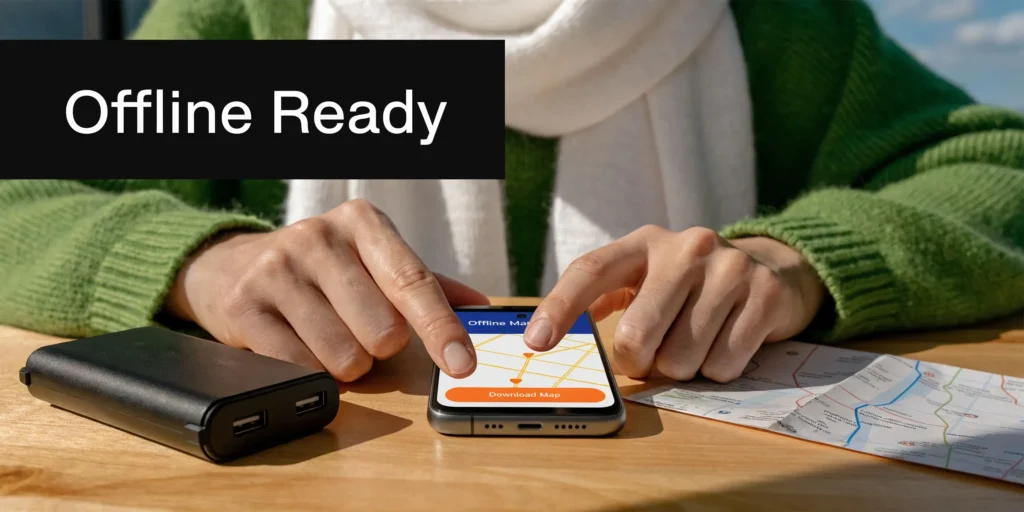
Set up your phone before departure
Do this while you still have stable home internet:
- Download offline maps: Save your destination area in Google Maps or another map app
- Install key apps early: Airline, rail, hotel, translator, ride-hailing, and banking apps
- Save confirmations offline: Screenshots help when apps won’t load
- Prepare power backup: Bring a charged power bank and the right cable
Offline maps are one of the simplest high-value habits in travel. The verified travel data specifically recommends downloading them to avoid data costs and navigation problems in dead zones. That advice is practical because navigation problems rarely happen when you’re calm and stationary. They happen when you’re late, tired, or outside a station with weak signal.
Use AI and booking tools with judgment
AI tools can help beginners turn a vague destination idea into a usable plan. According to travel industry data from Key Data, 55% of American men and 46% of women have adopted AI tools for travel planning. That’s useful context, but a key lesson is simpler: let AI speed up your draft, then check it yourself.
Use ChatGPT or Google Bard-style tools to build a rough itinerary, create packing prompts, or compare neighborhood options. Then verify opening hours, transport details, and booking conditions directly in the actual apps or provider sites.
The same goes for travel booking apps. Google Flights, hotel platforms, train apps, and translator tools can save time, but only if you treat them as tools, not authorities.
A good system is this: use technology for speed, offline backups for resilience, and your own judgment for final decisions.
5. Establish a Travel Budget and Track Expenses
The budget usually breaks in small places first.
A first-time traveler books a flight, picks a hotel, and feels prepared. Then the journey begins. Airport transfer. SIM card. Coffee near the station because check-in is still two hours away. A museum ticket with an audio guide. A taxi back because feet are shot. None of those costs feels serious on its own. Together, they change the trip.
Build the budget in layers
Start with fixed costs, then add the spending that happens on the ground. That second layer is where beginners underestimate.
Use five categories:
- Transport: Flights, trains, airport transfers, public transit, occasional taxis
- Stay: Hotel or hostel, cleaning fees, city taxes, baggage storage after checkout
- Food: Groceries, water, snacks, coffee, regular meals, one planned splurge
- Activities: Entry tickets, tours, rentals, tips where expected
- Buffer: Delays, price changes, medical basics, replacement items, weather-driven changes
As noted earlier, travelers are paying closer attention to costs and spending more effort finding deals. The practical lesson is simple. A rough total is not enough. Give every dollar or euro a job before you leave.
A good beginner rule is to separate needs from optional upgrades. Train ticket: need. First-class seat upgrade: optional. Lunch: need. Rooftop cocktail every night: optional. That distinction makes in-the-moment decisions easier when spending starts to creep up.
Use a 10-minute daily check
Track expenses once a day, preferably at night when receipts and card charges are still fresh.
Use the tool you will stick with. A notes app is fine. A spreadsheet is fine. A budgeting app is fine. Consistency matters more than features.
Try this mini-checklist each evening:
- Log what you spent today
- Compare it against your daily target
- Flag one category running high
- Adjust one choice for tomorrow
That last step matters. Budget tracking only works if it changes behavior while the trip is still happening.
For example, if day two shows higher-than-expected spending on transit and coffee, day three might mean a grocery breakfast, more walking in one neighborhood, and one free activity instead of a paid one. Small corrections are easier than a last-minute spending freeze.
A travel budget should help you make better decisions during the trip, not just explain the damage after it ends.
One more practical point. Airport currency exchange desks often give poor rates. If you need cash, one planned withdrawal usually beats several panicked exchanges in expensive locations.
6. Understand Local Culture and Customs
Beginners often focus so hard on what they want to see that they forget how they’re going to behave once they get there.
That’s where friction starts. Not because people expect perfection, but because disrespect usually looks like carelessness. Loud voices in quiet spaces, clothes that don’t fit the setting, photos taken where they shouldn’t be, and zero effort with basic local etiquette all stand out fast.

Learn the basics before you land
You don’t need a deep cultural education to be a respectful visitor. You do need the fundamentals.
Look up:
- Dress expectations: Religious sites, formal spaces, conservative neighborhoods
- Greeting norms: Handshakes, bows, cheek kisses, or more reserved distance
- Dining etiquette: Tipping, queueing, table customs, and payment habits
- Photo rules: Sacred sites, ceremonies, and portraits of strangers
Learning a few local phrases helps more than people think. Hello, thank you, please, excuse me, help, and “do you speak English?” are enough to show effort. The same travel statistics roundup notes that learning key phrases improves cultural competence and can reduce avoidable mishaps.
Observe first, then act
This is one of the best travel tips for beginners because it works almost everywhere.
When you enter a new environment, pause and watch. Are people speaking softly? Are they removing shoes? Are they lining up in a specific way? Are they paying first or after the meal? Local behavior will answer many questions faster than a guidebook.
A real-world example: at temples in parts of Asia, removing shoes may be expected. At mosques and conservative religious spaces, covering shoulders and knees may matter. In some places, photographing people without asking is rude even if the setting feels public.
What doesn’t work is assuming your home habits are neutral. They aren’t. Travel gets easier when you stop treating unfamiliar customs as obstacles and start treating them as part of the experience.
7. Prioritize Health and Safety Precautions
Travel problems aren’t dramatic. They’re annoying, preventable, and disruptive.
A dehydration headache ruins a day. So does food poisoning, a missing prescription, a fake taxi, or arriving somewhere after dark with no idea where you’re going. Beginners often think safety means worrying about major crime. In practice, it mostly means reducing avoidable risk and staying functional.

Protect your health before and during the trip
If your destination has specific vaccine or medication requirements, handle that well before departure. Bring prescriptions in original labeled containers and keep them in your carry-on, not in checked luggage.
A basic travel health kit should include pain relief, antihistamines, stomach medication, simple first aid supplies, and anything you know your body regularly needs. Don’t assume you’ll find the same products abroad, especially if you’re tired, jet-lagged, or dealing with language barriers.
Beginners should also ease into local food if they’re arriving in a place with very different water or food handling standards from home. Street food can be excellent, but it’s smarter to start with busy, well-reviewed vendors and see how your body responds.
Build simple safety habits
Safety habits don’t need to be paranoid to be effective.
- Use registered transport: Book through official taxi stands or known apps
- Keep valuables quiet: Don’t display cash, expensive jewelry, or flashy gear
- Share your plan: Let someone at home know where you’ll be staying
- Trust your instincts: If a place or situation feels wrong, leave
The verified travel data also suggests the “two-day rule,” which means spending at least two days per location to reduce fatigue and travel friction. That’s more of a pacing rule than a safety rule, but it has clear safety benefits. Exhausted travelers make poor decisions.
Rest is a safety tool. So is eating on time, staying hydrated, and not arriving in every new place depleted.
8. Master Flexible Booking and Cancellation Policies
A cheap booking isn’t always a good booking. Beginners often learn that too late.
They see a lower rate, click the non-refundable option, and only notice the downside when a flight changes, a train runs late, or they realize they booked the wrong dates. Savings look different once they become losses.
Read the policy, not just the price
Before you book flights, hotels, apartments, or activities, check three things:
- Cancellation window: How late can you cancel without penalty?
- Change rules: Can you move dates, and what fees apply?
- Refund method: Cash refund, travel credit, or no refund at all?
Screenshot the confirmation page and save the email. If something goes wrong, you want the exact terms you agreed to, not your memory of them.
This matters even more in an online-first booking environment. The Champ Digital travel marketing roundup notes that 82% of bookings happen online. Convenience is great, but online booking also makes it easy to click through terms too fast.
Use flexibility where it matters most
Not every booking needs the highest flexibility. But high-risk parts of the trip usually do.
If you’re booking the first night after an international flight, flexible terms are worth a lot. Same for airport transfers, expensive accommodations, and anything tied closely to weather or changing schedules.
A practical example: if you’re arriving late and changing planes on the same day, don’t pair that with a rigid, non-refundable activity booked for the same evening. That’s stacking stress for no reason.
What works is balancing certainty and adaptability. Lock in the things that need advance purchase. Keep breathing room around everything else.
9. Develop a Communication and Connectivity Strategy
Connectivity is one of those things people only think about when it fails.
Then they’re outside an airport trying to message a host, call a driver, or pull up a booking confirmation on weak public Wi-Fi. A little planning prevents that spiral.
Pick your connection method before departure
You generally have a few options: your home carrier’s roaming plan, a local SIM, an eSIM, or a Wi-Fi-first approach. The right choice depends on trip length, destination, and how much you’ll rely on navigation and messaging.
What matters is deciding in advance, not improvising in arrivals.
The travel marketing data from Champ Digital notes that 71% of travelers expect personalized recommendations. The convenience behind those recommendations usually assumes you’re connected. But don’t confuse that with a need to stay online every minute. You need reliable access, not constant scrolling.
Build redundancy into communication
Have at least two ways to stay reachable. For example, use an eSIM plus WhatsApp, or a local SIM plus hotel Wi-Fi calling. Also keep key numbers on paper, including your hotel, airline, embassy or consulate, and an emergency contact at home.
A simple beginner setup looks like this:
- Primary method: Local SIM or eSIM for maps, messaging, and transport apps
- Backup method: Wi-Fi calling or messaging over hotel and café Wi-Fi
- Offline backup: Paper list of essential contacts and addresses
Don’t underestimate messaging apps. WhatsApp, Telegram, and similar tools are usually more useful internationally than relying on standard SMS.
And while social media can be useful for research, don’t let connectivity consume the trip. The same Champ Digital roundup notes that 57% of travelers create content during trips. That’s normal now, but beginners are often happier when they use their phone intentionally instead of turning the whole trip into a posting schedule.
10. Build Flexibility Into Your Itinerary and Document Your Travel Experiences
You arrive in a new city with a color-coded plan, timed museum entry, dinner reservation, and a day trip booked for the next morning. Then the flight lands late, your bag takes an extra hour, and you start the trip already behind. That is how first trips become stressful.
A workable itinerary gives you direction without turning every delay into a problem.
The simplest way to do that is to separate your trip into anchors and flex time. Anchors are the parts that are hard to replace: flights, train tickets, first-night lodging, limited-entry sights, and anything booked far in advance. Flex time is everything around them. Keep at least one open block each day, or one lightly planned day every few days, so weather, energy, and local recommendations can shape the trip instead of wrecking it.
Use this beginner framework:
- Lock in: arrival logistics, first accommodation, major transport, high-demand bookings
- Leave open: neighborhood walks, casual meals, shopping, second-choice sights
- Protect your pace: avoid changing cities too often, especially on a first trip
- Review nightly: check the next day and cut one thing if the schedule feels tight
Pacing matters more than beginners expect. A trip usually improves when you spend enough time in one place to learn the area, recover from transit, and change plans without losing money. Rushed itineraries look productive on paper and feel thin in real life.
I use one practical test. If missing a booking would cost real money or create a long detour, I plan it. If it can be decided the same day with little downside, I leave it open.
Build a simple record of the trip
Documenting the trip helps in two ways. You remember more, and you learn how to travel better next time.
Keep it light. A good system takes five minutes daily:
- One photo worth keeping
- Three notes: what worked, what did not, what surprised you
- One logistics detail: actual transit time, real costs, or a place you would return to
That last point is where the value compounds. Your notes become a personal travel manual. After two or three trips, you stop relying on generic advice because you can see your own patterns clearly. Maybe you need slower mornings, shorter transit days, or fewer hotel changes. Maybe you spend less on attractions and more on food and convenience. Those are useful lessons.
You do not need a record you will keep. A short journal in your notes app, a small paper notebook, or a private photo album with captions is enough.
The goal is simple. Leave room for the trip to change, and keep enough of it that the next one gets easier.
Beginner Travel Tips, 10-Point Comparison
| Item | Implementation complexity | Resource requirements | Expected outcomes | Ideal use cases | Key advantages |
|---|---|---|---|---|---|
| Start with Thorough Research and Planning | Medium, time and coordination | Time, internet, guidebooks, booking tools | Fewer surprises; smoother logistics; cost savings | First-time trips, complex destinations, visa-required travel | Reduced risk, better itinerary, confidence |
| Pack Light and Smart | Low–Medium, mindful selection | Carry-on, packing cubes, versatile clothing, laundry access | Easier mobility; lower baggage fees; less stress | Short/multi-stop trips, budget airlines, active itineraries | Cost savings, flexibility, simplicity |
| Secure Travel Insurance and Emergency Contacts | Low, purchase and document | Insurance premium, policy comparison, digital copies | Financial protection; emergency assistance; medical coverage | International travel, adventure activities, expensive trips | Peace of mind, medical & evacuation support |
| Use Technology Wisely (Apps and Offline Features) | Medium, setup and management | Smartphone, apps, battery packs, eSIM/data | Reliable navigation; translation; reduced data costs | Low-connectivity areas, solo travel, complex transit | Offline access, real-time info, convenience |
| Establish a Travel Budget and Track Expenses | Medium, setup + ongoing tracking | Spreadsheet/apps, research, banking tools | Controlled spending; longer trips; informed adjustments | Long trips, budget travel, planning multiple destinations | Prevents overspending, financial clarity |
| Understand Local Culture and Customs | Medium, research and practice | Time, guides, basic language phrases, cultural resources | Respectful interactions; deeper local experiences | Cultural sites, conservative destinations, homestays | Improved safety, local goodwill, authenticity |
| Prioritize Health and Safety Precautions | Medium, medical prep and awareness | Vaccinations, travel health kit, insurance, health info | Reduced health risks; quicker emergency response | High-risk regions, remote travel, adventure trips | Health protection, emergency readiness |
| Master Flexible Booking and Cancellation Policies | Low–Medium, policy comparison | Potentially higher refundable fares, time to read terms | Reduced financial loss; adaptable plans | Uncertain schedules, pandemic-era travel, long itineraries | Refund flexibility, risk reduction |
| Develop a Communication and Connectivity Strategy | Low–Medium, setup and backups | SIM/eSIM, data plans, portable WiFi, messaging apps | Reliable contact; navigation; lower roaming costs | Remote stays, group coordination, digital nomads | Cost control, multiple backups, safety |
| Build Flexibility Into Your Itinerary and Document Experiences | Low–Medium, planning + documenting | Time for journaling, camera/phone, backup storage | More spontaneity; preserved memories; less burnout | Leisure travel, exploratory trips, creative travelers | Serendipity, rest, lasting memories |
Ready for Takeoff. Your Journey Starts Now
Good travel rarely comes from being fearless. It comes from being prepared enough that fear doesn’t run the trip.
That is the purpose behind practical travel tips for beginners. Not to make you more rigid, and not to turn every journey into a project plan. The goal is to remove the avoidable friction so you have enough energy for the parts that matter. Meeting people. Seeing new places. Recovering when things go sideways. Learning how you move through the world when you’re outside your routine.
If you take nothing else from this guide, take this: first trips go better when you simplify. Research the essentials. Pack less than you think you need. Keep your documents and backups organized. Protect your health. Use apps wisely, but don’t depend on them blindly. Build a budget that reflects reality, not optimism. Respect the place you’re visiting. Leave room in your itinerary for delays, detours, and better ideas.
Those habits matter because travel can feel expensive, crowded, and overstimulating, especially when you’re new to it. But beginner mistakes aren’t a sign that you’re bad at travel. They’re usually a sign that no one explained the operational side clearly enough. Experienced travelers aren’t calmer because they know every answer. They’re calmer because they have systems. They know what to check, what to carry, what to ignore, and what to do when the original plan stops working.
That’s why a framework beats random advice.
When you know how to research a destination, you book better. When you understand packing trade-offs, you move better. When you track spending daily, you adjust earlier. When you understand local customs, conversations go more smoothly. When you build in flexibility, small problems stay small.
And that shift happens fast. One well-planned trip teaches you more than months of reading.
So don’t wait until you feel completely ready. Few people ever feel completely ready. Pick a trip that fits your budget and comfort level. Start with a manageable itinerary. Give yourself enough time in each place. Keep your expectations realistic. Let the first journey teach you what kind of traveler you are.
Travel is not about ticking boxes. It’s about attention. Attention to your surroundings, to other people, to your own limits, and to the fact that the world is bigger and more varied than your normal week allows you to remember.
Go with a plan. Go with humility. Go with enough structure that you can relax once you arrive.
Then let the trip do its work.
If you enjoy practical travel writing, reflective guides, and approachable commentary across tourism, health, science, business, arts, entertainment, education, pets, fashion, sports, games, and technology, visit maxijournal.com. It’s a good place to read fresh perspectives, discover new topics, and explore publishing opportunities if you have your own story or insight to share.
Discover more from Maxi Journal
Subscribe to get the latest posts sent to your email.