You landed this morning. Your brain says it’s the middle of the night, your stomach wants food at the wrong time, and you’ve got meetings, sightseeing, or family plans in a few hours. The common response is the same. They drink random coffee, take a long nap, promise themselves they’ll “push through,” and then wonder why the first two days of the trip feel blurry.
That approach is backwards.
If you want to know how to overcome jet lag fast, the key isn’t one magic supplement or one lucky night of sleep. It’s getting the timing right. The biggest gains come from what you do before the flight, what you do in the air, and especially what you do in the first 24 hours after arrival. That window is where good decisions shorten recovery and bad ones lock the old time zone in place.
The good news is that the plan is simple once you strip away the noise. Prioritize light, time your sleep on purpose, use meals and movement as signals, and treat naps and melatonin as tools instead of guesswork.
Before You Fly: Pre-Program Your Body Clock
Jet lag recovery starts before departure. The common mistake is to wait until arrival and hope one decent night of sleep fixes a time-zone jump that has already started disrupting your circadian rhythm.
A better plan is to reduce the size of the adjustment before you ever get to the airport. If the first 24 hours after landing are the golden window for recovery, the 3 days before takeoff are where you make that window easier to use.

Use a three-day shift, not vague “early nights”
Start with your sleep schedule. Shift bedtime and wake time by about 1 hour per day for the 3 days before your flight. Move earlier for eastbound trips. Move later for westbound trips.
For eastbound travel, such as North America to London, Paris, or Dubai, use this schedule:
- Three days before departure: go to bed 1 hour earlier and wake 1 hour earlier.
- Two days before departure: repeat the shift.
- One day before departure: repeat it again.
For westbound trips, reverse it and slide both times later each day.
This works because jet lag is largely a timing problem. A partial shift at home means your body has fewer hours to adapt after landing. It is also realistic. Asking a traveler to move 3 hours in one night usually fails. Asking for 60 minutes a day is manageable, especially if work or family obligations limit how aggressive you can be.
Practical rule: Do not stay up late before an eastbound flight to “bank” sleep. In practice, that often leaves you overtired at the wrong time and makes the first evening at your destination harder.
Shift light and meals with the same discipline
Sleep timing helps, but light is the stronger signal for your body clock. The Sleep Foundation notes that light is the most powerful influence on circadian rhythm, which is why timed light exposure is one of the main tools used to reduce jet lag symptoms, as explained in its guide to jet lag causes, prevention, and treatment.
Use light on purpose:
- Eastbound travel: get bright light soon after waking and keep evenings dim.
- Westbound travel: keep light exposure later in the day and avoid flooding yourself with bright light too early in the morning.
- Meals: start moving breakfast, lunch, and dinner in the same direction as your sleep shift.
Meal timing does not replace sleep and light, but it helps align your digestive rhythm with the new schedule. That matters on arrival day, when many travelers feel sleepy at the right time but hungry at the wrong one, or vice versa.
Pack for the behavior you want on the way over
Pre-programming also means reducing friction. Put your eye mask, earplugs, water bottle, compression-friendly clothing, and any clinician-approved sleep aids where you can reach them fast. If you need a practical packing checklist before a long-haul trip, use this guide on what to pack for long trips.
One trade-off is worth stating plainly. Eastbound trips usually feel harder than westbound ones because falling asleep earlier is tougher for the body than staying awake a bit longer. That is exactly why pre-flight schedule shifting pays off most on those routes. If you leave home even partly aligned, arrival day becomes an adjustment, not a full reset.
Master the Flight: An In-Air Protocol for a Better Arrival
You board tired, the cabin lights stay on too long, drink service shows up at the wrong hour, and your body stops trusting the clock. That is why the flight matters. It can either protect the work you did before departure or wipe it out.
Treat the plane as a controlled transition period, not downtime.

My advice is to focus on three jobs in the air: keep fluids up, keep circulation moving, and protect sleep timing. Get those right and you arrive with less fog, less stiffness, and a better chance of using the first 24 hours well.
Your in-flight protocol
Start by switching your watch and your decisions to destination time once you settle in. That single step reduces the usual drift into random eating, random caffeine, and accidental naps.
Then work through this short plan:
- Hydrate steadily: drink water regularly through the flight. Dry cabin air and long stretches of sitting make fatigue feel worse than it already is.
- Move every chance you get: stand up when the aisle opens, flex your calves, roll your ankles, and change position often. If you want a broader routine for staying healthy while traveling on long trips, build that in before departure.
- Use sleep as a timing tool: sleep only when it lines up reasonably well with nighttime at your destination. If it is daytime there, stay awake unless safety or exhaustion makes that unrealistic.
This is a trade-off, not a purity test. A short rest can be smarter than forcing yourself awake into a miserable, dehydrated slump. The key is to avoid turning the flight into a full sleep period at the wrong biological time.
How to decide whether to sleep
“Try to sleep on the plane” is too vague to help.
Use a simple rule. If the next several hours at your destination are local night, create a sleep block. Put the screen away, use your eye mask and earplugs, and skip alcohol as a shortcut. If your destination is in local daytime, stay in wake mode. Sit more upright, keep some light exposure, and save your best chance to sleep for the correct local night after landing.
For eastbound flights, this usually means being stricter. Advancing the body clock is harder than delaying it, so mistimed in-flight sleep tends to cost more. For westbound flights, staying awake later is often easier, but random dozing can still leave you flat at the wrong hour after arrival.
Food and caffeine need a job
Plane meals are scheduled for airline operations, not for your circadian rhythm.
Eat lightly if the timing is off, and use meals to support the destination clock rather than to fill every bored hour. Heavy food close to an intended sleep window usually backfires. So does chasing alertness with repeated coffees across the whole flight. Caffeine works best when you use it deliberately, not continuously. If you need it, use a modest amount to support a planned wake period, then stop early enough that it does not interfere with your first proper sleep in the new time zone.
What to skip
A few common habits create trouble fast.
| Habit | Better option |
|---|---|
| Alcohol to knock yourself out | Use a mask, earplugs, and a destination-timed sleep window |
| Eating every time food appears | Eat lightly and closer to destination meal timing |
| Random caffeine through the cabin cycle | Use one planned dose when you need alertness |
| Sitting still for hours | Add short walks, calf squeezes, and posture changes |
To make the idea more concrete, this quick video gives a useful visual overview of timing-based jet lag strategies:
The flight should set up your arrival. Protect hydration, protect circulation, and be selective about sleep. Those choices matter most because they shape the golden window that starts when you land.
The Golden 24 Hours: Your On-Arrival Action Plan
Trips succeed or fail based on this.
The first day in the new time zone is your best chance to tell your body, clearly and repeatedly, “we live here now.” If you send mixed signals, a dark room, a long afternoon nap, indoor lighting all day, dinner at the wrong time, your old rhythm hangs on. If you line up the cues correctly, your body starts shifting faster.
The strongest cue is light. According to the Human Performance Alliance guide to strategic light exposure, strategic light exposure can shift the circadian clock by about 1 hour per day. That same guidance says eastbound travelers should get morning sunlight, westbound travelers should seek evening bright light, and incorrect timing, such as morning light for westbound travel, can delay adaptation by 20-50%.
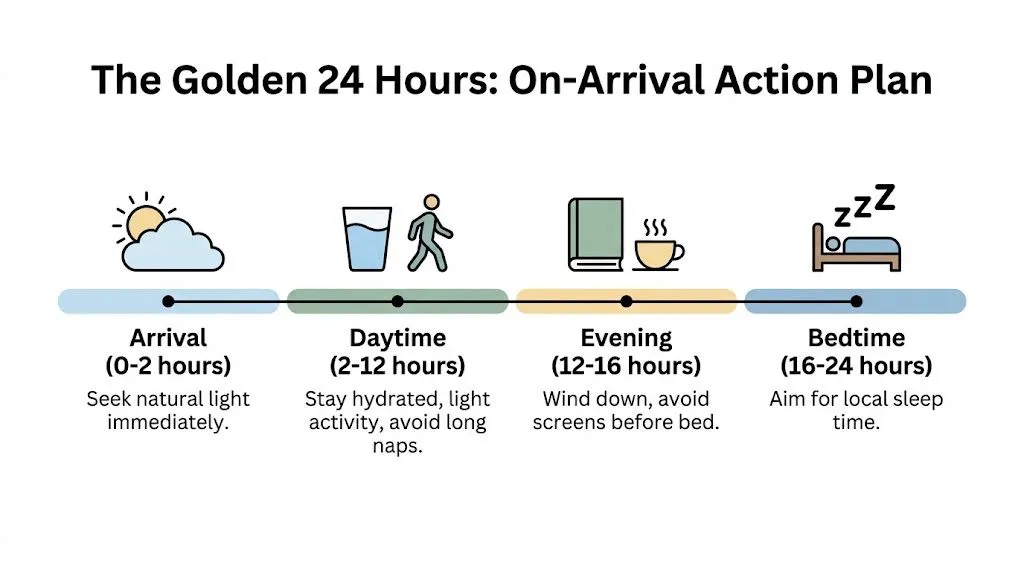
First two hours after landing
Don’t drift into “recovery mode.” Go straight into clock-reset mode.
If you traveled east, get morning light as soon as the timing lines up with local morning. If you traveled west, don’t chase early morning light if your goal is to delay the clock. Save your strongest light exposure for later in the day.
Then do three simple things:
- Eat on local time: even if appetite is off.
- Get outside: natural light beats hotel-room half-darkness.
- Stay moving: a walk is enough. You do not need a workout.
That first meal and that first stretch of outdoor light work well together because they both tell the body the same story.
Build the day around the right cue
People often ask whether food, exercise, or light matters most. In practice, light leads and the other cues reinforce it.
For an eastbound arrival, use this pattern:
| Local time | What to do | Why it helps |
|---|---|---|
| Morning | Get outside in bright light | Advances the body clock |
| Midday | Eat a normal meal and stay active | Reinforces local daytime |
| Afternoon | Keep moving, avoid hiding indoors | Preserves alertness until night |
| Evening | Dim lights and reduce stimulation | Prepares for local bedtime |
For a westbound arrival, the pattern changes:
| Local time | What to do | Why it helps |
|---|---|---|
| Early morning | Don’t overdo bright light if it’s too early for your new schedule | Avoids shifting the wrong way |
| Afternoon into evening | Seek bright light later in the day | Delays the clock appropriately |
| Dinner onward | Keep the evening social and lightly active | Helps you stay awake until local bedtime |
| Late night | Sleep at local bedtime, not when your home clock wants it | Anchors the new schedule |
Morning light is powerful, but only when it matches the direction you need. Bad timing can work against you.
The arrival-day rules that matter most
By this point, the plan needs discipline more than complexity. These are the rules I’d put first for a busy traveler:
- Adopt local time immediately. Don’t keep checking home time except for family logistics.
- Go outside early in the day you want your body to recognize.
- Eat meals at local times even if hunger feels off.
- Use light activity, not collapse, to get through the slump.
- Protect the first local bedtime.
If you need a broader travel wellness framework beyond jet lag alone, this guide on how to stay healthy while traveling pairs well with the arrival-day plan.
What not to do in the golden window
Travelers usually sabotage the first day in predictable ways:
- Checking into the hotel and sleeping immediately
- Sitting indoors under dim light for the entire afternoon
- Eating at odd hours based on home time
- Treating exhaustion as a reason to stop moving completely
None of those choices feel dramatic. That’s why they’re so easy to make. But the body responds to accumulated signals, and the first day gives those signals extra weight.
If you’re deciding between comfort now and adaptation later, choose adaptation. A short outdoor walk while tired often does more for recovery than an extra hour lying awake in a dark room at the wrong time of day.
Advanced Tools: Using Napping and Melatonin Wisely
You arrive wrecked at 2 p.m., tell yourself you’ll lie down for 90 minutes, and wake up at 6:30 p.m. hungry, foggy, and wide awake at midnight. That single decision can undo much of the work from the first day.
Naps and melatonin help only when they fit the clock you are trying to build in the first 24 hours. Used casually, they delay it.

The nap rule most travelers get wrong
A nap should solve one problem only: keeping you functional long enough to reach the target bedtime. The guidance from University Hospitals on reducing jet lag advises keeping naps to 20 to 30 minutes and leaving at least 4 to 6 hours before destination bedtime. Longer naps increase the chance of deep sleep and sleep inertia, which leaves you groggy and makes it harder to sleep that night.
Use a nap only if all three conditions are true:
- You cannot function safely without it
- You can keep it to 20 to 30 minutes
- You can take it early enough that bedtime stays intact
If one of those is missing, skip it.
For many daytime arrivals, the fastest recovery comes from staying awake, getting light, moving a little, and protecting the first full night. I advise travelers to treat the nap as a backup tool, not a reward for surviving the flight.
Set an alarm before you lie down. Sit up as soon as it goes off. Don’t crawl back under the blanket “for a few more minutes.”
Melatonin works on timing
Melatonin is a circadian signal, not a sedative in the usual sense. It can help tell your body that biological night should start earlier, which is why it is usually more useful after eastbound travel than westbound travel.
The common mistake is taking it at the wrong time and expecting it to overpower bright hotel lights, a late dinner, and phone use in bed. It won’t. Melatonin works best when the rest of the evening also supports sleep.
In practice, use it selectively:
- Eastbound travel: often the better fit, especially if you need help shifting bedtime earlier
- Close to the target evening: use it to support the bedtime you want locally
- With dim light: keep the room and screens as dark as you reasonably can after taking it
Dose matters less than timing for many travelers. If you already use melatonin, keep the dose modest unless your clinician has told you otherwise. If you have never used it, check for medication interactions and use caution if you have epilepsy, a bleeding disorder, are pregnant, or take anticoagulants or sedating medicines.
If your baseline sleep is messy before the trip, these tools become less predictable. Tightening your routine at home helps a lot. This guide on improving sleep quality before travel covers the habits that make naps and melatonin work better.
A practical call in real situations
| Situation | Best move |
|---|---|
| Barely functioning in early afternoon | Take one short nap only if you can cap it at 20 to 30 minutes |
| Reaching the hotel within a few hours of local bedtime | Stay awake, keep lights low later, and go to bed at local night |
| Eastbound, tired but unable to fall asleep at the new bedtime | Consider melatonin timed to the local evening |
| Tempted to sleep for one to two hours after check-in | Skip it. That often pushes the whole clock later |
The trade-off is simple. A short nap may improve the next few hours. A long nap often costs you the night. Melatonin may sharpen the bedtime signal. Bad light exposure can weaken it. Use both tools to protect the golden 24-hour window, not to escape it.
Staying on Track and When to Call a Doctor
The first 24 hours do most of the heavy lifting. The next two to four days decide whether that progress holds.
Keep the same anchors every day after arrival: local wake time, local meals, local light exposure, and local bedtime. That repeated pattern is what pulls your body clock into place. If you follow the plan on day one, then sleep late, hide indoors, or eat on home time the next day, recovery slows down fast.
Expect eastbound trips to take longer than westbound ones. In practice, the body clock usually shifts gradually, not all at once, so a big time-zone jump can leave some residue even when you do almost everything right. The goal is not instant perfection. The goal is to shorten the adjustment period, protect your sleep at the new bedtime, and stay functional enough to work, think clearly, and drive safely.
A simple rule helps here. Protect your local morning wake time more than your local bedtime. Getting up at the planned hour, then getting daylight and moving your body, usually does more to lock in progress than trying to force extra sleep in the morning after a rough night.
Stay consistent on the flight home too. Treat the return as a new shift, not a reset. If you can pre-shift before departure, do it. Then use the same arrival logic again, especially on the first day back.
Call a doctor if the problem stops looking like ordinary jet lag. That includes sleep disruption that stays severe for days, fatigue that interferes with work or basic daily tasks, or symptoms that make driving or decision-making unsafe. Get help sooner if you already have insomnia, sleep apnea, bipolar disorder, depression, epilepsy, or a medical condition that travel tends to aggravate.
Jet lag should improve as your schedule stabilizes. If it is not improving, or it is exposing a bigger sleep or health problem, get it checked.
maxijournal.com publishes approachable, thoughtful writing across travel, health, science, culture, and more. If you like practical guides that cut through noise and explain what helps, explore the latest articles or consider contributing your own perspective.
Discover more from Maxi Journal
Subscribe to get the latest posts sent to your email.