A traveler standing on the Alaskan coast can look west toward a narrow strip of sea and know that another continent is just beyond it. The distance feels small. The implications of crossing it by rail feel almost planetary.
The Ultimate Land Bridge
A Bering Strait tunnel starts as a simple idea. Build a fixed link between Alaska and Russia, then let trains, freight, power lines, and communications networks move between North America and Asia without a ship or plane.
That vision has a powerful pull because it turns world geography into something more connected and easier to picture. A rail journey that moves goods across continents on continuous track sounds like the logical next chapter after transcontinental railroads, undersea cables, and long subsea tunnels elsewhere. It also taps into a very old human instinct. If two landmasses are close, people will ask whether they can be joined.
The Bering Strait is narrow enough to make that question feel reasonable. Yet many readers get tripped up on this point. They hear “tunnel under a strait” and picture a single heroic piece of engineering. In reality, the tunnel is only the middle link in a chain. The project would only matter if vast rail and utility corridors existed on both sides to connect it to real cities, ports, mines, grids, and supply networks.
Why the idea keeps returning
The appeal isn’t only commercial. Supporters have long framed the crossing as a symbol of peaceful exchange, a way to make continents feel less separate. That dream also sits beside hard realities: military tensions, sanctions, Arctic weather, and the fact that remote infrastructure is expensive to build and even more expensive to maintain.
A Bering Strait tunnel isn’t just a hole under water. It’s a test of whether engineering, finance, diplomacy, and environmental stewardship can all hold together at the same time.
The Arctic adds another layer. Anyone curious about how long-term climate cycles shape public imagination might also enjoy this explainer on when the next ice age may happen. It’s a useful reminder that ideas about the far north often mix science, myth, and ambition.
Three questions decide whether the project stays a dream or becomes concrete and steel:
- Can engineers build it safely? The answer may be more plausible than many assume.
- Can governments and investors pay for the whole system? That’s tougher.
- Can rival powers cooperate long enough to finish and operate it? This may be the hardest part of all.
A Century-Old Dream of Connecting Worlds
On a map, the gap between Alaska and Russia looks like a narrow tear between continents. For more than a century, that small gap has invited a very large idea. If railroads could stitch together the interiors of North America and Eurasia, why stop at the water?
That question is older than modern globalization. It reaches back to the railway age, when politicians, industrialists, and planners treated transport corridors almost like the skeleton of a future civilization. A line on a map could promise trade, migration, military reach, resource extraction, and national prestige all at once.
The first big proposal
One of the earliest well-known advocates was William Gilpin, the first territorial governor of Colorado, who promoted the idea of an intercontinental railway connection in the late nineteenth century. The details changed across decades, but the core vision stayed strikingly consistent: connect the Old World and the New World with fixed infrastructure, then let commerce and politics reorganize around it.
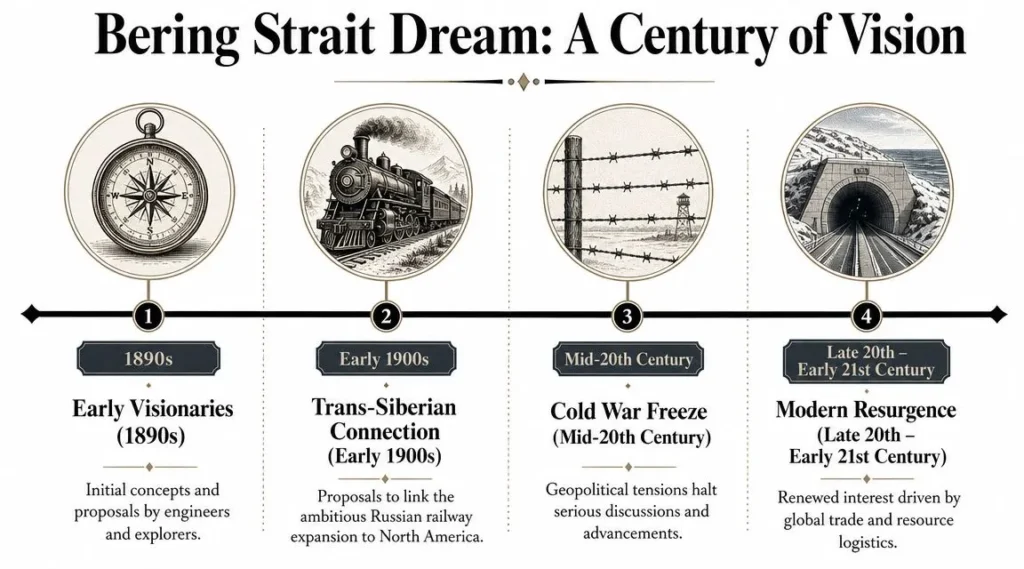
That helps explain why the proposal has such staying power. In the nineteenth century, railways were the internet backbone, interstate highway system, and power grid of their time rolled into one. A Bering connection was never only about travel time. It was about redrawing the mental map of the world.
Why the proposal kept resurfacing
The dream rose and fell with the political temperature.
During eras of rivalry between Russia and the United States, a tunnel under the strait looked less like infrastructure and more like a strategic vulnerability. During brief periods of warmer relations, the same project could be described as a peace dividend in concrete and steel. The history of the idea follows that pattern again and again. Technical ambition pulls it forward. Geopolitics pushes it back.
Plans from the early 2000s, including the TKM-World Link concept, made that tension plain. They treated the crossing as the centerpiece of a much longer corridor through Siberia and Alaska, not as an isolated megaproject. That distinction matters because it changes the whole feasibility question. A tunnel can be designed on paper. An international transport system requires border rules, long-term financing, security agreements, and years of construction through unstable ground, mountain passes, and permafrost. In terrain like that, expertise such as geotechnical slope design services becomes part of the broader conversation, because the approaches to the tunnel may be as difficult as the undersea segment itself.
More than a tunnel
The history makes more sense if you separate the romance of the project from the machinery required to sustain it.
| Lens | What people focus on | What it really implies |
|---|---|---|
| Symbol | A tunnel joining two continents | Peace, prestige, and a dramatic feat of engineering |
| System | Continuous transport and utility links | Rail, power, fiber, maintenance bases, and border regimes |
| Politics | A bridge between rivals | Cooperation that must survive for decades |
This is the part many retellings miss. The engineering, financing, diplomacy, and environmental burden are not separate chapters that can be solved one by one. They are braided together. A government will not fund the corridor without strategic reasons. Investors will not support it without reliable traffic and political stability. Engineers cannot finalize routes without knowing what environmental rules, Indigenous land agreements, and security arrangements apply on both sides.
That is why the project keeps returning without arriving. The dream is durable because it speaks to a real human impulse to connect distant worlds. The obstacle is just as durable. Building the tunnel means building a shared system, and shared systems are much harder to sustain than striking ideas.
The Engineering Feat of a Generation
The most common misunderstanding about the Bering Strait tunnel is that the main challenge is boring through seabed under cold water. That part is formidable, but mature tunnel engineering gives planners a starting point. The larger problem is how to create a reliable corridor through one of the harshest inhabited regions on Earth.
The tunnel would likely be multiple tunnels
A technically credible concept doesn’t rely on one giant bore. According to Engineering News-Record’s report on a possible Bering Strait tunnel, a 64-mile proposal would use twin 16.5-meter-diameter rail tunnels plus a separate 7-meter-diameter service and maintenance tunnel, and the route would intersect two islands in the strait to provide ventilation and construction access.
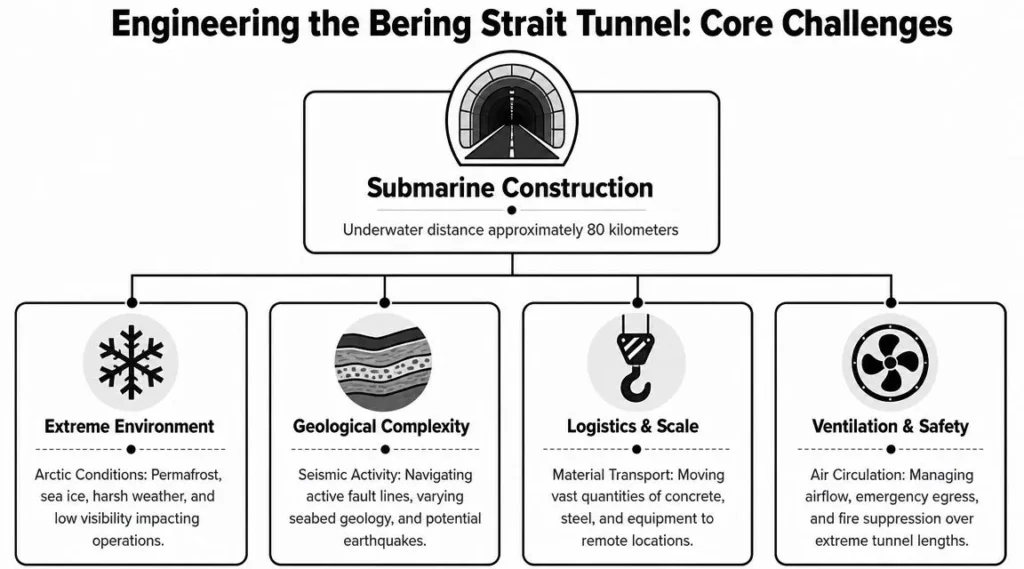
That design choice answers several practical needs at once:
- Safety first: A dedicated service tunnel gives crews emergency access if one rail tunnel has a fire, equipment failure, or evacuation event.
- Ventilation matters: Very long tunnels need carefully managed airflow, and intermediate points help.
- Construction gets segmented: Islands in the alignment can function like staging nodes, making the crossing feel less like one continuous impossible dig and more like several linked jobs.
This is similar to how a long mountain crossing is often broken into manageable sections with shafts, adits, and service access. The Bering Strait proposal scales that logic up and applies it under Arctic conditions.
Permafrost is a land problem with tunnel consequences
The underwater section gets headlines, but approach infrastructure may be the more punishing engineering environment. Proposals described in public summaries often involve Arctic terrain with permafrost, extreme cold, and long supply lines. Frozen ground sounds stable until it warms or gets disturbed. Then it can lose strength, settle unevenly, and damage track beds, embankments, and utility corridors.
That’s where adjacent disciplines become essential. Firms that work on slope stability and cold-region ground behavior, such as specialists in geotechnical slope design services, give a sense of the kind of expertise a corridor like this would need over decades, not just during excavation.
Arctic operations change the whole equation
One proposal summarized by the Universal Peace Federation notes that the Strait is about 51 miles (82 kilometers) at its narrowest point, but the broader concept includes a 6,000-kilometer corridor, with some descriptions calling for three parallel tunnels and emphasizing constraints such as temperatures down to –50°C, corrosion from saltwater, permafrost, and the need for immense financing, as outlined in the proposal overview for a Bering Strait peace tunnel.
That list matters because it shows why the Bering Strait tunnel isn’t just a bigger Channel Tunnel. It would be a rail-and-utility system exposed to cold, corrosion, isolation, and maintenance challenges over huge distances.
In ordinary infrastructure, bad weather slows a project. In Arctic infrastructure, weather shapes what can be built, when crews can move, how materials behave, and how often the system can be serviced after it opens.
Three engineering headaches that interact
Subsea boring
The bore itself needs redundancy, ventilation, and long-term safety systems.Remote approaches
Track, power, and service routes must cross terrain with almost no forgiving logistics.Operations for decades
A design isn’t enough. Crews need to inspect, repair, heat, ventilate, and secure the system in a place where even routine work becomes difficult.
None of these problems is isolated. A maintenance plan affects tunnel design. Tunnel design affects cost. Cost affects politics. That interlock is what makes the project so hard to reduce to a single yes-or-no engineering answer.
Counting the Cost Billions or Trillions
When people ask, “How much would the Bering Strait tunnel cost?” they usually mean the underwater crossing. That’s the wrong unit of analysis. The more honest question is: what would it cost to create a functioning intercontinental corridor in the Arctic?
The tunnel isn’t the whole bill
Proponents cited by InterBering describe a much larger rail-and-energy concept involving roughly 6,000 km of new connecting railway from Yakutsk toward North America, with the undersea portion around 64 to 74 miles (103 to 132 km) depending on alignment, and with total costs described in the tens of billions of dollars, according to InterBering’s project materials. The deeper point isn’t the exact figure. It’s that tunnel length alone isn’t the main cost driver. Building approach infrastructure through remote Arctic terrain may be the heavier burden.
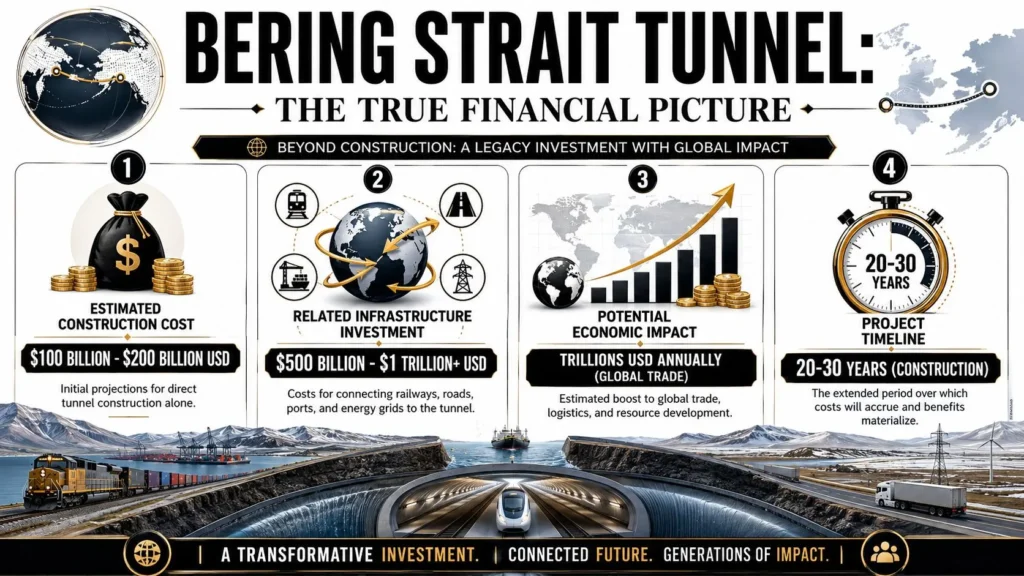
Think of it this way. If the tunnel is the front door, the project still needs an entire house behind it. A rail tunnel to nowhere has almost no economic meaning.
Why corridor economics dominate
Supporters increasingly package the project as a mixed system rather than a transportation link alone. The corridor could include rail, freight movement, power transmission, pipelines, and fiber-optic cables. That packaging isn’t decorative. It’s an attempt to solve the financing problem by stacking multiple revenue justifications into one route.
A stand-alone tunnel would struggle to explain its own price. A broader corridor can at least make the argument that several users are sharing one right-of-way.
Here’s the financial logic in plain language:
- Freight alone may not be enough: Rail volumes must be steady and politically resilient.
- Utilities widen the case: Power and communications links create additional reasons to build and maintain the corridor.
- Remote construction inflates everything: Labor camps, ports, equipment delivery, fuel, and seasonal access all push costs upward.
Why investors would hesitate
Mega-projects succeed when someone can answer four questions clearly.
| Question | Why it matters for the Bering Strait tunnel |
|---|---|
| Who pays upfront? | Construction would require very deep pockets and patient capital |
| Who earns revenue later? | Tunnel users, utilities, freight operators, and states may all expect a share |
| Who absorbs overruns? | Arctic work can punish optimistic budgets |
| Who guarantees access? | Political conflict can turn a business case upside down |
Financial reality: This is less like building one tunnel and more like building a new economic geography.
That’s why cost debates often become distorted. One camp talks only about excavation. Another talks as if the rail, energy, and telecom corridor naturally follows. In truth, those elements stand or fall together. If governments won’t fund the approaches, the tunnel makes little sense. If the tunnel doesn’t exist, some of the corridor’s value weakens.
A Bering Strait tunnel, then, isn’t merely expensive. It requires a financing model broad enough to treat steel, electricity, freight, maintenance, and geopolitics as parts of the same ledger.
Geopolitical and Economic Stakes
A tunnel under the Bering Strait sounds like a piece of civil engineering. In practice, it would behave more like a new border system, a new trade corridor, and a new security problem all at once. Rail track and concrete would be the visible part. The harder part would be deciding who controls access, who trusts whom, and who is willing to stay tied to that arrangement for half a century.
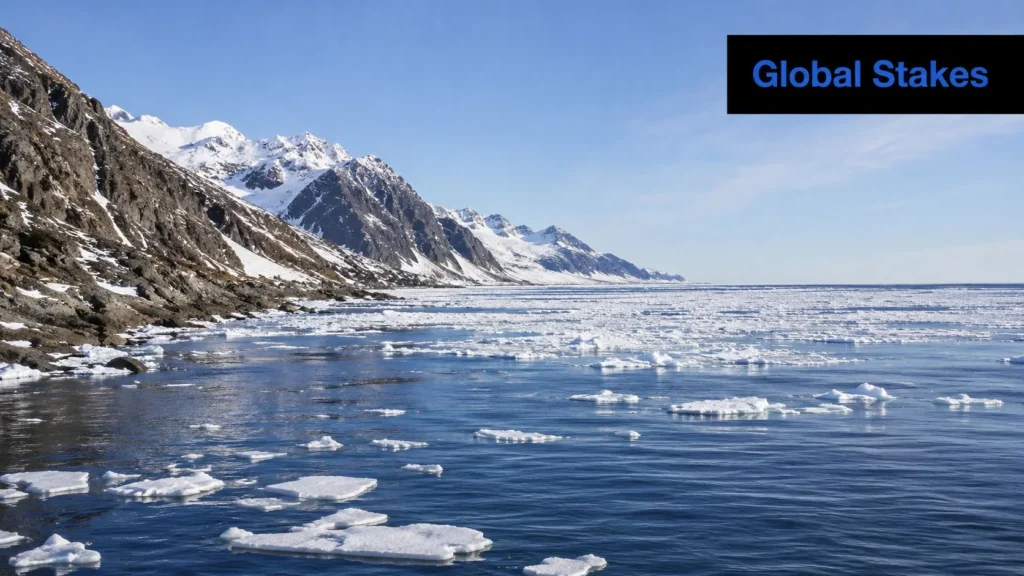
That is why the project cannot be sorted neatly into “engineering” on one side and “politics” on the other. A tunnel only has value if trains can cross predictably, inspections are accepted by all sides, digital systems are trusted, and the governments involved keep honoring the deal during bad years as well as good ones. The technical plan, the business model, and the diplomatic relationship are braided together like strands in the same cable.
Trade route or strategic vulnerability
Supporters often describe the tunnel as a land bridge between continents. The comparison works, but only up to a point. A bridge or tunnel does not create demand by itself. It creates an option. For that option to matter, manufacturers, rail operators, customs agencies, insurers, and governments all have to believe the route will stay open and usable long enough to justify shifting cargo onto it.
For some freight, that reliability could be attractive. A fixed crossing could offer redundancy when sea routes are disrupted or politically sensitive goods need tighter control. Utilities matter here too. Power lines and fiber cables can make a corridor more valuable than freight traffic alone, because they turn one piece of infrastructure into several revenue streams and several strategic dependencies at the same time.
That same logic also worries security planners. A tunnel meant to connect markets could become a pressure point during sanctions, conflict, cyberattacks, or diplomatic breakdowns. Every operating rule would carry political weight, from customs screening to data sharing to emergency shutdown authority.
For readers who want broader context on one side of that equation, this overview of the economy in Russia helps explain the industrial base, state priorities, and resource geography behind any proposal of this scale.
The problem of trust over time
The hardest material in this project may not be bedrock. It may be trust.
A tunnel under an international chokepoint would need agreements that survive elections, leadership changes, sanctions cycles, military tensions, and shifts in trade policy. Investors care about that because a rail tunnel is not a port crane or a warehouse that can be repurposed quickly. Once built, it ties the participants together for decades. If relations sour, the structure still exists, but much of its economic case can evaporate.
This is one reason advocates sometimes talk past critics. Engineers may ask whether the tunnel can be built. Economists may ask whether it can pay for itself. Security officials ask a different question: what happens if one side treats shared infrastructure as a bargaining chip during a crisis? All three questions matter, and none can be answered in isolation.
Students and delegates interested in how Arctic cooperation is debated in diplomatic settings may find this guide to preparing for MUN Arctic Council useful, because the same mix of sovereignty, resources, transit, and environmental stewardship shapes real-world arguments around projects like this one.
More than a US-Russia question
The tunnel is often framed as a bilateral decision, but any serious plan would draw in outside actors. Other major economies could seek construction contracts, financing roles, supply agreements, or influence over the corridor’s standards. That can make a project easier to fund, yet harder to govern. More partners mean more capital and more traffic potential. They also mean more veto points, more strategic suspicion, and more bargaining over who benefits most.
Arctic change adds another layer of uncertainty. A route planned for one set of coastal, logistical, and maintenance conditions may operate in a different Arctic decades later. That does not automatically rule out the tunnel. It does mean the project would be entering a region where the political map, the commercial map, and the physical environment are all shifting at once.
Here’s a short explainer that helps visualize the scale of the debate:
In that sense, the Bering Strait tunnel is not just a transportation proposal. It is a test of whether states can build a shared system in one of the world’s most sensitive regions and keep it working when economics, climate, and geopolitics stop pulling in the same direction.
Human and Environmental Toll on the Arctic
A project can be technically possible and still be the wrong choice. That’s especially true in the Arctic, where industrial infrastructure doesn’t enter an empty region. It enters living ecosystems and communities with long histories, land ties, and practical knowledge of survival in a severe environment.
The Arctic isn’t blank space
Maps make northern regions look vacant because there are few large cities and long stretches with minimal roads. But “empty” is a dangerous word in development. The Bering Strait region includes marine habitat, migration routes, hunting grounds, and coastal environments that can be disrupted by ports, rail lines, work camps, waste streams, and year-round industrial traffic.
The direct tunnel alignment is only one part of the disturbance. Access roads, staging areas, maintenance bases, power systems, and extraction-linked spurs could spread the footprint far beyond the strait itself.
A few questions should sit at the center of any serious debate:
- What happens to subsistence practices? Construction and corridor operations can interfere with travel, hunting, and seasonal rhythms.
- Who decides what counts as acceptable disruption? Distant capitals and investors often define benefits differently than local residents do.
- What does consent look like over decades? Communities may face a project timeline longer than political administrations or corporate ownership cycles.
Indigenous communities can’t be an afterthought
Any discussion of the Bering Strait tunnel that centers only on freight volumes and engineering misses the human issue. Indigenous peoples in the region have relationships to land and sea that don’t fit neatly into a conventional cost-benefit spreadsheet. Their concerns are not “soft factors.” They are part of whether the project is legitimate at all.
That’s one reason negotiation frameworks matter. Students trying to understand how Arctic diplomacy handles competing state, environmental, and community interests can get useful background from this guide to preparing for MUN Arctic Council. It’s not a construction manual, but it does show how quickly Arctic policy becomes a balancing act.
Environmental review would have to be unusually rigorous
The Arctic is already under stress from warming, erosion, and shifting ice conditions. A major new corridor would layer industrial pressure onto that instability. If you’re looking for a primer on the larger science behind those changes, this explanation of what climate change is gives helpful context.
Non-negotiable principle: If local communities bear the disruption while distant actors collect the gains, the project fails an ethical test before the first boring machine starts.
A responsible decision process would need more than formal consultation. It would require transparent monitoring, long-term remediation plans, legally meaningful community input, and willingness to stop or redesign parts of the project if harms prove too high.
The Bering Strait tunnel is often described as a connector of worlds. That phrase should include the human world already there.
From Dream to Reality What Will It Take
The Bering Strait tunnel remains compelling because each part of it seems just plausible enough. The strait is narrow. Tunnel-boring technology exists. Rail corridors have transformed continents before. Utilities can share a route. Freight networks do reward continuity.
Yet the closer you look, the less this resembles a single megaproject and the more it looks like four mega-projects that have to succeed together. Engineers would need a durable subsea crossing and reliable Arctic approaches. Governments and investors would need a financing structure that survives political turnover. Rival states would need decades of stable cooperation. Environmental review would need to be strict enough to protect the Arctic and the people who live there.
The real bottleneck isn’t only technical
The strongest case for feasibility is that no single engineering feature appears magical. The strongest case against it is that the project depends on alignment across institutions that rarely align for long.
A useful way to frame the issue is this:
| Requirement | Why it’s essential |
|---|---|
| Long-term political stability | The project would outlast normal election cycles and diplomatic moods |
| System-wide financing | Tunnel, rail, utilities, and maintenance must be funded as one package |
| Arctic-specific operations planning | Construction is only the beginning of the challenge |
| Social license | Communities and ecosystems can’t be treated as collateral |
So is it viable
Today, the Bering Strait tunnel looks less like an imminent build and more like a revealing thought experiment. It asks whether the modern world can still execute vast shared infrastructure when borders are tense, capital is cautious, and environmental scrutiny is rightly high.
If it ever moves from recurring proposal to reality, that shift won’t happen because someone suddenly solved tunneling. It will happen because countries decide that trade, resilience, diplomacy, and Arctic stewardship are worth building into one system, and because they can prove that local communities won’t solely bear the cost of a global vision.
The Bering Strait tunnel is a bridge to the future only if the future includes unusual patience, unusual trust, and unusual restraint.
If you enjoy clear, grounded explainers on science, technology, business, and big ideas, Maxi Journal is worth exploring. It’s an independent online magazine with approachable daily writing across fields that often overlap in practice, which makes it a good home for readers who like curiosity without jargon.
Discover more from Maxi Journal
Subscribe to get the latest posts sent to your email.