You’re probably reading this because one of two things is happening. Your bras annoy you all day, or you’re tired of buying “bestsellers” that look promising online and disappoint the moment you put them on.
The usual problems are familiar. Straps slide or dig. Cups gap at the top but still cut in at the center. The band creeps upward by lunchtime. A bra can look fine on the hanger and still be completely wrong for your body once you move, sit, and breathe in it.
That’s why the best bra brands aren’t universal. They’re personal. A brand that works beautifully for a shallow shape with wide roots can fail someone with more projection, softer tissue, or a shorter torso. Comfort matters, but comfort without fit language is too vague to be useful.
The Search for the Perfect Bra
A bad bra can ruin an otherwise good outfit and an otherwise normal day. You tug the band down in the back, pull the straps up on your shoulders, smooth your shirt in the mirror, and hope no one notices that you’re adjusting yourself every hour.
Most roundups of the best bra brands miss a fundamental issue. They rank bras by style, trend, or broad comfort claims, but they don’t answer the question shoppers ask: which brand is likely to work for my body and my fit problems? Even Good Housekeeping notes that top picks vary for “large breasts and small chests and in between,” which is exactly why a decision framework matters more than a simple list of winners in a Good Housekeeping guide to the best bras.
That gap matters because bra shopping often starts with the wrong assumption. People think they need a better bra. Often they need a better match between brand design and body geometry.
Why bra shopping feels harder than it should
Brands build around different priorities. Some cut for a rounder, fuller upper bust. Some favor softer wireless shapes. Others excel at containment, lift, or smoothing under thin knits. If you don’t know your own shape tendencies, you can keep buying from the wrong family of bras and assume the problem is your body.
The right bra should disappear into your day. You shouldn’t be thinking about straps, spillover, poking wires, or whether your shirt is sitting oddly over the cups.
This is also a much bigger category than many shoppers realize. The global bra market was valued at USD 27.38 billion in 2025 and is projected to reach USD 60.13 billion by 2034, with a projected 9.16% CAGR from 2026 to 2034, according to Fortune Business Insights’ bra market report. In the same report, Asia Pacific is identified as the dominant regional market, with a 91.19% share in 2024. That scale helps explain why leading brands keep investing in fit, materials, and distribution.
If you’re simplifying your closet overall, a bra strategy belongs in that process just as much as denim or outerwear. Building around pieces you’ll wear makes a huge difference in a capsule wardrobe approach.
And sometimes the best answer isn’t even a bra. For backless tops, clingy knits, or outfits where bulk is the problem, a smart nipple covers or bra comparison can help you decide whether support, coverage, or invisibility matters most.
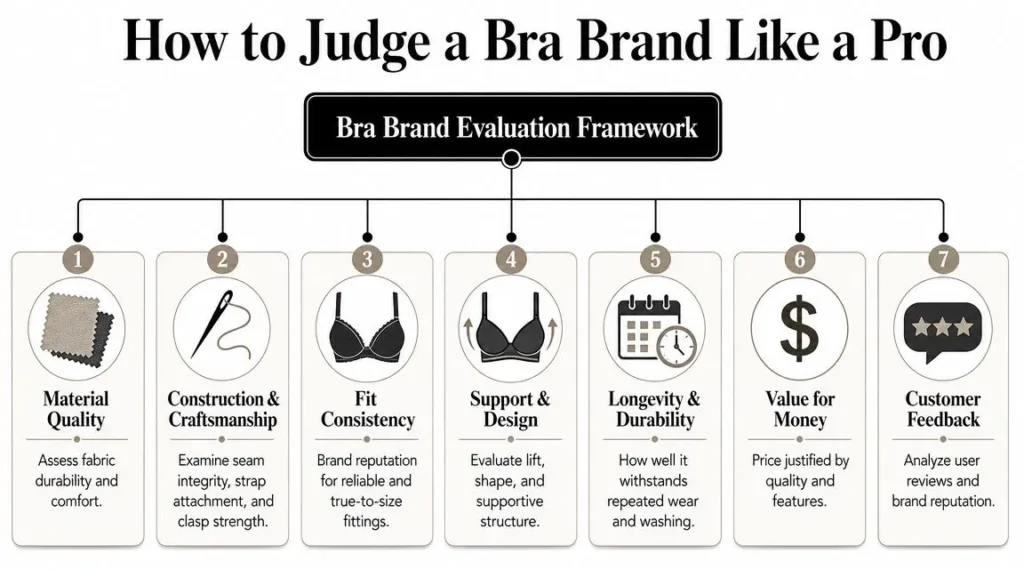
How to Judge a Bra Brand Like a Pro
A good brand earns trust in the details. Not just in campaign images or soft fabric claims, but in how consistently it fits, supports, and survives real wear.
Here’s the visual framework I’d use first.
Start with fit philosophy
Some brands grade sizes thoughtfully. Others scale a base pattern up or down, which often creates strange results in larger or smaller cup ranges. You can usually tell a lot by looking at how a brand describes fit on product pages.
Look for signs that the brand understands shape, not just size:
- Shape guidance: Notes about shallow versus projected fit, full-on-top versus full-on-bottom, or wide-set versus close-set breasts.
- Model variety: Different bust shapes shown in the same product category.
- Practical support language: Explanations of side support, plunge depth, coverage level, and wire height.
Construction tells the truth
Beyond marketing, engineering takes precedence. Bra performance is driven by measurable construction variables, including cup seam placement, band width, and underband elastic specification. For example, a full-bust wireless bra typically needs a 3 to 4 inch underband width plus elastic with at least 35% elongation recovery after 50 wash cycles to avoid progressive loss of lift over wear life, as noted in this technical bra construction overview.
That one detail explains a lot. Many wireless bras feel supportive in the fitting room and lose authority quickly because the underband wasn’t built to hold up over time.
Practical rule: If a wireless bra is meant for fuller busts, inspect the band before you admire the cups. Support starts lower than most people think.
A helpful video can make those details easier to spot in real life.
The seven criteria that matter
I use these seven filters when evaluating any of the best bra brands.
Fit consistency
Does the brand run predictably across styles, or does every bra fit like a different label? Consistency matters if you shop online.Support and design
A bra should match its promise. A lounge bralette doesn’t need the same structure as a high-support everyday bra. But if a brand promises lift, the frame, wing height, band firmness, and cup shape should reflect that.Material quality
Touch matters, but rebound matters more. Soft fabric that stretches out too fast becomes expensive disappointment.Durability
Check clasps, strap attachment points, seam finish, and whether molded cups keep their shape after washing.Style range
The stronger brands offer more than one silhouette. A useful line includes T-shirt bras, balconettes, plunges, wireless options, and at least one solution style.Inclusivity
This includes size range, skin-tone range, and whether the brand designs for different needs rather than adding token options.Value
Cheap bras can be costly if they fail fast. Expensive bras aren’t worth it if they fit beautifully for only one hour.
What sustainability should mean here
Sustainability in bras is tricky because stretch fabrics, elastics, and hardware complicate the picture. I look for brands that are clear about materials, manufacturing, and longevity. Durability is part of sustainability. A bra you wear happily for a long time is better than one you replace in frustration.
If you want a broader lens for evaluating responsible design and materials, this primer on sustainable fashion basics is a useful companion.
Your Guide to Finding the Perfect Bra Fit
Measurements help, but they don’t solve fit by themselves. Two people can measure into the same size and need completely different bras because their breast shape, tissue softness, root width, and torso proportions differ.
The goal isn’t to chase a number. The goal is to recognize what a correct fit feels like on your body.
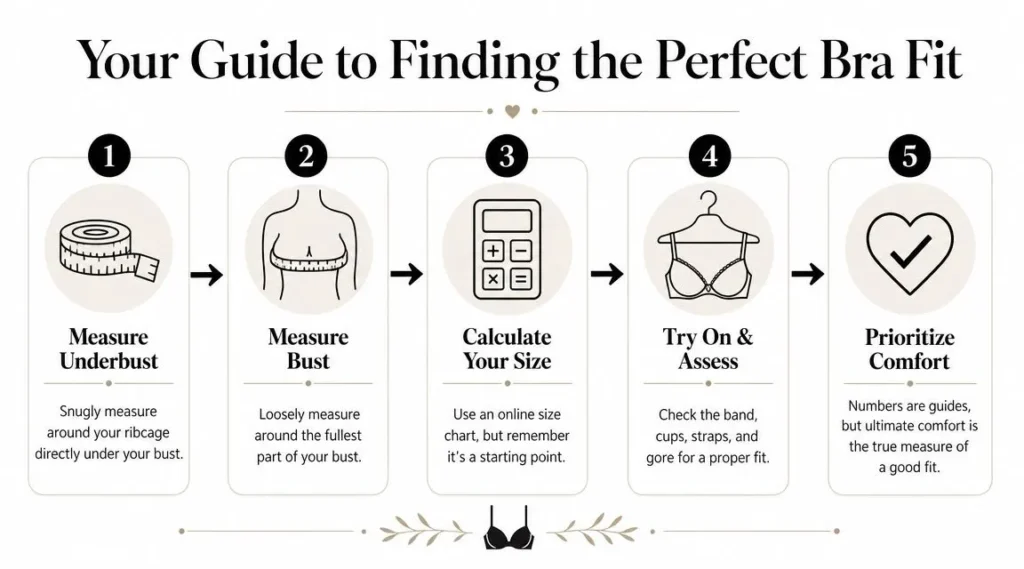
Measure at home, then treat that size as a starting point
Use a soft measuring tape and measure without a padded bra underneath.
Underbust measurement
Wrap the tape snugly around your ribcage directly under your bust. Keep it level.Bust measurement
Measure around the fullest part of the bust without pulling tightly.Use a size chart carefully
Brand charts can point you in a direction, but they can’t account for shape differences.
If you want extra help before ordering online, a guided online bra shopping solution can be useful, especially when you’re comparing several brands with different fit tendencies.
The five-point fit check
Once the bra is on, scoop breast tissue forward from the sides into the cups. Then assess these five areas.
Band
The band should sit level around your torso. It shouldn’t ride up your back or feel loose enough to drift during the day. Most of the support should come from here, not from the straps.
Signs of trouble:
- Band riding up: Usually too loose.
- Painful pressure all around: Possibly too tight, or the bra shape is wrong and forcing tension where it shouldn’t.
- Side wings rolling: Often a mismatch between body softness, band tension, and wing construction.
Cups
Cups should fully contain tissue without cutting in or collapsing.
Watch for:
- Spillage at the top or center: Cup volume may be too small, or the cup shape may be too closed for your fullness.
- Wrinkling or gaping: Cup may be too large, too tall, or too open for your upper fullness.
- Empty space near the apex: Common when a cup is too projected for a shallow shape.
Straps
Straps should stabilize the cup, not do the heavy lifting. If your shoulders carry all the weight, the band isn’t doing its job.
A strap adjustment sweet spot exists. Too loose and the cup shifts. Too tight and the band gets pulled upward in the back.
How to diagnose shape mismatches
This is the part most shoppers never get taught. Fit problems often come from shape mismatch, not size alone.
| Fit problem | What it often means |
|---|---|
| Cup gapes at the top but cuts in elsewhere | Wrong cup shape, often too tall or too open |
| Underwire sits on breast tissue at the sides | Cup too narrow, or your roots are wider than the brand accommodates |
| Center gore floats | Cup too small, breasts are close-set, or the gore is too tall for your shape |
| Bra slides down at the front | Cup too shallow for your projection, or band tension is off |
| Straps fall constantly | Straps set too wide for your shoulders, or cup shape isn’t anchoring well |
If a bra almost fits but keeps failing in the same place, pay attention to the pattern of failure. That pattern usually tells you more than the size tag.
Shape notes that matter in brand selection
You don’t need perfect technical language, but these observations help:
- Shallow breasts: Less forward projection, often need cups that are lower profile and not too deep.
- Projected breasts: Need more depth at the wire and apex so the bra doesn’t push tissue downward or out.
- Narrow roots: Often do better in bras with narrower wires and more centered projection.
- Wide roots: Usually need wider underwires and cups that don’t cut in at the sides.
- Full on top: Need upper cup openness.
- Full on bottom: Often suit balconette or lower-cut upper cup designs, depending on root height.
Comfort is the final test
Try the bra under a real shirt. Sit down. Raise your arms. Walk around. If you feel immediate relief, that matters. If you start negotiating with the bra in the fitting room, leave it behind.
The Best Bra Brands for Every Need in 2026
Brand recommendations only help when they’re tied to a use case and a body type. The strongest options differ depending on whether you need all-day comfort, support for a fuller bust, a smaller-cup specialist, athletic control, or premium finishing.
Top bra brands at a glance
| Category | Top Brand Pick | Best For | Size Range | Price Point |
|---|---|---|---|---|
| Everyday comfort | Natori | Smooth daily wear, shallow to moderately projected shapes | Mid-range to broad, varies by style | Mid to premium |
| Inclusive sizing | Elomi | Fuller busts, projected shapes, strong support | Broad in full-bust categories | Mid to premium |
| Small bust specialist | Pepper | AA to B shoppers, especially frequent cup gaping | Focused small-cup range | Mid |
| Budget-friendly basics | Aerie | Casual comfort, light support, easy basics | Moderate range | Budget to mid |
| High-impact sports | Panache Sport | Strong control for fuller busts during exercise | Broad in sports sizing | Mid to premium |
| Maternity and nursing | Kindred Bravely | Soft changing-body fit, lounge to nursing needs | Broad, especially in soft sizing | Mid |
| Luxury | Simone Pérèle | Refined finishing, elegant shaping, elevated fabrics | Moderate range | Premium |
Everyday comfort brands
Natori
Natori is often excellent for shallow to moderately projected shapes, especially if you like a clean line under clothing and don’t want bulky cup construction. Many of its bras work well for people who say, “I’m not very full on top, and molded bras usually gape on me.”
Where it works:
- Lower-profile busts
- Wider roots
- People who prefer a lighter feel under tops
Where it can miss:
- Very projected busts
- Shoppers who need deeper cups and more centered forward room
Natori also tends to appeal to people building an everyday wardrobe around polished basics rather than heavy-lift lingerie.
Wacoal
Wacoal is one of the more dependable mainstream choices when you want structure without drama. The fit can vary by style, but the brand often balances comfort, smoothing, and support well.
Best for:
- Office dressing
- Mid-range support needs
- People who like practical bras with a finished look
Be selective with cup shape. Some styles run taller in the cup, which can create top-edge emptiness on shorter roots or less upper fullness.
Inclusive sizing and fuller-bust support
Elomi
Elomi is a standout for projected fuller busts, especially when side support and stable bands matter. If many mainstream bras feel too shallow, too flimsy, or too wide in the wrong places, Elomi is often a better direction.
Why it earns a place here:
- Strong support architecture
- Thoughtful fuller-bust engineering
- Better odds of success for projected shapes
It tends to suit:
- Full-bust shoppers
- Softer tissue needing containment
- People who want anchored support, not just compression
Goddess
Goddess is worth considering if your top priority is coverage and stability. It may not be the first choice for someone seeking delicate styling, but it often performs well when practical support is essential.
Best for:
- Full coverage preferences
- Mature shoppers who prioritize comfort and hold
- Everyday support over fashion-led design
A bra doesn’t need to be trendy to be excellent. For many people, the best bra is the one that stays put, feels secure, and lets the rest of the outfit do the talking.
Small bust specialists
Pepper
Pepper is one of the clearest examples of a brand designed around a specific fit complaint: cup gaping on smaller busts. If you wear AA to B cups and regularly find that standard bras wrinkle, stand away from the chest, or feel like they were scaled down from a larger pattern, Pepper is a logical place to start.
Best for:
- Smaller cup sizes
- Shallow shapes
- Less upper fullness
It may be less ideal if you want dramatic lift or if your shape is more projected than many small-cup brands assume.
Skims
Skims can work well for soft everyday basics and body-hugging clothing, particularly if your priority is smoothness and modern neutral tones. The line is broad, but not every style suits every support need.
Best for:
- Loungewear-style comfort
- Smooth appearance under thin knits
- People who want soft structure rather than rigid shaping
Watch for whether a specific style is meant for support or for light comfort. Those are not the same thing.
Budget-friendly picks
Aerie
Aerie is often the easiest entry point if you’re refreshing basics without spending heavily. The brand tends to perform best in casual bras, bralettes, and easy everyday options.
Good match for:
- Light to moderate support needs
- Younger shoppers or anyone rebuilding a bra drawer affordably
- Weekend and casual wear
Less ideal for:
- Very projected busts
- Shoppers who need highly technical support
- People who rely on one bra to work from early morning to late night
Target house brands and department store basics
These can be useful for trend-driven or temporary needs, especially if your size changes frequently. The trade-off is fit consistency. You may find a gem, but you’re less likely to get repeatable results across styles.
High-impact sports bras
Panache Sport
When someone needs a sports bra that controls bounce without flattening everything into one compressed mass, Panache Sport is a strong contender. It’s especially useful for fuller busts that need shape plus hold.
Best for:
- Running and high-impact movement
- Full-bust support
- People who dislike the uniboob effect of some sports bras
Check whether you prefer wired or wireless sports support. Panache offers structure, and that’s a positive for many shoppers, but not everyone wants that feel for workouts.
Shock Absorber
Shock Absorber has long been a go-to for people who want firm athletic control. It usually appeals to shoppers who care more about reducing movement than about softness or fashion styling.
Choose it if:
- Performance is the top priority
- You need a dedicated workout bra
- You’re comfortable with a more locked-in feel
Maternity and nursing
Kindred Bravely
This brand works well when your body is changing and rigid sizing feels unrealistic from week to week. Soft cups, flexible fabrics, and nursing-friendly details make it a practical option for pregnancy, postpartum, and early nursing months.
Best for:
- Size fluctuation
- Comfort-first wear
- Sleep bras and lounge bras
It may not replace a structured underwire bra for everyone, but that’s not always the point in this stage.
Bravado Designs
Bravado is another reliable name for nursing and comfort-driven support. It often suits people who want easy access, soft fabrics, and less complicated daily wear.
Luxury and elevated design
Simone Pérèle
Simone Pérèle is the sort of brand I suggest when someone wants a bra to feel beautiful and technically considered at the same time. The finishing is often refined, and many styles balance elegance with genuine wearability.
Best for:
- Premium everyday bras
- Lighter, refined shaping
- Shoppers who care about fabric hand and finish
Chantelle
Chantelle sits in a similar premium lane, often with polished basics and strong visual restraint. It tends to work for shoppers who want understated luxury rather than overtly decorative lingerie.
A quick decision framework
If you’re not sure where to start, use this filter:
- You’re shallow and often get cup gaping: Start with Pepper or Natori.
- You’re projected and mainstream bras feel too flat: Try Elomi.
- You want easy comfort for casual days: Look at Aerie or Skims.
- You need workout support: Start with Panache Sport.
- You’re pregnant, postpartum, or nursing: Look at Kindred Bravely or Bravado.
- You want premium everyday bras: Explore Simone Pérèle or Chantelle.
The best bra brands reveal themselves faster when you stop asking, “What’s the top brand?” and start asking, “Which brand builds for my shape, my wardrobe, and my tolerance for structure?”
How to Care For Your Bras to Make Them Last
A bra is a piece of engineering, even when it looks delicate. If you wash it harshly, twist it when wet, or throw it in a hot dryer, you wear down the exact features you paid for: elasticity, shape retention, and support.
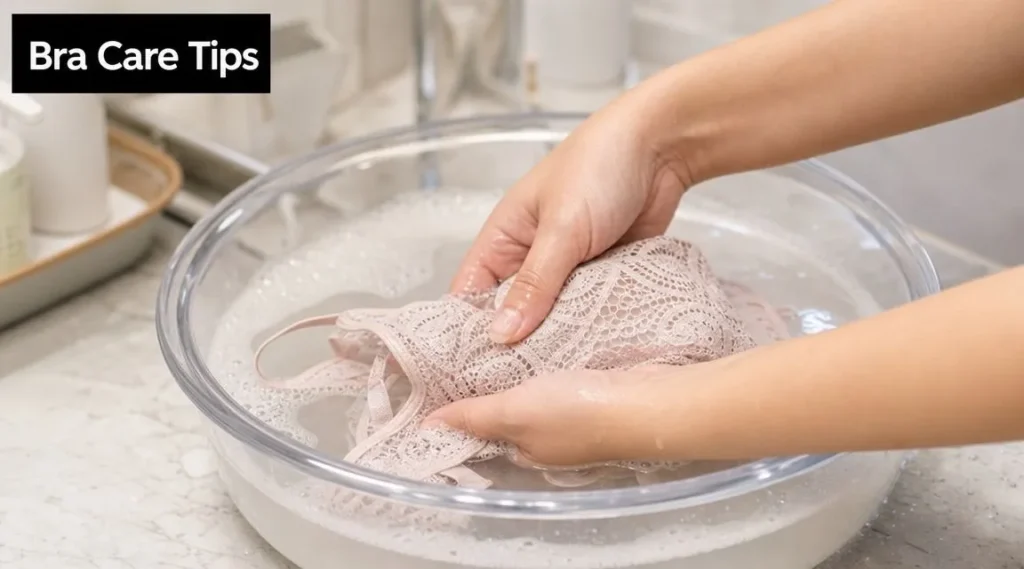
Wash with less force
Hand washing is the gentlest option, especially for underwire, lace, mesh, or molded cups. Use cool or lukewarm water and a mild detergent. Let the bra soak, gently press the water through the fabric, then rinse without wringing.
If you use a machine, at least protect the bra:
- Fasten the hooks: This prevents snagging.
- Use a lingerie bag: It reduces twisting and abrasion.
- Choose a delicate cycle: Less agitation means less stress on elastic and seams.
Never use high heat
Heat is rough on elastic. Air-dry bras flat or hang them from the center gore, not by one strap. Dryers shorten the life of bands and can warp molded cups.
Store them like they matter
For molded or padded bras, stack the cups inside each other instead of folding one cup into the other. That keeps the cup shape intact. For soft bras and bralettes, a neat drawer fold works fine.
The fastest way to ruin a good bra is to treat it like a T-shirt. The fabrics may feel soft, but the support system is precise.
A small care routine keeps your favorites supportive longer and makes expensive bras feel like smarter purchases.
Where to Find the Best Bra Deals
The best place to shop depends on what stage you’re in. If you’re still figuring out shape and sizing, in-person help can save you from buying the wrong five bras online. If you already know your favorite styles, online shopping usually gives you more choice and better price tracking.
The main shopping channels
- Brand websites: Best for full size runs, new color drops, and style details. They’re useful when you already know the brand fits you.
- Large online retailers: Good for comparison shopping across brands, especially if you want to test several fit philosophies at once.
- Department stores: Handy for mainstream brands and trying on multiple silhouettes in one trip.
- Specialty boutiques: Often the best source of fit knowledge, especially for fuller busts, hard-to-find sizes, and shape-specific advice.
When to buy
Semi-annual sales, end-of-season color markdowns, and holiday promotions are often the smartest times to buy. If you find a bra that fits exceptionally well, buying a second color during a sale is usually wiser than gambling on a different style later.
If you’re comparing stores before you buy, a broader guide to the best places to shop can help you think through selection, service, and value.
Frequently Asked Bra Questions
How often should I replace my bras?
Replace them when they stop doing their job. If the band has gone slack, the cups have lost shape, the straps no longer stay adjusted, or the underwire shifts and pokes, the bra is past its useful life. Rotation and care matter as much as time.
Is it unhealthy to wear an underwire bra all day?
Generally, no. The issue isn’t underwire by itself. The issue is a poorly fitted underwire. If the wire sits on breast tissue, presses painfully, or leaves you desperate to remove the bra after an hour, the fit is wrong.
Can I wear a sports bra every day?
Yes, if it’s comfortable and suits your needs. But many sports bras compress more, breathe differently, and create a different silhouette under clothes than an everyday bra. A high-impact sports bra can feel excessive for desk days.
How many bras do I actually need?
Enough to rotate without overworking one favorite. A small functional drawer often includes:
- An everyday smooth bra
- A second everyday option in a different outfit color
- A comfort bra or bralette
- A sports bra if you exercise
- A special-occasion solution bra if your wardrobe needs one
Why do straps keep falling down?
Usually one of three reasons. The straps are set too wide for your shoulders, the band is too loose, or the cup shape isn’t anchoring correctly. Tightening the straps can hide the issue for a while, but it often doesn’t solve it.
What if one breast is larger than the other?
That’s common. Fit the larger side first. If needed, tighten one strap slightly more, use removable inserts on the smaller side, or choose stretch-lace cups that adapt better to asymmetry.
If you enjoy practical, readable guides like this one, explore more fashion, lifestyle, and culture writing at Maxi Journal. It’s a good place to keep reading when you want advice that’s clear, useful, and easy to live with.
Discover more from Maxi Journal
Subscribe to get the latest posts sent to your email.