You’re probably here because you saw a trailer, caught a headline, or heard someone mention a new movie about time travel and wanted the quick answer: what is this thing, and what kind of night at the movies is it going to be?
That’s the right question. With time-travel stories, the premise alone rarely tells you enough. One film uses time travel for brain-twisting puzzles. Another uses it for romance, satire, or chaos. And sometimes a movie gets labeled “time travel” when the actual experience is closer to a pressure-cooker thriller with a sci-fi hook.
The Next Big Time Travel Movie Arrives
A stranger walks into a Los Angeles diner. He says he’s from the future. Then he takes the place hostage because he needs help to save the world.
That setup belongs to Good Luck, Have Fun, Don’t Die, which trailer coverage describes as a story about a man claiming to be from the future who takes a Los Angeles diner hostage to recruit helpers to save the world, making it a blend of thriller, comedy, and sci-fi according to Bleeding Cool’s trailer write-up.
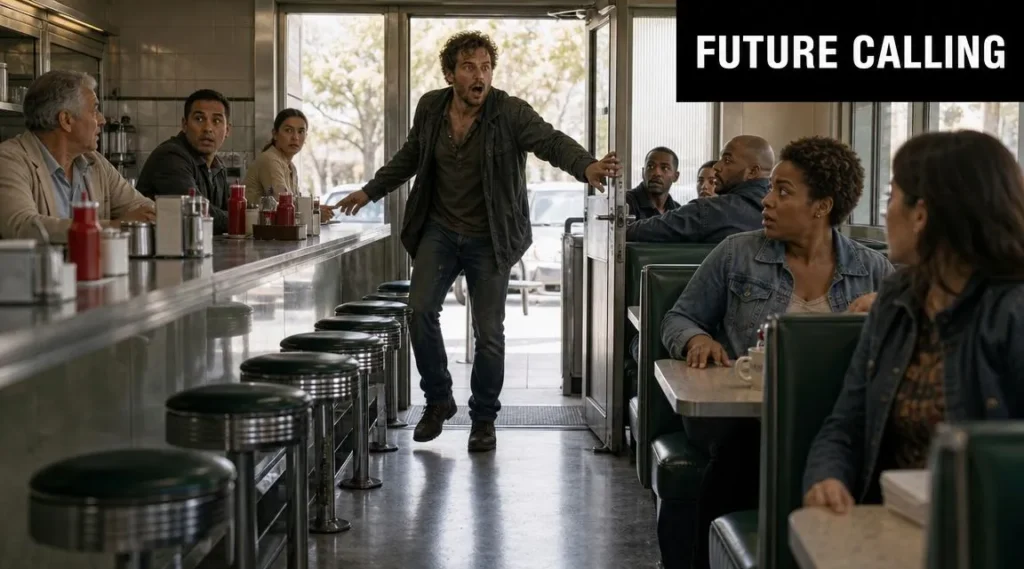
That description matters more than it may seem. A lot of people search for a new movie about time travel expecting a sleek puzzle-box story. Others want jokes, velocity, and a few reality-bending twists. This movie’s premise suggests it may live in a more combustible space where genre friction is the whole appeal.
Why the premise stands out
A diner is a great movie setting because it’s ordinary. It’s public, cramped, and full of strangers with different temperaments. Add one man with a future-war pitch and the room changes instantly. Nobody knows whether to laugh, panic, or listen.
That uncertainty is the engine.
Practical rule: When a time-travel movie traps characters in one location before it expands outward, it usually wants you to feel tension first and explanation second.
This is why the film already feels distinct from many time-travel stories. The hook isn’t just “someone can move through time.” The hook is “what happens when a desperate future claim collides with ordinary people in a situation that could turn absurd or dangerous at any second?”
The real question audiences are asking
The most useful way to approach this film isn’t “What’s the timeline logic?” at least not at first. It’s this:
- If you like thrillers, does the hostage setup have real pressure?
- If you like comedies, are the characters and reactions the source of the laughs?
- If you like sci-fi, does the future-saving premise create meaningful stakes?
That’s why this guide treats the movie as more than a premise summary. The key to understanding Good Luck, Have Fun, Don’t Die is understanding its tone.
Plot Synopsis and Release Details
At the broadest level, the story is easy to grasp. A man says he’s from the future. He needs help. He corners a group of people in a Los Angeles diner and pushes them into a crisis they didn’t ask for.
That’s a strong spoiler-free setup because it gives you the movie’s central tension without flattening it into pure sci-fi exposition. The conflict seems to come from two questions running side by side: is this man telling the truth, and what happens if he is?
What the movie appears to be about
The diner setting suggests an ensemble dynamic. Instead of following a lone genius in a lab or a trained operative with specialized knowledge, the movie appears to recruit regular people into a high-concept emergency. That often creates a more accessible kind of time-travel story because the audience learns alongside the characters.
A good way to think about the setup is that the film seems to use time travel as an instigator rather than as wallpaper. The future claim doesn’t sit in the background. It forces immediate choices, alliances, and suspicion.
Here’s the spoiler-free shape of the premise:
- A future warning arrives in the present. The claim alone destabilizes the room.
- A hostage scenario creates urgency. People can’t walk away and process the information later.
- Recruitment is part of the conflict. The mission isn’t only escape. It’s persuasion.
The interesting tension isn’t only whether the future can be changed. It’s whether anyone in the present is willing to believe the person making that demand.
What we can confirm and what we can’t
The available description gives a vivid premise and a clear genre blend. What it does not confirm here are precise release-date details, platform availability, or a verified theatrical versus streaming timetable from the approved fact set.
So if you’re looking for exact watch information, the safest answer is simple: check the latest official listings before making plans. At this stage, it’s more responsible to stay qualitative than to guess.
A practical viewing checklist helps:
| Question | Best takeaway right now |
|---|---|
| Is it a time-travel movie? | Yes, but with a hostage-thriller frame |
| Is it only sci-fi? | No, it appears to blend comedy, suspense, and sci-fi |
| Is the setup spoiler-heavy? | Not yet. The core hook is the main public-facing premise |
| Can we confirm release platforms here? | No exact platform details are verified in the approved source set |
Who this setup is likely to work for
This premise should appeal to viewers who like contained chaos. If you enjoy stories where one impossible claim forces every character to reveal what they believe, fear, or hide, this film looks promising.
It may be less ideal for someone who wants a purely technical time-travel story from scene one. The opening promise feels more behavioral than mechanical. People are trapped together. Someone claims impossible knowledge. The movie’s first job is likely to make that clash entertaining.
Meet the Cast and Creative Team
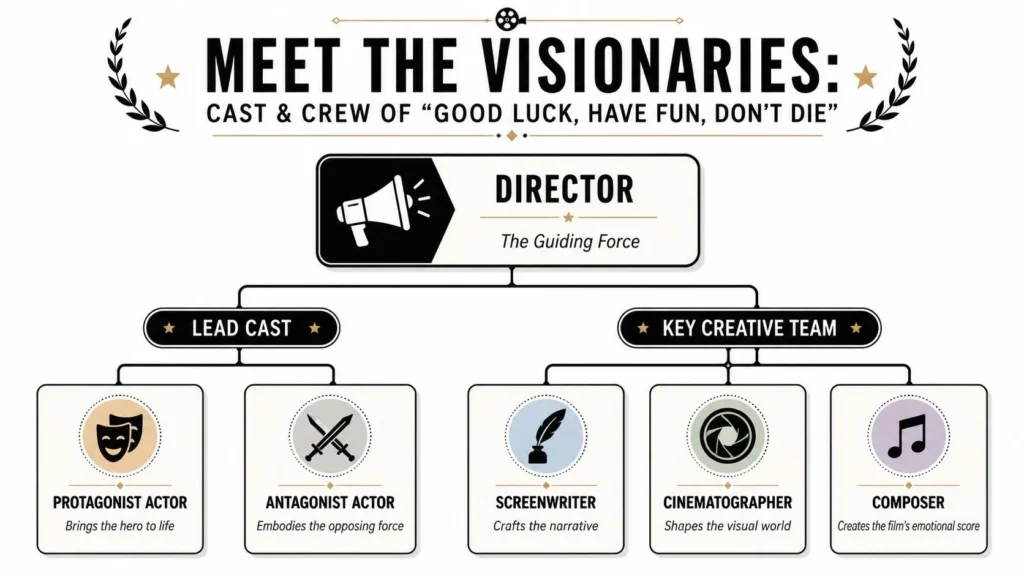
The hardest part of discussing the cast and crew here is staying honest about what’s verified. The approved information set for this article does not confirm a full cast list, director profile, or crew breakdown for Good Luck, Have Fun, Don’t Die. So rather than pretend otherwise, it’s better to talk about what kind of creative challenge this material demands.
A film with this premise needs performers who can pivot quickly. One scene may ask for dread, the next for disbelief, the next for comic timing. That’s harder than it sounds. In a movie like this, weak casting would flatten the whole concept because the audience has to buy several tones at once.
What the actors have to carry
This kind of story usually places unusual pressure on a few key roles:
- The future claimant has to be persuasive enough that you don’t dismiss him immediately, but unstable enough that the room stays on edge.
- The skeptics need to ground the film. They ask the questions the audience would ask.
- The reluctant believers often create the emotional bridge, because they move from resistance to investment.
That structure is common in confined sci-fi thrillers. The cast can’t just “deliver lines.” They have to sell changing levels of trust.
Why the crew matters even more in a concept film
A genre blend works when the filmmaking choices all point in the same direction. The screenplay has to control information. The cinematography has to decide whether the diner feels cozy, absurd, or threatening. The score has to know when to tighten suspense and when to release it.
If you’re curious about how filmmakers package and finance high-concept projects like this before cameras even roll, a useful outside reference is this guide on film project funding. It helps explain why a clear hook matters so much when a movie depends on tone and concept from the start.
A strong soundtrack also matters in movies that juggle suspense and humor. If you enjoy paying attention to how music changes your reading of a scene, this feature on the best soundtracks in movies adds good context for what composers can do in genre hybrids.
A useful comparison point
One illuminating contrast is Primer, identified by Wikipedia’s overview of the film) as a 2004 American independent science fiction movie written, directed, produced, edited, and scored by Shane Carruth in his feature debut, with a plot centered on the accidental discovery of time travel. That level of single-creator control fits its stripped-down, engineering-minded style.
The reason that comparison helps is simple. Some time-travel films emphasize mechanism above all else. Others emphasize performance pressure, group dynamics, and mood. Good Luck, Have Fun, Don’t Die appears, from its premise, to lean toward the second category.
How the Time Travel Works in This Universe
If you’ve ever left a time-travel movie saying, “Wait, so could they change anything?” you’re not alone. Most confusion comes from the fact that different movies use different rules.
One of the cleanest ways to sort them comes from a widely circulated explainer that breaks time-travel stories into three models: the multiverse timeline, the dynamic timeline, and the fixed timeline, with 2009’s Star Trek used as an example of the multiverse approach in the film explainer on YouTube. That framework helps audiences understand whether a story treats the past as changeable, resistant, or already locked in.
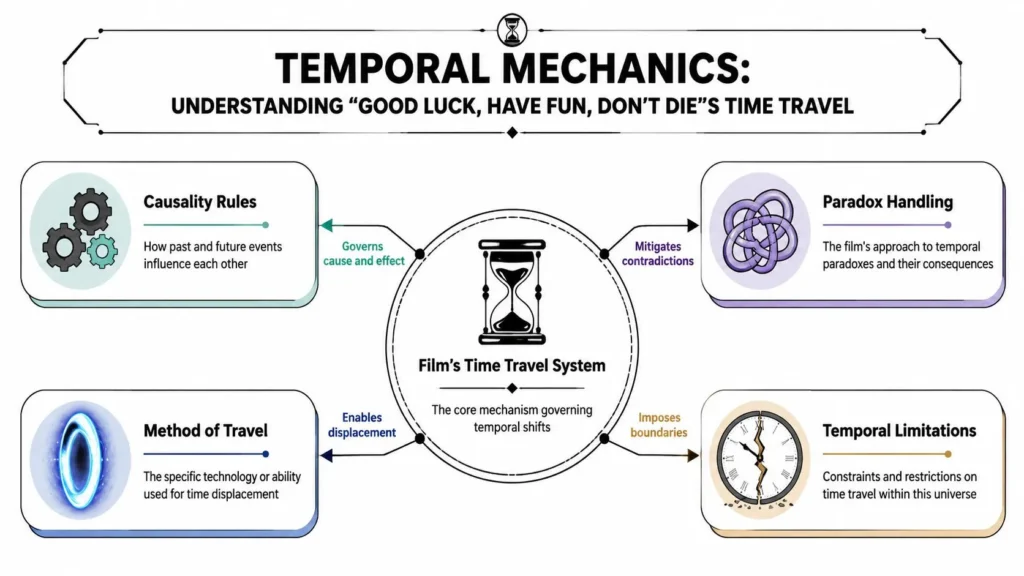
The three models in plain English
Here’s the simple version:
| Model | Basic idea | What it feels like in a movie |
|---|---|---|
| Multiverse timeline | Changing the past creates or reveals another branch | Consequences are big, but the original line may still exist |
| Dynamic timeline | Change the past, and the future rewrites itself | Every choice can trigger ripple effects |
| Fixed timeline | Events are already part of one closed loop | Attempts to change things may actually fulfill them |
For viewers, the practical difference is emotional. A dynamic timeline creates anxiety because small actions can spiral. A fixed timeline creates irony because escape may be impossible. A multiverse model creates room for alternate outcomes without erasing everything.
Which model seems most likely here
Based on the hostage-recruitment premise alone, Good Luck, Have Fun, Don’t Die seems most compatible with either a dynamic timeline or a multiverse timeline.
Why not fixed timeline first? Because the story hook depends on urgency and intervention. A man from the future is not merely observing events. He’s trying to recruit help to save the world. That implies action matters. If the film wants that mission to feel live and dangerous, it likely needs some version of changeability.
Working theory: The movie appears to treat the future as threatened, not merely foretold.
That doesn’t prove the exact mechanics. But it does help set expectations. If the characters are being recruited rather than informed, the plot probably wants choices to have consequences.
A broader philosophical companion to this kind of question is the idea of reality itself as a constructed system. If that angle interests you, this article on whether our universe is a simulation offers an accessible side path into similar thought experiments.
Why the rules matter to the viewing experience
Time-travel rules aren’t just nerd trivia. They shape suspense.
A dynamic model makes every decision feel dangerous. A fixed model turns suspense into tragic inevitability. A multiverse model often shifts the story toward identity, sacrifice, and alternate outcomes.
Here’s a useful visual explainer if you want a quick primer before watching:
One caution before overthinking it
Not every movie wants to be solved like a math problem. Some films use time travel less as a scientific system and more as a pressure device. In this case, the diner situation may be just as important as the temporal logic.
So the best approach is balanced. Watch for the rules, but also watch how the movie uses those rules to stress, trap, and transform the characters.
Analyzing the Film’s Unique Genre Blend
The most interesting thing about Good Luck, Have Fun, Don’t Die may be that it doesn’t sound like a “pure” time-travel movie at all. It sounds like a movie where time travel detonates inside another structure.
That structure is the hostage thriller.
A hostage thriller works by restricting movement, compressing time, and forcing social roles to change quickly. A comedy works by misalignment, surprise, and personality clashes. Sci-fi adds the destabilizing idea. Put all three together, and the viewing experience can become deliciously unstable in the best way.
Why the hostage element changes everything
If the film were only about a man from the future seeking help, it might play like quirky sci-fi. The hostage element changes the emotional grammar. It means the audience can’t settle into amused curiosity. Every scene now carries coercion.
That does two smart things at once:
- It gives the comedy an edge, because jokes land differently under pressure.
- It gives the sci-fi premise a body, because belief now has immediate consequences.
A person saying “the world must be saved” can sound grandiose in an open setting. In a locked room, that same claim becomes confrontational.
How comedy can survive inside suspense
Comedy in genre hybrids often comes from reaction, not punch lines. People deny what they’re seeing. They misread each other. They cling to petty concerns while the plot becomes outrageous. That’s fertile ground here.
The diner setup invites exactly those responses. One person may think the future man is delusional. Another may think he’s dangerous. Another may believe him for reasons nobody else understands. The humor can emerge from that mismatch without deflating the stakes.
The strongest genre blends don’t switch masks from scene to scene. They let the same scene be funny and tense at the same time.
That’s the sweet spot this movie seems to be chasing.
What kind of Friday-night movie does this sound like
If you’re choosing based on mood, this breakdown helps:
| If you want… | This movie may offer… |
|---|---|
| Cerebral sci-fi first | Possibly, but not as the only flavor |
| A tense single-location setup | Very likely |
| Character-driven comedy under stress | Also likely |
| Big spectacle over contained pressure | Probably not the main appeal |
That last point is important. A lot of audiences searching for a new movie about time travel are really searching for a vibe. This one looks less like a cosmic lecture and more like a pressure chamber with a sci-fi fuse.
The best way to watch it
Go in ready for tonal movement. Don’t demand that every moment obey one genre’s expectations. If the film works, it will ask you to laugh, doubt, and brace yourself in quick succession.
That kind of balance is hard to pull off. But when filmmakers get it right, the result feels fresher than a standard time-loop or paradox puzzle.
What Critics and Audiences Are Saying
At the moment, the verified material available here doesn’t provide a confirmed round-up of published reviews, aggregate scores, or direct critic quotations for Good Luck, Have Fun, Don’t Die. So the most accurate thing to say is that broad reception should be read cautiously until a fuller body of reviews is available.
That said, the public-facing premise already suggests the key fault lines that critics and audiences are likely to focus on. With a movie like this, responses usually turn on tone management. If the thriller side dominates too heavily, the comedy may feel stranded. If the jokes are too broad, the hostage setup may stop feeling urgent.
The likely points of debate
Viewers tend to split on genre hybrids for a few repeat reasons:
- Tone tolerance: Some people love abrupt shifts between danger and humor. Others find them distracting.
- Rule clarity: Sci-fi fans often want internal consistency, even in playful films.
- Character buy-in: The whole movie rises or falls on whether the trapped characters react in believable ways.
Those are good lenses to keep in mind when reading later reviews. They’ll tell you more than a simple thumbs-up or thumbs-down verdict.
Where to check responses intelligently
If you want broader context once more reviews are published, it helps to compare professional criticism with audience reactions instead of relying on one stream alone. A practical starting point is this overview of best movie review websites, which can help you sort through different review styles and priorities.
Some critics judge a time-travel movie by its logic. Many audiences judge it by momentum, cast chemistry, and whether they had a good time getting lost in it.
That difference matters. A film can divide reviewers while still finding a devoted audience if its voice is specific enough. And a premise as odd as this one almost invites that kind of split.
A sensible expectation
For now, it’s wisest to treat the early buzz qualitatively. Expect conversation around whether the film is really a time-travel movie, a hostage thriller with a sci-fi trigger, or a comedy that uses both. That debate isn’t a weakness. It may be the clearest sign that the movie has an identity.
More Time Travel Movies to Watch Next
If this film leaves you wanting more temporal chaos, the best follow-up depends on what exactly you enjoyed. Some viewers want more comedy. Others want denser mechanics. Others want another story where time travel disrupts ordinary life instead of arriving with glossy grandeur.
If you want comic confusion
The easiest recommendation is Frequently Asked Questions About Time Travel. According to Wikipedia’s film entry, it’s a 2009 British science-fiction comedy directed by Gareth Carrivick, written by Jamie Mathieson, starring Chris O’Dowd, Dean Lennox Kelly, Marc Wootton, and Anna Faris, and it runs 83 minutes. Its story follows three friends in a pub who encounter a visitor from the future.
That premise makes it a great companion piece. Both films seem interested in what happens when time travel crashes into an ordinary social setting. One uses a pub. The other uses a diner. In both cases, the fun comes from everyday people colliding with impossible information.
If you want hard mechanics instead
Go with Primer. It has a reputation for treating time travel like a process problem rather than a spectacle. The appeal isn’t flashy action. It’s the sense that you’re watching smart people get in over their heads because they can’t fully control what they’ve touched.
That makes it a useful contrast. If Good Luck, Have Fun, Don’t Die gives you the taste for causality puzzles after delivering a more socially chaotic ride, Primer is the next logical stop.
If you want a fixed interval premise
Another interesting title is RELIVE, whose trailer materials describe a protagonist who can travel back 20 years to a post-college hiking trip in an attempt to stop the man who will later develop time travel, as described in the film trailer on YouTube. That defined backward jump creates a very different kind of tension from a hostage-thriller setup.
In simple terms, RELIVE sounds more constrained by cause and effect across two separated time states, while Good Luck, Have Fun, Don’t Die appears more driven by immediate social danger and genre volatility.
How to pick your next watch
Use this quick guide:
- Loved the ordinary-setting chaos? Choose Frequently Asked Questions About Time Travel.
- Wanted denser logic and fewer tonal swings? Try Primer.
- Interested in a mission built around a specific temporal limit? Go with RELIVE.
If you’re the kind of viewer who likes exploring recommendation rabbit holes and creative discovery tools around entertainment, the writing and resources at LunaBloom AI tools are worth browsing for inspiration.
The larger lesson is that “time-travel movie” isn’t one flavor. It’s a shelf full of very different experiences. Some are comic. Some are severe. Some are built like diagrams. Others are built like social detonations. Good Luck, Have Fun, Don’t Die looks exciting because it may belong to that last category.
If you enjoy clear, approachable takes on movies, science, culture, and more, visit maxijournal.com for fresh reading across entertainment and beyond.
Discover more from Maxi Journal
Subscribe to get the latest posts sent to your email.