Most advice about the best gadgets for women still makes the same lazy mistake. It treats women as a marketing segment first and actual users second.
That’s how you get endless lists of pastel earbuds, gold-trimmed phone cases, and “cute” desk accessories that look good in a gift guide but solve almost nothing. A gadget doesn’t become useful because it comes in rose gold. It becomes useful when it removes friction from real life. Better sleep. Safer travel. Less strain during long workdays. Faster recovery. Easier focus.
The smarter way to shop is to ignore the label and inspect the fit. Not just physical fit, though that matters. Lifestyle fit matters more. The best tech earns its place by working with the rhythms of a person’s day instead of asking for more maintenance, more charging, more syncing, and more patience.
That matters even more in a category marketed “for women,” because women often get sold aesthetics where they need function, or generic function where they need more thoughtful design. The gap is obvious once you start looking closely. A smartwatch that tracks health well is different from one that buries useful features in a bloated app. A compact safety gadget is different from a bulky object that gets left at home. A wellness device can be supportive, or it can become one more task.
Beyond Simply Pink Gadgets
A gadget does not become better for women because it comes in blush tones and a smaller box. It becomes better when it fits the body, the bag, the schedule, and the level of effort someone is willing to spend keeping it charged, synced, and updated.
That standard sounds obvious, but plenty of products still miss it. The weak ones treat women as an aesthetic category. The useful ones address recurring friction. A personal safety device has to be easy to reach with one hand. A wearable has to sit comfortably on smaller wrists without giving up battery life or readable data. A desk accessory has to reduce strain, not add visual clutter.
Wearables show the shift clearly. Analysts at Statista track the category here: Statista’s wearable technology market data. The bigger point matters more than any single number. Women are active buyers in categories that solve real problems, especially health, safety, sleep, and daily organization.
A practical filter helps. Skip any product page that leads with color, engraving, or “feminine design” before it explains comfort, durability, battery life, app quality, and how the device behaves in real use. Connectivity matters too. Gadgets that depend on constant syncing or location features only feel useful if the wireless experience is reliable, which is why a basic grasp of how 5G affects connected devices in daily use can make shopping a lot easier.
I keep coming back to the same question during testing: does this device earn space in a crowded bag or on a crowded nightstand? Many do not. Some are too bulky to carry consistently. Some ask for too much setup. Some collect health data well but hide the useful parts behind a messy app. Those trade-offs matter more than the packaging.
The best products in this category usually combine restraint with good design. One watch that tracks sleep, movement, and health trends can replace a drawer full of single-purpose wellness gadgets. One compact tracker or alarm can do more for day-to-day safety than a larger device that gets left at home.
That is the standard here. Real use first. Everything else second.
Defining Modern Tech for Women

The useful definition is simple. Modern tech for women is tech that fits a real body, a real routine, and a real tolerance for complexity.
That sounds obvious, but product marketing often treats these as separate concerns. They’re not. The jacket analogy works well here. A well-fitted jacket supports how you move and feels natural after a minute. A one-size poncho technically covers you, but it never quite fits, and you spend the day adjusting it. Plenty of gadgets are ponchos.
Problem-solving comes first
The first test is direct. Does the gadget solve an actual recurring problem?
That could mean sleep disruption, commute stress, chaotic cords in a travel bag, poor desk posture, or the mental clutter that comes from juggling work and home logistics. The strongest products are specific. A sleep device should improve a wind-down routine. A travel tracker should reduce the chance of losing essentials. A wearable should present data that changes behavior, not just decorate a dashboard.
This is also why broader technology literacy matters. Understanding how connectivity affects everyday gadgets helps buyers sort lasting value from hype. A solid explainer on how 5G technology works is useful context when you’re evaluating wearables, smart home accessories, and connected health devices that rely on stable syncing.
Seamless integration beats feature overload
A gadget can be powerful and still be a bad fit.
Many devices fail not because the hardware is weak, but because the product asks too much from the user. Too many companion apps. Too many alerts. Too much charging. Too much setup. The best consumer tech disappears into routine after the first week.
Here’s a practical way to judge that:
| Question | Good sign | Red flag |
|---|---|---|
| Does it save time? | It replaces steps you already do | It adds a ritual you’ll skip |
| Is the app clear? | Core features are easy to find | Menus feel like software homework |
| Will you carry or wear it? | Comfortable, compact, discreet | Bulky enough to leave behind |
| Does it age well? | Useful even after novelty fades | Fun for three days, then drawer-bound |
Good gadgets reduce decisions. Bad gadgets create new ones.
Inclusive design is not a bonus
The third pillar is inclusive design. This includes ergonomics, interface clarity, sizing, weight, materials, and visual restraint. It also includes how a device looks in a bedroom, office, or handbag. People live with products, not just specifications.
That’s why the best gadgets for women often aren’t the ones labeled that way. They’re the ones designed with enough care that more people can use them comfortably. Good design respects variation. Wrist sizes vary. Grip comfort varies. Sensory tolerance varies. Workspaces vary. So do ideas of what looks good on a nightstand or clipped inside a tote.
A gadget doesn’t need “for women” on the box to work beautifully for women. It needs to be competent, considerate, and easy to keep in your life.
Exploring Key Gadget Categories
Categories matter less than the problem they solve. That is the useful way to sort this market.
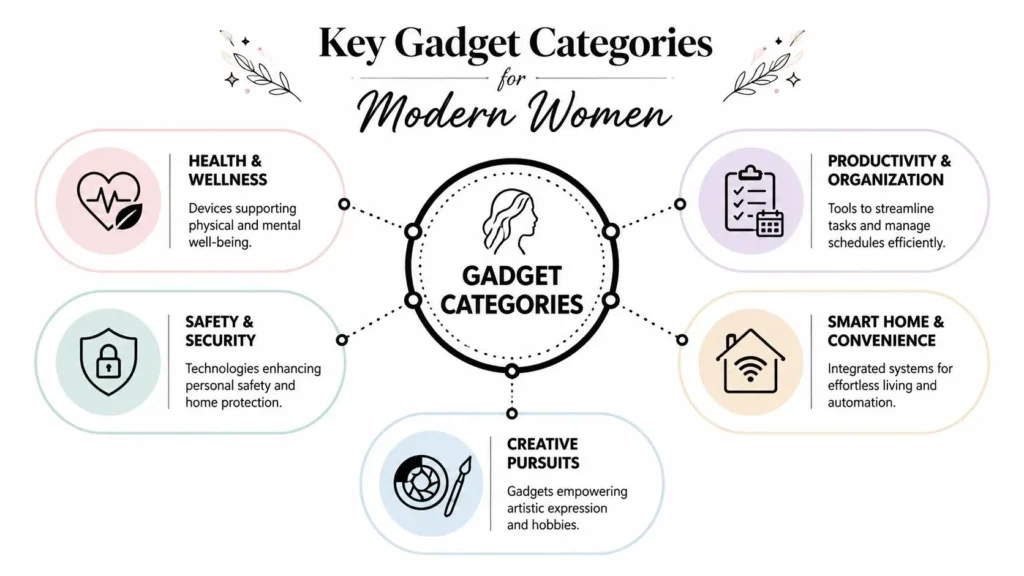
Health and wellness tech
Health tech earns its place when it changes behavior, not when it produces more charts. The strongest devices reduce guesswork around sleep, stress, movement, and cycle patterns, then fit into a routine without demanding too much attention.
Wearables remain the clearest example. Smartwatches and rings work well because they can collect signals passively while staying physically manageable for all-day use. The trade-offs are real. Watches usually give faster interaction and better notifications, but they can feel bulky on smaller wrists and too visible with dressier clothes. Rings are more discreet, yet they can be sensitive to sizing changes, hand swelling, and comfort during workouts or typing.
Sleep devices are useful when the actual problem is poor wind-down structure, not just waking up late. A bedside device that combines light and sound can help people who struggle to separate work, scrolling, and rest. Claims about biometric precision vary widely by product, so the safer test is practical. Does it help someone fall asleep earlier, wake more consistently, or keep the phone off the nightstand? If not, it is probably an expensive lamp.
More clinical wellness devices belong in a narrower category. Products aimed at nervous system regulation, migraine support, or guided stimulation can be helpful for specific users, but they are not casual gift picks. They make sense only when the user understands the intended use, the upkeep, and the limits. That is a very different buying decision from purchasing a general wellness wearable.
Good wellness tech supports a habit. It does not try to become one.
Beauty and skincare tech
Beauty gadgets are easy to oversell because the before-and-after promise is so marketable. In practice, the best tools do one of two jobs well. They improve consistency, or they add information that changes what someone does next.
LED masks, cleansing brushes, and skin imaging tools can all fit that standard, but only if the routine around them is realistic. Session length matters. Cleaning matters. Storage matters. A device that needs careful sanitizing, charging, and a long treatment window has to deliver obvious value or it will sit in a drawer.
Ergonomics matter here more than brands often admit. A mask that feels heavy on the bridge of the nose, a handle that gets slippery with cleanser, or an interface that requires squinting through tiny icons will ruin repeat use. Beauty tech works best when it respects tired evenings, limited counter space, and bare-minimum patience.
Smart travel and safety gear
This category solves stress fast, which is why it stays relevant. The best products reduce the chance of a small problem turning into a bad night, a missed train, or a frantic search through a tote bag.
Tracking tags, compact flashlights, portable chargers, personal alarms, and well-designed power accessories all fit here. What matters is reliability under pressure. Pairing should be simple. Alerts should be clear. Buttons should be easy to find without looking. If a safety device needs a tutorial every time it comes out of a bag, it misses the point.
Battery quality also matters more than shoppers expect. Power banks and rechargeable safety tools live or die by charge retention, heat management, and long-term durability. If you are comparing those products, it helps to understand the basics of lithium battery performance and charging behavior, because battery chemistry affects how portable a gadget really is over months of use.
Productivity and focus tools
Useful productivity tech removes friction from attention. It does not add another screen.
E-ink note devices, compact mechanical keyboards, focused desk lamps, timers, and noise-control gear can all earn their place if they reduce task switching or visual clutter. The key question is whether the device protects concentration better than a phone or laptop already can. Many do not. A dedicated tool has to justify its footprint.
Shared spaces change this category too. Plenty of people work at a kitchen table, a bedroom desk, or a vanity that doubles as an office. In those setups, appearance is not trivial. A productive workspace has to be livable. Devices with calmer materials, quieter lighting, and simpler controls often get used more because they do not make the room feel like a temporary tech lab.
Smart jewelry and creative gadgets
These categories are more personal, but they are not frivolous. They serve different kinds of needs.
Smart jewelry suits people who want passive tracking, gentle alerts, or a more discreet form factor than a watch. That can matter for comfort, style, and professional settings where a bright screen feels intrusive. The compromise is usually interface quality. Smaller devices often depend heavily on the app, so weak software can ruin otherwise elegant hardware.
Creative gadgets earn their place differently. Instant printers, compact cameras, mobile microphones, and portable audio tools help people capture, make, and share things they care about. That is practical value, even if it does not look like productivity on a spec sheet. If a gadget makes creative work easier to start and easier to keep doing, it belongs in the conversation.
How to Choose the Right Gadget for Your Life
A useful gadget should solve a recurring problem, not sell an identity. That sounds obvious, but plenty of smart-looking products still get bought for an imagined routine instead of an actual one.
Check the life-load
Before comparing specs, check the device’s life-load. I use that term for the total maintenance cost of ownership. Charging, cleaning, syncing, updating, storing, replacing attachments, and remembering where the app lives all count.
This matters more than brands usually admit. A facial tool that works only after careful prep and frequent charging may be effective, but it still loses to a simpler device that gets used three times a week instead of once a month.
Run through a quick filter:
- Charging burden. Does it need frequent charging, and will that fit your routine?
- App dependence. If the app disappeared tomorrow, would the hardware still do something useful?
- Setup friction. Can you start in minutes, or is there a long learning curve?
- Cleaning reality. If it touches skin, fabric, or food, upkeep will decide whether it sticks around.
- Storage footprint. If it does not fit your nightstand, tote, or desk naturally, habit usually breaks.
A higher-maintenance gadget can still be worth it. It just needs to repay that effort clearly.
Put ergonomics on the shortlist
A lot of “for women” tech coverage still gets the category wrong. The better question is not whether a product is pink, pretty, or marketed with soft lighting. It is whether it fits the body, the room, and the routine of the person using it.
That is why ergonomics belongs near the top of the checklist. Smaller hands, narrower shoulders, different wrist angles, longer hair, lighter clothing fabrics, and bag size all affect how a device feels in daily use. A keyboard, wearable, massager, bike accessory, or portable safety tool can be technically good and still be annoying to use if the fit is off.
Trend coverage has also started to connect wellness devices with home-office design and everyday usability, including reporting from trend analysts tracking health-tech and workspace product shifts. That direction makes sense. People do not use gadgets in isolation. They use them at kitchen counters, shared desks, bedside tables, and on commutes.
Here’s the standard I use:
If a gadget touches your body, your bag, or your workspace every day, fit matters as much as features.
Look for adjustability, weight, button placement, strap comfort, grip texture, cable length, and whether the product works across different clothing and room setups. Those details decide whether the device becomes part of life or ends up in a drawer.
Privacy is part of the product
Health and safety tech asks for trust. A device that collects cycle data, sleep patterns, heart rate, or location history should be judged on data handling as seriously as battery life.
You do not need to read every privacy policy line by line. You do need answers to a few plain questions.
| What to ask | Why it matters |
|---|---|
| What data does it collect? | You should know the scope before syncing |
| Can you use it without sharing everything? | Optional sharing gives you more control |
| Can you export or delete your data? | Lock-in is a hidden cost |
| Does the gadget still work if cloud features change? | Long-term usefulness matters |
If you want a sharper filter for product coverage before buying, it helps to follow a few tech news sites that separate useful devices from launch-day hype.
A short visual explainer can also help clarify how to evaluate device fit and digital habits before you buy:
Buy for the boring days
The strongest test is simple. Will the gadget still help on an ordinary Wednesday?
That’s a genuine use case. A good device works when you are tired, late, overloaded, or sharing space with other people. If it only feels appealing in a perfectly organized version of your life, it is probably not the right buy.
Choose the product that reduces friction on routine days. That is usually the one you keep.
A Practical Guide to Gifting Tech
Buying for yourself is one kind of decision. Gifting is another. The best gift lands when the recipient feels understood, not managed.
That’s why flashy specs aren’t enough. A useful tech gift reflects how someone lives. A frequent traveler needs something different from a new mom. A creative friend wants a different kind of delight than a colleague trying to survive a packed workweek.

Match the gift to the real routine
A few patterns work well:
- For the busy professional. Focus gifts beat novelty gifts. Desk lighting, compact audio gear, or a straightforward wellness tool often make more sense than experimental gadgets.
- For the frequent traveler. Think packable and dependable. Small trackers, practical charging gear, and easy-to-carry comfort devices usually win.
- For the creative friend. Give something that turns moments into output. Portable printers, instant cameras, and audio accessories can feel personal without becoming sentimental clutter.
- For close family. Wellness gifts can be thoughtful, but only when they don’t feel corrective. Sleep support tends to be gentler than “fix yourself” fitness messaging.
Price works best as a boundary, not a strategy
You can think in simple tiers without obsessing over feature charts.
| Gift range | Best type of gadget | Best recipient fit |
|---|---|---|
| $50 to $100 | Portable, easy-to-use, low-risk tech | Friends, coworkers, siblings |
| $100 to $250 | Better build quality or a more specialized tool | Partners, close friends, parents |
| $250+ | Wellness or premium devices with a learning curve | Very close relationships only |
One of the strongest examples of an affordable creative gift is the HP Sprocket Mini Printer. Esquire’s 2026 gadget review cites it at $89, calls it a reader favorite, and notes that 60% of its 1.2 million annual Amazon sales go to female buyers (Esquire electronic gift ideas). That’s useful evidence because it shows what gift buyers often forget. A thoughtful, easy-to-enjoy device can outperform a pricier “impressive” gadget.
Buy the gift that fits immediately, not the one that requires a presentation.
What usually misses
The misses are predictable. Highly personal health devices for casual acquaintances. Complicated skincare machines for someone who already keeps routines minimal. Smart home gear that assumes the recipient wants one more app in the house.
Good gifting respects the recipient’s threshold for setup and maintenance. Great gifting respects her taste without stereotyping it.
The Future of Women-Centric Technology
The most interesting shift isn’t that more gadgets are being marketed to women. It’s that more products are finally being built around women’s actual health, comfort, and daily constraints.
Health technology is leading that change. Wearables, sleep systems, and cycle-aware tools are pushing consumer devices closer to practical self-monitoring. Some of that progress comes from better sensors. Some comes from software that can spot patterns in behavior over time. The opportunity is clear. More personalized prompts, better symptom tracking, and devices that respond to a person’s routine instead of forcing a generic model onto it.
There’s also a quieter design trend worth watching. Safety and wellness features are being folded into ordinary objects rather than announced as specialty gear. That’s a better direction. The strongest women-centric technology often won’t look overtly gendered at all. It will just be better fitting, easier to wear, easier to read, and less annoying to live with.
Where the promise gets complicated
The challenge is data governance and bias.
The more intimate the device, the higher the standard should be. A product that tracks sleep, hormonal shifts, stress, or location can be useful and invasive at the same time. Algorithmic blind spots matter too. If a company trains features on narrow user profiles, the polished interface won’t save the experience.
A healthy future for this category depends on restraint as much as innovation. Better gadgets shouldn’t just know more. They should ask for less, explain more clearly, and respect the person using them.
Conclusion Integrating Tech Thoughtfully
The best gadgets for women aren’t a fixed list. They’re the devices that solve the right problem with the least friction.
That shifts the whole conversation. Instead of asking which products are trendy, ask which ones earn daily use. Instead of buying into gendered branding, look at fit, comfort, privacy, and whether the device makes ordinary life smoother. Instead of treating aesthetics as superficial, judge whether the design helps the product disappear naturally into a bedroom, office, commute, or travel routine.
The strongest categories all follow the same logic. Wellness tech works when it supports a real habit. Safety gear works when it’s compact enough to carry. Productivity tools work when they reduce clutter instead of adding it. Giftable gadgets work when they feel intuitive from day one.
That’s the standard worth keeping. Buy fewer gadgets. Expect more from them. Choose the ones that respect your time, your body, your space, and your attention.
Technology is most useful when it feels less like an accessory and more like good infrastructure. Reliably dependable. Easy to live with. Built for actual life.
If you enjoy practical, clear writing on technology, health, science, lifestyle, and culture, explore more approachable commentary and fresh features at maxijournal.com.
Discover more from Maxi Journal
Subscribe to get the latest posts sent to your email.