You’ve probably already done the part that feels productive. You read guides, watched videos, maybe drafted a few sample articles, and told yourself you’ll start pitching once you feel “ready.”
That’s where most beginners stall.
Freelance writing for beginners gets framed as a creative leap, but the first phase is mostly operational. You need a small body of work, a marketable angle, a rate you can say without flinching, and a repeatable way to contact people who might hire you. Without those pieces, talent doesn’t help much.
The income reality is rough at the start. New entrants to freelance writing face significant financial hurdles, with 91% of full-time freelance writers in their first year earning less than $30,000 annually, according to Smart Blogger data cited here. That’s not a reason to quit. It’s a reason to stop treating this like a vague dream and start treating it like a sales process.
Most beginners don’t fail because they can’t write. They fail because they jump straight to “How do I get clients?” before they can answer four simpler questions:
- What do I write well
- Who is this useful for
- What do I charge
- What proof do I send when someone asks
If you fix those in the next 30 days, you can move from stuck to credible fast. Not guaranteed-income fast. Credible enough to pitch, quote, follow up, and land your first real conversation.
Your Journey to Becoming a Paid Writer
Day 1 usually looks like this. You open a blank doc, a dozen tabs, and a note that says “start freelance writing.” Two hours later, you still have no sample, no niche, and no list of companies to contact.
That stuck feeling is the primary beginner problem. The first month is not about becoming impressive. It is about becoming usable. Clients hire writers who can show relevant work, explain what they write, quote a rate, and reply on time.
Beginners often lose weeks polishing a bio, redesigning a portfolio page, or reading one more guide before sending anything out. I made that mistake early. The market does not reward preparation by itself. It rewards proof and outreach.
Reality check: Clients are buying a business result. Clear content, a reliable process, and a topic match matter more than sounding “writerly.”
Treat the next 30 days like a build phase. Your goal is not to feel fully ready. Your goal is to remove the obvious reasons someone would say no.
A paid writer usually becomes hireable in this order:
- Pick a narrow starting lane so your samples and pitches point in the same direction.
- Create a few pieces that resemble paid work instead of writing whatever comes to mind.
- Set up simple proof assets such as a portfolio page, short bio, and service description.
- Choose a starter rate you can send without rewriting it every time.
- Start contacting real prospects before your confidence catches up.
That sequence matters. Portfolio examples make it easier to choose a niche. A niche makes it easier to describe your service. A clear service makes pricing and pitching less awkward. If you want a useful benchmark, review a few freelance writing portfolio examples and notice how the strongest ones make the writer easy to place.
What the first month should actually produce
By day 30, aim to leave the planning stage with assets and habits that can generate your first conversation:
- A list of 20 to 30 target companies or publications you could realistically pitch
- Three to five samples tied to one market so your work looks focused, not random
- A portfolio link and short intro you can paste into emails without editing from scratch
- One clear offer such as blog posts, case-study-style articles, or newsletter writing
- A basic outreach tracker showing who you contacted, when, and whether they replied
- Your first 10 to 20 pitches sent so you are testing the market, not guessing about it
That is enough to move from “I want to freelance” to “I am in the market.” For a beginner, that is real progress.
Build a Standout Portfolio Before You Pitch
A portfolio isn’t optional. If a client asks, “Can you show me clips?” and you don’t have anything ready, the conversation usually ends there.
The mistake beginners make is waiting for paid work before building samples. Paid work often comes after the samples, not before them. If no one has hired you yet, create the proof yourself.
Make three to five samples that look like client work
You don’t need random blog posts about productivity, coffee, and your morning routine. You need samples that tell a buyer, “This person can probably write what I need.”
Create three to five samples built around one market or a tight cluster of related markets. Good beginner combinations include:
- Business and SaaS with articles on software adoption, team workflows, or customer communication
- Health and education with explainers, parent-facing content, or wellness guides
- Tech and cybersecurity with beginner-friendly articles on risk, privacy, and AI tools
- Entertainment and culture with reviews, trend pieces, and creator-focused commentary
Write the samples as if a client commissioned them. Use a specific audience, a clear headline, subheads, and a practical angle. If possible, mimic formats businesses buy:
- A blog post
- A thought leadership article
- A product-adjacent educational article
- A simple case-style explainer
- A newsletter-style piece
Where to publish when nobody knows you yet
You have several workable options. The best one is the one you’ll finish this week.
| Option | Best for | Weakness |
|---|---|---|
| Google Docs folder | Fast setup and easy sharing | Less polished presentation |
| Medium | Public links and easy publishing | Branding belongs to the platform |
| Contently or Journo Portfolio | Cleaner portfolio layout | Some features may be limited on free plans |
| Personal website | Long-term control | Slower to set up at the start |
If speed matters, start with a clean Google Drive folder named with your name and niche. Use separate docs, consistent titles, and view-only links. If presentation matters more, use a portfolio platform.
Your first portfolio does not need to impress other writers. It needs to remove doubt for a potential client.
What a beginner portfolio should include
Keep it simple. A strong starter portfolio has these parts:
- A short intro with your niche and what you write
- Three to five samples with clear titles
- A services line such as blog posts, articles, content briefs, or editing
- Contact info so a prospect doesn’t have to hunt for it
If you want a reference point for structure and presentation, study these freelance writing portfolio examples. Don’t copy someone else’s voice. Copy the clarity.
The fastest sample strategy that works
If you’re stuck choosing topics, use this formula:
- Pick one industry you already understand even a little.
- List three problems people in that industry care about.
- Turn each problem into one article.
For example, someone with admin experience in healthcare could write about patient communication, appointment no-shows, and digital intake forms. Someone with a background in finance support could write about fraud alerts, customer trust, and app onboarding.
That gives you samples with business relevance, which is what buyers pay for.
How to Choose a Profitable Writing Niche
Most beginners call themselves versatile. Clients usually hear unfocused.
Being a generalist can work later, when referrals and reputation carry you. At the beginning, a niche helps people place you quickly. It also makes your samples, pitch, and pricing easier to understand.

Use the overlap test
A good niche usually sits at the overlap of three things:
- What you can stay interested in
- What you already know from work, school, or life
- What businesses regularly need content about
That last part matters most. A niche isn’t just a topic you enjoy. It’s a topic attached to buyers.
Someone who likes fitness but has no related experience can still write in health, but they’ll need stronger research and sharper positioning. Someone who worked in HR, customer support, teaching, finance operations, or IT already has raw material. That experience can become a niche much faster than starting cold.
Don’t force a narrow identity too early
A niche doesn’t have to be microscopic. In the beginning, a cluster is often smarter than a single tiny lane.
Examples:
- Education, EdTech, and career development
- Health, wellness, and patient communication
- SaaS, productivity, and remote work tools
- Finance, fintech, and cybersecurity basics
This gives you room to pitch more markets while still sounding specialized.
The best beginner niche is usually adjacent to your old job, not opposite from it.
Look for overlap markets, not just obvious ones
One useful blind spot in beginner advice is how often adjacent expertise beats starting over. Recent 2025-2026 trends show AI creating cybersecurity demand across B2B sectors, with fraud prevention overlapping nearly every niche, as noted in this discussion of beginner niche opportunities. That matters because a beginner with financial services experience doesn’t need to become a security analyst to write useful content. They can start with topics like fraud prevention, account protection, onboarding trust, or vendor risk.
That’s a practical way to niche. You take what you already know and move one step sideways into a market that buys content.
A quick niche filter
Before you commit, ask these questions:
- Can I write five sample topics in this niche today
- Can I explain this market’s problems in plain language
- Do businesses in this space publish blogs, guides, emails, or reports
- Would I still want to write about this after ten assignments
If the answer is mostly yes, the niche is viable enough to begin. You don’t need the perfect niche. You need one clear enough to pitch this month.
Setting Your First Freelance Writing Rates
Pricing scares beginners because it feels permanent. It isn’t. Your first rate is a starting position, not a life sentence.
What matters is picking a model you can explain, quote quickly, and defend without panic.
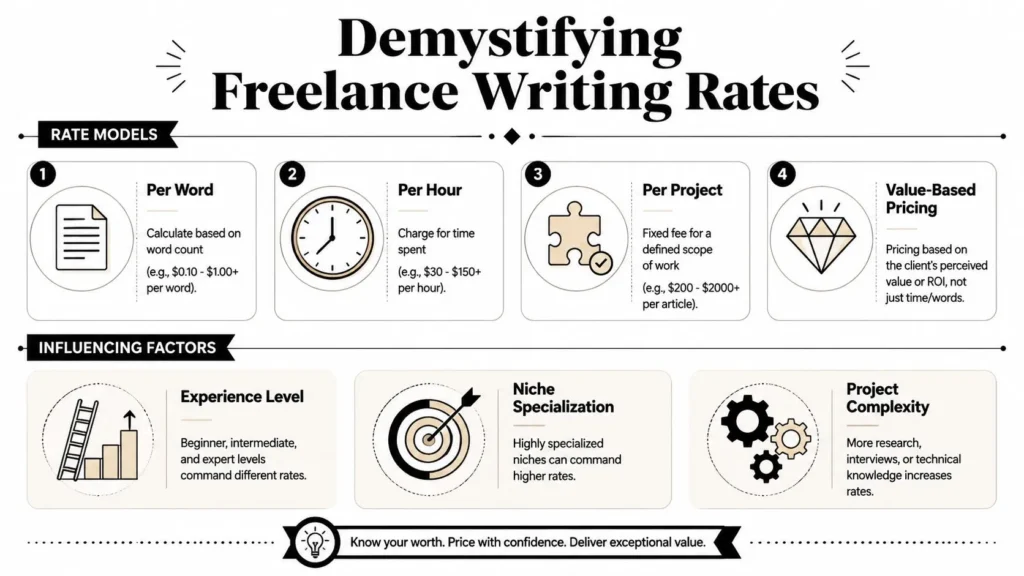
The main ways writers charge
Here’s the practical difference between the common pricing models:
| Model | Works well when | Risk for beginners |
|---|---|---|
| Per word | Blog posts and articles with defined length | You can underprice research and revisions |
| Per hour | Editing, consulting, messy scopes | Clients may fixate on time, not value |
| Per project | Clear deliverables and fixed scope | Requires decent estimating |
| Value-based | Mature writers solving business problems | Hard to justify without track record |
For most beginners, per word and per project are the easiest places to start. Per word is familiar and quick. Project pricing gets better once you know how long work takes and how often clients expand the scope.
Use benchmarks, then adjust for reality
Beginner freelance writers typically command entry-level rates of $0.05-$0.10 per word or $15-$29 per hour, according to these freelance writing rate benchmarks. Those numbers are not aspirational. They’re entry-level reference points.
That means a beginner shouldn’t feel ashamed quoting within that range for straightforward work. It also means you shouldn’t anchor yourself there forever, especially once your niche sharpens and your samples improve.
A few practical guidelines help:
- Use per-word pricing for standard blog content with predictable length.
- Use hourly pricing for revisions, strategy calls, or editing tasks that can sprawl.
- Use project pricing when the assignment includes research, outline approval, multiple sections, or stakeholder feedback.
What works and what usually backfires
Beginners often do one of two bad things. They charge too little because they want to seem easy to hire, or they charge expert-level rates because someone online told them never to undersell.
Both create problems.
What works better is this:
- Price within a realistic beginner range
- Define the scope tightly
- State what’s included
- Increase rates after you build proof and speed
Pricing rule: Quote the work in a way that protects your time, not just your ego.
If a client asks for a “simple blog post,” ask follow-up questions before naming a number. Does it require interviews? SEO formatting? Topic research from scratch? Uploading into a CMS? Two rounds of revisions? The rate only makes sense once the work is clear.
A clean first quote
A beginner quote can be plain:
- Deliverable: One article
- Scope: Agreed topic and length
- Includes: Research, draft, and a limited number of revisions
- Timeline: Delivery date
- Rate: Per-word, hourly, or fixed project fee
Simple beats clever here. If the client understands the scope and the price, you’re already ahead of many beginners.
Proven Ways to Find Your First Paying Clients
Once your samples, niche, and rates exist, the job changes. You’re no longer “getting ready.” You’re doing lead generation.
Most beginners should use two tracks at the same time: inbound and outbound. One gives you accessible opportunities. The other gives you control.

Inbound options and what they’re good for
Inbound means you respond to visible opportunities. That includes freelance platforms, job boards, publication calls, and contributor guidelines.
This route works well if you need reps. You’ll learn how clients describe projects, what they ask for, and how buyers compare candidates. It’s also useful if you don’t yet feel comfortable contacting companies directly.
Common inbound channels include:
- Upwork for beginner-friendly volume and quick testing
- ProBlogger-style job boards for content roles
- LinkedIn job listings for content marketing and editorial work
- Publication submission pages for bylines and clips
The downside is competition. You’re stepping into a crowded line where many writers see the same post.
Outbound options and why they matter more long term
Outbound means you choose who to contact. You identify companies, editors, agencies, or content managers and send targeted pitches.
This approach is harder at first. It also teaches better habits. You learn how to research a business, spot a content gap, and tie your offer to something useful instead of spraying applications into a platform.
A simple outbound list can include:
- Companies in your niche that publish blogs but haven’t updated recently
- Agencies that may need contract writers
- Editors at digital publications in your subject area
- Startups with weak educational content and clear product complexity
How to decide where to focus first
If you freeze when pitching strangers, begin with a platform or job board while building your confidence. If you’re comfortable with research and personalization, start outbound sooner.
Here’s the short comparison:
| Path | Better for | Main trade-off |
|---|---|---|
| Inbound | Fast exposure to open jobs | Less control and more competition |
| Outbound | Better-fit prospects and stronger positioning | More research per lead |
A lot of beginners do best with a split routine. Apply to a few open jobs each week, then send a few direct pitches to handpicked prospects.
After you’ve read a bit about client outreach, this video is worth watching before you send your first batch of pitches:
What to look for in a good first client
Not every first client is worth taking. A beginner often benefits more from a decent client at a moderate rate than a chaotic client who promises “lots of future work.”
Good first-client signs include:
- Clear assignment details
- Reasonable turnaround
- A budget conversation without drama
- Respect for contracts and revisions
- A business that already publishes content consistently
Bad signs show up early too. Vague requests, rushed unpaid tests, resistance to written scope, and constant “quick changes” usually get worse after the project starts.
One practical route for newer writers is to pitch smaller publications and digital magazines that accept outside contributors. For example, maxijournal.com accepts submissions from new contributors by email using Google Docs, plain text, Markdown files, or HTML links, which makes it a concrete option for writers who want clips and editorial feedback.
Writing a Pitch That Gets a Response
Most bad pitches fail before the second sentence. They’re generic, self-focused, and unclear about what the writer is offering.
A pitch works when it does four things fast: proves relevance, shows restraint, links to useful samples, and makes the next step easy.

Why preparation changes your response rate
You can’t outwrite a weak setup. New freelancers pricing too high without a portfolio to justify it close only 10-20% of leads, versus 50%+ for those who start with competitive rates and strong samples to build trust, according to the Freelance Writer Rates Benchmark Report. That’s why the pitch comes after the portfolio and pricing work, not before.
The strongest beginner pitch doesn’t pretend you’re established. It makes you look prepared.
A client doesn’t need your life story. They need a reason to believe you can handle this assignment.
The anatomy of a useful pitch
A workable cold pitch email usually includes:
- A direct subject line tied to the service or idea
- A personalized opening that proves you looked at their business
- A short value proposition that connects your writing to their audience
- One or two relevant samples
- A small call to action such as a reply, brief chat, or assignment consideration
Keep it short. Most beginners over-explain because they’re nervous.
A sample pitch you can adapt
Hi [Name],
I’m a freelance writer focused on [niche]. I was reading your recent content on [specific topic] and noticed you’re publishing for [audience].
I write clear, research-backed articles that help readers understand [relevant problem or topic]. I’ve attached a few samples below, including one on [topic] and another on [topic].
If you work with freelance writers, I’d be glad to send a few tailored ideas or discuss upcoming content needs.
Best,
[Your Name]
[Portfolio link]
That’s enough.
Two pitch mistakes that quietly kill replies
First, don’t lead with desperation. “I’m passionate, hardworking, and willing to do anything” is not a selling point. It signals low confidence and unclear value.
Second, don’t attach irrelevant samples. If you’re pitching a business publication, send business-related work. If you want editorial assignments, study how to pitch editors and publications more effectively through guides on freelance writing for magazines, then shape your clips to match that format.
If the pitch feels specific, calm, and easy to answer, you’re doing it right.
Your First-Month Action Plan and Business Basics
A beginner doesn’t need a complicated system. You need four weeks of deliberate work and a few business habits that protect your time.
Week-by-week roadmap
Week 1 should produce your niche decision and your first sample drafts. Pick one market, list article ideas, and write until you have strong material instead of endlessly adjusting your bio.
Week 2 is for packaging. Clean up the samples, upload them to a portfolio, write a short intro, and choose your starter pricing model.
Week 3 is lead generation. Build a list of prospects, save job posts, and draft a pitch template you can customize without sounding copied.
Week 4 is outreach and follow-up. Send pitches, answer replies quickly, track who you contacted, and note what language gets engagement.
The business basics beginners skip
The fastest way to make freelancing miserable is to treat every project casually. Put basic terms in writing from the start.
Over 70% of freelance writers encounter scope creep in their first year, and the fix is simple: use contracts that clearly state word count, revision limits such as two rounds, and charges for extra work, according to this breakdown of freelance writing challenges.
Use a simple contract, even if it’s brief. It should cover:
- Deliverable and expected format
- Deadline
- Revision limit
- Payment terms
- What counts as extra work
For invoicing and expense tracking, keep your tools boring and functional. A spreadsheet works at the start. If you want a more structured setup, compare options in this guide to accounting software for freelancers.
Working rule: If it isn’t written down, many clients will assume it’s included.
The first month isn’t about becoming fully booked. It’s about becoming operational. Once you have proof, a niche, a rate, and an outreach habit, you’re no longer guessing. You’re in business.
If you want more practical guidance on writing, publishing, and contributing in digital media, explore maxijournal.com. It covers a wide range of topics across science, technology, health, business, arts, education, entertainment, and more, and it also gives prospective contributors a clear sense of how online editorial work gets presented.
Discover more from Maxi Journal
Subscribe to get the latest posts sent to your email.