You’re probably here because the idea is stuck in your head already. You want your name in a magazine byline, not just on a personal blog or in a Google Doc nobody sees. You may also be staring at a messy notes app full of story ideas and wondering which one is worth pitching first.
That’s a normal place to start.
Freelance writing for magazines looks glamorous from the outside, but the day-to-day reality is more practical than romantic. Writers who last in this business usually aren’t the most naturally gifted people in the room. They’re the ones who learn how to target the right publications, pitch cleanly, report thoroughly, file on time, and turn one published piece into the next assignment.
The good news is that magazine writing still has room for new freelancers. The path just isn’t linear anymore. A sustainable career often starts with niche online outlets, then grows into stronger clips, better rates, and eventually assignments from larger print or hybrid magazines. If you treat that progression as a strategy instead of a consolation prize, you’ll move faster.
The Modern Landscape of Magazine Writing
At 9:12 a.m., an editor at a small online publication assigns a reported feature on short notice. At 2:00 p.m., a print editor at a regional magazine asks for two fresh ideas for a section that closes next month. Both are magazine jobs. Both can help a freelancer build a career. The difference is the pace, the edit process, and what each clip can do for you next.
Magazine writing no longer runs through a small set of glossy print titles. Editors now assign stories across print magazines, digital magazines, newsletters, membership publications, brand-adjacent editorial products, and independent niche sites with strong audiences. For freelancers, that shift changes the entry path. A writer can start with smaller online outlets, build published clips in a tight subject area, then use those clips to pitch larger regional, national, or print-first magazines.
That tiered path is more than a fallback. It is often the smartest way in.
What counts as magazine work now
A magazine assignment might be:
- A reported online feature for a niche publication with a defined editorial voice
- A print feature or front-of-book story with a longer production cycle and stricter fact-checking
- A hybrid piece that publishes digitally first, then appears in print in a revised form
- A service article that helps a specific audience solve a clear problem
- A column, essay, or department piece that fills a recurring editorial need
The practical difference is not prestige. It is workflow.
Online outlets often move faster, assign shorter pieces, and give newer writers a real shot if the idea is timely and well targeted. Print magazines usually buy fewer stories, plan farther ahead, and expect cleaner reporting, tighter structure, and more patience during edits. Both matter. Online clips can prove that you can report, hit deadlines, and write for an audience. Print clips still signal status, but they are easier to get once editors can see published work behind you.
Writers who are still building clips can also use blogs that accept guest posts in specific niches to get early bylines, test angles, and sharpen their subject focus before pitching tougher magazine markets.
What editors pay for
Editors buy finished story value. They buy access, timing, clarity, subject knowledge, and a usable angle. Strong prose helps, but clean sentences alone do not win assignments.
A workable pitch usually offers one of four things:
- A timely story with reporting potential
- A fresh angle on a familiar subject
- Specialized knowledge that saves the editor time
- A clear audience fit for an existing section or vertical
I have seen new freelancers waste months pitching broad ideas to famous titles while ignoring smaller publications that need contributors. The better move is usually narrower and less glamorous at first. Write three strong pieces for a respected niche site in your beat. Use those clips to approach a larger digital magazine. Then pitch print or hybrid magazines with proof that you already know how to report that subject.
Why the field still works for freelancers
Magazine writing is harder than it looks from the outside. Editors are busy. Budgets vary. Response times can be slow, and some pitches will go nowhere. Still, the field rewards writers who treat it like a long game.
A sustainable career often comes from stacking the right kind of work in the right order. Start where access is realistic. Get clips that show subject command. Move toward publications with stronger editing, larger audiences, and better rates. That progression is how many freelancers build a career that lasts.
Writers do not need to begin at a prestige title. They need to begin where they can do publishable work and turn one assignment into better ones.
Finding Your Niche and Targeting Publications
A writer spends an hour polishing a pitch for a glossy national magazine, hits send, and hears nothing. The same writer could have sold a sharper version of that idea to a niche digital outlet with the right section, the right editor, and a clear need for freelancers. In magazine writing, fit decides more assignments than style.
That starts with choosing a niche you can work in for years, not one article.
Editors hire for subject confidence. They want a writer who already knows the terminology, the common debates, the obvious sources, and the stories readers are tired of seeing. A broad label rarely does that. A narrower beat often does.
“Business” is too wide. “Small manufacturers adopting automation” gives an editor something concrete to assign. “Wellness” is vague. “Strength training for women over 40” suggests a readership, a source pool, and multiple story angles.
A useful niche usually passes three tests:
You already know the territory
Professional background, academic training, community connections, and lived experience all help.You can generate ten to twenty real story ideas
If the subject gives you one strong personal essay and nothing else, it is not a beat.Publications already pay for it
Search for recurring coverage, named sections, verticals, and seasonal packages. Those are signs of repeat demand.
Once the niche is clear, build a publication map. Do not build a dream list.
A dream list is full of famous titles. A publication map shows where your work can enter the market now, what kind of stories each outlet buys, and which clips will help you move up to the next tier. This is the part new freelancers skip because it feels less exciting than pitching. It is also where a lot of wasted time gets prevented.
Keep a simple spreadsheet and track:
- Publication name
- Print, digital, or hybrid
- Section or vertical
- Editor name
- Story types they run
- Tone and audience notes
- Word count range
- Submission guidelines
- Response time
- Pay information, if known
- Whether they assign reported features, essays, service pieces, or briefs
- Pitch ideas suited to that outlet
That last column is the one that matters. If the sheet does not contain outlet-specific ideas, it is just research storage.
Read publications like a contributor. A fan asks, “Do I like this magazine?” A working freelancer asks, “What do they buy, how often, and where could I fit?”
Study at least five to ten recent pieces from the section you want to pitch. Look for recurring formats, headline patterns, source habits, and how narrow the angle tends to be. Pay attention to what the publication avoids too. Some outlets like first-person service journalism. Others want reported stories with expert quotes and almost no writer presence. Missing that distinction can sink an otherwise decent idea.
I also look for one practical sign of opportunity: whether the outlet repeats a format with different subjects. If a magazine runs a monthly front-of-book profile, a regular service column, or a recurring trend feature, that section is often easier to break into than a big prestige feature well.
For early clips, niche online outlets often make the smartest first stop. They usually have clearer subject boundaries and more obvious contributor needs than large print magazines. If you need places to start researching, collections of blogs that accept guest posts can help you sort potential outlets by topic and decide which ones would produce credible portfolio pieces.
The strongest career path is usually tiered:
| Tier | Type of publication | What the clip proves |
|---|---|---|
| Entry | Niche blogs, trade sites, smaller digital magazines | You can file clean copy, hit a brief, and write for a defined audience |
| Middle | Established digital magazines, independent magazines, better-paying verticals | You can report, structure, and deliver publishable work consistently |
| Upper | Major print magazines and hybrid national outlets | You can handle stronger editing, bigger stakes, and more competitive assignments |
This sequence matters because different clips do different jobs. A niche online piece shows command of the subject. A mid-tier digital feature shows reporting range. Those together make a stronger case to a print editor than a stack of unrelated general-interest samples.
Writers who skip the middle tier often run into a credibility gap. The pitch may sound good, but the clips do not prove they can execute the kind of story the target outlet publishes. Editors notice that fast.
Three habits cause the most trouble here:
- Sending the same generic idea to unrelated magazines
- Mistaking personal enthusiasm for editorial fit
- Pitching outlets you have not read closely enough to understand
Magazine bylines build in sequence. Choose a beat with real demand, track publications like a working business, and use smaller digital wins to earn larger print opportunities. That is a slower path than chasing prestige first. It is also the path that tends to keep working.
Crafting the Perfect Magazine Pitch
You send a pitch at 9:12 a.m. By lunch, the editor has already decided whether it belongs in the assign pile, the maybe folder, or the trash. That decision usually happens fast, but not because editors are careless. They are managing volume, deadlines, budget, and section needs at the same time. A pitch has to help them make an easy editorial decision.
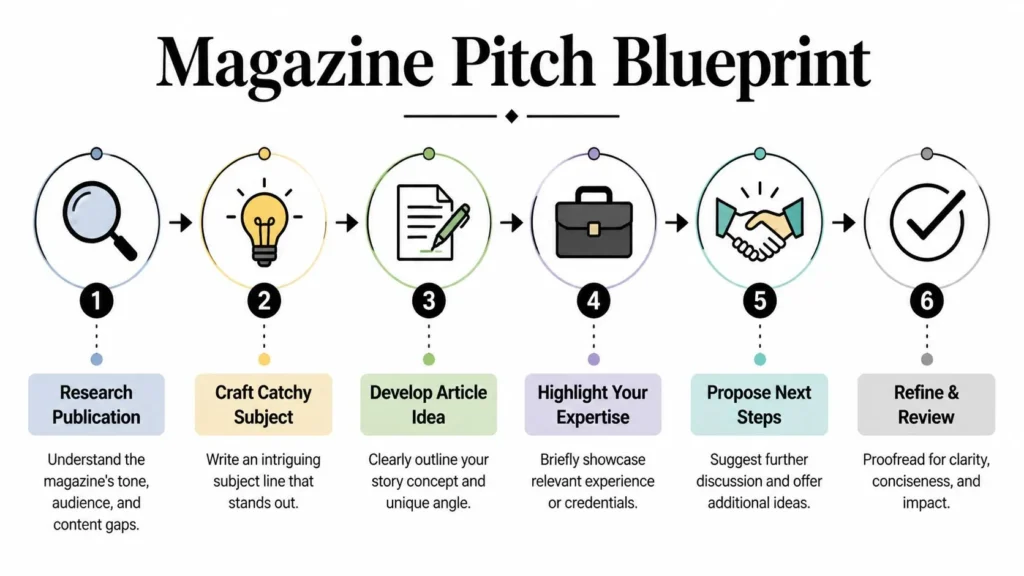
The writers who break in tend to understand one thing early. A pitch is a working assignment memo, not a performance. It needs to show the story, the angle, the audience fit, and why you are the right person to report it.
That matters even more in a tiered magazine career. A pitch to a niche online publication can be tighter, faster, and more serviceable if it proves you understand a narrow audience and can file clean copy. A pitch to a major print magazine usually needs stronger framing, clearer reporting depth, and a sharper sense of why this story belongs in that publication instead of somewhere else. Writers who treat those as the same document usually miss both markets.
What a strong pitch does quickly
Editors vary, but the useful pattern stays the same. Strong pitches answer four questions in a clear order:
What is the story?
State the idea in one or two sentences.Why this angle now?
Give the timely hook, tension, shift, or reporting opportunity.How will you report it?
Mention the kinds of sources, access, documents, or firsthand reporting you expect to use.Why does it fit this outlet?
Point to the readership, section, tone, or recent coverage gap.
A good pitch also shows restraint. It does not explain your childhood love of magazines. It does not summarize every thought you have had on the subject. It gives the editor enough to assign the piece with confidence.
A practical pitch template
Structure helps because it forces you to make decisions before the editor has to make them for you.
Subject line
Pitch: [clear angle or working title]Opening
One or two sentences with the story idea and why it matters now.Story summary
A short paragraph explaining what the piece will cover, what question it answers, and what the reader will get.Reporting plan
A sentence or two on the experts, case studies, data, or access you expect to use.Why this publication
One sentence showing you know the section and audience.Why you
Briefly note relevant expertise, access, or published clips.Close
Offer clips and say you can send more detail if useful.
For newer writers building from digital clips toward print, the “why you” section should match your current tier. If you have strong niche online work, use that to prove subject knowledge and reliability. If you have a few reported digital features, lead with those when pitching larger magazines. If you need better clips before aiming higher, it helps to first publish articles online with targeted bylines that show editorial fit for the next tier up.
Two pitch models that work
Feature pitch
This works for stories with reporting depth, character, movement, or a clear question to investigate.
A useful structure looks like this:
- A direct headline or hook
- A short paragraph framing the trend, problem, or conflict
- A paragraph on reporting. Who you plan to interview, what access you have, and what the piece will uncover
- A short bio line with relevant clips
For print magazines, I usually advise going one step further before sending. Pre-report enough to know the story holds up. One good source call, one document, or one strong case study can save you from pitching an idea that sounds interesting but collapses under reporting.
Recurring column or series idea
Editors rarely want a vague promise of ongoing content. They want proof that one installment can work.
Pitch the first piece as a stand-alone idea. Then mention two or three follow-up concepts that belong to the same lane. That shows range without asking the editor to buy an entire series on trust alone.
This model tends to work best for service journalism, trade coverage, and tightly defined beats where readers return for repeat guidance.
What gets a pitch rejected
Weak pitches usually fail for practical reasons, not mysterious ones.
The topic is broad enough to fit anywhere
“A piece about burnout” is not yet a magazine story.The fit line could be pasted into any email
Editors notice generic flattery immediately.The angle has no present-tense reason to assign it
A good idea with no urgency often becomes a pass.The writer leads with credentials instead of the story
Clips support the idea. They do not replace it.The reporting plan is thin
If the email suggests the draft will rely on opinions and surface research, the editor has to assume extra work later.
The standard is simple. The editor should be able to picture the finished piece, the section it belongs in, and the reader it serves.
Adjust the pitch to the market
This is one of the unwritten rules. Online editors often want sharper, faster, more utility-driven pitches. Print editors often want more narrative shape, stronger reporting promise, and a clearer argument for why the story deserves pages instead of a brief post.
So write to the assignment you want.
For a niche digital outlet, a successful pitch might be a clean service angle with a clear takeaway and three strong source categories. For a national print magazine, the same subject may need a character, scene, conflict, or reported tension that gives the story weight. The core idea can stay the same. The framing usually cannot.
The trade-off between polish and timing
New freelancers often keep revising a pitch long after the useful work is done. The result is not stronger. It is often flatter.
Send a pitch when the angle is clear, the reporting plan is credible, and the fit is real. Then move on to the next idea. Magazine pitching rewards steady output and editorial judgment more than literary perfection in the email itself.
The best pitches usually come from writers who have already done a small amount of reporting. Enough to test the premise. Enough to know the story exists. Enough to sound like a writer who can deliver.
From Assignment to Publication The Writer’s Workflow
The assignment email lands at 4:12 p.m. The editor wants 1,200 words by Friday, two reported examples, and a clean service angle. At that point, the job shifts from getting the yes to delivering copy that needs as little rescue work as possible.
Good magazine writers build a repeatable process. The details change by outlet and story type, but the core workflow stays steady. Confirm the assignment. Report beyond the obvious. Draft from structure, not from scattered notes. File clean. Handle edits without drama.
Start by tightening the assignment
A weak start usually happens before reporting begins. Writers hear “yes” and assume they understand the piece. Then they turn in something adjacent to what the editor commissioned.
Fix that early.
Reply with a short confirmation note that locks down the working angle, target length, deadline, source expectations, and any open questions about scope. If the editor wants a first-outline check-in, get that clarified now. If the publication uses a contributor agreement, read every line, especially payment timing, kill fee terms, revision expectations, and rights language.
That email can save a full rewrite.
A simple confirmation checklist covers:
- Working angle
- Expected word count
- Deadline and filing format
- Minimum reporting expectations
- Questions about framing, examples, or sidebars
Report to the piece, not to the word count
A short front-of-book item and a heavily reported feature do not need the same reporting load. New freelancers often overreport quick service pieces and underreport ambitious features. Both mistakes waste time.
For an in-depth feature or a technical story, freelancers may consult 5 to 15 subject matter experts per article, as Writer’s Digest explains in its guide to finding experts for article reporting. That range fits stories with real complexity, competing viewpoints, or material that needs verification from multiple angles. A 600-word trend brief usually does not need that many voices. A 2,500-word health, science, business, or policy feature might.
The practical rule is simple. Match the reporting depth to the editorial promise you made in the pitch.
If you are building clips on the way to larger print assignments, this is one of the clearest differences between tiers of publication. Niche online outlets often reward speed, clarity, and sharp source selection. Major print magazines usually expect broader reporting, stronger scene selection, and more original synthesis. Writers who use smaller digital assignments to practice clean interviewing, disciplined note-taking, and fact-check habits make that jump faster.
A reporting system that holds up under deadline
You do not need fancy tools. You need a system you can trust on a tired Thursday night.
Use one document or spreadsheet for source tracking. Include name, role, contact info, outreach date, response status, and the specific point each source can help you confirm. Keep interview notes and transcripts in one place. Before drafting, sort material by section or argument, not by interview. That prevents the common problem of writing one source at a time instead of writing the story.
A clean workflow usually includes:
A source tracker
One sheet for outreach, scheduling, and follow-up.Centralized notes or transcripts
Otter, Google Docs, Apple Notes, and Notion all work if you stay consistent.A working outline built from reporting
Group facts, quotes, scenes, and examples under the sections where they belong.A fact-check pass before filing
Confirm names, titles, dates, company descriptions, statistics, and URLs.
Writers balancing client work, magazine assignments, and self-published clips can also review practical guides on how to publish articles online so their digital process stays organized too.
One field rule matters here. If three interviews give you the same safe quote, the fix is usually a better source mix, not three more interviews.
Online and print require different workflows
The strategic mistake is treating all magazine assignments as the same job. They are not.
Niche digital publications often move fast and want useful copy with clear framing, clean subheads, and reporting that is solid enough to support authority without slowing publication. That makes them valuable training grounds. A writer can build clips, sharpen service journalism instincts, and learn how editors assign, revise, and package stories on tight timelines.
Print and hybrid magazines usually ask for more. They may want a stronger narrative frame, more live reporting, more source variety, and cleaner structural logic across a longer draft. The editor may also have more stakeholders in the process, which means more revision rounds and a slower path to publication.
Here is the practical difference:
| Workflow area | Online magazine | Print or hybrid magazine |
|---|---|---|
| Pace | Fast turnaround | Longer lead times |
| Reporting depth | Focused and efficient | Broader and more layered |
| Structure | Direct, utility-driven, concise | More narrative or argument-driven |
| Editing process | Quick, sometimes same-week | More formal, often multi-round |
| Best use for career growth | Build clips and prove reliability | Build prestige, depth, and stronger rates |
Use both deliberately. Digital clips can help get assignments from better-known print titles. Print bylines can then raise your credibility with higher-paying digital and hybrid outlets.
Draft from structure, then revise for force
A messy draft usually starts with messy notes. Once reporting is done, build a working structure before you write full paragraphs. Identify the lead, the nut graf or controlling idea, the order of evidence, and the strongest close available from your reporting.
Then draft quickly enough to preserve momentum.
The first pass should solve for structure and argument. The second should solve for clarity, pace, and repetition. The third should solve for accuracy, attribution, and line-level cleanup. Writers who try to perfect every sentence in draft one usually file late and still miss structural problems.
Revision is part of the job
Editors send questions because they are doing their job. Strong freelancers answer them cleanly and without sulking.
Handle edits in this order:
- Resolve factual and structural issues first
- Answer every editor query directly
- Add reporting where the draft is thin
- Push back only on matters of accuracy, fairness, or logic
A request for a clearer nut graf, a stronger example, or tighter transitions is routine. Magazine work is collaborative, and your reputation grows through the revision process as much as through the published piece.
The final habit is simple and underrated. File on time, label drafts clearly, keep your source material organized, and respond fast to follow-up questions. Editors remember writers who make publication easier.
Setting Rates and Negotiating Rights
The first time a new magazine writer gets a real assignment, the fee can feel like proof that the career is finally starting. Then the edits stretch out, the reporting takes twice as long as expected, and the contract claims broad reuse rights for a payment that barely covers the work.
That is a normal early mistake.
A sustainable magazine career depends on treating every assignment as two separate negotiations. One is the fee. The other is what the publication gets to do with the piece after you file it. If you get either part wrong, the byline may still help you, but the business side stays shaky.
What magazine pay actually looks like
Magazine editors use several payment models, and each one creates different risks for the writer. Some assign a per-word rate. Some offer a flat fee. Some implicitly expect extra interviews, rewrites, sidebars, or fact-check follow-up without changing the number.
The practical question is not just, “What does it pay?” Ask, “How many hours will this likely take, and what kind of clip will I have at the end?”
That matters even more if you are building in tiers. A niche digital publication may pay less, but a clean reported piece in a focused subject area can help you reach a better-paying regional or national magazine. A low fee is easier to justify when the assignment gives you a strong clip, a useful editor relationship, or experience in a format you can pitch upward. It is much harder to justify when the terms are weak and the finished piece will not help you get better work.
If you want to sanity-check how your published work presents your range and level, studying a few freelance writing portfolio examples can help you judge whether a lower-paying assignment is at least earning its place in your portfolio.
When to prefer per-word versus flat-fee pay
Per-word rates are easier to compare across publications. They also make scope creep easier to spot. If an 1,800-word feature turns into a 3,000-word reported package, the mismatch is visible.
Flat fees can work well, especially for repeat assignments. I like them for short service pieces, columns, front-of-book items, and Q&As where the reporting process is familiar and the format stays tight. They become risky when the editor has not defined the deliverable clearly.
Use a simple filter before you say yes:
| Model | How It Works | Best Use |
|---|---|---|
| Per-word | Payment is tied to assigned or published length | Features, essays, reported articles with stable scope |
| Flat fee | One fee covers the full assignment | Columns, Q&As, service pieces, repeat formats |
| Kill fee | Partial payment if the publication cancels after assignment | Protection for commissioned work |
A flat fee is fine if you know the assignment calls for one interview, one draft, and one revision round. The same flat fee is a bad deal if it grows into six interviews, a rewrite, and added research that was never discussed.
Rights decide the long-term value
Many beginners focus on the fee because the number is obvious. Rights language does the quieter damage.
A contract should spell out what the publication is buying. Common terms include first serial rights, one-time rights, digital rights, reprint rights, exclusivity periods, and all-rights agreements. Those terms are not interchangeable. A publication buying first rights for a defined use is asking for something very different from a publication asking for permanent control across formats.
Short-lived news pieces usually have little resale value. Evergreen service journalism, essays, reported features, and highly teachable pieces can have a longer life. That is where broad rights grabs hurt more. If the publication wants more than first publication rights, the fee should reflect that.
Writers trying to move from niche online outlets into larger print magazines should pay close attention here. Smaller digital publications sometimes use loose contracts copied from brand content or general web publishing. Print magazines with experienced editors are often clearer, but not always more generous. Read both with the same care.
The questions that keep you out of trouble
You do not need to turn rate negotiation into a performance. Clear questions usually do more than aggressive language.
Ask:
- What rights does this fee cover?
- Is the payment based on assigned length or published length?
- How many revisions are expected?
- Is there an exclusivity period?
- What happens if the piece is killed after assignment?
- If the scope changes, can we revisit the fee?
Those questions signal that you understand the work. Good editors do not object to that. They deal with contracts every day.
Real trade-offs, chosen on purpose
Some assignments are worth taking below your ideal rate. I have done that for a publication that gave me a missing clip, an editor I really wanted to work with, or a subject area that helped me move up a tier. That can be a smart decision.
The key is to know which kind of compromise you are making.
A strategic lower-paying assignment should usually do one of three things. It should improve your clips, improve your access to editors, or improve your position in a niche that pays better later. If it does none of those, it is probably just underpaying you.
Writers who build durable magazine careers get stricter over time. They quote more carefully, ask sharper contract questions, and stop accepting vague assignments with vague rights terms. That shift is part of becoming a professional, not part of becoming difficult.
Building Your Portfolio and Professional Reputation
An editor opens your pitch, likes the idea, clicks your portfolio, and finds six unrelated samples. One is a personal essay, one is a product roundup, one is a blog post with no byline, and none of them match the section you pitched. That is how capable writers get passed over.
A starting portfolio needs focus more than prestige. Editors want quick proof that you can report, structure, and finish the kind of piece they assign. Targeted clips answer that question faster than a mixed folder of decent writing.

The practical route into magazine writing is often tiered. Start with niche online publications that publish the kind of subject matter or format you want to be known for. Use those clips to approach stronger digital outlets. Then use your best published work from that level to pitch larger consumer or trade magazines, including print.
That approach works because each tier proves something specific. Smaller online outlets can show that you understand a beat, can interview real sources, and can file clean copy on schedule. Mid-tier publications add editorial credibility and often stronger assigning editors. Higher-tier magazines want evidence that you can do both.
I advise writers to build clips in sequence, not at random:
Tier 1: niche online outlets
Get published in places that cover your subject area regularly. Aim for service pieces, reported explainers, short profiles, and Q&As.Tier 2: stronger digital publications
Pitch sharper angles and more reported pieces. At this stage, your clips should start showing authority, not just competence.Tier 3: established print and flagship magazine brands
Use your best digital bylines to pitch features, front-of-book pieces, columns, or department stories that fit their exact editorial needs.
If you want a clearer sense of how to organize those samples, these freelance writing portfolio examples show useful ways to group clips by niche, format, and client type.
A strong portfolio usually includes three things:
A clear beat
An editor should understand your subject area within a minute.A few repeatable formats
Service writing, reported features, profiles, and interviews all signal different strengths.Real editorial context
Published clips with bylines, headlines, and working links carry more weight than unpublished drafts or generic writing samples.
Writers often ask whether international bylines count. They do. Editors care more about the quality and relevance of the work than the country where it ran, especially for digital-first publications. A good clip from a focused online outlet can help you reach magazines outside your local market, as long as the reporting is solid and the publication is credible.
Reputation grows from the parts of the job readers never see. Clean reporting notes. Accurate quotes. Fast replies to edits. A draft that matches the brief the first time. Editors remember freelancers who reduce friction.
This short video covers the career side of that process well:
A simple professional setup is enough. Keep a portfolio page with your best clips, a short bio that states your beat, and a reliable contact method. Add a LinkedIn profile if you use it, but do not confuse visibility with reputation. Reputation comes from filed work and repeat assignments.
Smaller outlets deserve more respect than they get. Many of them offer the exact training ground magazine writers need. You learn how to shape an idea for a defined readership, work with busy editors, revise without drama, and turn one assignment into another. Those habits carry upward.
The writers who build sustainable magazine careers usually treat each clip as a tool with a job to do. One clip proves service writing. Another proves reporting. Another proves subject authority. Put those pieces together and your portfolio starts making the case before you say a word.
Launching Your Career as a Magazine Writer
A magazine career doesn’t begin when a famous editor notices you. It begins when you start acting like a working freelancer. You choose a beat. You research publications carefully. You send targeted pitches. You report thoroughly when an assignment lands. You protect your time, your rates, and your rights. Then you use every published clip to reach for the next tier.
That loop repeats.
The writers who stick with freelance writing for magazines usually stop waiting for confidence to arrive first. Confidence comes later, after enough pitches sent, enough edits handled, enough deadlines met, and enough proof that you can do the work even when the work feels uncertain.
A sensible first plan is simple:
- Pick one or two niches you can report with authority.
- Build a spreadsheet of realistic target publications.
- Pitch a small batch of customized ideas each week.
- Treat every assignment like the start of a longer relationship.
- Save your best clips and use them to move up-market.
There’s no shortcut around craft, patience, and repetition. But this isn’t a lottery. It’s a profession with visible patterns. Editors need reliable freelancers. Publications need strong ideas. Readers still respond to sharp, well-reported stories.
That means there’s room for new writers who approach the work seriously.
If you’re starting from scratch, don’t measure yourself against someone who already has years of clips and editor contacts. Measure yourself against your own system. Are you researching better? Pitching more clearly? Writing stronger drafts? Following through more professionally than you did a month ago?
That’s how careers are built. They develop steadily at first, then more visibly.
If you want a practical place to publish, learn from working examples, and explore contributor-friendly resources across science, technology, health, business, arts, entertainment, and more, visit maxijournal.com. It’s an independent web magazine that also helps prospective contributors understand what strong online publishing looks like.
Discover more from Maxi Journal
Subscribe to get the latest posts sent to your email.