So you’ve poured your heart and mind into an article, and now it’s ready for the world. But where, exactly, does it go? This is arguably the most important decision you’ll make in the entire process.
Your choice of publication venue will shape who sees your work, the credibility it carries, and the opportunities that come from it. It’s like deciding where to open a shop: do you build your own standalone boutique, set up a stall in a bustling market, or get your products featured in a major department store? Each path has its own distinct rewards and challenges.
Finding Your Place in the Online Publishing World
Before you even think about submitting your piece, you have to get clear on your primary goal. What is the one thing you hope this article achieves? Are you trying to build a personal brand from the ground up? Or maybe you want to establish yourself as the go-to expert in a very specific niche. For some, it’s simply about getting a powerful message in front of as many people as possible.
There’s no single “best” answer, but your answer will point you in the right direction.
This decision tree can help you visualize how different goals naturally lead to different publishing strategies.
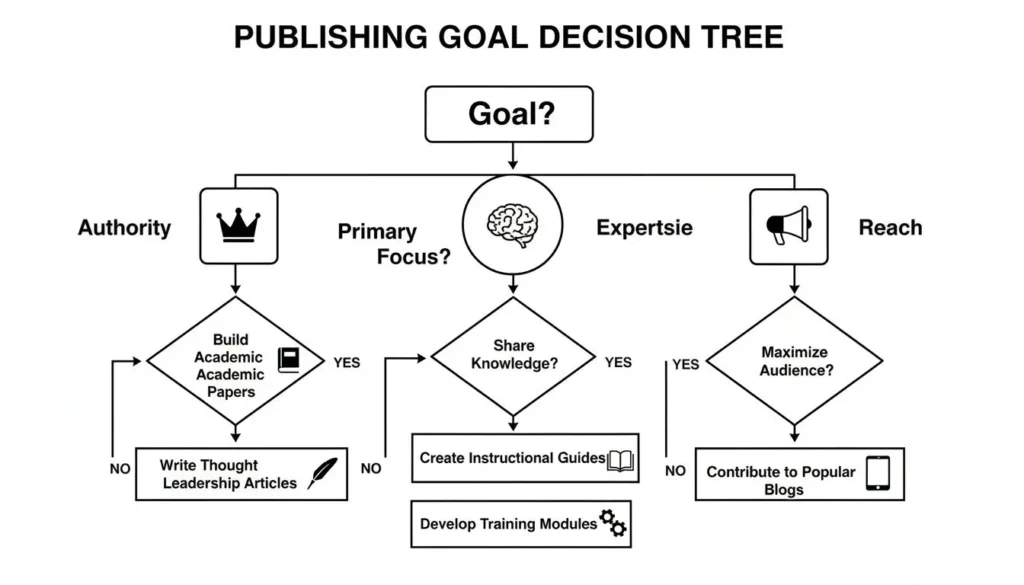
As you can see, if your core mission is building authority and a long-term asset, self-publishing on your own site makes a lot of sense. But if immediate, widespread reach is what you’re after, guest posting is probably a better bet.
Comparing Your Publishing Options
Let’s dig into the three main ways you can publish articles online. Each one offers a different mix of control, audience access, and effort.
Self-Publishing on Your Own Blog: This is your digital kingdom. You have 100% control over everything—the content, the design, how you make money, and when you publish. It’s the ultimate long-term play for building a brand, but it comes with a significant challenge: you have to build your audience from zero.
Publishing on Platforms: Think of sites like Medium or LinkedIn. They offer a ready-made audience and an incredibly simple publishing process. You can get your work live in minutes and even earn a little money through initiatives like the Medium Partner Program. The trade-off? You’re playing in someone else’s sandbox, with limited control over design and subject to their rules.
Guest Posting on Established Blogs: Writing for a well-known industry publication instantly lends their credibility to your work. It’s a fantastic way to tap into a large, pre-existing audience, network with editors, and prove your expertise. The catch is that you have to follow their strict guidelines and will likely go through a round or two of edits.
A bit of hard-won advice: Most new writers don’t start with a successful personal blog right away. A more effective strategy is often to build your reputation on platforms and through guest posting first. Once you have a following, you can drive that traffic back to your own site.
To help you weigh your options, here’s a quick breakdown of what each path offers.
Online Publishing Options at a Glance
This table provides a side-by-side comparison to help you decide which route aligns best with your resources and goals.
| Publishing Method | Control & Ownership | Audience Reach | Monetization Potential | Best For |
|---|---|---|---|---|
| Self-Publishing | Complete Control | Build from Zero | High (Ads, Products, Affiliates) | Entrepreneurs & Dedicated Brand-Builders |
| Platforms (Medium, etc.) | Limited Control (Platform Rules) | Built-in Audience | Moderate (Partner Programs, Tips) | Gaining Experience & Publishing Quickly |
| Guest Posting | No Content Control After Edit | Tapping into an Established Audience | Indirect (Leads, Credibility, Links) | Networking & Building Authority |
Ultimately, there’s no need to commit to just one path forever. The most successful authors I know use a hybrid approach, leveraging each method for its unique strengths at different stages of their careers.
Choosing the Perfect Home for Your Article

So, you’ve written a great article. Now comes the million-dollar question: where should it live? This isn’t just about getting it online; it’s a strategic choice that can make or break its impact. The right platform puts your work in front of the right people, while the wrong one can feel like shouting into the void.
Think back to the goals you set earlier. If your main objective is building a personal brand, nothing beats the autonomy of your own blog. You control everything. But if you’re aiming to establish yourself as an authority in a new industry, publishing on a well-respected journal lends you their credibility. It’s the classic trade-off: do you want total control, or do you want to borrow someone else’s established reach?
How to Vet Potential Publications
Before you fire off a single email, you have to do your homework. Think of yourself as a scout, trying to find the perfect team for your star player—your article. A brilliant piece of writing in the wrong publication is a missed opportunity for everyone.
The first step is to become a genuine reader of the publication. Don’t just skim a few posts. I mean really dig in and read at least five to ten of their recent articles.
As you read, look for these clues:
- Tone and Voice: Is the writing formal and academic, or is it friendly and conversational? Do they appreciate a bit of humor, or is it all business? Your article needs to sound like it belongs there.
- Content Formats: What kinds of articles do they publish? Are they known for 2,000-word deep dives, quick listicles, or data-rich case studies? Some sites have built their entire brand on a specific format, and they rarely deviate.
- Audience Expertise: Who are their readers? Are you writing for beginners who need a “What Is…” introduction, or are you addressing seasoned pros hungry for advanced strategy? Pitching a basic “Intro to Python” article to a blog for senior data scientists is a fast track to the delete folder.
This research isn’t just busywork. It’s about showing the editor you respect their publication and understand what their audience wants. It immediately sets you apart.
Finding and Following Submission Guidelines
Once you’ve shortlisted a few publications that feel like a good fit, it’s time to hunt for their submission guidelines. This is often the first, unspoken test—editors can instantly tell who has bothered to read the rules and who hasn’t.
Scan the website’s footer or main navigation menu for pages with titles like:
- Write for Us
- Contribute
- Submission Guidelines
- Guest Post
Can’t find it? Don’t give up. Try a site-specific Google search, like site:publication.com "write for us" or site:publication.com "guest post guidelines". That trick almost always works.
The submission process can feel like a black box. I’ve sent articles out and heard nothing but radio silence for weeks. Persistence helps, but so does knowing when to move on. My rule of thumb is to send one polite follow-up after a week or two. If I still don’t hear back, I withdraw my submission and pivot to the next publication on my list.
What Editors Are Really Looking For
Editors aren’t just gatekeepers; they’re actively on the hunt for amazing content that will make their readers happy and their publication shine. After years of pitching and editing, I can tell you what really catches their eye.
A Perfect Fit
Above all else, editors want an article that feels like it was written specifically for them. This is where your research pays off. When an editor sees you’ve matched their tone, style, and audience needs, you’re already ahead of 90% of submissions.
A Unique Angle
The world doesn’t need another generic article on a well-worn topic. Bring something new to the table. It could be a personal case study, surprising data you’ve collected, or a contrarian viewpoint that challenges the status quo. Ask yourself: what’s the one thing I can say about this that no one else can?
Actionable Value
Will your article help someone solve a real problem, learn a new skill, or make a better decision? Editors crave content that delivers tangible takeaways. Don’t just talk about high-level concepts; give readers clear, practical steps they can implement immediately.
Finding the right blogs can feel like a full-time job. To give you a head start, we’ve put together a curated list of blogs that accept guest posts to help you land your first few bylines.
Prepping a Submission That Editors Can’t Ignore
Let’s be honest: an editor’s inbox is a battlefield. Getting your article noticed isn’t just about having a great idea; it’s about presenting it so flawlessly that an editor has to pay attention. A polished, professional piece isn’t just a nice-to-have, it’s the cost of entry.
This has never been more true than it is today. As content creation tools become mainstream, the volume of submissions is exploding. Some academic journals, for instance, are reporting submission increases of up to 50% as AI gets woven into the writing process. You can get a better sense of this shift by reading up on the developing scholarly publishing trends.
That surge puts a huge strain on editors, which actually creates an opportunity for you. A submission that is thoughtfully prepared and easy to process immediately stands out. So, how do you make sure your work is the one that gets the green light? It all boils down to structure, polish, and providing value that goes beyond the words on the page.
Crafting a Compelling Structure
A good article structure isn’t just about an intro, body, and conclusion. It’s about creating a smooth, logical journey for the reader, guiding them from one point to the next without them even noticing the effort.
It all starts with your hook. You have one or two sentences to grab an editor’s—and later, a reader’s—attention. Open with a startling statistic, a relatable frustration, or a bold claim that makes them think, “I need to know more.”
From there, use clear subheadings as your guideposts. They break up the text and act as a roadmap, telling the reader what to expect in each section. Good subheadings promise a specific benefit and make your article instantly scannable, which is a huge plus for busy readers.
Finally, your conclusion needs to stick the landing. Don’t just rehash what you’ve already said. Offer a powerful final thought, a clear call to action, or a lingering question that keeps your article in the reader’s mind long after they’ve moved on.
The Final Polish Checklist
It’s the little things that signal to an editor whether you’re an amateur or a pro. Before you even think about hitting “send,” run your article through this final quality check. This simple step shows you respect their time and take your work seriously.
- Follow the Style Guide: Have you formatted your titles, subheadings, and citations exactly as the publication requested? Ignoring their guidelines is the fastest way to the “no” pile.
- Fact-Check Everything: Go back and verify every name, date, statistic, and quote. A single error can undermine the credibility of your entire piece.
- Proofread Like a Pro: Read your article out loud. This is the best way to catch clunky sentences and typos. Use a tool like Grammarly, but never trust it completely—nothing beats a final human review.
- Test Your Links: Click on every single link. Make sure they all work and are set to open in a new tab so you don’t accidentally navigate your reader away from the article.
An editor’s first impression is made in seconds. A clean, well-formatted document that follows all the rules tells them you’re a professional before they’ve read a single word of your argument. Don’t let sloppy mistakes sink a brilliant piece of writing.
Adding Value Beyond the Text
A truly great article is a complete package, not just a wall of text. By including other thoughtful elements, you can make your submission more engaging and much easier for an editor to say “yes” to.
High-Quality, Attributed Images
Visuals are essential for breaking up long blocks of text and making complex topics easier to digest. If you’re providing images, they must be high-resolution and directly relevant to the content. Most importantly, you have to provide proper attribution. Use royalty-free sites like Unsplash or Pexels, or create your own simple graphics. Never, ever just grab an image from a Google search.
Purposeful, Value-Adding Links
Every external link should have a clear purpose. Is it backing up a claim with a credible source? Is it pointing to a helpful tool? Or is it offering further reading on a key concept? Be strategic here. Avoid linking to a publication’s direct competitors unless it’s absolutely necessary for context. This shows the editor you’ve thought about their audience and business goals.
When you focus on a strong structure, a flawless finish, and value-added elements, you’re not just submitting an article. You’re giving an editor a solution to their biggest problem: finding fantastic content their audience will love. That’s how you get published and start building a reputation as a writer who delivers.
Mastering the Art of Article Submission
So, you’ve poured your heart and expertise into a finished article. Now what? Getting it published online isn’t just one single action; it’s a choice between two very different roads. You can either publish it yourself or pitch it to another publication.
Figuring out which path to take is the final, crucial step in getting your work seen. Let’s look at what each one involves.
The Self-Publishing Route: Your Site, Your Rules
Want total control and immediate results? Self-publishing is your answer. Using platforms like WordPress or Ghost, you are in the driver’s seat. You’re the editor and the publisher, and you decide the exact moment your article goes live. No waiting for an editor’s approval.
This approach is fantastic for writers building a personal brand, those who already have a following, or anyone who wants to publish content consistently. You just log into your site, drop in your article, hit “Publish,” and it’s out there for the world to see.
Self-publishing has exploded in recent years. It’s no longer a last resort but a dominant force, with around 1 million books being self-published every year in the US alone. Many readers I know actually prefer a lot of self-published work, finding the quality is often just as good, if not better, than what comes from traditional houses. You can read more about the current state of publishing today.
Pitching to Other Publications: The Guest Post Game
If your goal is to tap into a publication’s existing audience, you’ll need to play the guest-posting game. This involves pitching your article idea (or the finished piece) to an editor. All that research you did earlier on finding the right publication is about to pay off big time.
A great pitch is short, sharp, and gets straight to the point. Editors are swamped, so your email has to prove its worth in the first few seconds. After sending countless pitches over the years, I’ve learned what gets a response and what gets ignored.
Your pitch email is your foot in the door. It’s not just a message—it’s your first impression. A generic, copy-pasted email is the fastest way to get deleted. You have to show you know their publication and understand why your article is a perfect match for their readers.
Here’s an email template I’ve tweaked and perfected over time. It’s designed to be opened, read, and—most importantly—acted on.
Subject: Guest Post Pitch: [Your Article Title or a Compelling Hook]
Hi [Editor’s Name],
I’m [Your Name] and a big fan of [Publication Name]. I really enjoyed your recent piece on [mention a specific article] because [give a short, genuine reason].
I’m writing because I’ve just finished an article called “[Your Article Title]” that I think your readers would love. It’s a practical guide that shows them how to [briefly describe the main topic and what problem it solves].
You can read the full draft here: [Link to Google Doc with view/comment access]
I know your audience is passionate about [mention audience interest], and my article provides clear, actionable advice on [mention a specific takeaway or tip]. I’m confident it will perform well.
Thanks for your time, and I look forward to hearing from you.
Best,
[Your Name]
[Link to your portfolio or LinkedIn profile]
This format works because it’s respectful. It shows you’ve done your homework and makes the editor’s job easy by giving them everything they need in one place.
Your Final Submission Checklist
Whether you’re hitting “publish” on your own blog or emailing an editor, run through this quick final checklist to make sure you have all your ducks in a row.
- Author Bio: Have a snappy, 2-3 sentence bio ready. It should establish your expertise and link to your website or primary social profile.
- Headshot: A professional, high-resolution photo of you. No blurry selfies.
- Final Document: A clean, formatted version of your article, usually shared as a Google Doc.
- Image Files: If you’re providing your own images, have them ready as separate files and include the source links for proper attribution.
Building a writing career often starts with getting your work out there, one article at a time. Many talented writers are finding success by contributing to niche publications that value their specific expertise. If you have a deep knowledge of a particular subject, like technology, you might want to write for our technology section here at Maxijournal.
Getting Your Published Article Found with SEO

You’ve poured your heart into writing a brilliant article. But if you just hit “publish” and hope for the best, you’re missing a crucial step. An amazing article that no one can find is like a masterpiece locked in a closet. This is where you need to start thinking about Search Engine Optimization, or SEO.
Don’t let the acronym scare you. At its core, SEO is simply the practice of making your content easy for search engines like Google to find and understand. It’s not some dark art for tech wizards; it’s a fundamental skill for any writer who wants their work to have an impact.
Think of it this way: your article is a fantastic new shop. SEO is the big, bright sign on the highway that guides people right to your front door.
Find Your Focus with Simple Keyword Research
Before you lock in your headline, you need to get inside your reader’s head. What words are they actually typing into Google when they’re looking for the answers you provide? This is keyword research, and it doesn’t have to be a massive undertaking.
Your main goal is to identify the core phrase—your primary keyword—that your ideal reader is searching for. A fantastic, and free, place to start is Google itself. Just start typing your topic into the search bar and pay close attention to the autocomplete suggestions. Those aren’t guesses; they’re real queries from real people.
Once you’ve got your primary keyword, you need to place it where it counts.
- Your Title: The keyword should appear in your main title, preferably toward the beginning.
- The First Paragraph: Weave the keyword into your opening sentences to immediately signal the article’s relevance.
- Subheadings (H2, H3): Sprinkling your keyword and related phrases into your subheadings gives your article structure and reinforces its topic for search engines.
By aligning your article’s language with real search behavior, you’re not trying to trick the system. You’re just making it incredibly easy for Google to connect your solution to someone’s problem.
Create Irresistible Titles and Descriptions
When your article shows up in search results, you have a split second to earn a click. Your only tools are the title and the little snippet of text below it, the meta description.
The title tag—what Google displays in its results—needs to be clear, intriguing, and stay under 60 characters so it doesn’t get awkwardly cut off. It must include your keyword while also sparking enough curiosity to make someone have to click.
The meta description is your 155-character ad for the article. While it doesn’t directly boost your ranking, it has a massive impact on whether someone clicks on your result or a competitor’s. It should expand on the title, promise a solution, and maybe include a call to action like “Discover the steps…” or “Find out how…”
Think of your meta description as the back cover of a book. It’s your one shot to convince a searcher that your article holds the answers they’re looking for, making it one of the most important pieces of copy you’ll write.
Boost Visibility with Smart Linking and Images
The connections you build in and around your article are powerful signals to search engines. A thoughtful linking strategy shows that your content is well-researched and part of a broader conversation.
First, look for opportunities for internal linking. This is when you link to other relevant articles on your own site. It’s a win-win: it helps search engines map out your content, and it keeps readers on your site longer, guiding them to more helpful information. For a great overview of these fundamentals, check out our guide on SEO tips for beginners.
You should also use external linking, which means linking out to other reputable, authoritative websites. Citing credible sources or pointing to helpful resources shows that you’ve done your homework and adds a layer of trust to your work.
Finally, every image you use is an SEO opportunity. Don’t overlook alt text, which is the short description you assign to an image. This text is vital for accessibility (it’s what screen readers use to describe an image) and gives search engines another clue about your content. Instead of a generic file name, write a clear description like, “writer reviewing SEO analytics on a computer monitor.”
Promoting Your Article and Measuring What Matters
You’ve hit the publish button. It’s a great feeling, but the work isn’t over just yet. A fantastic article that nobody reads is like a tree falling in an empty forest. Without a solid promotional plan, even your best work can get lost in the noise.
Think of it this way: writing is half the job, and promotion is the other half. It’s your responsibility to build bridges that connect your content with the people who need to see it. This means sharing your work smartly, engaging with your audience, and paying attention to what resonates.
Create a Promotional Plan That Actually Works
Just blasting a link across your social media channels and calling it a day is a recipe for disappointment. Every platform has its own culture and unwritten rules. To get real traction, you have to stop broadcasting and start a conversation.
Here’s how you can adapt your message for a few key networks:
LinkedIn: This is your professional stage. Don’t just post the link; frame it with an insightful question for your industry peers or pull out the main business takeaway. The goal is to spark a professional dialogue and showcase your expertise.
X (formerly Twitter): A single tweet is easy to miss. Turn your article into a thread. Start with a hook—a surprising stat, a provocative quote, or a key insight—and then unpack the main points in a series of short, punchy tweets. Don’t forget relevant hashtags to reach beyond your immediate followers.
Facebook & Instagram: These platforms are more visual and personal. Pair a compelling image from your article with a caption that tells the “why” behind the piece. A short personal story or a direct question can do wonders for encouraging comments and creating a genuine connection.
This isn’t about creating more work; it’s about making the work you’ve already done count.
Your job isn’t finished when you publish—it’s finished when you’ve actively guided your audience to the article. Promotion is the essential final step that connects your writing with the people it was written for.
There’s a good reason to get this right. The digital media market is booming, with digital ad revenues expected to reach $258.6 billion in 2024. That massive number shows just how valuable high-quality, visible content has become. Mastering both creation and promotion puts you in a prime position to benefit. You can explore more on this trend in the digital media market revenue playbook.
Measuring What Truly Matters
Once your article is out there, you need to understand how it’s performing. It’s easy to get overwhelmed by analytics, so focus on the few metrics that give you a clear picture of reader engagement. These numbers are your audience’s direct feedback.
Essential Metrics for Writers:
Page Views: This is your baseline. It tells you exactly how many sets of eyeballs landed on your article. Think of it as your initial reach.
Average Time on Page: This metric is pure gold. It tells you if people are actually reading what you wrote. A low time on page means people are clicking away quickly, while a high number is a strong signal that your content is holding their attention.
Social Shares: A share is the ultimate compliment. When someone shares your article, they’re putting their own reputation on the line to recommend it. Keep an eye on this to see what content inspires people to spread the word.
By tracking these key numbers, you’ll start to see patterns in what topics, headlines, and formats truly connect with your readers. This is the feedback loop that will help you make your next article even better.
Your Questions About Online Publishing Answered
As you get ready to publish your work online, you’re bound to run into a few common questions. I’ve heard these from countless writers over the years, and getting them sorted out early can make the entire process feel much less intimidating. Let’s clear up some of the big ones.
How Much Does It Cost to Publish an Article?
Believe it or not, you can get started for free. Publishing on platforms like Medium or LinkedIn, or even writing a guest post for an established blog, costs you nothing but your time. It’s an excellent way to get your work in front of an audience without any financial risk.
The real costs start to creep in when you decide to build your own platform. If you want to self-host a website, you’ll need to budget for a domain name (typically $10-20 per year) and web hosting, which can run anywhere from a few dollars to $30+ per month depending on your needs. You could also choose to pay for ads or promotional services to give your article an extra push.
Can I Get Paid for My Articles?
Yes, absolutely! Making money from your writing is a very real possibility, and there are a few different ways to go about it. Most people start with freelance writing, where a client simply pays you a flat fee for an article.
It’s not always about a direct paycheck, though. I know many successful writers who use their articles as powerful marketing tools. They publish valuable content for free to attract high-paying clients for their main business, turning those articles into a fantastic source of leads.
Beyond freelancing, you can also explore other monetization models:
- Revenue Sharing: Platforms like Medium’s Partner Program will pay you based on how much time members spend reading your work.
- Ad Revenue: If you run your own blog, you can earn money through display ads once you start getting consistent traffic.
What to Do After a Rejection
First, let’s get one thing straight: every writer gets rejected. I have, your favorite author has, and it will happen to you. It’s just part of the game. A rejection is not a verdict on your talent or a sign that your article is bad.
So when you get that “no,” take a breath. It’s okay to be disappointed. Then, a simple, polite “thank you” to the editor for their time goes a long way. If they gave you feedback, study it. Read your article and the pitch again with fresh eyes—you’ll often spot something you can improve.
Your next move is straightforward: find another publication that feels like a better fit and submit again. A rejection is just a data point, telling you that specific article wasn’t right for that specific home at that specific time.
At maxijournal.com, we provide a platform for diverse voices across countless fields, from technology to travel. Explore our journal and find your next favorite read.
Discover more from Maxi Journal
Subscribe to get the latest posts sent to your email.