A puppy’s first-year vaccination series usually costs $100 to over $300, while individual dog shots often run from $27 to $96 per shot. If you’re trying to budget for a new dog right now, that’s a concrete starting point, not the vague “it depends” answer often received.
That sticker shock usually hits at the same moment you’re buying a crate, food, leash, flea prevention, and the rest of the starter kit. Dog shots cost isn’t just one bill. It’s a series of decisions about which vaccines your dog needs, where you get them, and whether you’re paying for the shot alone or the whole appointment around it.
I’ve seen owners make two common mistakes. First, they underestimate the puppy year because it involves repeat visits. Second, they compare only the price of the vaccine and ignore exam fees, package pricing, or low-cost clinics that can change the total by a lot. A smart budget looks at the full first-year plan, not a single receipt.
Your Guide to Navigating Dog Vaccination Costs in 2026
If you’ve just brought home a puppy, the easiest way to think about vaccine costs is this. There’s the series cost for the first year, and there’s the maintenance cost after that.
The first year is heavier because puppies need multiple visits close together. Adult dogs are usually simpler to budget for because you’re dealing with boosters, lifestyle vaccines, and whatever your local rules require for rabies. That’s why one owner feels like shots were manageable, while another feels blindsided by the total.
Budget the year, not the visit
A single vaccine price can look reasonable on paper. The full year can still catch you off guard if you don’t map out the schedule in advance.
Use this simple budgeting frame:
- Start with core protection. These are the vaccines most dogs need regardless of lifestyle.
- Add lifestyle risks. Daycare, boarding, dog parks, hiking, and travel can add more shots.
- Choose your clinic type early. Private vet, low-cost clinic, and mobile events don’t bill the same way.
- Ask what is bundled. Some places charge a separate exam fee. Some don’t.
Practical rule: Don’t ask only, “What does the shot cost?” Ask, “What will today’s total be, including exam fees, administration, and any required recheck?”
That one question can save a lot of frustration.
Why owners get different answers
Dog shots cost varies because clinics price care differently. One practice may include a full wellness exam and medical record review in the visit. Another may operate like a vaccine clinic and keep the visit focused and fast. Neither model is automatically better. They serve different needs.
A new puppy owner who wants continuity, questions answered, and a hands-on exam may prefer a full-service vet. A healthy adult dog that just needs routine boosters may be a better fit for a community vaccine clinic.
If you’re also learning how your dog reacts to new environments, basic stress signals matter during vet visits. A quick refresher on understanding dog body language can make vaccine appointments smoother for both you and your dog.
What Shots Do Dogs Actually Need?
The cleanest way to understand dog vaccines is to sort them into core and non-core.
Think of core vaccines like seat belts and airbags in a car. They’re basic protection. Non-core vaccines are more like snow tires or chains. Not every driver needs them, but some really do depending on where they live and how they use the car.

Core vaccines
Core vaccines protect against diseases vets treat as standard risks for most dogs. According to CareCredit’s dog and puppy vaccine cost guide, DHPP averages $42, rabies $35, and leptospirosis $34, while Bordetella averages $38, canine influenza $53, and Lyme disease $50.
DHPP matters because it covers several serious diseases in one shot: distemper, adenovirus, hepatitis, parainfluenza, and parvovirus. Rabies is in its own category because it’s also a public health issue, not just an individual pet health issue.
Lifestyle vaccines
Non-core vaccines depend on exposure.
A dog that never boards, never goes to daycare, and rarely meets outside dogs may not need the same add-ons as a social dog who spends weekends at the dog park. A dog that hikes in tick-heavy areas raises a different conversation than a city dog who stays on sidewalks and visits the groomer.
Here’s how I usually break it down for owners:
- Bordetella fits dogs that board, groom frequently, or spend time around lots of dogs.
- Canine influenza comes up more often when dogs are in high-contact environments.
- Lyme is a location and exposure discussion, not an automatic yes for every dog.
- Leptospirosis often matters more than many owners expect because exposure can happen outside deep-woods settings.
A useful question for your vet is, “What does my dog’s weekly routine expose them to?” That gets you a better answer than asking for a generic vaccine list.
What’s actually worth paying for
Owners waste money when they either approve every recommended add-on without discussion or skip vaccines blindly to save cash. Both choices can backfire.
The better move is to match the dog’s vaccine plan to the dog’s real life. If your dog boards twice a year, that matters. If your dog drinks from puddles, hikes, or spends time where wildlife passes through, that matters too. The right plan is specific.
How Much Do Individual Dog Shots Cost?
Once you know which vaccines matter for your dog, the next step is turning that list into an actual budget. At this point, owners usually notice that dog shots cost is less about one “average price” and more about a range per dose.
Estimated cost of common dog vaccines
| Vaccine | Protects Against | Average Cost Range (2026) |
|---|---|---|
| DHPP / DAPP | Distemper, adenovirus, hepatitis, parainfluenza, parvovirus | $20 to $60 per dose |
| Rabies | Rabies disease | $20 to $30 |
| Bordetella | Kennel cough / respiratory infection risk | $30 to $50 |
| Leptospirosis | Leptospira infection affecting organs such as liver and kidneys | $20 to $30 per dose |
| Canine influenza | Dog flu strains | $45 to $65 per dose |
| Lyme | Lyme disease | $20 to $40 per dose |
Those per-dose ranges are useful for planning because they reflect the common spread owners see in the market. The challenge is that your final bill may still be higher if the clinic adds an exam, medical record fee, or visit charge.
Why the same shot costs different amounts
Location matters. MetLife’s vaccination cost overview notes that rabies averages $36.34 in Los Angeles, $34.20 in Chicago, and $32.57 in Houston in 2023 to 2024 city-level data. Those examples are close enough to show the pattern clearly. Even a standard vaccine can shift depending on market pricing, clinic overhead, and local demand.
A few practical factors usually drive the difference:
- Clinic overhead. Full-service hospitals have more staff, equipment, and appointment time built into the price.
- Package pricing. Some clinics bundle vaccines together, which changes the cost per shot.
- Booster timing. A puppy series involves repeat doses, so the total rises even if each individual shot looks moderate.
- Regional pricing. Big-city rates often land differently than suburban or rural rates.
First-year budgeting works better than line-item shopping
If you’re budgeting for a puppy, looking at one row in a table isn’t enough. The first year includes several doses over multiple visits, and the total usually feels bigger because you’re paying in stages.
A practical way to estimate the first year is to build a list like this:
- Core series first. Start with DHPP and rabies.
- Add likely extras. Boarding, daycare, and travel often trigger Bordetella or influenza requirements.
- Leave room for the visit itself. The vaccine isn’t always the whole bill.
Budgeting shortcut: Call two clinics and ask for the total price of a puppy’s first-year vaccine plan, not just the price of DHPP. That gives you a number you can actually use.
A note on combinations
Combination vaccines can be more efficient than trying to parse every disease separately. DHPP is the clearest example. You’re not paying for five separate appointments and five separate injections for those covered diseases. That’s one reason broad cost tables can look more manageable than owners expect.
Still, don’t compare a combination-shot price from one clinic to a total visit price from another and assume the shot itself is overpriced. Make sure you’re comparing like with like.
Where to Get Your Dog Vaccinated and Why Prices Differ
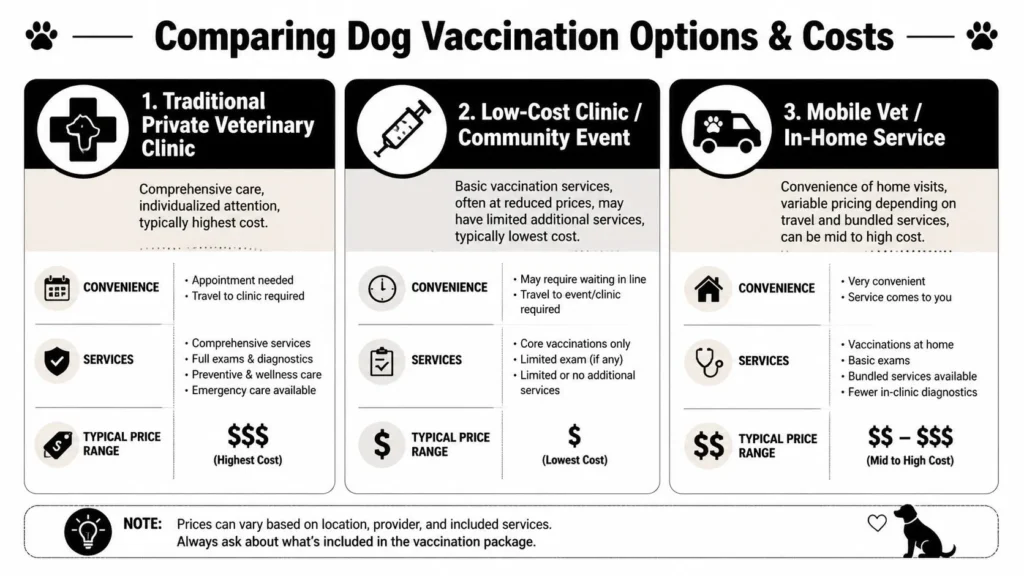
Where you go has a major effect on what you pay. In practice, most owners choose between a private veterinary clinic, a low-cost clinic or community event, and a mobile or pop-up service.
Private veterinary clinic
A private clinic is usually the most complete option. You get the exam, the record keeping, a relationship with one medical team, and a place to discuss things like allergies, weight, behavior, dental issues, and future preventive care.
That extra service costs more. The Angels for Animals pricing comparison notes that a standard wellness exam with core vaccines at a private vet can cost $150 to $250, while low-cost clinics can offer the same shots for under $100 by skipping office visit fees.
Best fit for:
- New puppies that need a full exam and ongoing medical history
- Dogs with health issues where the vet may adjust timing or recommendations
- Owners who want one home base for routine and urgent questions
Low-cost clinic or community vaccine event
These clinics are built for efficiency. You’re there for vaccines, basic preventive care, and fast throughput. If your dog is healthy and straightforward, this setup can work well.
The trade-off is depth. You may not get the same time for broader medical questions. If your dog has skin issues, anxiety, a history of reactions, or anything else that needs discussion, a quick clinic can feel limiting.
A lot of owners do well with a hybrid model. They use a regular vet for exams and a low-cost clinic for routine boosters when that’s appropriate.
Low-cost doesn’t mean low value. It usually means the clinic narrowed the service to the essentials and stripped out extra overhead.
Mobile and pop-up clinics
Mobile services sit in the middle for many people. Some are parked outside retailers. Some are local vans. Some offer in-home convenience. The appeal is obvious. They can be easy to schedule and easier to fit into a busy week than a traditional appointment.
The downside is variability. Some are excellent and organized. Some are purely transactional. Read what they require before you show up, including whether they need prior records, whether they charge separate fees, and how they handle follow-up proof of vaccination.
The real comparison
If I were helping an owner choose, I’d compare providers on three things:
| Option | Cost pattern | Convenience | Depth of care |
|---|---|---|---|
| Private vet | Highest total in many cases | Scheduled appointment | Strongest continuity |
| Low-cost clinic | Lowest total for routine shots | Good if dates align | Limited discussion time |
| Mobile or pop-up | Varies | Often very convenient | Usually narrower scope |
What works best depends on the dog in front of you. A healthy adult dog needing a routine shot is different from an eight-week-old puppy on visit one.
How to Reduce Your Dog Vaccination Bills
There are good ways to save on vaccines, and there are risky ways. The goal is to lower the bill without making your records unusable or creating problems for boarding, travel, or legal compliance.

Savings that usually work well
Some money-saving strategies are boring, but they’re reliable.
- Ask for vaccine packages. Clinics sometimes price a bundle more favorably than separate line items.
- Use community clinics for routine care when appropriate. This works best for healthy dogs with simple needs.
- Keep records organized. Lost vaccine paperwork can lead to repeat visits or repeat charges.
- Call before the appointment. Ask whether an exam fee is mandatory and what the total visit usually includes.
Nutrition planning matters too, because vaccine season often lands alongside parasite prevention and food costs. If you’re tightening the pet budget overall, a practical review of best dog food brands recommended by vets can help you avoid overpaying in another part of your monthly spend.
The controversial option of at-home vaccines
At-home kits can save money for some owners, but they aren’t a universal fix. The SnipWell wellness clinic information states that at-home vaccination kits are legal for non-rabies shots in most U.S. states and can cut costs by 40% or more, reducing the price to as low as $15 per dose, though liability and administration concerns remain.
That last part matters. A cheaper vial doesn’t automatically mean better value if:
- you store it incorrectly
- your dog has a reaction
- the shot isn’t documented in a way your boarding facility accepts
- you’re not confident giving injections
Worth considering: At-home vaccination can make sense for experienced owners handling non-rabies shots, but it’s a poor place to experiment if you’re unsure about technique, storage, or paperwork.
This video gives a useful look at the topic before you decide:
What usually does not work
Owners often try to save money by delaying boosters, skipping records, or bouncing between clinics without tracking what was given and when. That tends to create more expense later.
The best savings come from planning, not from guessing. Pick the clinic model that fits your dog, ask for total-visit pricing up front, and save every receipt and certificate.
Dog Vaccination Schedule and Common Questions
You bring home an 8 week old puppy, call one clinic, and hear one price. Call a low cost event or mobile clinic and the total can look very different. The schedule itself is usually straightforward. The budget gets messy when owners price each shot one at a time instead of mapping the whole first year.
Put the plan on a calendar first. Then price the full series by clinic type.
A typical first-year timeline
A standard puppy plan usually starts at 6 to 8 weeks, continues with DHPP boosters every 2 to 4 weeks until the series is complete, and adds rabies at about 16 weeks if your local rules and your veterinarian agree that timing fits. Some dogs also need non-core vaccines during that same window, depending on boarding, daycare, hiking, dog park exposure, or local risk.
A simple framework:
- 6 to 8 weeks: first puppy vaccines
- 10 to 12 weeks: next DHPP booster, and possibly other vaccines based on lifestyle
- 14 to 16 weeks: final DHPP in the puppy series for many dogs, plus rabies around this stage
- After the puppy series: booster timing depends on the vaccine used, your vet’s protocol, and your dog’s exposure risk
Budgeting matters in real life. A private clinic may bundle the exams, vaccine certificates, and follow-up reminders in a way that feels easier. A low-cost clinic or mobile event may bring the first-year total down, but you may need to track records yourself and be more organized about timing. Owners usually save the most when they compare the cost of the entire puppy series, not just the cheapest price for one DHPP visit.
Common questions owners ask
Do indoor-only dogs need the same shots?
Usually not the same non-core vaccines. Core vaccines are still commonly recommended because indoor dogs still slip outside, meet visiting dogs, go to groomers, or need emergency boarding.
Are titer tests better than boosters?
Sometimes, but they are not a universal budget shortcut. The answer depends on the vaccine, your dog’s age, medical history, and whether boarding or daycare facilities will accept a titer in place of a booster.
Can I get a multi-pet discount?
Sometimes. Community clinics, shelter events, and mobile vaccine days are the places where I see this most often. Ask before you book, and ask whether the discount applies to the exam fee, the vaccines, or both.
What if my dog is nervous at the vet?
Book a quieter appointment time if the clinic offers one. Bring every vaccine record you have so the visit stays focused and short. If your veterinarian suggests medication support for future visits, review safety first. This guide on whether Benadryl is safe for dogs covers one of the questions owners ask most often.
The practical takeaway is simple. Keep the schedule tight, keep your records in one place, and budget by first-year total. That approach makes it much easier to compare a private clinic with a low-cost clinic or mobile service and pick the option that fits both your dog and your wallet.
Discover more from Maxi Journal
Subscribe to get the latest posts sent to your email.