
The best travel insurance for international trips is never a one-size-fits-all policy. It’s a careful balance of high-limit emergency medical coverage and medical evacuation benefits, mixed with flexible trip cancellation options. Ultimately, the right plan is the one that perfectly matches your destination’s risks, your personal health profile, and the adventures you have planned.
Why Smart Travel Planning Starts with the Right Insurance

It’s easy to see travel insurance as just another line item on your trip budget—a frustrating but necessary expense. That’s a mistake. A much better way to think about it is as a critical investment in your financial safety and peace of mind. Once you leave the country, you’re dealing with countless variables completely out of your control, from a flight crew strike to a sudden medical emergency where your domestic health plan is useless.
Without proper coverage, you are personally on the hook for what could be staggering costs. A medical crisis in a foreign country can easily run up bills over $100,000. A last-minute trip cancellation could mean you forfeit thousands in non-refundable deposits. A solid insurance policy is what shifts that enormous financial risk from your shoulders to the insurer’s.
What Defines the “Best” Policy?
So, what makes a policy the “best”? It’s not about finding a single top-rated plan, but about finding the one that aligns with the unique details of your trip.
Here are the big factors that should shape your decision:
- Your Destination: The cost of healthcare varies wildly across the globe. A trip to the U.S. or Western Europe requires much higher medical limits than one to Southeast Asia.
- Trip Activities: Planning on scuba diving, skiing, or even rock climbing? Your standard policy probably won’t cover it. You’ll need to look for specific adventure sports add-ons.
- Your Health: If you have pre-existing medical conditions, you’ll need a policy with a specific waiver to ensure you’re covered if a related issue flares up while you’re away.
The real job of international travel insurance is to shield you from catastrophic financial loss. It’s less about small hiccups and more about protecting you from the kind of emergency that could derail your entire trip—and your finances.
Travelers are getting wiser to these risks, and it shows. With global tourism roaring back, the travel insurance market is on track to hit over $31 billion by 2025. This trend is explored in more detail on imarcgroup.com, highlighting just how essential this protection has become.
Essential Coverage Types at a Glance
Before we dive deeper, let’s break down the core components you’ll see in most comprehensive plans. Getting a handle on these pillars is the first step to comparing policies like a pro. And as you map out your travels, take a look at our guide on the top destinations for 2026 for a little inspiration.
| Coverage Type | What It Protects You From |
|---|---|
| Emergency Medical | Crippling costs from an unexpected illness or injury abroad. |
| Medical Evacuation | Transport to a proper medical facility or all the way back home. |
| Trip Cancellation | Losing non-refundable deposits if you have to cancel for a covered reason. |
| Trip Interruption | Unused trip costs if a covered event forces you to return home early. |
| Baggage & Personal Items | Loss, theft, or damage to your luggage and belongings during transit. |
Think of these as the non-negotiables. Any policy you seriously consider should offer robust protection in each of these five areas.
Decoding the Fine Print of Your Insurance Policy

The single most important step in finding the right travel insurance is learning how to actually read the policy. This is where the slick marketing promises meet reality. A policy’s true worth isn’t in its brochure but in the definitions, limits, and exclusions—the nitty-gritty that decides if you’re actually covered when things go sideways.
It can feel a little intimidating, I know. But the good news is that a few key terms and clauses do most of the heavy lifting. If you can learn to spot these, you can quickly cut through the noise and figure out what a policy is really offering. Don’t just glance at the summary of benefits; the real story is always buried in the details.
Medical Coverage Nuances You Cannot Ignore
Emergency medical coverage is the absolute core of any good international policy, but how effective it is boils down to the specific definitions. A classic phrase you’ll see everywhere is “reasonable and customary” charges. In plain English, this means the insurer will only pay what it considers a standard rate for a medical service in that particular city or country.
This is meant to protect them from wildly inflated hospital bills, but it can leave you holding the bag if you end up in a pricey private clinic. It’s always a smart move to have the 24/7 assistance team approve a facility before any major procedure. That way, you know the costs will be deemed “reasonable.”
Another huge detail is how medical evacuation works. Some basic policies only cover evacuation to the “nearest adequate facility,” which might just be a hospital in the next country over. The better policies, however, include “repatriation of remains” or, more importantly, evacuation all the way back to your home country. This is a far more comprehensive benefit you’ll be thankful for after a serious emergency.
The difference between getting flown to the ‘nearest’ hospital versus your home hospital can be tens of thousands of dollars. It’s also worlds apart in comfort and having family support nearby. Always, always verify which one your policy offers.
Understanding Your Financial Responsibility
Beyond the big, flashy coverage limits, two little numbers have a direct impact on your wallet: the deductible and the co-insurance.
- Deductible: This is the flat amount you have to pay out of pocket before your insurance starts paying. If you have a $250 deductible and get a $1,000 medical bill, you pay the first $250, and your insurer handles the remaining $750.
- Co-insurance: This is a percentage of the bill you might still be on the hook for even after your deductible is met. An 80/20 split is common, meaning the insurer pays 80% of the covered costs, and you’re responsible for the last 20%.
People often overlook these, but they are crucial for understanding your total potential cost. A policy with a $0 deductible might have a slightly higher premium, but it could save you a few hundred bucks if you just need to make a small claim.
The All-Important Exclusions List
Every single insurance policy has an exclusions list. Think of it as the “What We Don’t Cover” section. It’s hands down the most important part of the entire document, because this is where a huge number of claims get denied. You absolutely must read this part.
Here are some of the usual suspects you’ll find on that list:
- High-Risk Activities: Your standard policy will almost certainly exclude things like scuba diving, mountaineering, paragliding, or bungee jumping. If you’ve got adventure on the brain, you’ll need to buy a specific add-on or a specialized policy built for it.
- Pre-Existing Conditions: This is a big one that trips people up constantly. A pre-existing condition is pretty much any health issue you’ve received treatment or advice for before your policy started. If you don’t get a policy that includes a “pre-existing condition waiver,” any claim tied to that condition is almost guaranteed to be denied.
- Mental Health Disorders: Many basic plans offer very limited or zero coverage for mental health crises. If this is a concern, you need to check this section carefully.
- Intoxication: If you get hurt while under the influence of alcohol or non-prescribed drugs, your insurer has every right to deny the claim. This is a standard clause in virtually every policy on the market.
Skipping the exclusions list is one of the biggest mistakes travelers make. It’s so much better to know your coverage gaps before you leave home than to find out the hard way during an emergency. By taking a few minutes to decode these key sections, you go from being a hopeful buyer to a savvy, informed traveler—ready to pick a policy that will actually have your back.
Matching Your Travel Style to the Right Policy
Finding the best travel insurance isn’t about picking some “top-rated” plan off a list. It’s about matching the policy to your trip. The perfect coverage for a backpacker tackling remote jungles would be a disaster for a family on a two-week European cruise. It’s deeply personal.
To get it right, you have to think about your trip through the lens of risk. Where are you going? Who’s with you? What will you actually be doing? How long will you be gone? Each answer dramatically changes what you need, telling you which benefits to prioritize.
How Your Destination Shapes Your Policy
The single biggest factor here is your destination. Healthcare costs can be wildly different from one country to the next, and your policy’s medical limit has to be up to the task.
High-Cost Healthcare Regions: If you’re heading to places like the United States, Canada, or Western Europe, you need a policy with serious emergency medical limits—ideally $100,000 or more. A simple ER visit in the U.S. can easily rack up a five-figure bill. A standard plan with a low cap could leave you in a world of financial hurt.
Remote or Developing Regions: For trips to remote spots in Southeast Asia or South America, your main worry might shift from cost to quality. Local care might be cheap, but it could be subpar. A beefy medical evacuation benefit is key here, ensuring you can get transported to a modern hospital or all the way back home if things get serious.
Europe is a huge driver of the travel insurance market, and for good reason. It holds a massive share of the global market, partly because of strict requirements for things like the Schengen visa. These rules really highlight how important it is to have solid, compliant coverage when visiting the continent.
Factoring in Age and Pre-Existing Conditions
Your health profile is just as critical as your itinerary. Insurers see age as a direct indicator of risk, which is why premiums tend to climb for older travelers. But more importantly, anyone with a pre-existing medical condition needs to read the fine print very, very carefully.
A standard policy will almost always deny claims related to an unstable pre-existing condition. To cover yourself, you need to find a plan that offers a pre-existing medical condition waiver. This isn’t automatic; you usually have to buy your policy within a certain window (often 14-21 days) of paying your first trip deposit. Skip that waiver, and a flare-up of a known issue abroad will likely be on your dime. You can learn more about finding affordable airfare in our article about how to find cheap flights.
The Adventure Seeker’s Insurance Dilemma
So, are you planning to scuba dive in Thailand, ski the Alps, or go rock climbing in Costa Rica? If the answer is yes, your standard insurance policy probably isn’t going to cut it. Most basic plans have a long list of exclusions for activities they deem “high-risk” or “adventure sports.”
Do not assume your policy covers adventurous activities. Most basic plans explicitly exclude them. If you get injured while doing an excluded activity, your claim will almost certainly be denied, leaving you responsible for all medical and evacuation costs.
To make sure you’re actually protected, you have two paths:
- Purchase an Adventure Sports Add-On: Lots of providers sell an optional rider that extends coverage to a specific list of activities. Just make absolutely sure your planned activity is on that list.
- Buy a Specialized Policy: Some insurance companies cater directly to adventure travelers. Their policies are built from the ground up to cover everything from mountain trekking to surfing.
A family taking a city tour of Rome has completely different needs from a solo traveler trekking in Nepal. By being honest about your destination, health, and planned activities, you stop buying a generic product and start selecting a personalized safety net. That’s the only way to lock in the right coverage for your trip.
Comparing Top Travel Insurance Providers
Trying to pick the right international travel insurance provider can feel like you’re just throwing a dart at a board. On the surface, they all seem to offer the same core benefits, but the real difference—the thing that matters when you’re stuck in a foreign hospital—is in the fine print. It’s all about how they handle specific situations, the quality of their 24/7 assistance, and whether they actually pay claims without a fight.
Instead of just rattling off a list of features, let’s look at a few of the big names through the lens of different types of travelers. This way, you can cut through the marketing noise and see which provider truly aligns with how you travel. A policy that’s perfect for a trekker in Nepal is almost certainly the wrong fit for a family heading to Disney World.
This infographic breaks down three common travel styles to help you see where you fit.
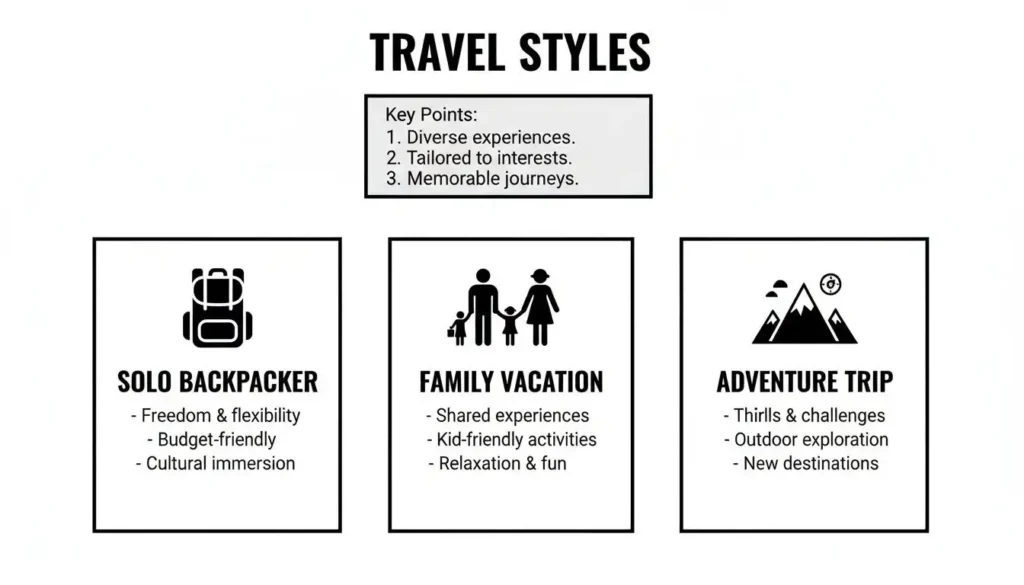
As you can see, the priorities of a solo backpacker, a family on a big trip, and an adventure junkie are worlds apart. Their insurance coverage needs to reflect that.
Scenario 1: The Adventure Traveler
Let’s say you’re off to Peru for two weeks to hike the Inca Trail and explore the Amazon. Your biggest worry isn’t a missed flight—it’s getting acute mountain sickness at 13,000 feet or twisting an ankle on a remote trail. For this trip, you need two things above all else: high-limit medical evacuation and coverage that doesn’t exclude “risky” activities.
A provider like World Nomads is built for this kind of travel. Their policies are designed from the ground up for active travelers, and they automatically include coverage for a ton of sports and activities you’d normally have to pay extra for.
Compare that to a more standard insurance plan, which might make you buy a pricey “sports rider” add-on just for trekking. With a company like World Nomads, hiking up to a certain altitude is often covered in their basic plans, which saves you a headache and some cash.
For adventure travel, the make-or-break feature isn’t just the medical limit; it’s the evacuation coverage. Getting you off a mountain and to a good hospital is a massive logistical challenge. You need a provider with a battle-tested global assistance network that knows how to make that happen.
Scenario 2: The Family Vacation
Now, picture a family of four heading to Italy for 10 days. They’ve dropped thousands on non-refundable flights, hotels, and tours. Their biggest risk is one of the kids getting a nasty ear infection a day before they leave, forcing them to cancel everything. Or maybe a huge flight delay makes them miss their connection and a prepaid cooking class in Rome.
For this family, a provider like Travelex or AIG Travel Guard is often a better bet. Their plans typically have robust trip cancellation and interruption benefits, which is critical when you have so much money tied up in prepaid costs. They also make it easy to cover the whole family under a single, simplified policy.
If this family chose a policy geared toward a solo backpacker, they might find the trip cancellation limits are way too low to cover the combined costs for four people. Family-focused plans also have better provisions for things you’d never think of, like reuniting a hospitalized child with their parents.
International Travel Insurance Provider Scorecard
To put this all into perspective, here’s a quick scorecard. This isn’t about picking a winner, but about matching the provider’s strengths to your travel style.
| Provider | Medical Limit | Evacuation Limit | Ideal Traveler Profile | Key Differentiator |
|---|---|---|---|---|
| World Nomads | Up to $100,000 | Up to $500,000 | Adventure Seeker, Backpacker | Built-in coverage for a wide range of sports and activities. |
| Travelex | Up to $50,000 | Up to $500,000 | Family, Cruise Traveler | Strong trip cancellation and children-under-17-covered-free policies. |
| AIG Travel Guard | Up to $100,000 | Up to $1,000,000 | All-Around Traveler | High evacuation limits and a strong global assistance reputation. |
| Seven Corners | Up to $5,000,000 | Up to $1,000,000 | Expat, Long-Term Traveler | Very high medical limits suitable for long stays or high-cost destinations. |
See what I mean? The “best” provider is totally dependent on who you are and where you’re going.
Scenario 3: The Traveler With a Pre-Existing Condition
Finally, let’s think about a retiree with a managed heart condition who’s planning a month-long journey through Southeast Asia. Their number one fear is that their condition might flare up abroad, leaving them with a crippling hospital bill that their insurance refuses to pay.
For this traveler, a single feature trumps all others: a pre-existing medical condition waiver. This is non-negotiable. Providers like John Hancock and Seven Corners often have plans with clear and accessible waivers. The catch? You usually have to buy the policy within 14-21 days of making your very first trip payment. Miss that window, and the waiver is gone.
A policy without this waiver would give the insurer a clear reason to deny any claim related to the heart condition. That’s why, even if another company offers higher coverage limits, the plan with a solid, attainable waiver is the only smart choice for this traveler. It really comes down to digging into the policy details to find the provider whose rules offer the protection you actually need.
Navigating the Claims Process Successfully

Even the best international travel insurance policy is just a piece of paper if you don’t know how to use it when things go wrong. Filing a claim can feel overwhelming, especially when you’re already stressed, but thinking ahead and acting fast will make all the difference. It’s about being methodical.
Think of your policy as your instruction manual for a crisis. The very moment something happens—a sudden illness, a stolen passport, a canceled flight—your first move should be calling your insurer’s 24/7 assistance line. This is the single most important step. They’ll guide you, and for medical emergencies, they often need to pre-authorize treatment to ensure it’s covered.
Before You Even Need to File a Claim
Honestly, a successful claim starts before you’ve even packed your bags. A little bit of organization upfront can turn a potential nightmare into a straightforward task. Get your ducks in a row now so you can act decisively later.
Here’s your pre-trip checklist for claims prep:
- Save the 24/7 Hotline Number: Program your insurer’s emergency assistance number into your phone. Seriously, do it now. Also, stick a physical copy in your wallet.
- Share Your Policy Details: Email a PDF of your policy to a trusted friend or family member who isn’t traveling with you. Keep a copy for yourself, either on your phone or printed out.
- Know Your Policy Number: Make sure your policy number is easy to find. You’ll need it for that first crucial call.
What to Do When an Incident Occurs
When something happens, your safety is priority one. But priority 1A is documentation. Insurance companies run on proof, and a lack of evidence is the number one reason claims get denied.
Start thinking like an investigator from the get-go. Your mission is to collect undeniable proof that a covered event happened and to document every single cost associated with it. The more thorough you are, the smoother things will go.
Begin collecting everything related to the incident immediately. If it’s a medical issue, you need itemized receipts, a doctor’s report explaining the diagnosis and treatment, and proof you paid. If your bag gets stolen, you need an official police report, receipts for essential things you had to buy, and any paperwork from the airline. Don’t forget to take photos and videos—a picture of a damaged suitcase or a delayed flight board can be powerful evidence.
Submitting Your Claim the Right Way
When you’re ready to file, pay very close attention to your insurer’s specific rules and deadlines. They are often incredibly strict, sometimes giving you as little as 30 days from the date of the incident to submit everything. The good news is that most companies now have online portals, which makes uploading all your carefully collected documents much easier.
Follow these steps for a clean submission:
- Complete the Claim Form: Fill out the official form completely and accurately. No shortcuts.
- Organize Your Documents: Attach all of your evidence—receipts, police reports, medical records, photos, and any other correspondence.
- Keep Copies: Never send your only copy. Always save a digital copy of the entire package you submit for your own records.
- Follow Up: Once submitted, write down your claim number. If you don’t hear anything for a week or two, give them a call to check on the status.
Getting your claim approved comes down to diligence and communication. By calling your provider right away, documenting everything meticulously, and submitting your paperwork on time, you give yourself the best possible chance of getting the full reimbursement you’re entitled to.
Frequently Asked Questions About International Travel Insurance
After you’ve compared a few policies, it’s natural to have some final questions pop up. Travel insurance has a lot of moving parts, and getting those last few details sorted is what leads to a confident decision.
Think of this as the practical stuff that comes to mind right before you’re about to click “buy.” We’ll cover everything from how your credit card perks measure up to what happens if your flight is already booked and you still don’t have a policy.
Do I Still Need Insurance if My Credit Card Has Travel Benefits?
This is easily one of the most common questions, and my answer is almost always a firm yes. While those premium travel credit cards offer some nice perks, they are absolutely not a substitute for a real, comprehensive travel insurance plan.
Here’s the thing: credit card benefits are designed to handle inconveniences, not catastrophes. They might give you decent trip cancellation coverage (if you paid for the whole trip with that card), but the medical coverage is usually an afterthought. We’re talking low limits—sometimes just $25,000 or less—which is a drop in the bucket if you have a serious medical emergency overseas.
What’s more, credit cards almost never include emergency medical evacuation. That alone can cost six figures and is one of the most critical reasons to get a dedicated insurance policy in the first place.
Your credit card’s travel benefits are a great backup plan, but they should never be your primary defense. They’re for lost bags and delayed flights, while a proper insurance policy is there to protect you from life-altering financial disasters.
Can I Buy Travel Insurance After I Have Already Left?
Generally, the answer is no. Most travel insurance is designed to be purchased before your trip starts. Insurers are all about managing risk, and letting travelers buy a policy mid-trip opens the door to people trying to get coverage for an accident that’s already happened.
However, a few companies have built their business around this exact need. Providers like World Nomads or SafetyWing specialize in policies for travelers who are already on the road. Just know that these usually come with a waiting period—often 24 to 72 hours—before benefits like medical coverage kick in. This is their way of making sure you aren’t buying a policy because you just broke your leg.
What Is the Difference Between Single-Trip and Annual Policies?
This one is pretty straightforward and just comes down to your travel habits. A single-trip policy covers one specific journey from start to finish. An annual (or multi-trip) plan covers all the traveling you do over a 365-day period.
For the vast majority of people, a single-trip plan is the way to go. There’s a reason it’s the dominant force in the market, generating USD 16.52 billion in 2024 and projected to grow by over 15% each year. It’s simple and tailored for that one big vacation. Grand View Research has some great data on these market trends if you’re curious.
An annual plan really only becomes a smart financial move if you’re taking three or more international trips a year. If that’s you, just make sure to read the fine print. Most annual plans have a cap on how long any single trip can be, usually 30, 45, or 90 days.
How Does Cancel for Any Reason Coverage Work?
Cancel for Any Reason (CFAR) is an optional upgrade that offers the ultimate peace of mind, but it’s not as simple as it sounds and it definitely costs extra. It lets you cancel for reasons your standard policy won’t cover—maybe you got into a fight with your travel buddy, a work project came up, or you just don’t feel like going anymore.
But it isn’t a get-out-of-jail-free card. There are some strict rules you have to follow:
- It’s a Time-Sensitive Add-On: You can only add CFAR coverage within a small window after booking your trip, typically 14-21 days from your first payment.
- You Must Insure Your Full Trip Cost: You have to insure 100% of your prepaid, non-refundable expenses. No cutting corners here.
- It Provides Partial Reimbursement: This is the big one. CFAR doesn’t give you all your money back. You’ll typically get between 50% and 75% of your insured trip cost.
- You Must Cancel in Advance: You can’t just not show up. You have to formally cancel your trip at least 48 hours before you’re scheduled to leave.
CFAR is a fantastic tool for people with expensive, non-refundable trips who want an escape hatch for any possible scenario. If you’re planning one of those big trips but haven’t settled on a spot, check out our guide on the top 10 countries to travel to in 2026 for some ideas.
At maxijournal.com, we believe that informed travel is smart travel. We’re dedicated to bringing you clear, actionable insights on everything from technology and health to the arts and tourism, helping you explore the world with confidence. Explore more articles and perspectives at maxijournal.com.
Discover more from Maxi Journal
Subscribe to get the latest posts sent to your email.


Pingback: Essential Activities and Sites to Visit in Tokyo for 2026
Pingback: Top 10 Affordable Honeymoon Destinations for 2026
Pingback: Plan Your 2026 Itinerary with 12 Essential Travel Stops
Pingback: Your Guide to Understanding Dog Training Cost - Maxi Journal