What makes a reader trust a science explainer, finish a fashion piece, and share a business article, all on the same publication? Strong blog writing usually comes down to editorial judgment.
Generic advice covers the basics, but a multi-category site asks more from a writer. maxijournal.com publishes across subjects with very different reader expectations. Science needs precision. Fashion needs pace and taste. Health needs restraint. Travel needs usefulness. The standard has to stay consistent even as the voice shifts by vertical.
That is the central editorial challenge. Good contributors handle it without flattening every article into the same template. They know how to adjust tone, sourcing, structure, and level of detail so each piece feels right for its category while still meeting the same bar for clarity, accuracy, and readability.
Volume raises the stakes. Readers have no shortage of posts competing for their attention, so frequency alone does not carry much weight anymore. Useful, well-edited work does. That is especially true for a publication covering everything from trend pieces to reported explainers.
If you are building your process, start with standards before ideas. A strong editorial system can turn even a broad list of blog post topic ideas for different categories into publishable work that feels consistent from section to section.
These 10 blog writing tips focus on that job: producing articles that fit their audience, hold up under editing, and read like they belong on the same publication even when the subjects are miles apart.
1. Know Your Audience and Write for Their Interests
Writers often confuse topic with audience. “AI tools,” “Paris travel,” and “summer skincare” are topics. The audience question is narrower: who is this for, what do they already know, and what do they need from this piece right now?
That matters even more on a site with many verticals. A health reader expects caution and clarity. A gaming reader usually tolerates more personality and speed. A business reader wants decision-useful information fast. If you flatten all of that into one generic house style, every category starts sounding slightly wrong.
A good starting point is a simple persona sheet for each vertical. Keep it practical, not corporate. What does this reader search for, what annoys them, what level of jargon can they handle, and what would make them trust the article enough to continue?

Match depth to reader intent
A science explainer about CRISPR should define terms early and trim speculation. A fashion piece about capsule wardrobes can move faster and lean on visual examples. A travel article should answer practical questions before drifting into atmosphere.
When contributors struggle, it’s often because they’re writing for themselves. The fix is usually simple:
- Read adjacent coverage: Study how strong publications in that niche frame similar stories.
- Review top-performing ideas: Use your own archive and resources like topics for blog posts to spot recurring reader interests.
- Adjust your vocabulary: Use specialized language only when it helps the reader understand the point, not when it helps the writer sound informed.
Practical rule: If your first three paragraphs don’t make it obvious who the article is helping, the draft isn’t ready.
The writers who do this well don’t chase everyone. They choose a reader and write directly to that reader’s level of curiosity, patience, and skepticism.
2. Create Compelling Headlines and Meta Descriptions
A weak headline wastes a strong article. An overpromising headline does something worse. It gets the click, then loses trust.
That trade-off matters on multi-category sites because each vertical has a different click culture. Entertainment can carry more playfulness. Health and science usually need restraint. Business readers often prefer direct value over drama. Good headlines respect the genre without becoming bland.
The safest pattern is simple. Be specific about the topic, clear about the benefit, and honest about the scope. “How to Build a Capsule Wardrobe for Work and Weekends” works because it tells the reader what they’ll get. “This Wardrobe Trick Changes Everything” might pull curiosity clicks, but it doesn’t build much confidence.
Write the headline after the draft
Editors do this for a reason. Once the piece is finished, you know what it delivers.
Try several versions before choosing one:
- Benefit-led: “How to Read a Nutrition Label Without Getting Misled”
- Question-led: “Why Do Some Running Shoes Feel Fast and Others Don’t?”
- Specific list-led: “7 Mistakes That Ruin a Beginner Travel Itinerary”
Meta descriptions deserve the same discipline. They aren’t ad copy detached from the article. They’re a compact promise. If the post is measured and evidence-based, the meta description should sound measured and evidence-based too.
Write headlines with tension, not trickery. Curiosity works best when the article resolves it quickly.
I’ve found that the best headline test is editorial, not technical. Would a careful reader feel accurately briefed after reading only the headline and meta description? If the answer is yes, you’re in the right range.
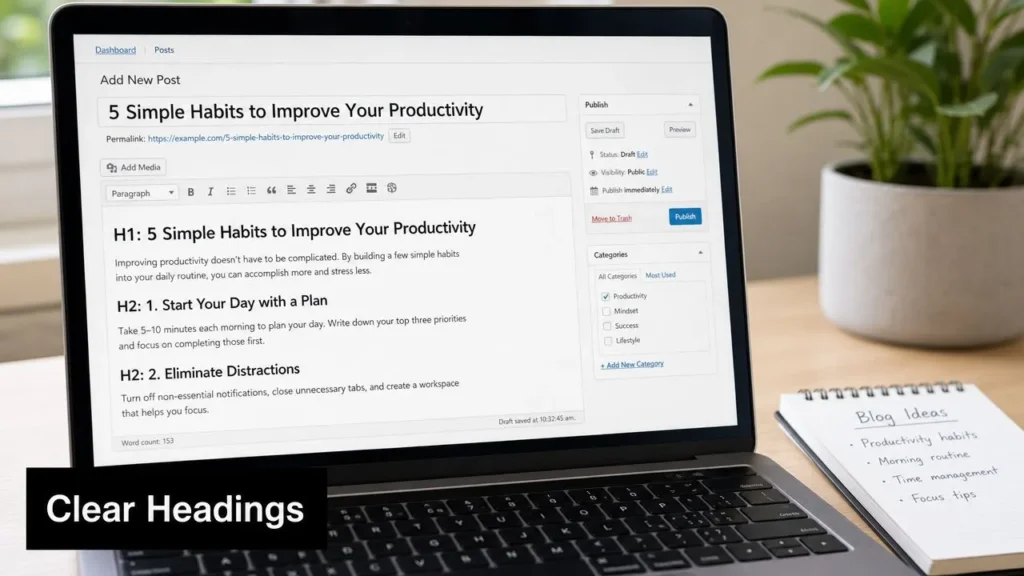
3. Structure Content with Clear Headings and Subheadings
Readers don’t read blogs the way they read essays. They scan, pause, jump, and return. If your structure is muddy, even strong reporting starts to feel harder than it is.
For long-form posts, structure also affects discoverability. One 2026 blogging roundup reports that posts over 3,000 words earn 3.5x more backlinks and 2.4x more social shares than posts under 1,000 words, while average blog post length has risen to 1,427 words (Digital Applied’s 2026 blogging data points). Long posts can win, but only if readers can move through them without friction.
Build a usable outline first
Good headings are not decoration. They’re the architecture of the argument.
For example, a travel guide might use:
- Getting there
- Where to stay
- What to eat
- What to skip
A tech review might use:
- What it does well
- Where it falls short
- Who should buy it
- Who should pass
That kind of structure helps writers stay focused and helps readers orient themselves. It also prevents the common problem where every section sounds like a variation of the introduction.
If outlining is a weak point, tools can help you get unstuck. This resource on how to create powerful blog outlines is useful for shaping a draft before you write full paragraphs.
Headings should carry information
Don’t write vague subheads like “Important considerations” or “Final thoughts” unless the section requires them. A better heading tells the reader what’s inside. “How to compare mirrorless cameras for travel” is far stronger than “Buying advice.”
The more complex the topic, the more your headings need to do real work.
4. Write in a Conversational, Accessible Tone
Accessible doesn’t mean shallow. It means readable on the first pass.
Writers sometimes swing too far in one direction. They either over-formalize and sound like a policy memo, or they over-casualize and drain authority from the piece. The sweet spot depends on the category, but the principle stays the same. Write like an informed person speaking clearly to another person.
A science article can use precise terminology and still sound human. A business article can be polished without slipping into jargon. A gaming review can be funny without becoming sloppy. Tone should serve comprehension first.
Translate complexity without flattening it
If you mention a technical term, define it immediately in plain language. If you quote a niche concept from fashion, finance, or health, explain why the reader should care. Don’t make people earn basic understanding.
A few habits help fast:
- Use contractions: They soften stiffness and make explanations sound natural.
- Prefer active voice: “The update improves battery life” is cleaner than “Battery life is improved by the update.”
- Cut throat-clearing: Remove openings that delay the point.
A readable sentence isn’t a lesser sentence. It’s usually a better edited one.
This matters even more on a publication that spans categories. Readers may come for one subject and sample another. If every article assumes insider knowledge, the publication becomes harder to enter. The best digital magazines widen the doorway without lowering standards.
5. Incorporate Multimedia Elements
Text does the heavy lifting, but visuals often make the article usable. In some categories, they’re not optional. Fashion needs styling examples. Travel needs a sense of place. Gaming benefits from screenshots. Science and business often need charts, diagrams, or process visuals.
Use media to clarify, not to decorate. A stock image of someone typing on a laptop rarely helps a finance article. A labeled comparison graphic might. A close-up image showing fabric texture can help in a fashion piece. A map or route screenshot can improve a travel guide immediately.
A useful example of video support appears below. It works best when the article topic has a process, demonstration, or visual sequence that readers benefit from seeing.
Use media with editorial intent
Every visual should answer one question: what does this add that text alone doesn’t?
That usually means one of four things:
- Show the object: product photos, outfit details, destination scenes
- Demonstrate the action: embedded video, step sequence, annotated screenshots
- Simplify the concept: charts, diagrams, infographics
- Break reading fatigue: visual pacing in long articles
Captions and alt text matter too. They improve accessibility, and they force the editor to decide whether the image is relevant. If you can’t describe why the image belongs there, it probably doesn’t.
Multimedia should make the article easier to understand, easier to scan, and more credible in categories where showing beats telling.
6. Optimize for Search Engines Without Compromising Quality
SEO advice often turns bad the moment writers start treating search terms as the audience. Search is a distribution method. The reader is still the job.
That distinction matters because formulaic SEO is easy to spot. You see it in stiff intros, repetitive wording, and headings written for robots rather than humans. Those pieces might get impressions, but they rarely hold attention. Good optimization should be almost invisible in the final read.
Current writing advice also needs updating. Many blog writing tips still stop at keywords and readability, but modern posts increasingly need to work for answer engines, AI search tools, and snippet extraction. Grammarly’s guidance highlights this gap and points toward a more useful question: how should writers structure content so it can be surfaced as a direct answer, not just as a standard page result (Grammarly’s article on how to write a blog).
Write for search results and answer extraction
That means doing a few things consistently:
- State the answer early: Put a concise answer near the top when the query is question-based.
- Use descriptive subheads: They help both readers and search systems understand section purpose.
- Support claims cleanly: Assertions without evidence are less useful for both trust and extraction.
For foundational guidance, this internal resource on SEO tips for beginners is a sensible companion. Practical taxonomy choices matter too, especially on category-heavy sites. This piece on tags and keywords for blog organization is worth reviewing if your archive is getting messy.
What works and what doesn’t
What works is search-aware writing that still sounds edited. What doesn’t is stuffing every heading with a phrase variation or forcing the keyword into sentences that don’t need it.
A useful article should be easy to find. It should also be worth finding.
7. Research Thoroughly and Cite Credible Sources
Authority is easier to claim than to earn. Readers can tell the difference.
On a publication that covers health, science, business, and technology alongside lighter categories, source discipline protects the whole brand. One weakly sourced article can make readers question the rest. That’s why good editorial systems treat fact-checking as part of writing, not as optional cleanup.
Use sources that deserve the reader’s trust
Start with primary material when possible. That might mean a study, official documentation, a public filing, a product manual, a direct interview, or a firsthand statement from the organization involved.
Then ask basic editorial questions:
- Who produced this information
- Why was it published
- Is there a conflict of interest
- Can the claim be independently verified
For contributors, source quality should be a submission standard, not a suggestion. If you’re building a draft for a reported or explanatory piece, this guide on how to find credible sources for research is the right starting point.
Weak sourcing usually hides behind confident prose. Strong sourcing lets the prose stay calm.
This applies differently by category, but it applies everywhere. A pet care article still needs dependable veterinary guidance. A travel article should distinguish firsthand recommendations from recopied listicles. A business piece should cite original company materials before repeating commentary.
Credibility shows in restraint
Good writers note uncertainty when the evidence is mixed. They avoid dressing up assumptions as facts. They don’t quote social chatter as if it were reporting.
That restraint makes the article stronger, not weaker. Readers trust publications that know the difference between “established,” “reported,” and “still developing.”
8. Write Clear Topic Sentences and Logical Flow
Why do promising blog posts lose readers halfway through? In editorial review, the problem is often simple. The writer knows the material, but the paragraph order makes the reader work too hard.
A clear topic sentence fixes that fast. The first line of a paragraph should tell the reader what the paragraph will prove, explain, or argue. Then the rest of the paragraph should deliver on that promise with detail, evidence, or example.
Weak paragraphs hide the point until the end. Strong paragraphs state the point early.
For example:
- Weak: a long setup about industry change before finally saying old content needs revision
- Strong: older posts need regular editorial review because useful archives lose value when facts, examples, or search intent change
That distinction matters on a multi-category publication such as maxijournal.com. Readers move differently through a science explainer than through a fashion trend piece, but both need the same editorial courtesy. Each paragraph should announce its job, stay on that job, and hand off cleanly to the next one.
Build flow at the paragraph level
Logical flow is paragraph order, not just sentence polish. If one paragraph explains a problem, the next should answer the obvious question. If one paragraph introduces a concept, the next should define it, apply it, or test it.
A practical sequence usually looks like this:
- Lead with the answer for search-driven posts and direct questions
- Move from context to detail for explainers
- Follow real step order in how-to pieces
- Keep related ideas together so readers do not see the same point repeated in different sections
Writers who cover multiple verticals need to be stricter here than specialists do. A business reader may tolerate tighter abstraction. A lifestyle reader may expect quicker payoff and clearer signposting. Good editing creates consistency without forcing every category into the same voice.
Check transitions for cause and consequence
The easiest way to test flow is to read only the first sentence of every paragraph. If those sentences form a clear outline, the piece is probably holding together. If they jump between ideas, repeat the same claim, or introduce points out of order, the draft needs restructuring before line edits.
I use a simple standard in edits. Every paragraph should answer one of three questions: What is the point? Why does it matter? What comes next? If a paragraph does none of those, it usually belongs somewhere else or should be cut.
9. Include Calls to Action and Engagement Opportunities
A blog post shouldn’t end like the power went out. Readers need a next step.
That doesn’t mean every article needs a hard sell. It means the piece should create a logical continuation. After a science explainer, that next step might be a related article. After a travel guide, it could be a destination roundup. After a business piece, it may be a newsletter invite or a contributor submission link.
Make the CTA fit the article
Bad CTAs feel imported from another page. Good ones complete the reading experience.
Useful CTA options include:
- Related reading: point to the next article a reader is likely to want
- Comment prompts: ask for specific reactions, not generic engagement
- Newsletter invites: match the category, not the entire site at once
- Contributor prompts: invite pitches from readers with relevant expertise
The best call to action feels like service, not interruption.
On a multi-category publication, editorial strategy is critical. Don’t ask a pet-care reader to subscribe to a broad business update. Don’t end a fashion article with a random technology prompt. Build category-specific pathways that respect why the reader arrived.
Keep it visible, not intrusive
Mid-article CTAs can work when they’re closely related to the content, but they shouldn’t break momentum. End-of-article CTAs are usually the safest place to ask for a bigger action because the reader has already received value.
If the article is good, the CTA doesn’t need to shout.
10. Edit, Proofread, and Revise for Quality and Clarity
Strong writing is usually rewritten writing. First drafts are for getting the material down. Finished articles come from decisions made afterward.
Publications develop their standards through editing. Editing isn’t just grammar correction. It involves testing logic, removing repetition, sharpening the angle, checking links, verifying claims, and making sure the voice fits both the category and the publication.
Revise in passes, not all at once
Trying to fix structure, style, spelling, and sourcing at the same time leads to missed problems. Separate the passes.
A practical edit sequence looks like this:
- First pass for structure: Does the piece answer the right question in the right order?
- Second pass for clarity: Can any sentence be made shorter, plainer, or sharper?
- Third pass for factual integrity: Are claims sourced, links working, names correct, and details consistent?
- Final pass for polish: Grammar, punctuation, formatting, captions, and mobile readability
I also recommend distance before final edits whenever the schedule allows. A short pause helps you hear clunky phrasing and spot missing transitions that were invisible during drafting.
Multi-category sites need consistent editing rules
A style guide earns its keep. You want flexibility in tone across categories, but consistency in fundamentals: attribution, headline style, capitalization, link handling, formatting, and evidence standards.
Good editing preserves the writer’s voice while protecting the publication’s credibility. That balance is hard. It’s also the work.
10-Point Blog Writing Tips Comparison
| Practice | Implementation complexity | Resource requirements | Expected outcomes | Ideal use cases | Key advantages |
|---|---|---|---|---|---|
| Know Your Audience and Write for Their Interests | Medium, research and segmentation required | Analytics, surveys, time, editorial coordination | Higher engagement, retention, targeted traffic | Multi-category sites, targeted campaigns, persona-driven content | Better targeting, improved SEO, stronger reader connection |
| Create Compelling Headlines and Meta Descriptions | Low–Medium, creative testing and optimization | Headline tools, A/B testing, copywriting time | Increased CTR, social shares, lower bounce rate | Social-driven posts, search snippets, listicles | Boosts clicks, sets accurate expectations |
| Structure Content with Clear Headings and Subheadings | Low, apply consistent hierarchy | CMS support, templates, editorial discipline | Improved readability, SEO, and accessibility | Long-form articles, tutorials, technical guides | Scannability, better SEO, easier navigation |
| Write in a Conversational, Accessible Tone | Low, stylistic calibration needed | Skilled writers, style guide, editorial review | Higher engagement, readability, audience loyalty | Lifestyle, entertainment, general audience pieces | Relatable voice, increased time-on-page |
| Incorporate Multimedia Elements (images, video, infographics) | Medium–High, production and integration effort | Photographers/designers, video editors, hosting, budget | Increased engagement, shares, retention, SEO lift | Fashion, travel, gaming, arts, product reviews | Visual appeal, better retention and shareability |
| Optimize for Search Engines (SEO) Without Compromising Quality | High, ongoing technical and content work | SEO tools, analysts, dev support, time | Sustainable organic traffic, discoverability, authority | Evergreen content, pillar pages, competitive niches | Long-term qualified traffic, improved visibility |
| Research Thoroughly and Cite Credible Sources | High, deep verification and sourcing | Access to studies, expert interviews, fact-checkers, time | Enhanced credibility, trust, backlinks, authority | Science, health, investigative, business analysis | Trustworthiness, authoritative content, reduced risk |
| Write Clear Topic Sentences and Logical Flow | Low–Medium, planning and discipline | Outlines, writing skill, editor oversight | Better comprehension, retention, smoother editing | How-to guides, explanatory articles, academic-style pieces | Clarity, easier editing, improved reader comprehension |
| Include Calls-to-Action and Engagement Opportunities | Low, strategic placement and wording | Copywriting, CMS elements, analytics for testing | Higher conversions, subscriptions, community engagement | Newsletters, community building, lead-generation posts | Converts readers to subscribers and participants |
| Edit, Proofread, and Revise for Quality and Clarity | Medium, multiple review rounds | Professional editors, proofreading tools, time | Polished publication, fewer errors, professional perception | High-stakes articles, expert pieces, brand content | Consistency, credibility, quality assurance |
Your Next Steps as a Master Blogger
The best blog writing tips are not tricks. They’re habits. Know who you’re writing for. Build a headline that earns attention without borrowing trust from the article. Structure the piece so readers can scan it, follow it, and return to it. Use a tone that sounds human, not inflated. Add media only when it clarifies something. Optimize for search without turning the draft into a keyword container. Research carefully. Sequence ideas cleanly. End with a next step. Then revise until the article says exactly what it needs to say, no more and no less.
For a multi-category publication, those habits matter even more. A magazine that covers science, health, fashion, pets, business, tourism, games, and entertainment can’t rely on one narrow writing formula. It needs contributors and editors who understand how to adapt the voice without lowering the standard. That’s the core job. Consistency doesn’t mean sameness. It means readers should feel the same level of care whether they click into a technology analysis, a travel feature, or a music-related commentary piece.
There’s also a practical reason to treat revision as part of the craft. Publishing is crowded, and archives matter. Strong posts can keep working if they’re updated, clarified, and improved over time. Old content isn’t dead weight if the editorial team maintains it. It becomes a living asset. That is one reason experienced editors care so much about structure, sourcing, and evergreen usefulness. They make future updates easier.
If you write for your own site, these principles give you a cleaner process. If you pitch publications, they help you submit work that feels publishable before an editor even touches it. That alone puts you in a different class from writers who send rough opinion dumps and hope editing will save them.
And if you’re aiming to contribute to a broad publication, study the category you want to write for before you pitch. Match the reader’s expectations. Bring specific expertise. Show that you can deliver a clear article, not just a promising idea. maxijournal.com is one relevant example of an independent web-based publication that works across multiple subject areas, which makes strong editorial discipline especially important for both staff and guest contributors.
Keep the standard high. Keep the writing readable. Keep the reader’s time in mind. That combination still beats most of what gets published.
If you want a place to apply these blog writing tips, read category coverage, or explore writing opportunities, visit maxijournal.com.
Discover more from Maxi Journal
Subscribe to get the latest posts sent to your email.