Tax season often catches freelance writers in the same posture. Laptop open, coffee cold, inbox full of payment notices, and a shoebox or folder full of receipts that suddenly looks important.
You know you spent money to do your work. You paid for software, internet, maybe a desk lamp, maybe a course, maybe website hosting. But knowing something feels like a business expense isn’t the same as knowing how to claim it properly. That gap is where stress lives.
The good news is that freelance writer tax deductions aren’t a mystery once you understand the logic behind them. You’re not trying to find magical loopholes. You’re identifying the actual costs of running your writing business, recording them clearly, and reporting them in the right place.
If you’re new to freelancing, the tax side can feel like a language nobody taught you when you learned how to pitch editors or land clients. That’s common, especially for people coming from salaried work or just getting started with freelance writing for beginners. Writing is creative work. Taxes are administrative work. You still need both.
Your First Step to Stress-Free Writer Taxes
A writer named Maya sits down in March to “get organized.” She has payments from a few clients, receipts in email, a monthly software subscription she forgot about, and a spare room she uses for work. Her first instinct is to search for a giant list of deductions and start checking boxes.
That usually creates more confusion, not less.
The better first step is simpler. Treat your taxes like you treat a writing assignment. You need a framework before you start drafting. For taxes, that framework is this: income in, expenses out, records kept, forms filed.
Once you see the process that way, the pile on your desk starts to separate into clear groups:
- Income records like client payments, bank deposits, and tax forms
- Expense records like receipts, invoices, and subscription confirmations
- Business-use details for things shared between work and life, such as internet or phone service
- Workspace information if you work from a dedicated area at home
Taxes get easier when you stop asking, “What can I get away with deducting?” and start asking, “What did it cost me to run this business?”
That shift matters. It keeps you grounded in real business activity instead of internet myths.
Most writers don’t need a complicated tax strategy. They need a repeatable method. You need to know which expenses count, how to calculate the ones that require allocation, which forms matter, and where people make expensive mistakes. One of the biggest is assuming every business headache creates a deduction. It doesn’t.
A clean tax season starts long before filing day. It starts when you understand what kind of worker you are in the eyes of the tax system. For a freelance writer, that answer is straightforward. You’re running a small business.
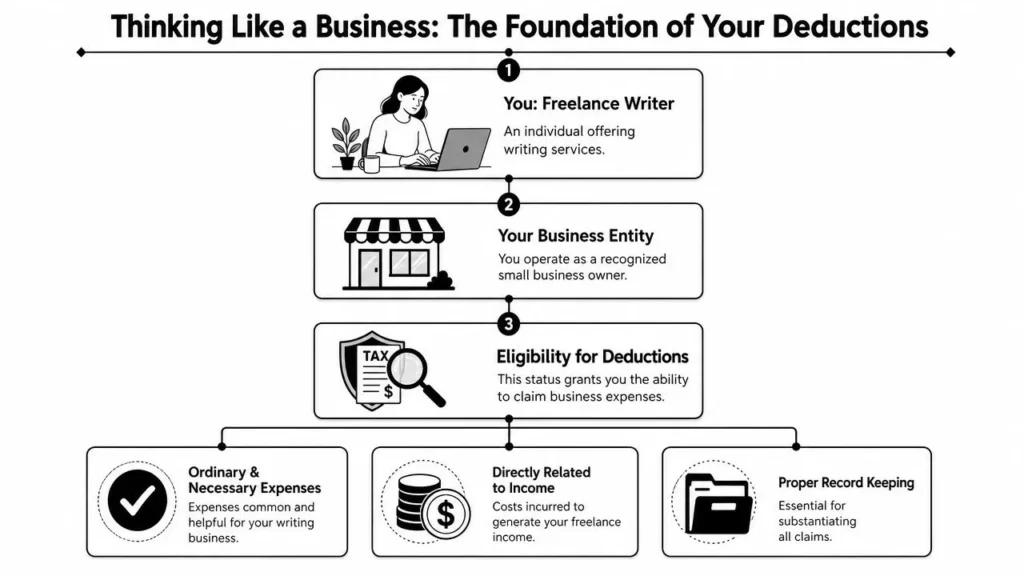
Thinking Like a Business The Foundation of Your Deductions
Freelance writing may feel personal, creative, and flexible. Tax law sees it differently. It sees a business owner earning income and paying the costs required to earn that income.
That mindset helps almost every tax decision.
A coffee shop owner buys beans, cups, cleaning supplies, and a point-of-sale system. Those costs exist because the shop exists. A freelance writer does the same thing in a different form. You might buy Scrivener, Adobe Acrobat, domain hosting, printer ink, or a transcript tool. Those aren’t random purchases. They’re part of how you operate.
Ordinary and necessary means business related
The phrase you’ll hear often is ordinary and necessary. In plain language, that means the expense is common, helpful, and connected to your work.
If you subscribe to Grammarly because you edit client drafts, that makes business sense. If you pay for website hosting because clients find you through your portfolio site, that also makes business sense. The deduction isn’t a reward. It’s recognition that you spent money to produce income.
Writers who want more structure often benefit from thinking through their operation the same way any owner would. Even a simple outline like a business plan for a solo service business can help you identify what you spend to market, deliver, and manage your work.
Practical rule: If an expense helps you write, edit, research, market, deliver, or manage client work, it belongs on your review list.
The tax you pay because you’re self-employed
Employees split Social Security and Medicare taxes with an employer. Freelancers don’t have that setup, so they pay self-employment tax themselves.
For freelance writers in the U.S., self-employment tax is 15.3% on 92.35% of net self-employment earnings, and you can deduct half of that tax as an adjustment to income according to TurboTax’s guide for freelance writers and self-published authors. In the same guidance, a writer with $10,000 in profit has a taxable self-employment base of $9,235, owes about $1,412 in self-employment tax, and can deduct roughly $706.
That example is useful because it shows two separate ideas:
- Profit matters more than gross income. You calculate tax after business expenses reduce your income.
- Part of your self-employment tax becomes deductible. You don’t get out of paying it, but you do get an adjustment that lowers taxable income.
Why this foundation matters
When writers skip this business-owner mindset, they usually make one of two mistakes. They either fail to claim legitimate costs, or they try to deduct things that aren’t grounded in the work.
Think of deductions like trimming a manuscript. You’re not inventing words that weren’t there. You’re removing what shouldn’t be taxed because it was the cost of producing the final piece.
That’s the foundation of freelance writer tax deductions. Once you understand that, the categories make much more sense.
The Ultimate Checklist of Deductions for Freelance Writers
A long deduction list can feel messy because it mixes very different kinds of spending. A better approach is to group expenses by how they function in your business. That mirrors how writers work.
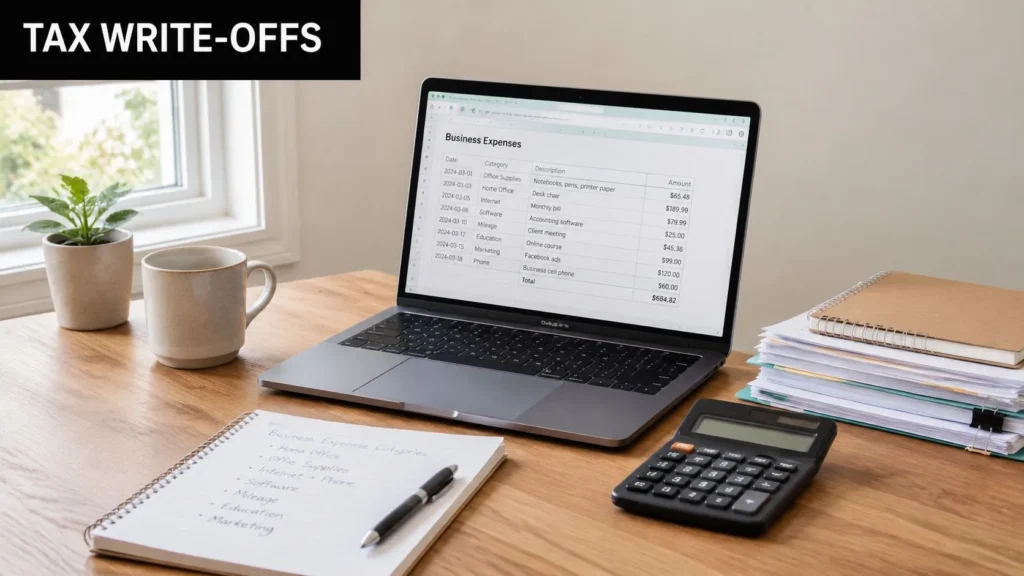
Your workspace
This category covers the place where you do the work.
A home office deduction hinges on one key idea. The space must be used regularly and exclusively for business.
That rule sits at the center of common writer deductions, along with software, marketing, and supplies, and many writers can also deduct 50% of qualifying business meal costs when the meals are ordinary and necessary for business, as explained in Found’s tax deductions guidance for writers.
Expenses in this group may include:
- Home office use if you have a dedicated writing space
- Utilities tied to that space when you’re using the actual-expense method
- Office furniture and small workspace supplies used for your writing business
- Internet access to the extent it’s used for work
A common confusion point is the kitchen table. If you write there and also eat there, that’s usually not the kind of exclusive business use the home office rule expects.
Tools of the trade
These are the tools you need to create and deliver your work.
- Computer and writing devices used for drafting, editing, communication, and file management
- Software subscriptions such as word processors, invoicing platforms, cloud storage, grammar tools, and PDF tools
- Research materials like books, databases, trade publications, and archives tied to your assignments
- Office supplies including notebooks, pens, printer paper, postage, and similar items
If you buy something that serves both work and personal life, don’t assume it’s fully deductible. Shared-use items usually need a business-use allocation.
Marketing and operations
Writers often forget these because they don’t feel as tangible as a laptop or desk.
Key distinction: If the expense helps people find you, hire you, or pay you, it often belongs in your business operations bucket.
Think about:
- Website hosting and domain fees
- Portfolio expenses such as design help or platform costs
- Advertising and promotional materials
- Payment processing or admin tools
- Professional memberships connected to your writing business
If you’re outside the U.S. or you want a practical comparison for solo-business thinking, this roundup of expert Australian sole trader guidance offers a useful parallel framework for separating business costs from personal ones.
Professional growth and client work support
Some expenses help you improve your skill or deliver work more effectively.
Examples include:
- Courses and workshops that maintain or improve your current writing business
- Conferences and industry events related to your niche or service
- Editing, proofreading, or subcontractor help if you outsource part of a project
- Business meals when they qualify under the ordinary-and-necessary standard
This category is where context matters. A general hobby purchase isn’t the same as a work-related education cost.
The simplest checklist to use all year
Use this short monthly review list:
- Scan subscriptions for software, hosting, and research tools
- Review card statements for supplies, memberships, and marketing costs
- Check your workspace for rent, utilities, and internet items that may need allocation
- Flag mixed-use expenses like phone or broadband so you can prorate them properly
- Save proof such as receipts, invoices, and confirmation emails
A deduction is easiest to claim when you recognize it close to the time you paid it.
How to Calculate Your Biggest Write-Offs
Most writers don’t struggle with obvious expenses like a grammar app or printer paper. They struggle with expenses that need math. The home office deduction is the clearest example.
You generally have two methods for a home office. One is simple and quick. The other takes more recordkeeping but may fit your real costs better.
Home office deduction at a glance
| Feature | Simplified Method | Regular (Actual Expense) Method |
|---|---|---|
| How it works | Uses a flat amount based on office square footage | Uses the business percentage of actual home costs |
| Rate | $5 per square foot up to 300 square feet according to Found’s common deductions guide for freelancers | Based on your actual eligible home expenses |
| Maximum square footage | 300 square feet | No flat square-foot cap stated under this method in the cited guidance |
| Example for a 150 square foot office | $750 deduction | 15% of actual eligible home expenses if the home is 1,000 square feet |
| Best fit | Writers who want speed and less paperwork | Writers whose actual home costs make allocation worthwhile |
A simple home office example
Let’s use a fictional writer, Lena.
She uses a spare bedroom only for client work, drafting, invoicing, and calls. The room is 150 square feet, and her home is 1,000 square feet. That means the office represents 15% of the home under the regular method, based on the same Found guidance linked above.
Here’s the logic:
- Measure the office area.
- Measure the whole home area.
- Divide office space by total home space.
- Apply that share to eligible home costs if using the regular method.
If Lena chooses the simplified method, she multiplies 150 square feet by $5 per square foot, which gives a $750 deduction under the same source.
If Lena chooses the regular method, she applies the 15% business-use percentage to eligible home expenses. That method can capture actual costs more closely, but it demands better records.
How proration works for shared expenses
Proration sounds technical, but the idea is basic. If you use something partly for business and partly for personal life, only the business part belongs on the tax return.
Visualize it as slicing a pizza. If your writing business ate one slice and your personal life ate the rest, your deduction is only that one slice.
Shared expenses often include:
- Internet service used for client communication, research, file delivery, and personal browsing
- Cell phone service used for both editor calls and family texts
- Software bundles where only certain tools support your work
- Supplies that drift between household and office use
Don’t guess wildly. Use a reasonable method and keep notes on how you arrived at your business-use percentage.
You don’t need perfect laboratory precision. You do need a method you can explain without scrambling.
Which home office method should you choose
The simplified method is like using a standard template. Fast, clean, easy to maintain.
The regular method is more like customizing a manuscript for a demanding editor. It takes longer, but it may reflect your actual situation better.
Use the simplified method if:
- You want ease and don’t want to track every home-related detail
- Your office is clearly measured and your records are otherwise minimal
- You prefer predictability over a more documentation-heavy approach
Use the regular method if:
- You already track home costs carefully
- Your dedicated office is substantial relative to the home
- You want your deduction tied to actual expenses
The right method isn’t the one that sounds smartest. It’s the one you can calculate accurately and defend with records.
Navigating Tax Forms and Estimated Payments
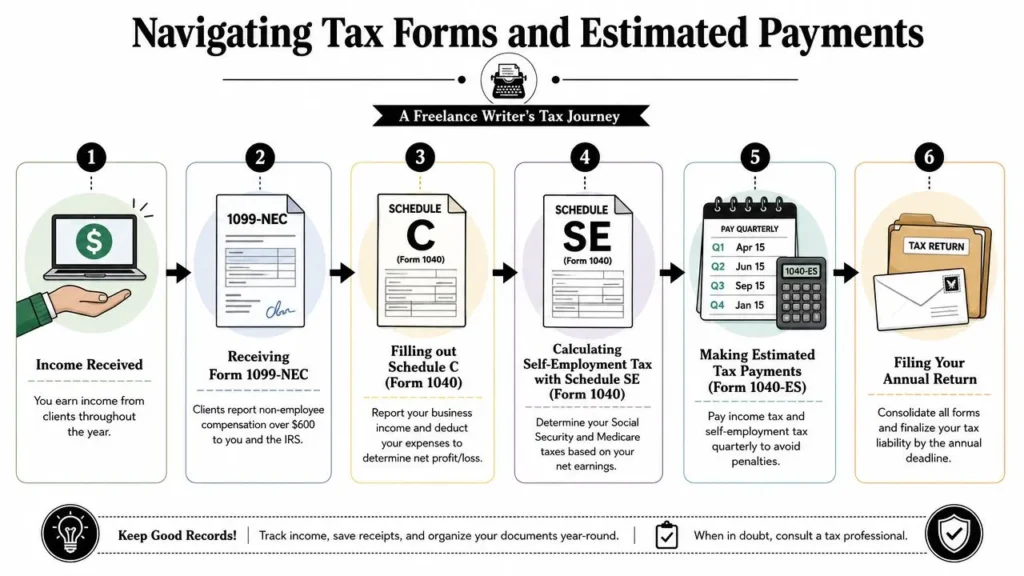
Freelance taxes feel overwhelming when the forms look disconnected. They’re a sequence. Money comes in, records gather, profit gets calculated, and tax gets paid.
The first document many writers notice is the payment form from a client.
The forms most writers deal with
If a single publisher pays you $600 or more, that payment generally triggers a Form 1099-NEC, as noted in the verified guidance from TurboTax cited earlier in the article. Even if you don’t receive one for every client, you’re still responsible for reporting your income.
The core workflow usually looks like this:
- You get paid by clients. Some may send tax forms, some may not.
- You total your business income and expenses.
- You report that business activity on Schedule C.
- Your net profit flows into your main tax return.
Schedule C is where your writing business really shows up on paper. It functions like a profit-and-loss statement for your freelance work. Income goes in. Deductible expenses come out. What’s left is your net business profit or loss.
For a quick visual explainer, this walkthrough can help:
Why estimated payments matter
Writers often ask why they owe money at filing time even when they’ve tracked deductions correctly. The answer is usually timing.
Clients typically don’t withhold taxes from freelance payments. That means nobody has been prepaying income tax and self-employment tax for you throughout the year. Employees have withholding. Freelancers usually make estimated tax payments instead.
The easiest mental model is this: each time your business earns money, a portion of that money isn’t fully yours to spend. Part of it belongs to taxes. If you wait until the annual return to deal with all of it, the bill can feel brutal.
A manageable payment routine
You don’t need a perfect crystal ball. You need a habit.
Try this routine:
- Set aside tax money when payments arrive in a separate savings account
- Review income and expenses regularly instead of waiting until year-end
- Use your bookkeeping records to estimate what part of your profit is likely taxable
- Pay on schedule so tax season becomes a reconciliation, not a rescue mission
A writer who tracks this monthly usually feels calmer than one who tries to reconstruct the whole year from bank statements and inbox searches.
Audit-Proof Your Business with Smart Recordkeeping
Good recordkeeping isn’t just protection. It’s visibility.
A writer with clean books can answer simple business questions fast. Which client pays most reliably? Which subscriptions still earn their keep? Which category keeps growing every month? Without records, those answers turn into guesses.
Separate your business life from your personal life
The cleanest habit you can build is separation.
Open a dedicated business bank account. Use a separate card for business purchases. Send client payments to the same business account whenever possible. That one boundary removes a huge amount of confusion later.
When all your transactions are mixed together, tax prep turns into detective work. When they’re separated, tax prep turns into review.
If you’re comparing systems, this guide to the best accounting software for freelancers can help you choose a setup that fits solo work instead of a large company workflow.
What to keep and how to keep it
You don’t need a complicated filing cabinet. You need consistency.
Keep these records:
- Income proof such as client invoices, payment confirmations, and deposit records
- Expense proof such as receipts, emailed confirmations, and subscription records
- Allocation notes for mixed-use items like phone and internet
- Home office support such as measurements and a note showing how you calculated business use
A receipt without context can become useless later. Add a short note when the business purpose isn’t obvious.
A restaurant receipt that says “editor lunch about project revisions” is stronger than a mystery charge with no explanation.
The real payoff
Clean records do more than help in an audit. They show you whether your writing business is working.
You can spot waste faster. You can see which tools matter. You can prepare estimated taxes without panic. And when it’s time to file, you’re not rebuilding a year from memory. You’re reviewing a system you’ve maintained all along.
Answers to Your Top Freelance Tax Questions
Some tax questions keep coming up because the answer feels counterintuitive, often leading many writers to make avoidable mistakes.
Can I deduct an unpaid client invoice
Usually, no.
Most freelance writers use cash-basis accounting, and under that approach they generally can’t claim a bad-debt deduction for unpaid client invoices because they never reported that unpaid amount as income in the first place, according to the ASJA tax tips for self-employed writers.
That’s one of the most misunderstood points in freelance taxes. If you sent an invoice and the client never paid, it feels like a loss. Economically, it is. Tax-wise, for most writers, it’s mainly a collections problem rather than a deduction.
If the money never made it into taxable income under your accounting method, there usually isn’t a tax loss to write off.
Do state taxes work the same way
Not always.
Federal rules are only one layer. Your state may have its own income tax rules, filing thresholds, and payment expectations. If you work across state lines, moved during the year, or earn from multiple locations, state issues can become more complicated than your federal return.
Should I think about retirement accounts
Yes, especially if freelance income has become stable.
Many self-employed people look at options such as a SEP IRA or Solo 401(k). The right choice depends on your income pattern, cash flow, and whether simplicity or flexibility matters more to you. This is one area where personalized advice can pay off because retirement decisions connect to taxes, savings goals, and long-term planning.
When should I hire an accountant
Hire help when DIY stops being efficient or accurate.
That might be the year you add multiple income streams, start earning enough that estimated taxes feel harder to manage, use a home office with several allocated expenses, or realize you’re avoiding your books because the process feels murky. A good accountant doesn’t just file forms. They reduce mistakes and give you better decisions.
If you want more practical, reader-friendly guides on business, writing, education, and everyday how-to topics, explore maxijournal.com. It’s a useful place to keep learning without wading through jargon.
Discover more from Maxi Journal
Subscribe to get the latest posts sent to your email.