Real Madrid have won 156 of the 305 official Madrid derbies, while Atlético have won 76 and 73 have finished level, according to LaLiga’s derby statistics page. That’s the usual headline. The more interesting one is what it hides.
The modern Atletico Madrid vs Real Madrid matchup no longer turns on romance, noise, or old stereotypes about one side having the ball and the other waiting to break. It’s become a far more technical contest. Atlético compress space, defend in a compact block, and force Real into crowded central zones. Real still carry the stronger historical record and stronger attacking performance indicators, but they don’t get easy solutions against this opponent.
That’s why this derby keeps resisting lazy analysis. The talent gap often points one way. The game pattern often points another.
| Category | Real Madrid | Atlético Madrid |
|---|---|---|
| All-competition derby wins | 156 | 76 |
| Draws in all competitions | 73 | 73 |
| LaLiga derby wins | 92 | 42 |
| Current 1vs1 Score | 87.96 | 76.53 |
| Current attacking xT | 9140.18 | 7285.13 |
| Current defensive xT conceded | 367.47 | 349 |
The Madrid Derby Stakes for 2026
This specific derby matters because it sits at the intersection of pressure, momentum, and unfinished argument. In March 2026, Real Madrid beat Atlético 3-2 at the Bernabéu, and match reporting said the comeback kept Real’s title chase alive while cutting the gap to Barcelona to four points, as noted in the 365Scores match coverage. That result did more than shift the table. It sharpened the rivalry’s current question.
The old debate asks which club owns Madrid. The better one asks whether the derby has become more balanced in single-match, high-pressure situations, even while Real still carry the heavier historical record. That distinction matters because modern derbies are often decided by game states, not reputation. One early turnover, one set piece, one wide duel won repeatedly, and the match script changes.
Why this fixture feels sharper now
Real enter this rivalry with the burden of expectation. Their squad profile, status, and broader body of results push them into favorite territory in most public conversations. Atlético, meanwhile, often arrive with a different kind of advantage. They don’t need territorial dominance to make the match uncomfortable. They need control of spacing, second balls, and transition moments.
The derby’s edge now comes from structural tension, not just emotion. Real usually have more attacking capacity. Atlético often have the cleaner plan for denying it.
That’s why the recent 3-2 matters. It suggests volatility. Real could still impose themselves and recover in a high-stakes setting, but the match also underlined how narrow the margin can be. This isn’t a fixture where historical superiority automatically turns into control.
For 2026, that makes the derby feel less like a legacy contest and more like a tactical referendum. If Real win, they reinforce the idea that superior attacking quality still finds a route through. If Atlético win, they strengthen the case that the rivalry has become a matchup problem first and a talent contest second.
A Rivalry Written in History
The scale of Atletico Madrid vs Real Madrid starts with volume. The clubs have met 305 times in all competitions, with Real winning 156, Atlético winning 76, and 73 ending in draws, according to LaLiga’s all-time derby record. The first recorded meeting came on February 28, 1904, and Madrid won 4-0. History, in other words, didn’t ease Atlético into this rivalry.
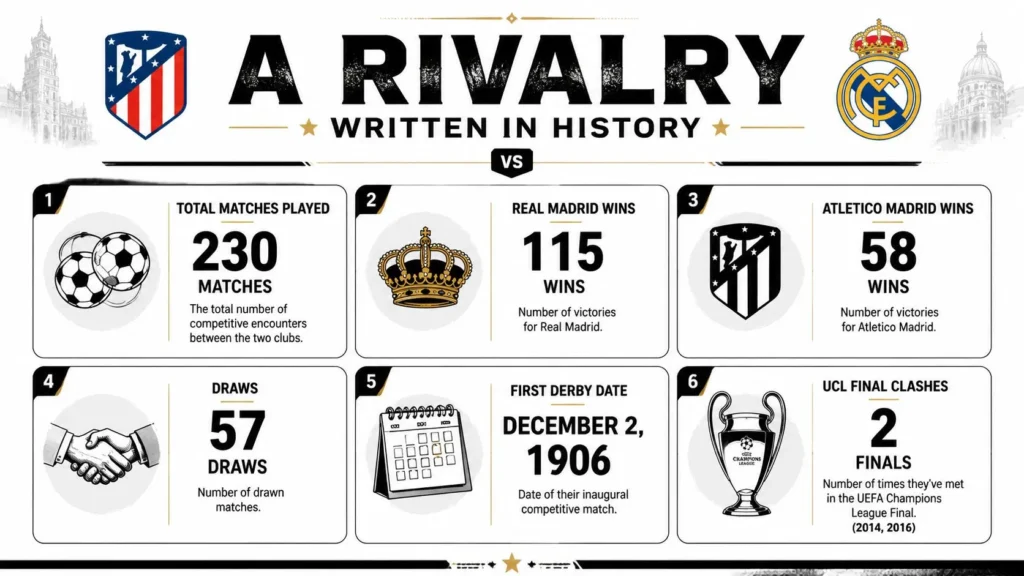
League play tells a similar story. Across 174 LaLiga meetings, Real have 92 wins, Atlético have 42, and 44 have been drawn, again per LaLiga’s derby breakdown. That matters because league derbies strip away some of the one-off volatility of cup football. Over repeated meetings, Real have still held the stronger line.
The weight of Europe
The rivalry changes shape in Europe. There, every meeting carries heavier symbolic baggage because Real bring continental authority and Atlético bring the memory of near-misses and resistance.
Historical fault line: In the UEFA Champions League head-to-head, Real Madrid lead 6 wins to 3, with 2 draws, and the goals stand at 16 for Real and 9 for Atlético, according to UEFA’s head-to-head page.
That same UEFA summary adds the starkest contrast of all. Real Madrid have 15 European Cup or Champions League titles. Atlético have 0. No domestic statistic captures the emotional asymmetry of the derby more cleanly than that one.
What history does and doesn’t decide
History sets the terms of the conversation, but it doesn’t decide the next match. Real’s long-term edge is real, and it’s substantial. Their overall win rate in official derby meetings is about 51.1%, while Atlético’s is about 24.9%, based on the same LaLiga historical record.
Still, those numbers can mislead if you use them lazily. They explain prestige. They don’t explain why recent derbies can still feel so awkward for Real over long stretches.
That’s the tension at the center of this fixture. One club owns more of the past. The other keeps finding ways to complicate the present.
Analyzing Current Form and Performance Metrics
Current performance data gives Real Madrid the statistical edge, but it also hints at why the derby isn’t straightforward. In the season comparison at One-versus-One’s Real Madrid vs Atlético Madrid page, Real hold a 1vs1 Score of 87.96 compared with Atlético’s 76.53. They also post a higher attacking Expected Threat total, 9140.18 against 7285.13.
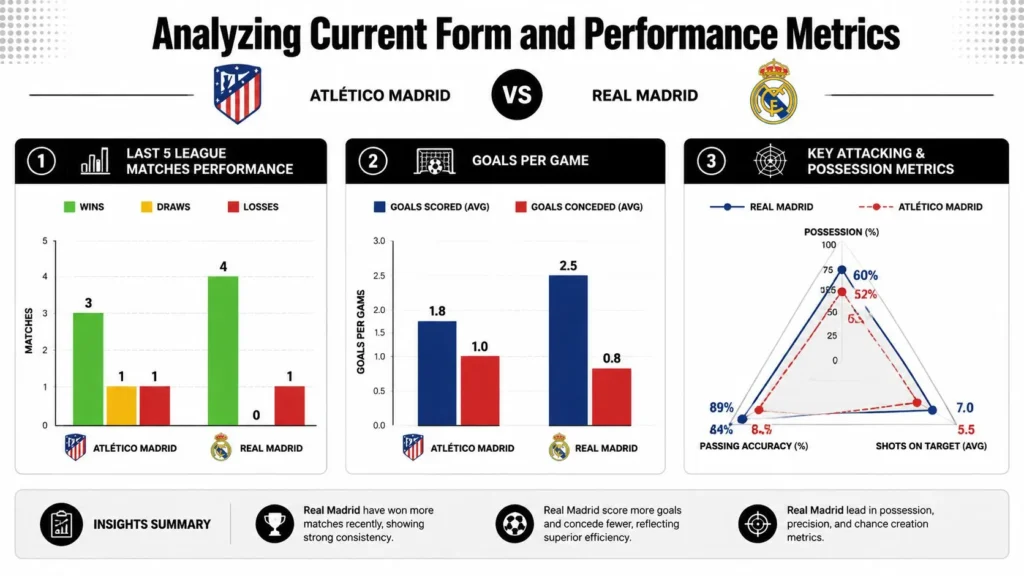
Expected Threat matters here because it points to how often a team moves the ball into dangerous zones, not just how often it shoots. Real’s advantage suggests they’re better at pushing possessions into areas that can destabilize defensive structures. That’s an important marker against most opponents. Against Atlético, it becomes a test of patience.
Where Real look stronger
Real’s profile is the more expansive one. The stronger 1vs1 Score supports the basic eye test that they carry more individual winners across the pitch. The higher xT number also suggests they don’t rely on one pattern to threaten. They can build danger through combinations, carries, and positional rotations.
A useful practical read is this. Real tend to arrive at dangerous spaces more often. When they control the rhythm, they force the opponent into repeated defensive decisions.
If you’re interested in the mentality side of high-pressure sport, there’s a thoughtful piece on building confidence in sports that fits derby football more than it might seem. These matches often come down to whether players keep repeating the right action after a few failed ones.
Where Atlético stay close
Atlético’s offensive output in this comparison is lower, but the defensive side is tighter. Their defensive xT conceded is 349, compared with 367.47 for Real in the same One-versus-One comparison. The gap isn’t huge, but it supports the idea that Atlético are built to limit how cleanly opponents advance danger against them.
Real’s edge shows up in chance progression. Atlético’s relevance shows up in resistance.
That combination explains why this derby often feels tense rather than open. Real’s data says they should generate more attacking momentum. Atlético’s defensive profile says they can reduce the quality of the spaces where that momentum develops.
So the metrics don’t point to a mystery. They point to a clash between a team that creates more threat and a team that’s especially good at making threat feel incomplete.
The Evolving Tactical Battleground
The modern Madrid derby has moved beyond the old possession-versus-counterattack cliché. As described in AS match coverage of Real Madrid vs Atlético Madrid, the more accurate frame is mid-blocks, transition defense, and set-piece strength. Atlético sit in a compact 4-4-2 mid-block, and Real often struggle to break that structure down cleanly.
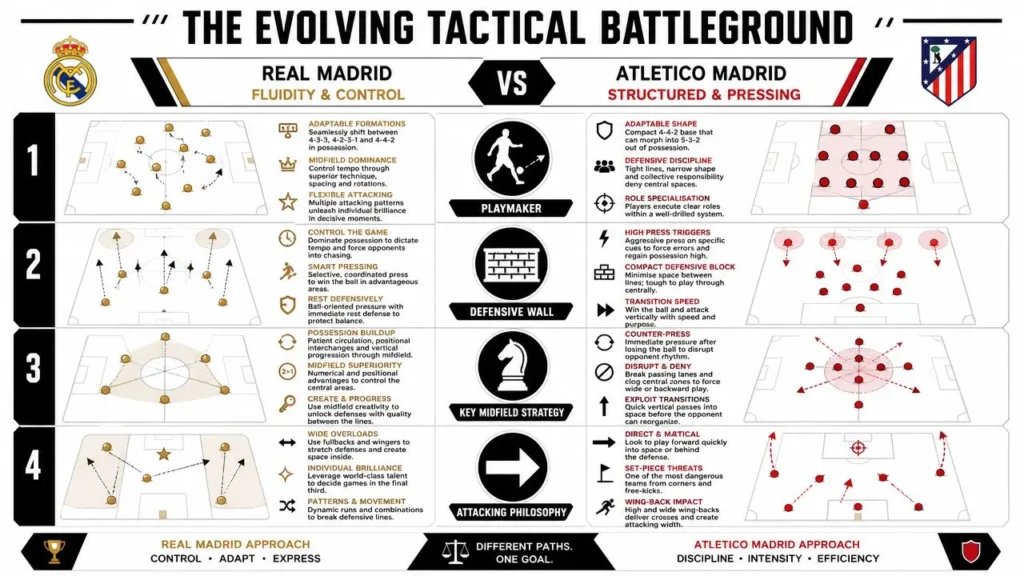
That tactical shift matters because it changes what “control” means. Real can have more of the ball and still feel uncomfortable. Atlético can defend lower than people expect and still feel like the side dictating the game’s geometry.
Why Atlético’s block still causes trouble
Atlético’s compactness does two jobs at once. First, it protects central areas, where Real often want to combine between the lines. Second, it invites Real toward zones that look available but don’t produce clean final actions.
The result is a derby pattern many viewers recognize without always naming. Real circulate, probe, and try to drag the block apart. Atlético stay narrow, hold distances, and wait for either a poor pass or a loose touch that turns defense into transition.
Atlético don’t just defend space. They defend Real’s preferred sequence of actions.
That’s why these matches can feel tighter than the squad lists suggest. Atlético aren’t only trying to survive pressure. They’re trying to distort where Real’s creativity appears.
A useful parallel for shape and spacing is how analysts discuss Manchester United formation ideas. The names change, but the principle is the same. Structure decides which player receives facing forward and which one receives under pressure.
Real’s likely route through the problem
Real’s answer usually starts wide. If central spaces are packed, the obvious route is to stretch the block, isolate defenders, and force Atlético’s wide midfielders or full-backs into uncomfortable decisions. Wide overloads matter because they can create the half-second needed for a cutback, switch, or dribble inside.
The second route is tempo variation. Atlético’s block is hardest to break when Real attack at one speed. If Real alternate patient circulation with sudden vertical passes and aggressive runs, they can make the block reset under stress instead of on schedule.
A third factor is transition defense after losing the ball. That sounds defensive, but it’s central to attacking Atlético. Real can only commit numbers if they trust their rest defense behind the play. If they don’t, every attack becomes cautious.
The set-piece layer
Set pieces sit underneath all of this. In these games, they aren’t side events. They’re pressure points. A compact tactical battle creates fewer open-play advantages, so dead-ball moments gain outsized value.
That’s another reason the derby no longer fits easy labels. It’s not artistry against grit. It’s a chess match about field zones, second phases, and who can force the other side into repeating its least comfortable pattern.
Key Players and Decisive On-Pitch Battles
The derby usually turns on a handful of repeated confrontations rather than one grand tactical gesture. You can understand the match by watching who keeps winning the same duel.
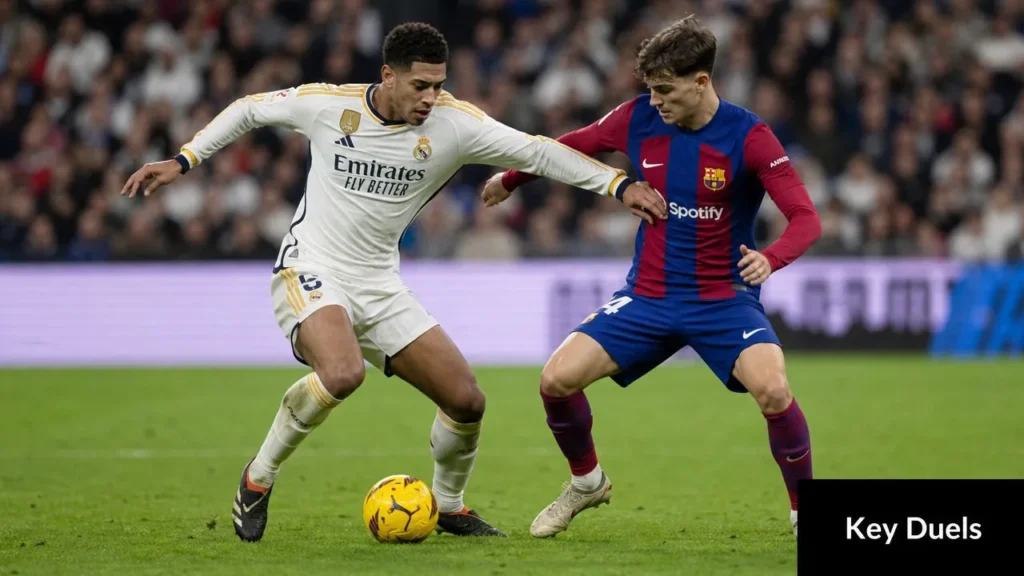
This section has to stay qualitative because no verified injury or suspension list has been provided here. So the key question isn’t who’s unavailable. It’s which roles become decisive if both sides can execute their preferred plan.
The wide dribbler against the compact flank
Real’s most dangerous attacking player in this fixture is often the one who can break the shape without needing a perfect passing chain. That’s why the wide dribbler matters so much. Against Atlético, individual elimination of a defender can do what sustained circulation often can’t. It can force the entire block to shift late.
That duel isn’t only about beating a man. It’s about what follows. If the first defender is beaten, does Atlético’s cover arrive in time? If it does, can Real find the cutback before the block recovers?
For readers who enjoy the technical side of 1v1 play, these soccer dribbling techniques help explain why body shape, first touch, and timing matter as much as raw speed in matches like this.
The playmaker between the lines
Every derby has a player whose job is to receive where the game is tightest. For Real, that’s the advanced midfielder or roaming creator who must operate between Atlético’s midfield and defensive lines. For Atlético, it’s the forward or hybrid attacker who can connect relief passes and turn defensive recoveries into attacks.
This duel often decides whether the match gets pinned in one half or starts to breathe. If Real’s between-the-lines player receives cleanly and often, Atlético’s block gets stretched from the inside. If Atlético’s connector can collect and turn after recoveries, Real’s rest defense suddenly has to retreat.
The midfield battle that doesn’t always look dramatic
The center of the pitch in this derby rarely announces itself with constant spectacular moments. It functions in a more understated manner. One side wins the second ball, resets possession, and attacks again. The other clears pressure, finds a simple outlet, and gains twenty seconds of oxygen.
Three details tend to matter most:
- Receiving under pressure: The midfielder who opens his body well changes the angle of the next pass.
- Counterpress timing: Real need immediate pressure after turnovers to stop Atlético escaping.
- Foul management: Atlético often benefit when the game becomes stop-start. Real usually prefer sustained rhythm.
The decisive midfielder in this derby often isn’t the one who plays the prettiest pass. It’s the one who keeps his team in the right part of the field.
The box defenders
At some point, all the tactical theory collapses into the penalty area. Atlético’s defenders need to judge crosses, cutbacks, and near-post movements. Real’s defenders need to deal with direct balls, second phases, and set-piece chaos.
That’s where the derby can feel brutally simple. One side survives repeated entries. The other survives repeated restarts. Whichever group defends its box with fewer hesitations usually controls the emotional flow of the night.
Pathways to Victory for Each Club
The cleanest way to read this derby is to picture two different match scripts.
How Atlético win
Atlético’s best route is to make Real’s superior attacking data feel irrelevant for long stretches. That means preserving compact distances, protecting central spaces, and forcing Real toward lower-value touches outside the block. Once that’s established, Atlético can attack selected moments rather than chase the game.
Their winning script usually includes several ingredients:
- A disciplined mid-block: Real must see bodies in every central lane.
- Fast punishment after recoveries: Atlético don’t need many transition moments. They need a few clean ones.
- Set-piece pressure: In a tight game, dead balls can become the clearest route to scoreboard control.
If Atlético score first, the match often bends toward them. Not because Real can’t come back, but because Atlético’s structure becomes easier to maintain when they can defend the game instead of opening it.
How Real win
Real’s route is different. They need to keep trusting circulation without letting it become sterile. The danger against Atlético is frustration. A blocked pass, an underhit cutback, a promising run that ends in traffic. If Real start forcing central solutions too early, Atlético get the kind of game they want.
Real Madrid’s blueprint usually looks like this:
- Stretch the block early through width.
- Attack the second phase after partial clearances.
- Sustain pressure without giving up transition control.
Their decisive moments often come when the game loosens slightly. A successful wide duel. A quick switch after Atlético shift too far. A cutback from the byline. Or a single elite attacking action that no structure can fully prevent.
The deeper read
Both teams want the same thing in different forms. They want the game played on their terms of repetition. Real want repeated entries into dangerous zones until quality tells. Atlético want repeated defensive actions until impatience appears.
That’s why this fixture is so compelling. It’s not random. It’s a battle over which pattern the opponent is forced to live inside.
Viewing Information and Betting Odds Context
Verified data provided for this article doesn’t include official kickoff times, broadcasters, streaming listings, or bookmaker prices for the upcoming derby, so it would be wrong to invent them. The practical move is to check official club channels, LaLiga’s match center, or your local rights holder shortly before the game.
If you’re trying to sort out your viewing options by venue rather than by app, this guide on where to watch La Liga is a useful starting point for finding public screenings and football-friendly bars in the right setting. For a derby like this, that’s often better than scrambling at the last minute.
How to think about the market without forcing fake precision
Even without citing odds, you can still read the likely market logic. Real Madrid will usually attract favorite status because of their broader historical edge and stronger current attacking metrics. Atlético will usually appeal to anyone who expects a compressed game state, a tactical grind, or a match decided by one swing event.
A few sensible checks before kickoff:
- Confirm the official start time: Schedules can shift.
- Verify the broadcaster in your region: Rights differ by country.
- Treat odds as sentiment, not truth: Markets reflect expectation, not certainty.
That last point matters in this derby more than most. The public often prices quality. Atlético often price disruption.
If you like football analysis that goes beyond surface-level talking points, maxijournal.com is worth bookmarking. It publishes accessible commentary across sports and other topics, with room for readers who want sharp breakdowns without the usual noise.
Discover more from Maxi Journal
Subscribe to get the latest posts sent to your email.