Most advice on Bull Terrier vs Pitbull starts in the wrong place. It asks which dog is stronger, calmer, safer, or better for families, as if you’re comparing two single breeds with neat, fixed traits.
You’re not.
A Bull Terrier is one specific breed. “Pit bull” is commonly used as a label for several breeds and mixes, and that one fact changes almost every practical part of ownership. It affects what the dog may look like, how predictable its size will be, whether people identify it correctly, and whether housing or legal problems show up before you’ve even brought the dog home.
If you miss that distinction, online comparisons get confusing fast. One article may really mean the American Pit Bull Terrier. Another may mix in the American Staffordshire Terrier, Staffordshire Bull Terrier, or dogs that only resemble those breeds. Then readers walk away thinking they learned something concrete, when really they compared one defined breed with a moving target.
That doesn’t mean the comparison is useless. It means you need a better one. A responsible choice isn’t about repeating breed stereotypes. It’s about understanding standardization, labeling, training demands, public perception, and the kind of daily owner effort each dog needs.
Bull Terrier vs Pitbull An Introduction
The first thing to clear up is the word pitbull. Many comparisons are misleading because “pit bull” is used inconsistently for multiple breeds and mixes, while the Bull Terrier is a single, specific breed with its own registry standards, as noted by the United Kennel Club’s American Pit Bull Terrier overview.
That sounds technical, but it has real consequences.
If someone says they own a Bull Terrier, you can usually picture a fairly specific dog. If someone says they own a pit bull, you may be talking about an American Pit Bull Terrier, a similar bully breed, or a mix that got that label from a shelter, landlord, neighbor, or veterinarian. Those are not always the same thing.
Why readers get tripped up
Many individuals search this topic looking for simple answers:
- “Which one is more aggressive?” That question assumes breed label tells you enough about behavior.
- “Which one is bigger?” That only works if both sides of the comparison are equally standardized.
- “Which one is legal where I live?” That gets messy because laws often target labels, not careful breed identification.
The most useful comparison isn’t Bull Terrier versus a stereotype. It’s Bull Terrier versus the real-world category people call pit bull.
This matters most for prospective owners. A Bull Terrier usually gives you more consistency in appearance and structure. A pit bull-type dog may give you a broader range of body types, energy levels, and public reactions, depending on the individual dog and how others label it.
The practical lens that actually helps
For most homes, the better questions are:
- Can I handle a muscular, energetic dog with strong opinions?
- Am I prepared for training and socialization from day one?
- Will my housing, insurance, and local rules create extra barriers?
- Am I choosing an individual dog, or reacting to a breed name?
Those questions lead to smarter decisions than internet folklore ever will.
Shared Origins and Divergent Paths
Bull Terriers and pit bull-type dogs do share history. Both the Bull Terrier and the American Pit Bull Terrier were developed in 19th-century Britain from similar Bulldog and terrier stock, but the Bull Terrier was standardized early as a distinct show breed, while “pit bull” became a broader label for several related breeds, according to Spark Paws’ historical comparison.
That single split explains a lot.
Same roots, different destination
Both types came from crosses meant to combine terrier drive with bulldog strength. From there, breeders and owners pushed them in different directions.
The Bull Terrier moved toward a recognizable breed identity. Over time, that meant a more fixed look, a more uniform outline, and clearer expectations about what a Bull Terrier should be.
Pit bull-type dogs followed a different path. The label stayed broader, and in real life it came to cover several related breeds and mixes rather than one universally agreed form. That’s why so many conversations about pit bulls become circular. People think they’re discussing one dog type, but they’re often picturing different dogs.
Why standardization matters to owners
Breed standardization isn’t just for dog shows. It shapes what owners can reasonably predict.
With a defined breed like the Bull Terrier, you’re more likely to get consistency in:
- General appearance
- Body shape
- How breeders and registries describe the breed
- What professionals mean when they identify the dog
With pit bull-type dogs, the experience can be less predictable because the label itself is less precise. A shelter may apply it based on looks. A landlord may apply it based on fear. A passerby may apply it to any muscular short-haired dog with a broad head.
Practical rule: If a breed label will affect your housing, insurance, or local restrictions, ask what the dog is called on veterinary, adoption, and registration paperwork before you commit.
Why online advice often feels contradictory
Often, the usual breed articles fall apart. One writer compares Bull Terriers to the American Pit Bull Terrier. Another folds in the Staffordshire Bull Terrier. Another uses “pit bull” for almost any bully mix. Then the size, temperament, and training sections don’t match from article to article.
So when you read bull terrier vs pitbull, remember you’re not comparing two equally fixed categories. You’re comparing one breed with one broad label. Once you understand that, the rest of the differences make far more sense.
Comparing Appearance Physicality and Strength
If you only look at muscle and short coats, these dogs can seem similar from a distance. Up close, the differences are easier to spot, especially when you compare a standard Bull Terrier with the American Pit Bull Terrier rather than with the broad pit bull label.
| Trait | Bull Terrier (Standard) | American Pit Bull Terrier |
|---|---|---|
| Breed status | One specific breed | One specific breed within the broader pit bull label |
| Overall build | More standardized and compact | More variable within pit bull-type dogs |
| Head shape | Distinctive, egg-shaped profile | Broad, powerful head |
| Height | 21.5 to 24.5 inches based on one breed guide in Dogster’s comparison | Often somewhat shorter, with wider variation by line and sex |
| Weight | 55 to 80 pounds in the same Dogster guide | Commonly 30 to 60 pounds for the American Pit Bull Terrier in that same guide |
| Visual consistency | Usually easier to identify correctly | Often confused with other bully breeds and mixes |
| Athletic impression | Dense, sturdy, animated | Lean to muscular, often more rangy or power-driven |
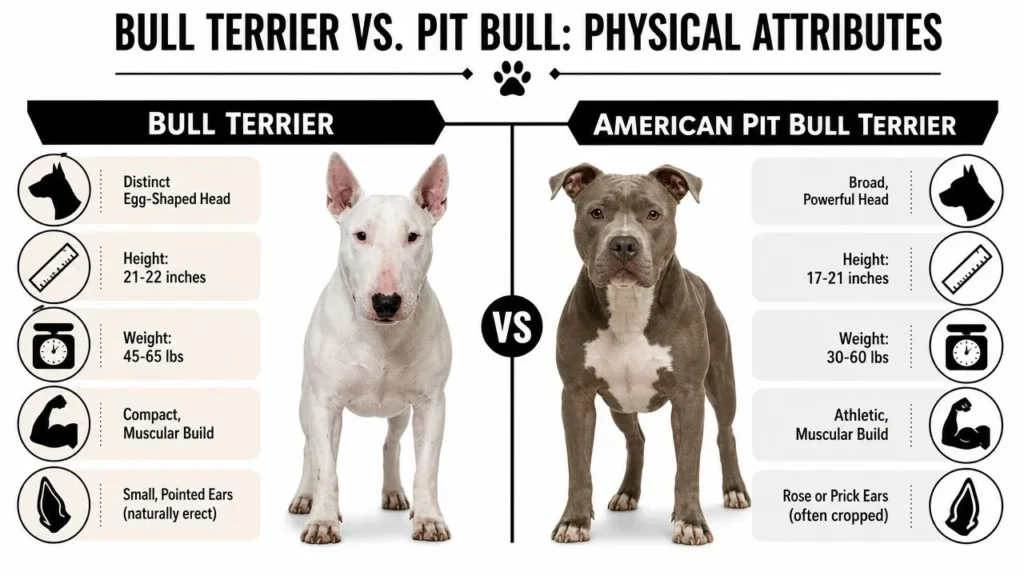
The easiest way to tell them apart
The Bull Terrier’s head is the giveaway. It has that unusual curved profile and narrow, triangular eyes that make the breed hard to mistake once you’ve seen it a few times.
The American Pit Bull Terrier usually looks more conventionally blocky through the head and jaw. But that still doesn’t solve the wider pit bull problem, because many dogs labeled pit bulls don’t neatly match one standard appearance.
If your main concern is visual predictability, the Bull Terrier usually wins that comparison.
Size and structure are not equally fixed
One useful breed guide lists the Bull Terrier at 55 to 80 pounds and 21.5 to 24.5 inches, while pit bull-type dogs vary more broadly and the American Pit Bull Terrier commonly falls around 30 to 60 pounds in that same comparison at Dogster.
That doesn’t mean every Bull Terrier is bigger than every pit bull-type dog. It means the Bull Terrier tends to sit inside a more stable frame of expectation, while pit bull-type dogs can vary much more.
For an owner, that affects practical things like:
- Crate and kennel sizing
- Strength on leash
- How much dog you are physically managing
- Whether breed ID by appearance will be straightforward or contested
Strength without drama
People often search this topic because they want to know which dog is stronger. The honest answer is that both are powerful dogs, and individual conditioning matters a lot.
One media comparison cites a bite-force estimate of 269 psi for the Bull Terrier and 330 psi for the Pit Bull, and scores athletic capability at 7/11 for the Bull Terrier and 8/11 for the Pit Bull, as discussed in this video comparison. Those figures are best treated cautiously because they are not presented as a controlled veterinary benchmark.
What can you safely take from that? Not that one dog is a monster and the other isn’t. The practical takeaway is simpler: both need competent handling, solid leash manners, and impulse control training.
If your household can’t safely manage a strong dog during excitement, frustration, or poor weather walks, keep shopping. Strength is only manageable when training and handling are already in place.
Understanding Temperament and Training Needs
The most common mistake in this debate is treating breed name like a personality test. It isn’t. Research indicates that breed is generally a poor predictor of individual dog behavior, and that responsible ownership, consistent training, and thorough socialization matter more than breed stereotypes, as summarized by Best Friends’ pit bull resource.
That should change how you evaluate both dogs.
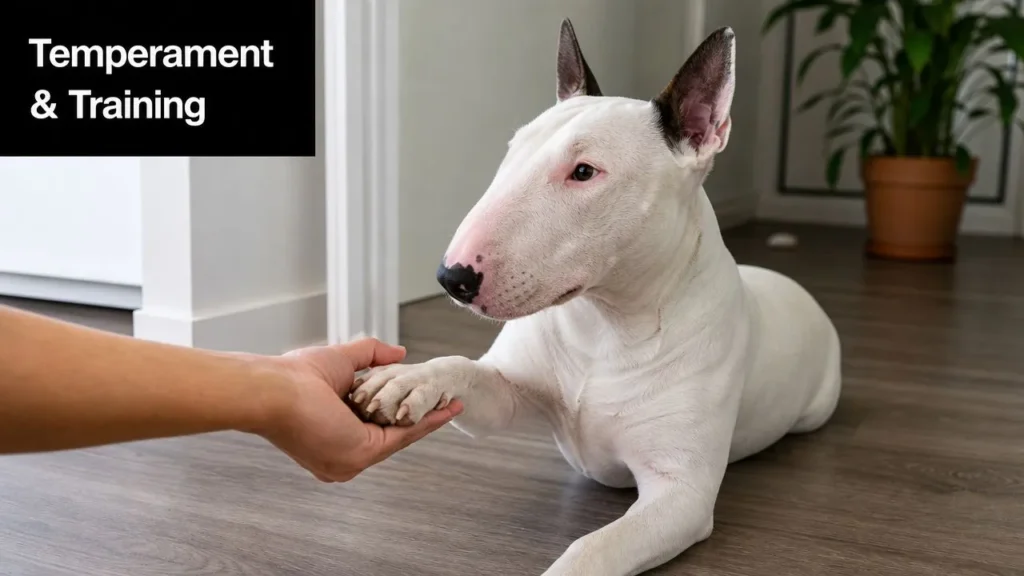
What owners usually experience
Bull Terriers often strike people as comic, busy, and a bit stubborn. They can be charming one minute and headstrong the next. That means training has to be clear and consistent, not emotional, repetitive, or sloppy.
Many pit bull-type dogs, especially those bred and raised well, come across as people-focused and physically affectionate. But because the label covers different dogs, you’ll see more variation. Some are highly biddable. Some are intense. Some are soft and sensitive. Some are overaroused and need structure more than cuddles.
Neither type does well with lazy training.
What matters more than breed label
For a strong dog, owner habits shape outcomes fast. Focus on these areas:
- Early routine: Feed, walk, rest, and train on a predictable schedule so the dog learns how the home works.
- Leash foundations: Reward loose-leash walking before pulling becomes self-reinforcing.
- Handling practice: Touch paws, ears, collar, and mouth gently so grooming and vet visits don’t become a fight.
- Arousal control: Teach settle, place, wait, and polite greeting skills, not just sit.
- Careful socialization: Expose the dog to people, surfaces, sounds, and daily life in a calm, structured way.
A rescue dog may need even more patience. If you’re adopting rather than buying, this guide on how to train a rescue dog is useful because it focuses on decompression, structure, and trust-building instead of forcing quick results.
Training style should fit the dog in front of you
Bull Terriers often need sessions that are upbeat and brief. They can get silly, bored, or oppositional if you drill too long. You want engagement, not a battle of wills.
Pit bull-type dogs often respond well to clear reward-based work and regular physical outlets, but many also need help learning to settle when excited. A dog that loves people can still knock guests over, drag on leash, or become hard to interrupt if nobody taught self-control.
Good training doesn’t ask, “Is this breed good or bad?” It asks, “What motivates this individual dog, and what structure does this home provide every day?”
If you’re comparing Bull Terrier vs Pitbull for family life, this is the answer that matters most. Choose the dog whose needs you can meet consistently, especially when life gets inconvenient.
Health Lifespan and Daily Care
A responsible owner shouldn’t choose between these dogs based on appearance alone. Daily care is where an owner’s commitment becomes evident. Both can be relatively low-maintenance in coat care, but neither is low-effort overall.
Day-to-day needs you should assume
Both types generally need regular exercise, deliberate mental stimulation, and household rules that stay consistent. If they get bored, frustrated, or underexercised, many strong terrier-bully dogs invent their own entertainment. That can mean rough play, chewing, pacing, jumping, or persistent attention-seeking.
Their coats are usually easy to maintain, but short-haired dogs still need routine care:
- Brushing: Helps remove loose hair and dirt.
- Skin checks: Short coats make it easier to spot irritation, rashes, or bumps.
- Nail care: Strong, active dogs still need trims if nails don’t wear down evenly.
- Ear and paw checks: Especially important after outdoor play.
Health planning matters more than guesswork
Bull Terriers and pit bull-type dogs can each have breed-associated health concerns, but the exact risks depend on lineage, breeding quality, and the individual dog. That’s why your best protection isn’t internet folklore. It’s working with a careful breeder or a transparent rescue, then staying current with veterinary care.
Before bringing either dog home, ask for:
- Veterinary records if the dog is being rehomed or adopted.
- A clear history of past skin, orthopedic, or hearing issues if known.
- Photos or videos of normal movement so you can watch how the dog carries itself.
- Current diet details, because abrupt food changes can create avoidable problems.
For feeding, don’t default to flashy packaging. Use a veterinarian-informed approach and compare ingredient quality, life-stage suitability, and tolerance. A roundup of dog food brands recommended by vets can help you narrow options before discussing them with your own veterinarian.
The daily-care question that decides ownership
Ask yourself this: can you still meet this dog’s needs on a bad week?
If your schedule gets chaotic, a muscular, energetic dog won’t lower its needs to be convenient. The right owner for either type is someone who can keep routines stable, notice early health changes, and respond before small issues become expensive or dangerous ones.
Legal Considerations and Public Perception
The ownership experience often varies substantially between these breeds. A Bull Terrier may attract curiosity. A pit bull-type dog is more likely to trigger rules, assumptions, and extra scrutiny before anyone knows the individual animal.
That burden is real. In 2023, pit bull-type dogs made up about 22% of the 3.2 million dogs entering North American shelters and about 40% of the 450,000 shelter euthanasias, according to pit bull shelter statistics compiled by The Pit Bull Coalition. Those numbers don’t tell you what any one dog is like. They do show how strongly the label affects welfare outcomes.
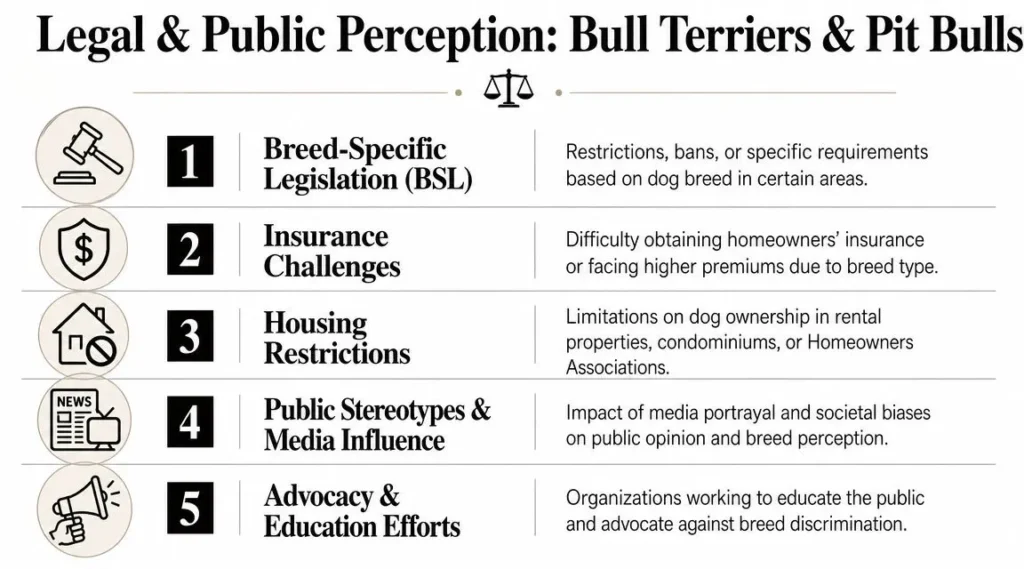
The ownership problems people don’t plan for
Some owners prepare for food, training, and vet bills, but not for outside restrictions. With pit bull-type dogs, you may run into:
- Housing limits: Rentals, condos, and HOAs may ban or restrict certain breed labels.
- Insurance problems: Some carriers ask breed questions or apply exclusions.
- Public misidentification: Your dog may be labeled by appearance, not by paperwork.
- Travel complications: Visiting another city or staying with family can raise new rule issues.
Bull Terriers can also face confusion because they are muscular bully-type dogs, but pit bull-type labels tend to draw more direct policy attention.
Why law and liability deserve serious attention
Any strong dog owner should understand local liability rules before an incident happens. If you want a plain-English legal primer, this overview of Texas dog bite laws is a practical example of the kinds of issues owners should review in their own state, especially if they own a dog that strangers may already view with suspicion.
Public perception doesn’t just shape opinions. It can shape leases, insurance decisions, complaint calls, and what happens after a single misunderstanding.
What a prepared owner does
A smart owner of either dog, especially a pit bull-type dog, plans ahead:
- Verify local rules before adoption or purchase
- Read lease and insurance language carefully
- Keep vaccination, licensing, and training records organized
- Use secure equipment and good leash habits in public
- Advocate calmly, not defensively, when people ask questions
This part of the Bull Terrier vs Pitbull decision isn’t glamorous, but it may be the deciding factor for where you can live and how easily your dog can stay with you.
How to Choose the Right Dog for Your Home
A good choice isn’t about which dog wins on paper. It’s about which dog fits the life you lead.

The Bull Terrier is often a better fit if
You want a clearly defined breed with a distinct look and more predictable overall type. You also don’t mind a dog with comic intensity and a stubborn streak that requires patient, consistent training.
This can be a strong match if you enjoy quirky dogs and won’t take pushy behavior personally. You need structure, humor, and enough physical control to manage a solid, energetic animal.
A pit bull-type dog may fit better if
You’re open to choosing the individual dog rather than chasing a single neat breed description. That often works best for adopters who can evaluate temperament carefully, commit to training, and manage the realities of housing rules and public perception.
If you’re setting up a crate or run for a rescue or new adoption, kennel dimensions matter more than many people expect. This kennel size guide from Van Dyke Outdoors is a helpful planning tool when you’re matching enclosure space to the dog’s build and movement style.
Your final checklist
Ask these before you decide:
- Can I handle a strong dog politely and consistently every day?
- Am I ready for training that includes impulse control, not just basic commands?
- Will my landlord, insurer, or local laws create breed-label problems?
- Do I prefer a standardized breed or am I comfortable evaluating a broader category of dogs?
- Am I choosing based on lifestyle fit, not fear or image?
If family compatibility is a big part of your decision, a broader look at dog breeds for families can help you compare temperament and household fit beyond the bully-breed conversation.
The right answer isn’t “Bull Terrier” or “pitbull” in the abstract. It’s the dog whose needs, label, handling demands, and real-life consequences you can manage humanely for years.
If you like clear, practical guides like this one, maxijournal.com publishes approachable articles across pets, health, science, travel, culture, and more. It’s a useful place to keep reading when you want plain-English explanations instead of recycled internet myths.
Discover more from Maxi Journal
Subscribe to get the latest posts sent to your email.