You’re probably reading this after a rough stretch. Maybe you’ve trained well but tighten up in games. Maybe one bad performance has followed you into every practice since. Or maybe you look confident from the outside, but your belief disappears the second something goes wrong.
That’s common. It’s also fixable.
Most athletes try to build confidence the wrong way. They wait to feel confident, then hope performance follows. In practice, it works the other way around. Confidence grows when training, routines, and self-management give you repeated evidence that you can handle the moment.
That’s why the most reliable answer to how to build confidence in sports isn’t “think positive.” It’s to treat confidence like a skill. Skills can be trained, tracked, adjusted, and rebuilt after setbacks. When you approach confidence that way, it stops being a mood and starts becoming part of your preparation.
Understand Your Confidence Sources
Confidence gets shaky when it rests on one thing. For a lot of athletes, that one thing is winning. If they play well, they feel strong. If they struggle, confidence disappears by the drive home.
That’s fragile. A stronger model is to think in terms of a confidence portfolio. Confidence in sport is not a single trait but a portfolio of sources, including skill improvement, observing capable teammates, and pre-competition routines such as sleep, recovery, nutrition, imagery, and positive self-talk. The strongest evidence recommends broadening confidence sources rather than relying only on praise or outcomes, as explained in this research on confidence sources in sport.
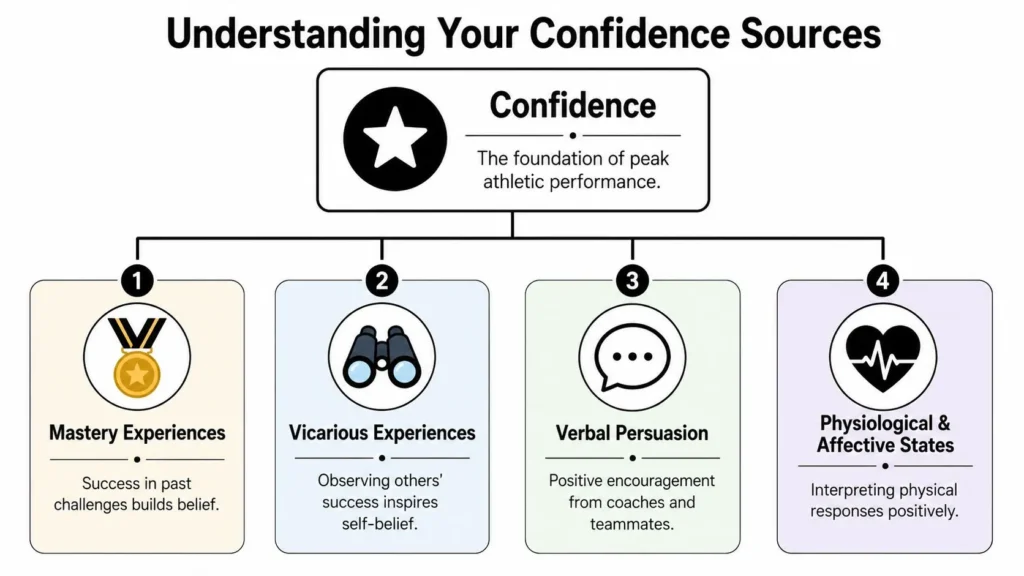
Four places confidence usually comes from
Most athletes build confidence from a mix of sources, not one source.
- Mastery experiences. You trust skills you’ve repeated under stress. A striker trusts a finish they’ve hit hundreds of times. A swimmer trusts pacing they’ve rehearsed repeatedly.
- Vicarious experiences. Seeing a teammate execute well can expand what feels possible. This is especially useful for younger athletes who are still forming their own standards.
- Verbal persuasion. Feedback matters, but only if it connects to something real. “Good job” fades quickly. “Your first step was more decisive on that rep” sticks.
- Physiological and emotional states. Sleep, recovery, nutrition, breathing, and pre-game self-talk affect whether nerves feel like danger or readiness.
Practical rule: If your confidence only rises after a win, it isn’t stable enough yet.
A quick confidence audit
Take five minutes and score your current confidence sources with simple words such as weak, steady, or strong.
| Confidence source | What to ask yourself |
|---|---|
| Skill mastery | Do I have recent proof that I can execute key actions well? |
| Preparation habits | Did I sleep, recover, fuel, and warm up in a way that supports belief? |
| Support system | Do I hear useful feedback from coaches, teammates, or parents? |
| Mental routines | Do I use imagery, self-talk, and breathing before pressure hits? |
This audit helps you avoid a common mistake. Athletes often say, “I’ve lost confidence,” when what they’ve lost is one source of confidence. Maybe they had a bad game, but their training quality is still good. Maybe they’re injured, but their tactical understanding and routine discipline are still intact.
That matters because rebuilding confidence gets easier when you know what still works.
For parents and coaches working on developing confident young athletes, this broader approach is especially useful. Young players often attach confidence to praise or scoreboard results long before they learn how to anchor it in preparation and controllable habits.
What doesn’t work
Three patterns reliably undermine confidence:
- Outcome-only thinking. If your belief depends on stats, selection, or wins, your confidence will swing constantly.
- Praise without proof. Encouragement helps, but it can’t replace evidence.
- Comparison as a measuring tool. If your confidence rises only when you feel better than someone else, pressure will expose that weakness fast.
The athlete who says, “I know what my confidence is built on,” is already in a stronger position than the athlete who says, “I just hope I feel good today.”
Set Goals That Build Momentum
Confidence improves faster when goals produce evidence. That’s why vague intentions fail. “Play better.” “Be more aggressive.” “Stay confident.” None of those tell an athlete what to do on the next rep.
The most useful structure is to separate goals into three buckets. Outcome goals focus on results, such as winning or making the team. Performance goals focus on a standard, such as reducing errors or improving pace. Process goals focus on controllable actions, which is where confidence gets built.
A technically sound way to build sports confidence is to use process-goal design. Experts recommend breaking training into specific, controllable objectives and logging evidence of success because confidence is strengthened by repeated proof that an athlete can execute key actions under pressure. A practical benchmark is setting micro-goals with roughly 70% to 95% success rates in this sport-confidence synthesis.
Outcome, performance, and process goals
Here’s the simplest way to distinguish them.
- Outcome goal: Win the match.
- Performance goal: Keep unforced errors down.
- Process goal: Reset between points, get feet set early, and commit to full follow-through.
Only one of those is fully available on every rep. That’s the process goal.
If an athlete tells me they’re low on confidence, I usually don’t start by asking what result they want. I ask what actions they need to trust again.
Build process goals with SMART discipline
SMART works when you use it with real behaviors, not motivational slogans.
Specific
Pick an action you can see. “Strong body language after mistakes” is better than “stay positive.”Measurable
Track whether it happened. A volleyball player might log whether they called the ball early on each serve receive rep.Achievable
The target should challenge you without crushing execution. That’s where the 70% to 95% success benchmark becomes useful in practice.Relevant
Tie the goal to performance under pressure, not random busywork.Time-bound
Give it a window. One training block, one week, or one competition cycle.
Examples athletes can use right away
A basketball guard might use these process goals for one week:
- On offense. Get low before the first move on every live rep.
- On defense. Communicate the screen coverage out loud.
- After mistakes. Use one reset breath and sprint into the next action.
- In review. Write down one rep each day that showed good decision-making.
A tennis player might use a different set:
- Before serve return. Commit to one visual cue before the toss.
- Between points. Turn away from the court, breathe, then choose a target.
- During rallies. Finish the swing instead of steering the ball.
- After practice. Log three points where they executed the plan, regardless of who won the point.
The fastest way to create momentum is to make your goals so clear that you can recognize success while it’s happening.
What athletes usually get wrong
They choose goals that are emotionally loaded but behaviorally empty. “Dominate.” “Prove myself.” “Don’t choke.” These raise pressure because they don’t tell the body what to do.
Good process goals do the opposite. They narrow focus. They create usable feedback. They turn confidence from a judgment into a record of completed actions.
Master Your Mental Skills Toolkit
Mental skills don’t replace training. They help you access training when pressure rises.
Athletes often wait until confidence dips before they start using these tools. That’s backwards. A mental skills toolkit works best when it’s built into normal preparation, the same way you’d treat mobility, video review, or technical work.
Use imagery to make pressure familiar
Visualization is useful when it’s specific. Don’t just picture yourself winning. Rehearse the exact environment, the timing, the cue, and the response.
Try a simple two-minute script before practice:
- First, see the setting clearly. The field, court, track, pool, or gym.
- Next, picture one pressure moment you tend to rush.
- Then, watch yourself slow down, use your cue, and execute the action correctly.
- Finish by imagining a calm response after a mistake, followed by the next play.
This works because the mind gets less reactive when a situation feels familiar. Pressure doesn’t disappear, but it stops feeling new.
Build self-talk that gives direction
A lot of athletes misuse self-talk by making it too broad. “I’m amazing” won’t help much if your mind doesn’t believe it in the moment. Effective self-talk is short, believable, and tied to action.
Use this pattern:
| Situation | Unhelpful thought | Better cue |
|---|---|---|
| Missed shot | “I’m off today” | “Set feet. Next rep.” |
| Strong opponent | “They’re better than me” | “Play my job.” |
| Tight score | “Don’t mess this up” | “Breathe and commit.” |
If you want more structured language prompts, resources that improve self-confidence using affirmations can help athletes build phrases that are direct and repeatable rather than vague.
A good cue doesn’t need to sound inspiring. It needs to be usable at speed.
Learn to lower noise in the body
Confidence drops fast when athletes misread normal activation as danger. Nerves aren’t always the problem. The problem is usually what athletes do next.
A simple breathing routine helps create control:
- Inhale through the nose.
- Pause briefly.
- Exhale slowly.
- Repeat until your attention returns to the task.
Many athletes pair this with a short mindfulness habit outside sport. A basic guide to meditation for stress relief can be a practical starting point if you want a simple way to train focus away from competition.
Here’s a guided reset you can use before a session or between rounds.
Keep the toolkit small
Athletes get in trouble when they collect techniques and use none of them consistently. Start with one tool from each category:
- Imagery for rehearsal
- Cue words for in-the-moment direction
- Breathing for arousal control
That’s enough to begin. The goal isn’t to become mentally busy. The goal is to become mentally prepared.
Engineer Confidence in Your Training
Game-day confidence is mostly a memory problem. Under pressure, athletes search for proof. If practice has given them clear proof, they settle faster. If practice has been casual, random, or too easy, pressure feels like a surprise.
That’s why confidence has to be engineered in training, not chased in competition.
A useful benchmark from coaching guidance is to keep training tasks near an 85% success rate so they challenge athletes without causing skill regression, while also using pressure drills and consequence-based practice to prepare for competition stress, as described in this guide to building confidence in youth sports.
Find the right level of difficulty
Practice that’s too easy creates comfort without belief. Practice that’s too hard creates frustration without learning. The sweet spot is often called desirable difficulty. The athlete has to work, adjust, and stay engaged, but the drill shouldn’t collapse into repeated failure.
That has real coaching implications.
- Raise pressure slowly when an athlete is learning a skill.
- Add consequences when technique is stable and decision-making needs stress.
- Pull difficulty down if execution quality falls apart for too long.
A soccer example makes this clear. Repeating penalty kicks with no pressure is skill rehearsal. Taking penalties after a hard conditioning block, with teammates watching and a consequence for the result, is confidence rehearsal.
Turn ordinary drills into confidence builders
Most training sessions already contain confidence opportunities. Coaches and athletes just fail to name them.
Consider these upgrades:
| Standard drill | Better confidence design |
|---|---|
| Repeated free throws | End practice with a make-or-repeat rule |
| Basic serve practice | Add a target and a reset routine before each rep |
| Scrimmage play | Start each possession from a pressure scenario |
| Sprint work | Pair each rep with a posture or breathing cue |
This doesn’t mean every session should feel punishing. It means the session should teach the athlete that they can still execute while slightly uncomfortable.
Practice should give you receipts. You want evidence you can trust later.
Use physical training as part of the confidence system
Athletes often separate physical preparation from confidence work. That’s a mistake. If your body feels underprepared, your mind notices.
Strength training, movement quality, and conditioning can all support confidence when athletes connect them to performance. A basic primer on how to start strength training is useful for athletes who need a simple, structured entry point rather than random gym sessions.
One more thing matters here. Don’t confuse fatigue with toughness. Some athletes leave hard sessions feeling mentally strong, but technically messy. Confidence grows from demanding training that still preserves enough quality to create proof.
Create Bulletproof Game-Day Routines
A routine doesn’t make you robotic. It makes you reliable.
When confidence falls apart before competition, it usually isn’t because the athlete forgot how to play. It’s because attention got pulled toward things they can’t control. Opponents. Crowds. Selection decisions. Weather. Officiating. Expectations. Strong routines bring attention back to the athlete’s own job.
An expert coaching framework recommends reducing the pre-performance plan to 3–4 controllable actions and rehearsing them before games, focusing on self rather than opponents, in this coaching guidance on athlete confidence.
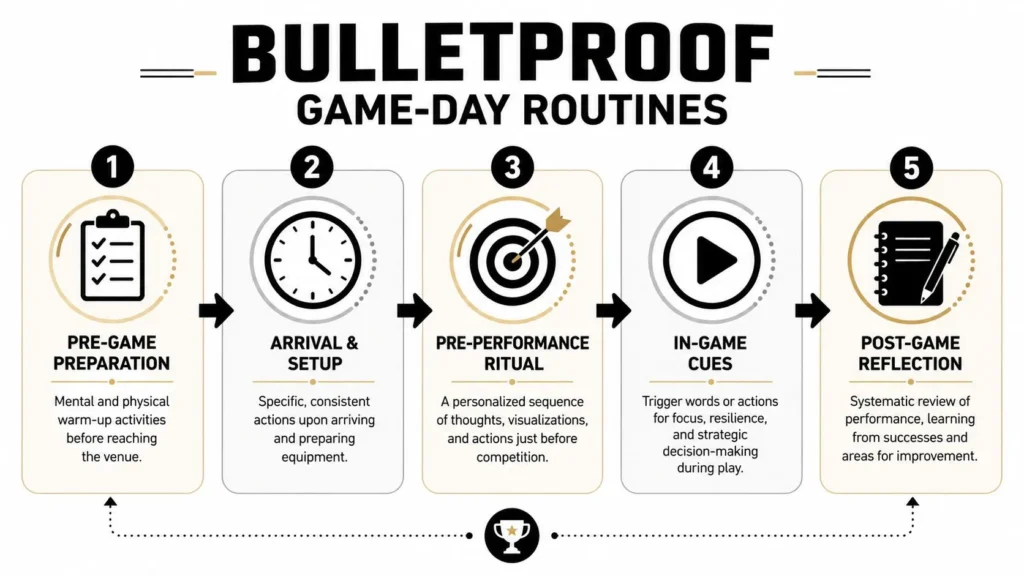
Pre-game
Pre-game confidence should come from repetition, not emotion. Keep it simple and repeatable.
- Arrive with a plan. Know the first few actions of your day. Equipment check, warm-up start time, first movement prep, first mental cue.
- Use a short controllables list. Pick 3 to 4 actions that are fully yours. Examples include active feet, clear communication, full follow-through, or one reset breath before starts.
- Prime your nervous system. A short breathing sequence and one or two imagery reps are usually enough.
Athletes who struggle with rushed mornings often perform better when the whole day begins more predictably. If your preparation starts in chaos, a guide on creating a morning routine can help build consistency before you even reach the venue.
Mid-game
Competition always includes disruption. The question isn’t whether something will go wrong. The question is whether you have a reset.
Try these in-game scripts:
- After a mistake. “Breathe. One cue. Next play.”
- When emotion spikes. Look at one fixed point, exhale, loosen shoulders, then re-enter.
- When comparison starts. Replace “They’re dominating” with a task cue tied to your role.
The best in-game routines are brief. If they take too long, you’ve already missed the next moment.
Post-game
Confidence lasts longer when review is structured. Without structure, athletes usually choose one of two extremes. They either protect themselves by avoiding reflection, or they overreact and turn one result into a global judgment.
Use this review pattern instead:
- Name what held up under pressure. One or two process wins.
- Identify one adjustment. Not a full personality rewrite. One next action.
- Log the evidence. Keep short notes after games so confidence isn’t left to memory.
Don’t let the scoreboard write the whole story. Review your execution before you judge your identity.
A good post-game routine protects confidence without becoming soft. It lets you be honest and constructive at the same time.
Sustain Confidence for the Long Haul
You miss a shot you usually make. Then you miss another. By the end of the week, the problem is no longer just execution. You start questioning whether your confidence was real in the first place.
That is the point where athletes either protect confidence or drain it.
Long-term confidence is built differently from game-day hype. It comes from a system you can return to during slumps, injury setbacks, selection disappointment, and flat stretches in training. The athletes who stay steady are not depending on one source, such as results. They have a wider confidence portfolio, and they know how to shift weight inside it when one area takes a hit.
A slump usually pulls athletes toward two mistakes. One group changes everything at once, including technique, routines, and goals. Another group waits for the feeling to pass and avoids making any adjustment. Both reactions make confidence less stable. The better response is disciplined. Keep your identity anchored, narrow your focus to controllable actions, and collect fresh evidence.
When confidence drops
Start by identifying what changed.
- After one bad result, return to your highest-value habits instead of rewriting your whole approach. Confidence returns faster when the athlete sees familiar actions done well.
- During injury, stop treating confidence as if it only comes from competing. Shift it toward rehab consistency, body language, tactical study, and how well you stay connected to the team.
- During a plateau, resist the urge to chase dramatic fixes. Improve drill quality, tighten feedback, and check whether your goals still measure execution rather than outcome.
This shift matters. Confidence built only on winning is fragile. Confidence built on preparation, skill growth, adaptation, and follow-through lasts longer because you can keep feeding it even when results dip.
A sample four-week reset
A short reset works well because it gives athletes something concrete to do before doubt grows into identity.
| Week | Primary Focus | Key Action |
|---|---|---|
| Week 1 | Confidence audit | List your current confidence sources. Mark each one as strong, shaky, or missing |
| Week 2 | Process goals | Pick a small number of controllable actions in training and track whether you complete them |
| Week 3 | Mental skills | Rehearse one imagery script, one cue word, and one breathing reset until each feels automatic |
| Week 4 | Pressure transfer | Add consequences, scoring, or competition to training, then use your routines under stress |
I often tell athletes to judge the reset by compliance, not emotion. If you complete the plan for four weeks, confidence usually becomes more stable because the brain has new evidence to work with.
What long-term confidence actually looks like
Long-term confidence is recovery speed.
A mistake does not become a spiral. A poor performance does not become a verdict on your talent. An injury does not erase your sense of competence. You still feel nerves, frustration, and doubt, but those states stop dictating your behavior.
That is the practical standard. Can you return to useful action quickly?
The athletes who appear naturally confident usually built that stability over time. They know where their confidence comes from. They train those sources on purpose. They protect them during hard stretches. And when confidence gets shaken, they rebuild it from evidence, repetition, and honest review.
Discover more from Maxi Journal
Subscribe to get the latest posts sent to your email.