So, what exactly is a morning routine? It’s simply a sequence of small, positive habits you intentionally perform right after waking up. It starts with figuring out what you want—like more energy or less stress—and then piecing together a few actions that get you there. The real magic is in starting small and sticking with it.
Why Your Morning Shapes Your Entire Day

That first hour after your alarm goes off sets the trajectory for everything else. A deliberate morning routine isn’t just some wellness fad; it’s a practical way to boost your productivity and find some mental clarity. When you start your day with purpose, you immediately shift from reacting to the world to proactively shaping your day.
Think of your willpower as a battery. Every little choice you make—what to wear, what to eat, which email to tackle first—drains a bit of that power. By putting your first hour on autopilot, you save that precious mental energy for the bigger, more important decisions that will come later.
The Science of a Consistent Start
Our brains love consistency. When you follow a predictable set of actions every morning, you’re essentially carving out neurological pathways that make those habits feel automatic. This cuts down on cognitive load, freeing up your mind. It’s like a warm-up for your brain, getting it ready for the day’s challenges.
This consistency also helps regulate your body’s internal clock. Waking up and performing the same gentle activities tells your system it’s time to be alert but calm, not panicked and rushed. Research shows that cortisol (the main stress hormone) is naturally highest in the morning. A calming routine can help manage this spike so you don’t start your day in “fight or flight” mode.
A solid morning routine can lead to some major benefits:
- Reduced Decision Fatigue: Making your first few choices automatic saves your brainpower for bigger things.
- Lowered Stress Levels: A predictable start can seriously decrease morning anxiety and those cortisol spikes.
- Increased Productivity: Getting a few small wins early on builds momentum that can carry you through the entire day.
- Improved Well-Being: Purposefully carving out time for yourself fosters a sense of control and genuine self-care.
Building Momentum for Success
The real power in learning how to create a morning routine is in the momentum it creates. When you successfully knock out a few small, planned actions—like drinking a glass of water, stretching for five minutes, or jotting down three priorities—you generate a feeling of accomplishment. This cascade of small wins gives you a psychological boost, making you more likely to take on bigger goals.
Your morning doesn’t have to be a frantic race against the clock. It can be a quiet, intentional space that you control, setting the foundation for focus, creativity, and resilience no matter what the rest of the day throws at you.
This isn’t about waking up at 5 a.m. (unless that’s your thing) or chasing perfection. It’s about reclaiming a small piece of your day to serve your own well-being. By doing so, you’re not just making your mornings better; you’re actively working toward a healthier how to improve work-life balance. It’s a simple but profound shift from letting the day happen to you, to making the day happen for you.
The Pillars of a Powerful Morning Routine
Before you start building a morning routine, it helps to know the “why” behind the “what.” The best routines aren’t just a random collection of habits; they’re built on a few core principles that work with your body’s natural biology.
Think of these as the foundational pillars that support a more energized, focused day. By centering your routine on these four areas, you ensure you’re getting the most impact from your efforts.
To lay a solid foundation, we’ll focus on these core components and their science-backed benefits.
Core Morning Routine Components and Their Benefits
| Pillar | Scientific Rationale | Primary Benefit |
|---|---|---|
| Hydration | After 7-8 hours of sleep, the body is naturally dehydrated. Rehydrating immediately supports cellular function and metabolism. | Boosts mental clarity and physical energy. |
| Movement | Physical activity increases blood flow, delivering oxygen to the brain and muscles. It also releases mood-boosting endorphins. | Increases alertness and improves mood. |
| Mindfulness | Intentional focus through practices like meditation or journaling calms the nervous system and reduces cortisol (the stress hormone). | Builds mental resilience and reduces reactivity. |
| Fuel | A balanced breakfast with protein, fats, and complex carbs replenishes glucose stores and stabilizes blood sugar. | Provides sustained energy and prevents a mid-morning crash. |
Each pillar works together to create a powerful synergistic effect, setting the tone for the rest of your day.
Hydrate for Clarity
The very first thing you do can have a massive impact. After a full night’s sleep, your body is naturally dehydrated. Making a glass of water the first thing you reach for is one of the simplest yet most powerful habits you can adopt.
This goes beyond just quenching thirst. Proper hydration gets your metabolism going, helps flush out toxins your body processed overnight, and sharpens cognitive function. A dehydrated brain is a foggy one. By drinking water first thing, you’re waking up your mind and body from the inside out.
Move to Energize
You don’t need a grueling workout to get the benefits of morning movement. The real goal is to shake off the stillness of sleep and get your blood circulating. This could be as simple as five minutes of stretching or a quick walk around the block.
Movement sends a clear signal to your brain to ramp up energy and alertness. Physical activity boosts endorphins, giving you a natural mood lift. It also increases circulation, which delivers oxygen to your muscles and brain, preparing your body for the day.
A study from Talker Research found that some of these core habits are already widespread, with 60% of people drinking water and 65% brushing their teeth right after waking. This shows an intuitive understanding that these small actions matter. As trends shift toward “micro-wellness”—like quick breathwork sessions—it’s clear that personalized, small habits are key. You can find more of their insights on Talker Research.
Focus Through Mindfulness
The morning offers a rare pocket of quiet before the day’s chaos kicks in. Taking just a few minutes for a mindfulness practice can ground you in the present and build serious mental resilience. This isn’t about emptying your mind, but rather about directing it with intention.
This can look different for everyone:
- Meditation: Even a few minutes of guided or silent meditation can cut down on stress.
- Journaling: Writing down your thoughts or a quick gratitude list brings incredible clarity.
- Deep Breathing: A simple exercise of five slow, deep breaths can instantly calm your nervous system.
Starting your day with a focused mind keeps you from falling into a reactive state. If you want to dive deeper, check out our guide on how to meditate for stress relief.
Fuel for Performance
The final pillar is what—and when—you eat your first meal. The right breakfast restores your glucose levels, giving your brain and body the direct energy they need to perform at their best.
Focus on a meal with a good balance of protein, healthy fats, and complex carbs. This provides steady, sustained energy, unlike a sugary breakfast that causes a sharp spike and the inevitable crash. Your morning fuel sets the metabolic pace for the hours ahead.
Designing Your Personalized Morning Blueprint
The biggest mistake people make with morning routines? They try to copy-paste someone else’s. The difference between a routine that sticks and one that’s abandoned by Wednesday comes down to personalization.
This isn’t about cramming more into your already-packed morning. It’s about being strategic, choosing small actions that give you back more energy and focus than they cost.
The whole process starts with a simple question: What do you really want from your mornings? A moment of peace before the day’s chaos? A jolt of physical energy? Or just some quiet time to think? Your answer is the compass for everything that follows.
Start with Your Why
Before you even think about specific habits, you need a clear purpose. Without a strong “why,” your motivation will evaporate the first time your alarm feels a little too loud.
Take a second to think about what a better morning would actually give you. A few prompts to get you started:
- What feeling do I want to create? (e.g., calm, energetic, focused)
- What’s the biggest point of stress in my morning right now? (e.g., rushing, phone notifications, deciding what to do first)
- If I had an extra 15 minutes, what one thing would make the biggest difference in my day?
Your goal could be as practical as, “I want to stop feeling frantic while getting the kids out the door.” Or it might be more internal: “I want to connect with my own thoughts before the world rushes in.” Whatever it is, write it down. This is your anchor.
This clarity is your filter. If your goal is calm, a high-intensity workout might not be the right first move. If you need energy, a 20-minute silent meditation might feel like pulling teeth.
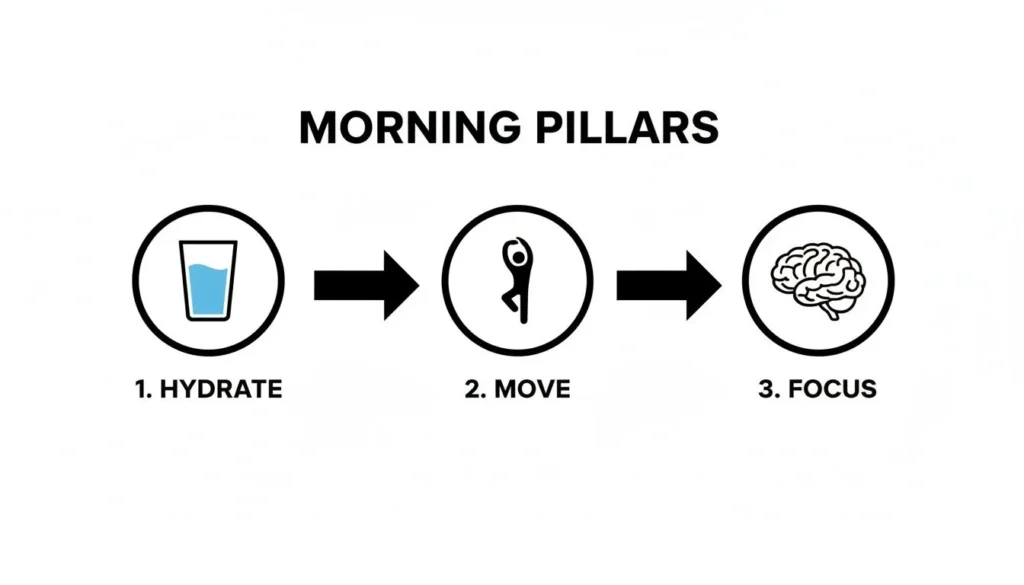
As you can see, the most successful routines are built on a few fundamental actions. The magic is in how you customize them.
Introduce Habit Stacking
Now that you have your “why,” we can get to the “how.” One of the most powerful techniques I’ve ever used for building new behaviors is habit stacking.
The concept, popularized by James Clear in Atomic Habits, is simple: you link a new habit you want to start with an existing one you already do on autopilot.
The formula is straightforward:
After [Current Habit], I will [New Habit].
This simple trick works because it eliminates the need to decide when to do your new habit. Your brain already has a well-worn path for the old habit, so you just pave a tiny new extension off of it.
For instance, instead of a vague goal like “stretch more,” you get specific:
- After my alarm goes off, I will drink the glass of water on my nightstand.
- After my coffee starts brewing, I will do 5 minutes of stretching in the kitchen.
- After I brush my teeth, I will write down one thing I’m grateful for.
The secret is to make the new habit almost laughably small. A “five-minute stretch” is far less daunting than a “30-minute yoga session.” You can always add more time later, once the habit is automatic.
By piggybacking a new action onto an existing one, you aren’t fighting for motivation. You’re building an automated neurological link that makes the new habit feel as natural as the old one. This is how you achieve real consistency.
Build Your First Draft
Okay, let’s put this into practice. Grab a piece of paper or open a note on your phone. We’re building version 1.0—don’t worry about getting it perfect.
Find Your Anchors: List 3-5 things you already do every single morning without thinking (e.g., turn off alarm, use the bathroom, let the dog out, start the coffee). These are your anchor habits.
Pick Your First Stack: Look back at your “why.” Choose one tiny, two-minute action that moves you toward that goal. For more energy, it might be 10 push-ups. For more calm, it could be three deep breaths.
Write the Formula: Now, pair your new action with an anchor. For example: “After the coffee maker beeps, I will do 10 push-ups.”
That’s it. That one simple stack is your entire routine to start. It might feel too small, but that’s exactly the point. The goal for the first week isn’t a life-changing transformation; it’s just proving to yourself that you can show up. Once that single action feels effortless, you can add another. This is how you build a powerful routine that serves you without ever feeling like a chore.
Morning Routine Examples for Different Lifestyles

The best morning routine is yours, not a copy-paste from someone else. To get your creative juices flowing, let’s look at how these principles apply to a few different lives.
Think of these less as strict templates and more as a starting point for your own routine. The goal is to see how the core pillars—hydration, movement, mindfulness, and fuel—can fit into any schedule, no matter how packed it is.
The Busy Parent Squeezing in 20 Minutes
For parents, mornings often feel like a race against the clock before the kids are up. The secret isn’t finding more time, it’s making the most of the tiny windows you have. This routine is all about impact in just 20 minutes.
The main goal is to ground yourself and create a moment of calm before the chaos begins.
Example Routine (6:00 AM – 6:20 AM)
- 6:00 AM: Alarm goes off. First thing: drink the glass of water you left on your nightstand. (1 min)
- 6:01 AM: While the coffee brews, do a quick mobility circuit right there in the kitchen. Focus on hip flexors and your upper back, areas that get tight from carrying kids. (5 min)
- 6:06 AM: Grab your coffee and find a quiet corner. Instead of reaching for your phone, open a journal. Write down one priority for the day and one thing you’re grateful for. (4 min)
- 6:10 AM: Take five slow, deep breaths. This is a simple micro-meditation that can reset your nervous system. (2 min)
- 6:12 AM: Get a simple, protein-heavy breakfast ready. Think a pre-made smoothie or Greek yogurt with some nuts. (8 min)
This routine proves that even 20 minutes of focused intention can completely reframe your mindset and set a positive tone for the day.
The Remote Worker Building a Boundary
When your home is your office, the line between your personal life and work can get incredibly blurry. A solid morning routine acts as a psychological “commute,” signaling to your brain that the workday is about to begin.
This routine is designed to create clear mental and physical boundaries.
Example Routine (7:30 AM – 8:30 AM)
- 7:30 AM: Wake up, hydrate, and immediately change into workout clothes. This small act tells your brain you’re shifting out of rest mode.
- 7:45 AM: Head outside for a brisk 15-minute walk. Getting some natural light helps regulate your circadian rhythm and clears your head.
- 8:00 AM: Come back inside for some mindfulness. This could be a 10-minute guided meditation or even just reading a few pages from a non-work book.
- 8:10 AM: Make and eat a real breakfast—away from your desk. This reinforces the idea that your kitchen is for living and your office is for working.
By creating this buffer, you’re not just “getting ready” for work; you’re intentionally priming your brain for focus. It transforms the act of sitting down at your desk from a sluggish drift into a deliberate choice.
The Creative Seeking Inspiration
If you’re an artist, writer, or designer, your morning can be the most valuable time to find that creative flow state before distractions pile up. This routine is less about strict productivity and more about cultivating an open and curious mind.
Ever wonder where your morning goes? A YouGov survey found that 30% of people spend the equivalent of 7.6 days a year just getting ready. That’s a huge opportunity to reclaim time for something more inspiring.
Example Routine (7:00 AM – 8:00 AM)
- Hydrate and Move: Start with water, then do some gentle, intuitive stretching or yoga. The idea is to connect with your body, not to follow a rigid workout.
- Input Before Output: Spend 15-20 minutes consuming something inspiring that has nothing to do with your current projects. This could be poetry, a short documentary, or an album you’ve never heard.
- Free-Form Journaling: Grab a notebook and just write for 10 minutes. This “brain dump” practice is a fantastic way to clear out the mental clutter and uncover surprising ideas.
- Start with Play: Before jumping into your main project, spend 10 minutes on a low-stakes creative warm-up. Sketch something random, play an instrument, or just experiment with a new technique without pressure.
This approach prioritizes mental space and exploration, creating the perfect environment for fresh ideas to surface.
How to Troubleshoot Your Morning Routine
Let’s be real. Even the most meticulously planned morning routine is going to have off days. Life gets in the way—you oversleep, a kid gets sick, or your motivation just vanishes. This isn’t a failure. It’s just part of the process of building a real, sustainable habit.
The goal was never about being perfect. It’s about being resilient. Knowing how to troubleshoot common problems is just as crucial as building the routine in the first place. This is how you adapt and get back on track without the guilt trip.
Overcoming Morning Inertia
That moment the alarm goes off and your bed suddenly feels ten times more comfortable? That’s the first, and often biggest, battle of the day. The impulse to hit snooze can completely derail your plans before they even start.
This is where the ‘5-Minute Rule’ is a game-changer. Forget about the entire 30-minute routine. Just commit to the very first step for five minutes. Tell yourself, “I’m just going to put on my workout gear and stretch for five minutes.” More often than not, just starting is the hardest part. Once you’re up and moving, it’s much easier to keep going.
Another simple but powerful tactic is to prep the night before. This little bit of effort removes friction and eliminates decision-making when your brain is still in a fog.
- Lay out your workout clothes.
- Fill a glass of water and put it on your nightstand.
- Place your journal and pen where you’ll see them first thing.
Each tiny preparation makes it that much easier to say yes to your routine when morning comes.
When Your Routine Feels Boring
What felt inspiring a month ago can start to feel like a tedious chore. If your routine has become monotonous, that’s your cue to introduce some variety—not to abandon it completely.
Don’t hesitate to swap out activities while keeping the core structure intact. If you’re bored with your usual 10-minute walk, try a different form of movement. A quick mobility session targeting your hip flexors or upper back can feel entirely new and address different physical needs.
Key Takeaway: Think of your morning routine as a living document, not something carved in stone. It should evolve as your needs and energy levels change. The goal is consistency in the practice, not rigidity in the specific tasks.
For instance, if mindfulness is your goal, you could switch from meditating to journaling. Or you could simply listen to an instrumental song without any other distractions. This keeps the core benefit while making the experience feel fresh again.
Create a Minimum Viable Morning
Some days, you just won’t have the time or energy for the full experience. On those chaotic mornings, trying to force everything will only lead to frustration. Instead, it’s time to deploy your Minimum Viable Morning (MVM).
An MVM is just one or two essential habits that take five minutes or less but still manage to set a positive tone for the day. This is your non-negotiable, bare-bones routine for when life intervenes.
Here’s what a simple MVM could look like:
- Hydrate: Drink a full glass of water as soon as you wake up.
- Move: Do one minute of stretching or 10 push-ups.
- Focus: Take three slow, deep breaths before you even glance at your phone.
This tiny routine keeps the momentum going. That simple glass of water, for instance, has a bigger impact than you might think. A recent study found rehydrating first thing helps kickstart cellular repair and metabolism. You can read about the fascinating findings on how this one habit supports longevity at Droptheacscent.com.
Having this backup plan helps you sidestep the “all or nothing” trap. You maintain the chain of consistency, which is vital for building lasting self-care practices. If you’re searching for more inspiration, check out our guide on mental health and self-care tips.
Frequently Asked Questions About Morning Routines
Even a well-designed routine can hit a few snags. It’s completely normal to have questions as you start to figure out what truly works for you. Let’s clear up some of the most common hurdles people face.
This is your go-to guide for fine-tuning your approach and building a routine that lasts.
How Long Should My Morning Routine Be?
There’s no single right answer. A great routine could be 15 minutes, or it could be 90. The only thing that matters is finding a length you can stick to consistently without feeling rushed or stressed.
The goal isn’t to cram as much as possible into your morning. It’s about creating a sustainable practice that serves you. If you’re just starting, aim for 10 minutes. You can always add more later once the initial habits feel second nature. Remember, consistency beats duration every time.
What If I Am Not a Morning Person?
You don’t need to force yourself into the 5 AM club to benefit from a morning routine. The whole point is to work with your body’s natural rhythm, not fight against it. Your “morning” is simply the first hour after you wake up, regardless of what time that is.
If you’re a night owl, keep it simple. Your routine might just be drinking a glass of water and doing a few stretches before you even think about looking at your phone. This creates a moment of intention without demanding a full-scale lifestyle change that’s doomed to fail.
The biggest mistake I see is people trying to do too much, too soon. They get excited, map out a perfect 90-minute routine with meditation, journaling, and a workout, and then abandon it by day three. Start with one small habit and build from there.
This approach ensures you get the benefits of a routine without forcing a schedule that feels completely unnatural.
How Do I Stick to My Routine When I Travel?
When you’re on the road, the key is to adapt, not replicate. Don’t worry about trying to squeeze your entire home routine into a hotel room. Instead, just focus on one or two “anchor” habits that make you feel centered.
Your travel routine could be as simple as:
- A 5-minute stretching session to undo the stiffness from a plane or car ride.
- Taking ten deep breaths before you get out of bed to ground yourself.
- Jotting down your main goal for the day in a small notebook.
These tiny actions keep the habit’s momentum going without adding any stress to your trip. You’re maintaining the ritual, even if it’s a scaled-down version.
What If I Miss a Day or Two?
Missing a day doesn’t mean you’ve failed. This is a classic trap. People break their streak, fall into an “all-or-nothing” mindset, and decide it’s not worth continuing.
The most critical habit of all is getting back on track. If you miss a day, don’t overthink it. Just show up the next day and do your routine—or at the very least, your Minimum Viable Morning. True consistency isn’t about being perfect; it’s about refusing to let one slip-up derail all your progress.
Ready to create a life you love, one intentional morning at a time? maxijournal.com is your daily source for insightful articles on health, productivity, and well-being. Explore more content and join our community of curious readers at https://maxijournal.com.
Discover more from Maxi Journal
Subscribe to get the latest posts sent to your email.