You pull a wool jumper out of a drawer, hold it up to the light, and spot a line of tiny holes along the seam. That’s the moment many people get it wrong. They shrug, toss the jumper back, and hope the moths go away on their own. They don’t. A clothes moth infestation usually means larvae have already settled somewhere dark, warm, and undisturbed, and if you leave it alone, the damage keeps spreading through the textiles you care about.
The Moment You Find the First Hole
The first hole is rarely the whole story. By the time you notice it, larvae have usually been feeding for a while, which is why the visible damage often looks small compared with the hidden mess behind it. English Heritage’s Operation Clothes Moth survey, which placed 5,000 indoor traps across 42 counties in England, caught 3,607 webbing clothes moths and averaged 17 moths per trap overall. London and the South East were hit hardest at 23 moths per trap, while the East Midlands averaged only 3 English Heritage.
That uneven pattern matters in plain English. If you live in an older property, or in a dense area with shared walls and voids, you’re not imagining the problem. English Heritage said catches were significantly higher in older, pre-1950 properties, and linked that to more voids, fireplaces, and attics that shelter pests English Heritage.
Practical rule: if you found one chewed jumper, don’t treat one jumper. Treat the wardrobe, the room, and anything stored nearby.
The reason is simple. Clothes moth larvae digest keratin, so wool, silk, fur, feathers, and other natural fibres are food, not decoration, to them. The adult moth fluttering around the room is not the one doing the damage. The problem is the hidden larval population, and once you see holes, you should assume there are more eggs and larvae tucked into seams, folds, and storage edges.
The broader UK picture backs that up. English Heritage reported a 216% rise in captures of the common clothes moth from 2012 to 2016, and later reporting showed that moth pressure can swing sharply from year to year, with the National Trust noting a 39% fall in 2022 followed by another 18% drop across historic houses the next year The Guardian summary of UK moth monitoring. That volatility is exactly why you act fast. A small hole today can become a drawer full of ruined wool by the next season.
Identifying the Moth You Are Actually Dealing With
Don’t start treatment until you know what pest you’re looking at. Clothes moths, carpet beetles, and case-bearing moths all damage fabrics, but they leave different clues, and mixing them up wastes time. The easiest mistake is focusing on the adult insect. Adults tell you something is present, but the larvae are the ones eating your clothes.
Quick ID Comparison of Common Fabric Pests
| Pest | Adult Look | Key Sign on Fabric | Damage Pattern |
|---|---|---|---|
| Webbing clothes moth | Small, plain golden-buff moth with a reddish tuft on the head | Silken webbing across wool or stored textiles | Irregular holes, feeding tracks, hidden damage in folds |
| Case-bearing clothes moth | Smaller moth with dull brown wings and dark spotting | Tiny rice-grain cases on carpet edges or skirting | Patchy damage near edges, under furniture, in dark crevices |
| Carpet beetle | Tiny beetle, not a moth, often seen wandering in light | Shed larval skins, bristly larvae, damage near natural fibres | Shredded-looking fibres, worn patches, often in rugs and upholstery |
Webbing clothes moths usually leave the clearest trail. If you see silk webbing on wool, treat that as an active warning, not a vague possibility. Case-bearing moths are more deceptive because the larva lives inside a portable case, so you’ll often find the evidence on carpets, skirting boards, and other edge zones before you ever spot the adult. If you want a quick primer on how moth problems are viewed in warm climates, the overview of moth risks for Texas homes is a useful comparison point, even though the control logic still starts with the same basics, source finding and textile treatment.
Adult moths are a clue. Webbing, cases, and hidden feeding damage are the evidence.
Don’t overcomplicate the ID if you’re not an entomologist. If the fabric damage is in wool or silk, if you see silk threads, or if tiny cases are sitting in the corners of storage spaces, you’re dealing with a fabric pest that needs active intervention. If the insect is a beetle, not a moth, the treatment path changes. If you’re still unsure, move forward as if it’s a clothes moth problem and inspect every nearby natural fibre item. That approach won’t hurt you, and hesitation usually does.
Washing and Freezing Textiles to Kill Every Life Stage
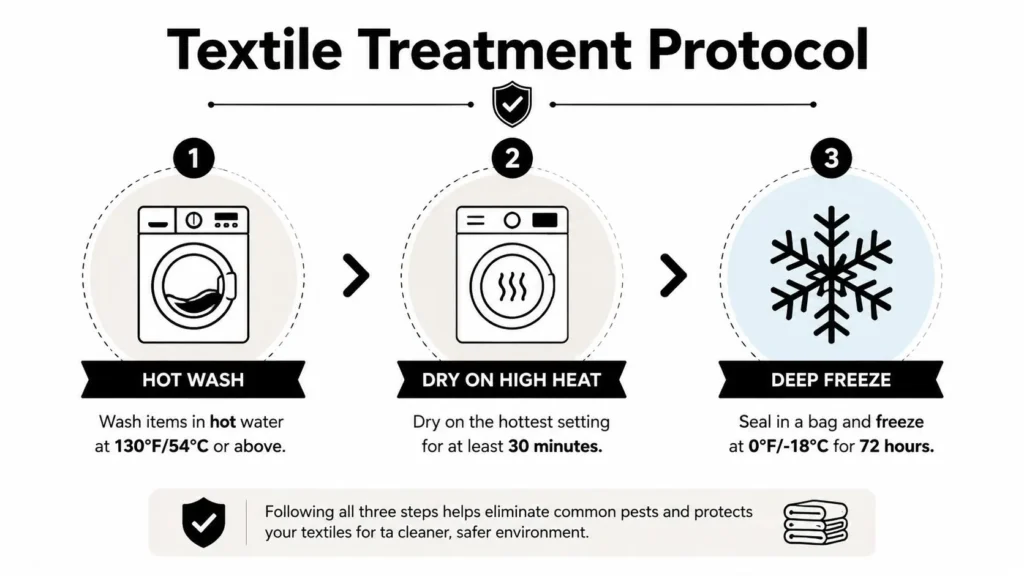
The fastest way to stop a clothes moth infestation from spreading is to kill the life stages already living in your textiles. Heat and cold both work, but only if you use them properly. UC ANR and NPIC identify laundering items for 20 to 30 minutes in water at least 120°F, about 49°C, as an effective kill step for all life stages UC ANR and NPIC clothes moth guidance.
Use heat on washable items
Wash what you can first. That means jumpers, blankets, scarves, and any textile the care label will tolerate. Put the item through a full cycle that keeps the fabric at the kill temperature long enough, not a quick rinse, and then dry it completely before it goes back into storage. If you’re handling a mixed pile, sort it by care label first and keep the suspicious items away from clean ones until they’re treated.
Use freezing on delicates and structured pieces
For items that can’t be washed, seal them in plastic and freeze them. UC ANR and NPIC recommend below 18°F, about -8°C, for several days, while English Heritage specifies -18°C for at least two weeks if you want to be certain of killing eggs, larvae, and adults UC ANR and NPIC clothes moth guidance. I’d follow the stricter freezer protocol when you can, because under-treatment is the mistake that lets the same moths come back.
Do not skip the seams. Eggs and larvae hide in cuffs, folds, linings, and collar edges, not just on the visible surface.
That’s the part people miss. They treat the ruined jumper and ignore the other six items in the same drawer. If one wool item was attacked, inspect every nearby natural fibre item, then treat the whole group together. The surrounding shelf, drawer, or storage box also needs cleaning, because hidden life stages can sit in lint and debris waiting for the next chance to emerge. This is why a “clean one garment” response keeps failing in real homes.
The goal is not to rescue every item with the least effort. The goal is to make sure no viable moth survives in the load you’re putting back into the wardrobe.
Tracing the Source Beyond the Wardrobe
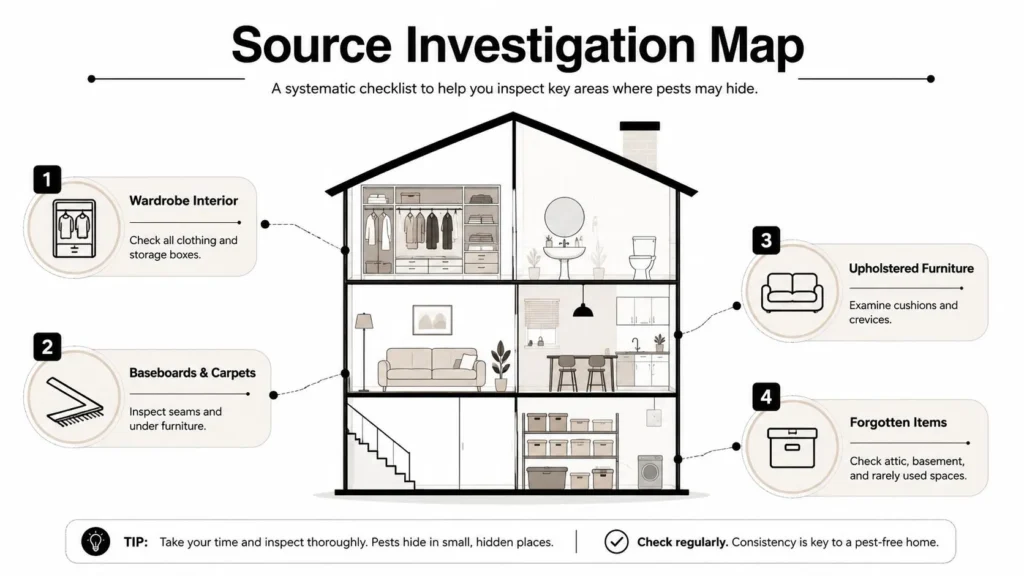
A wardrobe problem is easy to believe because the damage shows up there first. A building problem is harder to accept, but it’s common enough that you should check for it before you declare victory. The University of Kentucky extension guidance on fabric pests is clear that larvae hide in dark crevices, baseboards, carpets, and nearby susceptible items, and that a full inspection of the storage area matters before treatment UK entomology guidance.
Start at the damage and fan outward
Begin with the drawer, shelf, or hanging section where you found the hole. Pull everything out. Check the corners, seams, and the underside of shelves, then move outward to under-bed storage, skirting boards, behind radiators, upholstered furniture, and any natural-fibre rugs. If you find silken threads along carpet edges, shed skins, or cases in dark crevices, you’ve got a breeding zone, not just a passing moth.
Use traps as a map, not as a cure. Place pheromone traps in different rooms and compare where activity shows up first. Traps won’t solve the infestation, but they tell you where adult males are moving, and that helps narrow down the source when the damage isn’t obvious. If the trap closest to the wardrobe is empty but the one near the sitting room picks up activity, stop assuming the closet is the only problem.
Treat apartments like shared systems
If you live in a flat, don’t rush to blame yourself. Shared walls, voids, and common service spaces can let moths move between units, which means reinfestation can come from an adjacent source you never touched. Talk to the neighbour or building manager calmly, with one objective, identify whether the issue is local to your unit or wider than that. If the same moths keep returning after you’ve cleaned and treated properly, the source may never have been isolated in the first place.
For people organizing their storage from scratch, a good home wardrobe plan helps reduce hiding places and makes inspection easier. A practical reference is this wardrobe-building guide, because the more modular and visible the storage, the less room moths get to hide.
The rule I’d use in a real house is blunt. If the wardrobe is clean but traps still show activity, keep expanding the search until you find the edge of the problem. Moths don’t respect the border between “my clothes” and “the room next door.”
Layered Control With Traps, Vacuuming, and Humidity
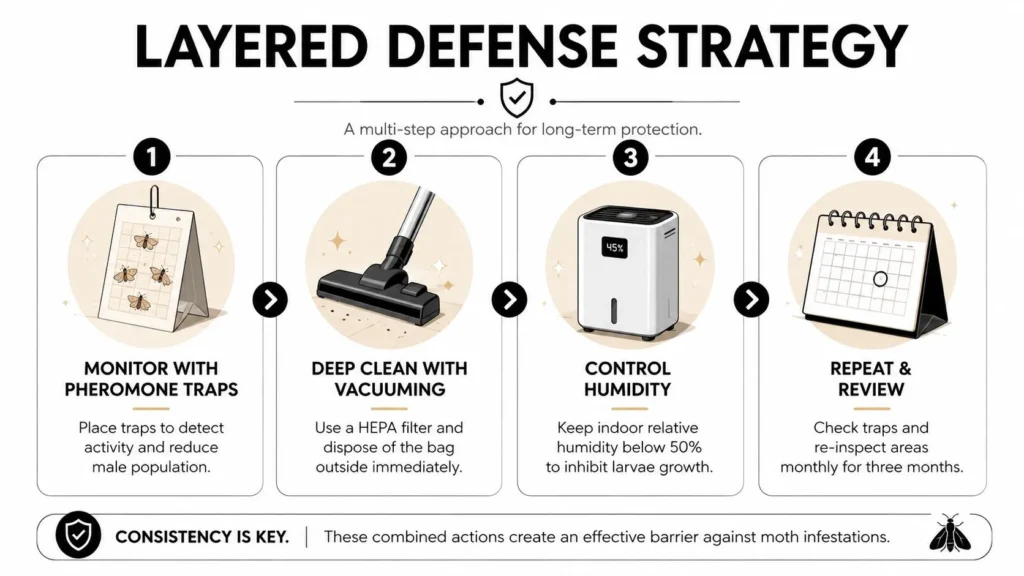
Once you know where the activity is, stop looking for one silver bullet. You need layers. Rutgers recommends clothes-moth pheromone traps for detecting hotspot activity, and for directing control to structural surfaces and cracks and crevices rather than delicate fabrics Rutgers fabric pest guidance.
Monitor first, then clean hard
Traps tell you whether the problem is still active and where it is strongest. Vacuuming does the heavy lifting. Go slowly along carpet edges, drawer tracks, furniture seams, and the underside of shelves. Adults often lay eggs in lint and debris, so the dirt itself is part of the problem. Empty the vacuum outside immediately, because leaving the contents indoors just hands the pests back their starting point.
Practical rule: if you can’t reach it with a vacuum nozzle or crevice tool, you probably haven’t cleaned it well enough.
Use dry ice only as a sealed treatment
Rutgers also notes that dry-ice fumigation can be done in a heavy-duty 42-gallon bag with 3 pounds of dry ice, and that a 48-hour fumigation at around 70°F is enough to kill fabric pests, with colder conditions needing longer exposure Rutgers fabric pest guidance. That’s a specialist-style option for sealed items, not a casual experiment in the middle of a room. Use it for delicate textiles that need whole-item treatment and can be sealed properly.
For a broader storage strategy, a practical humidity-control discussion can help you think beyond the one-off cleanup. The guide from Posch & Silva Moving Solutions is useful because moths hate dry conditions, and keeping relative humidity below 20% to 30% prevents them from surviving Rutgers fabric pest guidance. That low-humidity threshold is a long-term control lever, not an emergency fix, but it matters if you’re tired of the same infestation returning every season.
The point is simple. Traps show you where the moths are. Vacuuming removes food, eggs, and debris. Drying the storage environment makes the whole room less livable for the pest. Miss one layer and you’ll be repeating the same cleanup in six weeks.
When DIY Stops Working and a Professional Makes Sense
DIY is the right move for a small, contained clothes moth infestation. It stops being the right move when the pests spread beyond a single storage area or keep coming back after you’ve done the basics properly. If damage is showing up in multiple rooms, if adults keep appearing after thorough cleaning, or if you suspect activity in wall voids, insulation, or under floorboards, call a professional.
What a good pest controller does differently
A qualified technician doesn’t spray delicate fabrics and hope for the best. Rutgers advises residual control on structural surfaces and cracks and crevices, not directly on textiles Rutgers fabric pest guidance. That matters because the hiding places are usually not the garments you can see, they’re the narrow gaps around the room where larvae and pupae stay protected. Professionals also have the equipment to treat whole rooms or enclosed spaces more consistently than a homeowner can with a domestic heater or spray can.
If you have children, pets, or respiratory sensitivities in the home, this becomes more than a convenience issue. The wrong chemical use around soft furnishings and storage spaces can create more risk than the moths themselves. A pro knows how to target the pest without turning your wardrobe into a chemical minefield.
Vet the company before you hire them
Ask direct questions. What life stages are they targeting, how will they verify the source, and what follow-up monitoring is included? If they can’t explain the difference between fabric treatment and crack-and-crevice treatment, keep looking. A realistic plan should include inspection, source tracing, treatment of hidden areas, and a follow-up check, not just a quick spray and a receipt.
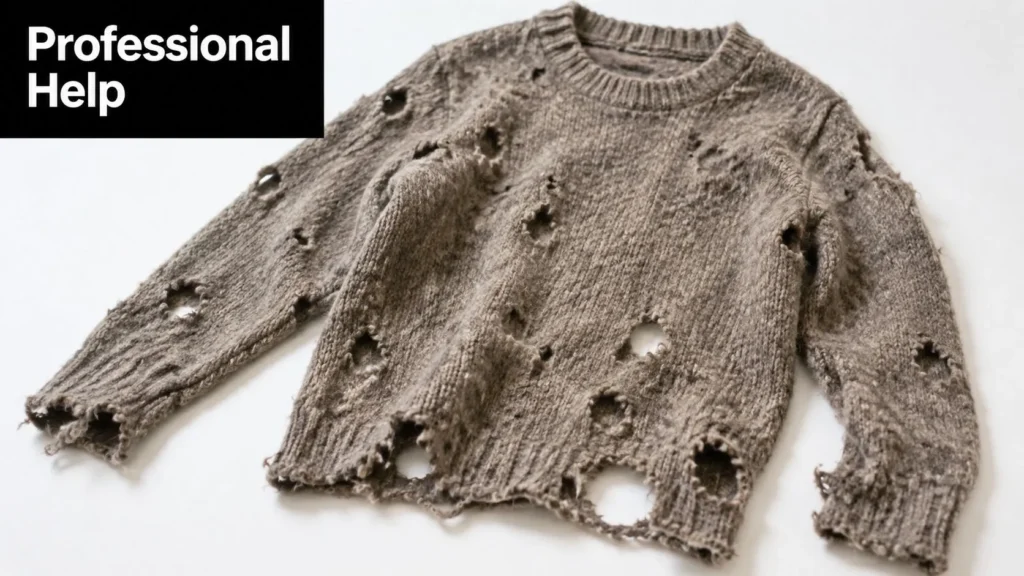
The line I use with homeowners is plain. If you’ve already washed, frozen, vacuumed, and monitored, and the moths are still active, the source is bigger than your wardrobe. At that point, paying for proper inspection is cheaper than buying replacement knits again.
Stopping the Next Infestation Before It Starts
Prevention works, but only if you treat it like routine, not like a special event after the damage is done. Store off-season woollens clean, sealed, and away from clutter. Cedars and lavender can smell nice, but they’re background extras, not treatment, so don’t mistake them for a defense system. For quilt and bedding storage ideas that keep textiles more organised, this storage-bag guide for quilts is a useful reference.
Keep the routine boring
Use pheromone traps as an early warning system, then replace them before they lose usefulness. Shake out and inspect stored garments before you put them back into circulation, especially after a season of sitting untouched. Clean storage beats decorative storage every time, because moths want darkness, still air, and lint.
If you’re rebuilding your closet habits from scratch, a capsule approach helps because it reduces overload and makes inspection easier. A practical starting point is this capsule wardrobe guide, since fewer neglected garments means fewer places for larvae to hide.
Keep to a seasonal rhythm
Use a simple cycle. Do a pre-summer wardrobe swap, because warm-weather storage is where forgotten wool often sits untouched. Do an autumn deep clean of storage areas, because dust, lint, and debris are part of the food chain for fabric pests. Check humidity in mid-winter, because heated indoor air can hide the fact that your storage space is still too welcoming.
The habit that saves people money is the one they keep doing after the panic fades. Clean before storage, inspect during storage, and trap early if anything looks off. That’s how you keep one moth problem from becoming a yearly household tax.
If you want more clear, practical household guidance like this, visit maxijournal.com for straightforward articles that help you solve real problems without the fluff. You’ll find advice you can use, whether you’re dealing with pests, storage, or other everyday home headaches.
Discover more from Maxi Journal
Subscribe to get the latest posts sent to your email.