Yes, lantana is poisonous, and the risk is very real for livestock because as little as 5 to 20 kg of fresh leaf may poison a 500 kg cow. For people, the picture is usually milder, but all parts of the plant can still cause harm, especially if berries are eaten.
You’ve probably seen lantana on a fence line, in a roadside hedge, or in a sunny corner of a neighbour’s yard and wondered whether it’s harmless colour or a plant to treat with care. The honest answer is that it’s both a garden favourite and a toxic plant, depending on who touches it, what part gets eaten, and how much is involved. The chemistry, the symptoms, and the right response all make more sense once you separate human exposures from animal exposures instead of treating them as one simple yes-or-no question.
The Short Answer and Why It Depends
If you’re standing beside a lantana shrub and asking whether it’s poisonous, the plain answer is yes. The more useful answer is that the danger changes a lot depending on whether the exposure is in a home garden, a child’s accidental taste test, a pet’s nibble, or a grazing animal’s meal.
That’s why the best way to think about lantana is not “safe” versus “unsafe,” but low-risk contact versus ingestion risk. Touching the plant is usually not the main problem for the average person, although the leaves can irritate skin in some cases. Eating it is where the danger starts, and the amount matters. In livestock, the threshold can be surprisingly small, which is one reason Australian weed guidance treats lantana as a serious stock hazard and a weed of national significance NSW WeedWise.
For gardeners, that means one plant can raise three different questions. Is it a problem in a front bed where no one eats it, a concern for toddlers or pets that chew leaves and berries, or a threat to sheep, goats, cattle, or horses near a paddock? Those are not the same scenario, and the evidence isn’t equally strong in each one.
Practical rule: If any animal is likely to graze on it, treat lantana as a serious poison, not just an ornamental with a warning label.
The chemistry explains why it behaves this way, the symptom patterns show how it shows up in bodies, and the ripeness and variety questions explain why some online advice sounds contradictory. A careful answer needs all three.
What Makes Lantana Toxic and How It Damages the Body
A lantana plant can look harmless in a garden bed, yet the problem sits in its chemistry. Its toxicity comes mainly from pentacyclic triterpenoids, especially lantadene A and lantadene B. Those compounds are the toxic core, and they explain why lantana can do more than upset the stomach, it can also injure the liver.
The liver problem underneath the symptoms
The main injury is intrahepatic cholestasis, which means bile cannot move through the liver as it should. A simple way to understand that is to picture the liver as a drainage system with very small channels. Lantana’s toxins damage those channels, so bile backs up instead of flowing out cleanly.
That backup is why lantana poisoning can look like a liver illness rather than a simple digestive upset. In poisoned animals, the usual pattern can include anorexia, dehydration, jaundice, rumen stasis, and photosensitization. Those signs come from liver dysfunction, not just from the plant sitting in the stomach and causing irritation.
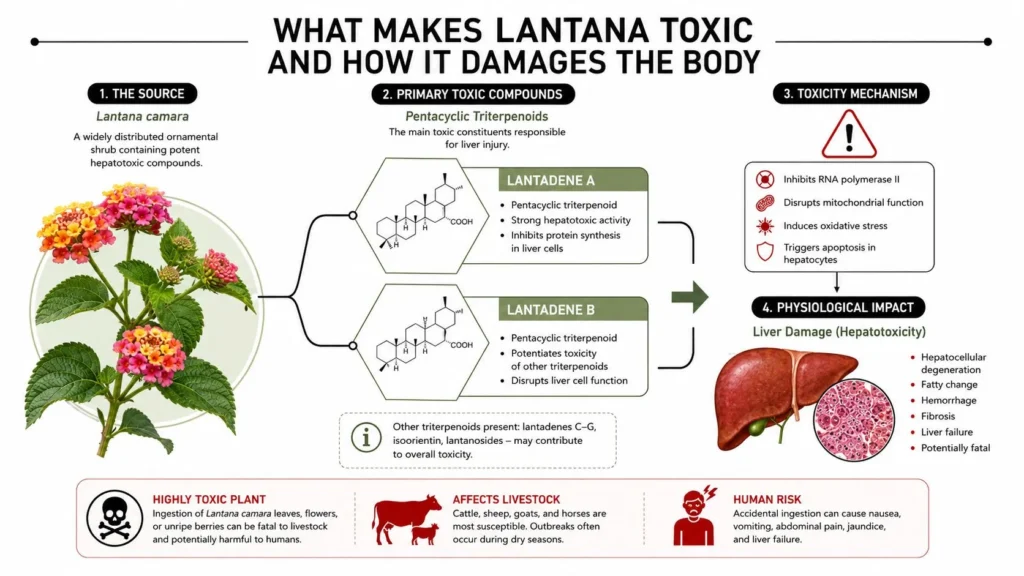
That mechanism also helps explain why symptoms can seem delayed or hard to sort out. A person or animal may taste the plant first, then show digestive trouble later, and the liver-related signs may follow after that. A calm-looking animal is not automatically safe just because the first hour passed without obvious distress.
The same biology is why lantana is treated so seriously in grazing settings. Sheep, goats, bovines, and horses can be affected, and repeated exposure makes the risk worse PubMed review noted in the verified data. The plant is toxic because of what it contains, not because of how it looks.
For readers comparing garden plants, the pattern is similar to other ornamentals that can be mild in touch but risky if eaten, including some pet hazards discussed in our guide to whether lavender is toxic to dogs. With lantana, the body damage starts after ingestion, and the liver is where much of that damage shows up.
Who Is at Risk and How Much It Takes
Risk depends on who eats the plant, how much they eat, and whether they keep getting exposed. A child who mouths a berry, a dog that snatches a leaf, and a cow grazing in a paddock are not facing the same problem, even if the shrub is the same.
Livestock face the clearest, best-documented danger
For grazing animals, the warning is direct. NSW WeedWise says all types and parts are poisonous to stock, and Queensland’s lantana flyer says a 500 kg cow may be poisoned by about 5 to 20 kg of fresh leaf, roughly 1% of body weight NSW WeedWise. That is why lantana is treated as a pasture problem, not just a garden nuisance. Once animals can reach it again and again, the risk is no longer a one-time nibble, it becomes repeated exposure.
That matters because livestock do not always make a clean, single-choice mistake. They may sample the plant, keep grazing, and take in more over time. In that setting, the question is not only how much was swallowed at once, but how much access the animal had.
Human exposures are often milder, but not trivial
Human risk is more uneven. Queensland health guidance says green unripe fruits are toxic to humans and that eating flowers, fruits, or leaves can lead to vomiting, diarrhoea, difficulty breathing, and liver failure. It also notes that the leaves can cause contact dermatitis. For children, that makes the plant a hazard if berries are picked, tasted, or handled and then rubbed near the mouth or eyes Queensland health guidance in the verified data.
The human case-series in PubMed adds an important correction to the panic-first view. A clinical review of 145 patients found that many had no or minimal symptoms, and only a small share needed health-care treatment PubMed case-series in the verified data. That does not make lantana harmless. It does show that a lot of accidental human exposures are mild, while a smaller number are serious enough to need medical attention.
For a pet-owner comparison, the question is similar to other garden plants that can be irritating in one context and risky in another, including the concerns covered in our guide to whether lavender is toxic to dogs. With lantana, the main issue is still ingestion. A quick brush against the plant is one thing, but a dog or child that eats part of it has a different level of risk.
Species and plant part change the picture
The plant does not behave like a simple yes-or-no poison. Green fruit is treated more seriously than ripe fruit in the Queensland guidance, and that distinction is one reason people get confused when they see birds or wildlife around the berries. A plant can be harmful to one species and less of a problem to another, just as some animals browse flowers that would not be safe for livestock. The Richmond Tree Experts GA wildlife guide is a useful reminder that feeding habits vary by species, so the presence of an animal near a plant does not prove the plant is safe for everything that eats it Richmond Tree Experts GA wildlife guide.
That is the useful middle ground here. Lantana is clearly dangerous for livestock, clearly capable of harming people and pets, and still uneven in how it shows up across species and plant parts. The safest way to read it is not as “always deadly” or “basically harmless,” but as a plant whose risk rises with what was eaten, how much, and who ate it.
Symptoms in Humans, Pets, and Livestock
A bite, lick, or mouthful of lantana does not always look the same across species. Humans, dogs, cats, and grazing animals process the plant differently, so the warning signs also differ.
What humans usually notice first
In people, the first signs are usually digestive. Vomiting, diarrhoea, and stomach pain are the common early complaints, and more severe poisoning can bring difficulty breathing or liver failure after enough plant material is eaten.
The human case-series in the verified data helps put that in context. Many patients had no symptoms or only mild ones, while only a smaller group needed treatment. That does not make lantana harmless, but it does explain why a small accidental taste may pass with little more than a stomach upset.
What pets tend to show
Dogs and cats usually follow the same broad pattern. Vomiting, reduced appetite, tiredness, and weakness are the signs owners are most likely to see, so any known chewing episode deserves attention even if the animal looks normal at first. If you are trying to sort out a skin problem from a poisoning concern, a separate rash can confuse the picture, and a guide like this rash reference for dogs can help you compare the signs.
What livestock can show
Livestock can become much sicker because the liver injury can be more severe. Weakness, jaundice, rumen stasis, and photosensitization are the kinds of signs that appear when animals have eaten lantana repeatedly or in larger amounts. That is the pattern farmers are taught to watch for, and it is why lantana has such a strong reputation in stock country.
A plant that seems mild in a garden can be a different problem in a paddock.
The ripeness question that keeps causing confusion
Berries are where people often get mixed messages. Green unripe fruit is the stage that raises the most concern in the Queensland guidance, but the human case-series did not show a clear jump in symptom frequency between ripe-berry and unripe-berry ingestion. That leaves one important point intact. Ripe berries should not be treated as a free pass, even if the evidence for a sharp stage difference in people is less certain than many garden warnings suggest.
Species also changes the picture. The Richmond Tree Experts GA wildlife guide is a useful reminder that animals do not all eat plants the same way, so wildlife near a plant does not prove it is safe for every animal that might mouth it Richmond Tree Experts GA wildlife guide.
Does Variety, Color, or Berry Ripeness Change the Risk
A garden label can make lantana look more predictable than it is. Flower color, berry stage, and plant variety all shift the risk a little, but none of them turn the plant into a safe one.
Color and variety change the warning, not the rule
Queensland’s lantana poisoning flyer says red-flowered varieties are thought to be most toxic, and white and pink varieties can also be highly toxic. That matters because it stops people from using bloom color as a safety test. A paler cultivar is still lantana, and lantana still deserves caution.
Pet Poison Helpline also notes that toxicity can vary with flower color, season of year, quantity ingested, and frequency of ingestion. That matches what gardeners and livestock handlers run into. A plant is not a fixed-dose tablet. Its risk changes with growth stage, weather, and how much gets eaten.
Berry ripeness is the part people ask about most
Green unripe fruits are the stage that raises the most concern. That is the clearest part of the guidance. The trickier question is whether ripe berries are harmless enough to ignore, and the human evidence does not support that kind of confidence.
The case-series of 145 patients found no significant difference in symptom frequency between ripe-berry and unripe-berry ingestion, even though many patients had mild symptoms or none at all PubMed case-series in the verified data. That leaves a plain lesson. Ripeness may change how warnings are worded, but it does not create a safe berry stage.
Best practice: treat all berries as unsafe for children, pets, and livestock, even if some sources suggest ripeness changes the intensity.
For gardeners, the practical response is simple. Keep every fruit out of reach, and do not use color or berry stage as a loophole. If children, dogs, or grazing animals can reach the plant, the safest habit is to treat the whole shrub as off-limits.
A small correction helps here. Human skin irritation after handling lantana is usually a separate issue from swallowing the plant, so the mouth and stomach concerns need to be handled on their own. If you want a quick reminder of how different exposures can look in pets, a guide such as this Benadryl dosing reference for dogs may help owners think through the right kind of response, though it is not a substitute for veterinary advice.
A no-panic rule for humans
- Rinse the mouth with water.
- Do not induce vomiting unless a poison professional tells you to.
- Call Poison Control or a doctor if berries, leaves, or flowers were swallowed.
- Watch for delayed symptoms over the next day, especially vomiting, diarrhoea, trouble breathing, or fatigue.
A livestock checklist that does not waste time
- Remove the animal from the lantana patch.
- Call a veterinarian immediately.
- Keep the animal from eating more of the plant.
- Bring a sample of the plant so the vet can confirm what was eaten.
What to Do If Someone or Some Animal Is Exposed
The right response is calm and fast, not dramatic. Lantana exposures don’t need panic, but they do need action, especially when the ingestion is known rather than suspected.
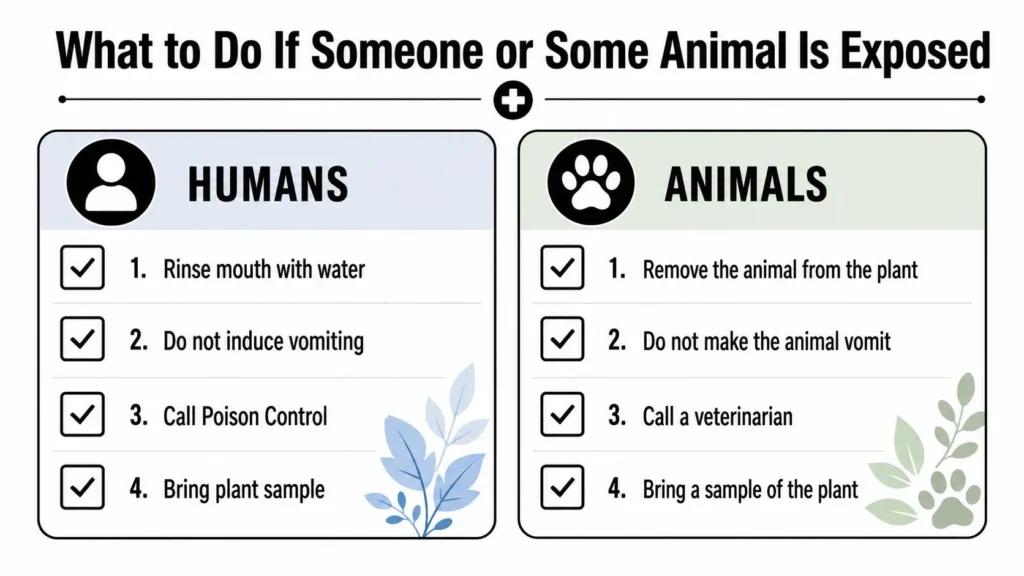
For humans
If a child or adult ate lantana, start with the mouth. Rinse with water, then keep the person from eating more plant material. Don’t try to force vomiting, because that can make things worse and doesn’t solve the underlying exposure.
If the plant part was a berry, leaf, or flower, contact Poison Control or a doctor and be ready to describe what was eaten and roughly how much. Because symptoms can lag, watch closely for vomiting, diarrhoea, breathing difficulty, or unusual tiredness during the next day. If skin irritation appears after handling the leaves, wash the area gently and keep an eye on it.
For pets and livestock
With pets, the same rule applies. Don’t wait to see whether the animal gets sick if you know it ate lantana. Call a veterinarian or the ASPCA Animal Poison Control Center, remove the animal from the plant, and keep the plant sample if you can.
For livestock, the response is more urgent because the liver risk is stronger. Move the animal away from the paddock, contact a vet at once, and give the vet the best estimate you can of what was eaten. Supportive care is a professional job here, and the sooner it starts, the better the outcome can be.
If you’re deciding whether a chew on a garden plant is a skin issue or a poisoning issue for your dog, a practical reference is this veterinary guide on Benadryl dosing for dogs. It’s not a lantana treatment, but it’s the kind of cautious comparison people often need when they’re trying to separate allergic symptoms from toxic exposure.
Practical rule: if the plant was actually swallowed, treat it as a poison call, not a wait-and-see moment.
Safer Garden Habits Around Lantana
You don’t have to turn your yard into a sterile space to lower the risk. A few routines make lantana much less likely to become a problem.
Start with gloves and bagging when you weed or prune. Keep berry clusters out of reach of children and pets, and fence off any patch that grazing animals could access. If lantana is already in a paddock edge or along a shared boundary, move it or remove it before it becomes a repeated nibbling target.
For garden planning, it helps to think in zones. A front bed near a sidewalk can sometimes be managed differently from a back boundary near animals. If you’re sketching those zones out, plan your home garden with SteadStack can help you think through access, sight lines, and plant placement in a more deliberate way.
Three habits reduce most of the risk:
- Bag prunings immediately so berries and leaves aren’t left on the ground.
- Use sterile ornamental cultivars when available so the plant sets little seed.
- Time major pruning before heavy fruiting if your climate and cultivar make that practical.
The main point is simple. Risk drops when berries aren’t accessible, livestock can’t browse the plant, and the yard isn’t inviting to accidental tasting.
Beautiful Alternatives If You Decide to Replace It
If you want the lantana look without the same poison concern, choose the replacement by job, not by name. A long-blooming shrub for colour, a compact border plant for structure, and a fragrant option for sensory appeal each solve a different garden problem.
A good place to compare heat-tolerant choices is Pool & Landscaping of Vistancia plant guide, especially if you’re gardening in a hot, sunny yard where lantana usually gets picked in the first place.
For a bright, pollinator-friendly shrub, Flame Acanthus works well when you want upright colour and hummingbird activity. For low edging where habit matters more than dramatic flowers, Blackfoot Daisy gives a neat, drought-tough mound. If you want fragrance and a softer feel near a walkway, Turk’s Cap is a strong pick because it brings flowers without trying to mimic lantana exactly.
The right swap is the one that fits your light, water, and traffic conditions. If the plant is near children, pets, or stock, safer design matters more than keeping the exact same flower palette.
If you want more plain-English plant guidance like this, visit maxijournal.com for practical articles that connect science, safety, and everyday gardening. Maxijournal.com publishes approachable guides across health, pets, education, and home life, so you can make better decisions without wading through jargon.
Discover more from Maxi Journal
Subscribe to get the latest posts sent to your email.