You open the closet, see rails packed tight, shelves stacked with “options,” and still reach for the same few pieces. That feeling isn’t irrational, and it isn’t a sign that you need more clothes. It usually means your wardrobe was built in fragments. A sale here, a trend there, a panic purchase before an event, and eventually the whole thing stops working as a system.
That matters financially as much as it matters stylistically. The average woman spends $1,800 to $4,800 a year on clothing yet wears less than 50% of what she owns, according to this wardrobe-building discussion. A functional wardrobe solves that mismatch. It helps you wear more of what you buy, buy less out of frustration, and get dressed with less noise.
This guide is about clothing and personal style, not built-in storage or carpentry. If your closet is chaotic, the answer usually isn’t a dramatic purge followed by an expensive shopping spree. It’s a slower process. Better wardrobe building looks more like editing, learning, refining, and adding with purpose over time.
Starting Your Wardrobe Journey
A wardrobe often doesn’t need to be bigger; it needs to be clearer.
A good wardrobe does three jobs at once. It fits your real life, it reflects your taste, and it makes daily dressing easier. If one of those pieces is missing, the closet starts filling with backups that don’t fix the problem. You buy another black top because none of the others feel right. You buy another pair of shoes because the pair you own only works with one hemline. The volume grows, but the usefulness doesn’t.
What a workable wardrobe actually looks like
A wardrobe worth building has a few clear characteristics:
- It matches your calendar. If you work in a relaxed office, you don’t need a closet full of formal pieces that only make sense on paper.
- It supports repeat wear. Your best items should be the ones you can wear often, not the ones you’re always “saving.”
- It mixes easily. Clothes should cooperate with each other in color, shape, and level of polish.
- It leaves room to evolve. Personal style changes. A wardrobe should be edited, not frozen.
That last point matters. Many people approach wardrobe building like a one-weekend project. They declutter aggressively, buy a set of “essentials,” then feel oddly disconnected from the result. Style rarely arrives like a flat-pack kit. It develops through repetition and honest observation.
Practical rule: Build your wardrobe in rounds. Edit first. Wear what remains. Shop only after you can describe the gap clearly.
What doesn’t work
Some common mistakes show up again and again in real closets:
| Approach | Why it fails |
|---|---|
| Buying for an imagined life | The clothes look aspirational but stay unworn |
| Replacing everything at once | You lose useful reference points and make rushed choices |
| Shopping by item category alone | “Need jeans” is too broad. You need the right rise, wash, cut, and length |
| Keeping duplicates that solve nothing | More versions of the wrong piece still leave you with nothing to wear |
If you want to learn how to build a wardrobe that lasts, start by dropping the fantasy that one perfect haul will fix everything. It won’t. The strongest wardrobes are assembled with restraint. You notice patterns, identify what earns its place, and add pieces that make the rest of your closet more useful.
Lay the Foundation with Your Personal Style
Before you sort a single hanger, get clear on your point of view. Not your favorite trend. Not what looks good on someone else. Your point of view.

When people skip this step, they usually build wardrobes that are technically fine but emotionally flat. The clothes fit. The colors are safe. Nothing feels wrong, but nothing feels like them either. That’s when shopping turns into a cycle of correction.
A plan that starts with a color palette and style inspiration board has been linked to a 75% success rate in maintaining long-term wardrobe cohesion and a 25% reduction in annual fashion spending through informed research, based on this capsule wardrobe discussion.
Build a style vision before you build the closet
Start with images, not items. Open a Pinterest board or a saved folder and collect outfits you’d wear. Don’t pin fantasy gowns if your life is denim, knits, and errands. Look for repetition.
Ask yourself:
- Which silhouettes keep appearing? Wide-leg trousers, cropped jackets, column skirts, oversized shirts?
- What level of polish feels right? Refined, relaxed, artistic, classic, sporty?
- Which colors dominate? Cream, navy, olive, charcoal, chocolate, denim blue?
- What’s missing from your current closet? Ease, structure, softness, drama, simplicity?
If you want a deeper framework for that self-assessment, this guide on how to find your personal style is useful because it focuses on identifying recurring preferences instead of chasing labels.
You can also sharpen your eye by reading more broadly about wardrobe direction and visual coherence. This article on how to develop a fashion sense is a helpful companion when you’re trying to connect taste with practical choices.
Choose boundaries that make dressing easier
Personal style isn’t about boxing yourself in. It’s about making decisions faster.
Try defining three style words. For example: clean, textured, understated. Or feminine, structured, modern. Those words become a filter when you shop or edit. If a garment is beautiful but doesn’t fit the words, it probably won’t integrate well.
Then set a core color palette. Keep it small enough that pieces naturally mix. A practical palette often includes:
- Base neutrals like black, navy, grey, cream, taupe
- Support shades such as olive, burgundy, chocolate, soft blue
- Accent colors you enjoy in smaller doses
Style gets clearer when you stop asking, “Is this nice?” and start asking, “Is this mine?”
That shift changes everything. It moves you from admiration to selection, which is where a functional wardrobe begins.
Conduct a Ruthless Closet Audit
Once you know what your wardrobe is supposed to say, empty it. Completely.
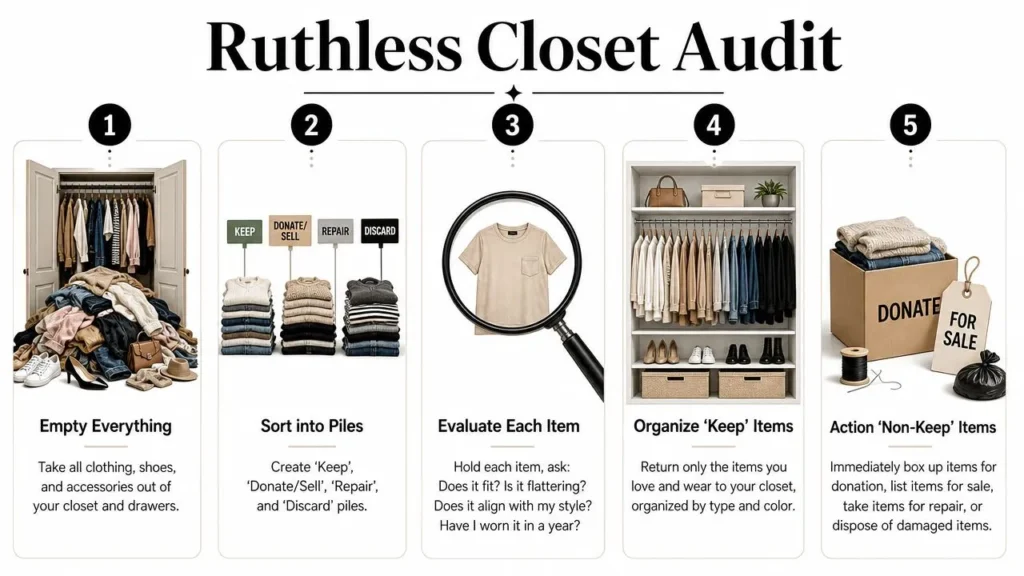
This is the point where emotions often surface. That’s normal. Clothing carries memory, guilt, hope, and sometimes old identities. But if you try to edit while everything is still crammed together, you won’t see the truth of what you own.
The overwhelm is also real at a basic volume level. People own an average of 148 pieces of clothing, with most falling between 77 and 155 pieces, according to wardrobe ownership data. If your closet feels like too much, that reaction makes sense. The answer isn’t shame. It’s selection.
Pull everything out and sort fast
Use four categories:
- Keep
- Store
- Donate or sell
- Discard
“Store” matters because not every non-current item deserves to leave your life. Off-season pieces, occasionwear, and a few sentimental garments can live elsewhere without clogging your daily closet.
Move quickly on the first pass. Don’t try to style each piece into a comeback story. You’re looking for evidence.
Speed-date every garment
Pick up one item at a time and ask:
- Does it fit my body as it is now?
- Does it support the style direction I defined?
- Would I buy this again today?
- Can I name where I’d wear it?
- Do I avoid it for a specific reason?
If you hesitate for too long, that hesitation is information.
Here’s a useful distinction:
| Keep it if… | Let it go if… |
|---|---|
| You wear it without adjustment or annoyance | You tug, layer, pin, or “make it work” every time |
| It pairs with several other pieces | It only works with one difficult item |
| It reflects your current taste | It belongs to a past version of you |
| It’s worth repairing | Repair is just an excuse to avoid deciding |
Some clothes aren’t bad. They’re just not part of your life anymore.
Audit for patterns, not just clutter
Value of a closet audit isn’t the donation pile. It’s pattern recognition.
Maybe you discover you own too many “almost right” tops and very few strong layers. Maybe your shoes are stylish but impractical for your actual week. Maybe every pair of trousers requires heels, which explains why you keep defaulting to jeans.
Look for clusters:
- Repeat mistakes such as itchy knits, wrong undertones, awkward lengths
- True heroes that you wear on instinct
- Missing connectors like a simple belt, a better loafer, a jacket with structure
- Fantasy buys that suit a mood, not a lifestyle
Be strict about what returns to the rail
Only put the keepers back. Organize by type first, then by color if that helps you see combinations quickly. Good organization isn’t about aesthetics alone. It makes weak spots obvious.
If you’re learning how to build a wardrobe from the ground up, this stage gives you your inventory and your shopping brief in one move. By the end, you should know three things clearly: what works, what doesn’t, and what’s missing.
Master Capsule Wardrobe Principles
A capsule wardrobe isn’t a punishment, and it isn’t a personality test. It’s a decision-making tool.
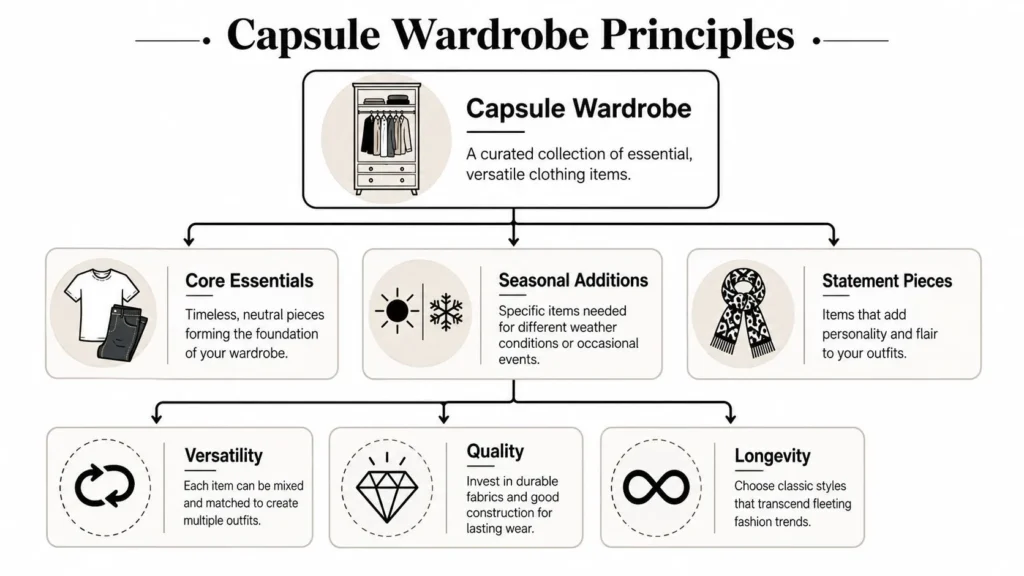
Used well, capsule principles help you stop measuring a wardrobe by quantity and start measuring it by interaction. A piece earns its place because it multiplies outfits, not because it fills a category slot.
One of the clearest templates is the 5-4-3-2-1 model: 5 tops, 4 bottoms, 3 layers, 2 shoes, 1 special item. This structure has been shown to achieve 90% outfit versatility with only 15 items, according to this capsule wardrobe methodology.
A short visual example helps if you think best in outfits rather than lists.
What the formula gets right
The power of the model isn’t the exact count. It’s the ratio.
Five tops give enough variety across necklines, sleeve lengths, and levels of polish. Four bottoms prevent you from relying on one silhouette for every occasion. Three layers handle structure and weather. Two shoes force practicality. One special item keeps the wardrobe personal.
That “special item” matters more than people think. It could be a printed skirt, a sculptural jacket, a red flat, or a textured knit. Without a personal note, a capsule can become sterile.
Build from workhorses first
Start with your highest-frequency pieces. These are the clothes that carry the week.
Common workhorses include:
- A reliable trouser that works with flats and layers well
- A clean knit or sweater that isn’t too bulky under outerwear
- A shirt or top silhouette you know you’ll reach for repeatedly
- A practical shoe you can wear for actual movement
- A layer with structure like a blazer, chore jacket, or neatly cut overshirt
Then test combinations. Don’t just admire each item on its own. Put them together.
A good capsule piece should answer yes to at least several of these questions:
- Can it dress up and down?
- Does it work with multiple bottoms?
- Can you wear it in more than one setting?
- Is the fit easy enough that you won’t avoid it?
- Does it support the overall mood of your wardrobe?
Capsule doesn’t mean minimal at all costs
Many individuals misinterpret the approach. They strip their wardrobe down to a severe set of basics, then wonder why they’re bored. The answer isn’t to abandon the concept. It’s to build a capsule that reflects your actual style language.
For practical outfit-building ideas and category planning, these expert tips for a capsule wardrobe offer a useful outside perspective.
The best capsule wardrobe isn’t the smallest one. It’s the one where each piece has a job and gets worn.
That’s the standard. Not minimalism for its own sake, but usefulness with character.
Develop a Smart Shopping Strategy
Shopping is where wardrobe plans usually collapse. Not because people lack taste, but because stores are designed to blur urgency and desire.
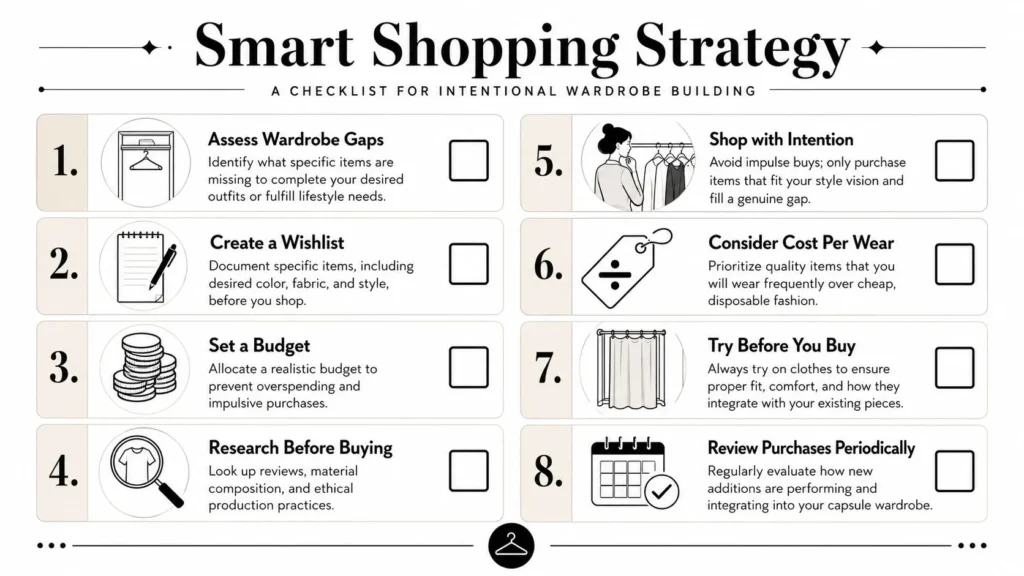
The strongest approach is gradual curation. Buy into your wardrobe the way a good editor builds a publication: selectively, repeatedly, and with standards. That approach matters because a gradual curation philosophy reduces wardrobe replacement cycles by 38% over 3 years, while also addressing the wardrobe fatigue reported by 62% of young shoppers, according to this discussion of cohesive wardrobe building.
Stop shopping for excitement alone
Excitement is a terrible buying criterion. It makes dramatic pieces feel useful and practical pieces feel boring, even when your wardrobe needs the practical piece.
Use a pre-purchase filter instead. Before buying anything, ask:
- Does it match my style words?
- Can I build several outfits with what I already own?
- Does it solve a specific gap I found during the audit?
- Is the fabric and finish good enough for repeat wear?
- Will I still want to wear this once the initial buzz fades?
If the answer is unclear, wait.
Buy in an order that improves the whole closet
Not all purchases have equal value. Some items create immediate outfit options. Others just add noise.
A smart buying order often looks like this:
Missing basics that unblock outfits
A correct tank, knit, trouser, or shoe can activate pieces you already own.Fit fixes and alterations
Tailoring is often a better spend than another “good enough” replacement. If you want a clear overview of what proper adjustments involve, this guide to the tailoring process for a perfect fit explains why precision changes how a garment performs.High-frequency layers
Outer layers and knitwear influence the wardrobe more than impulse tops do.Personality pieces
Add these after the core is stable, not before.
You can also broaden your search strategically instead of defaulting to the same chain stores every time. A curated list of best places to shop can help when you’re trying to match budget, quality, and style level more intentionally.
Use a wishlist, not a wandering browse
Keep a running list on your phone with exact notes. Not “need boots.” Write “dark brown flat ankle boot, almond toe, walkable sole, works with straight jeans and midi skirts.” Specificity protects you from near-miss purchases.
Here’s a simple comparison:
| Unfocused shopping | Smart shopping |
|---|---|
| Browsing without a list | Entering with named gaps |
| Buying because it’s on sale | Buying because it completes outfits |
| Prioritizing novelty | Prioritizing repeat wear |
| Ignoring tailoring potential | Considering whether a good piece can be improved |
If a new piece doesn’t make at least a few existing outfits easier, it probably isn’t helping your wardrobe.
That’s the heart of how to build a wardrobe without overspending. You don’t need constant replacement. You need better standards.
Style and Maintain Your New Wardrobe
A wardrobe only proves itself in daily use. If it looks polished on hangers but still creates stress every morning, it isn’t finished.
The easiest way to keep momentum is to create outfit formulas. These aren’t rigid uniforms. They’re repeatable combinations that suit your proportions, lifestyle, and taste. Once you know your formulas, getting dressed stops feeling like a fresh puzzle every day.
Create a few reliable outfit formulas
Think in combinations, not isolated items.
Examples might include:
- Straight-leg jean + fine knit + loafer + structured coat
- Wide-leg trouser + fitted tee + blazer + sneaker
- Midi skirt + soft sweater + boot
- Shirt dress + belt + flat sandal
- Black trouser + simple tank + cardigan + clean jewelry
Save photos of outfits you wore and liked. Not aspirational ones. Real ones. After a few weeks, you’ll see patterns. That record becomes more useful than any trend roundup.
If your wardrobe shifts with the seasons, it can also help to revisit color combinations before the weather changes. This piece on autumn colors in fashion is a useful reference when you’re refreshing a palette without rebuilding your closet from scratch.
Care for clothes like they matter
Clothing lasts longer when you treat it like a wardrobe, not a pile.
A few habits make an outsized difference:
- Wash less often when appropriate. Many garments need airing out more than they need a full wash.
- Use the right hanger. Knitwear should usually be folded. Structured jackets need support.
- Handle repairs early. Loose buttons and dropped hems rarely fix themselves.
- Store by visibility. If you can’t see it, you probably won’t wear it.
Keep editing as your life changes
The mistake is thinking you “arrive” at a final wardrobe. You don’t. Jobs change, bodies change, routines change, taste sharpens. A strong wardrobe can absorb that because it was built through observation in the first place.
Review it regularly. Notice what you wore hard, what sat untouched, and what felt missing in real life rather than in theory.
A good wardrobe should feel edited, not finished.
That’s the long game. Not one dramatic reset, but a closet that keeps getting more accurate.
If you enjoy practical fashion advice, thoughtful lifestyle writing, and clear guides like this one, explore more at maxijournal.com. It’s a smart place to find approachable articles across fashion, culture, health, business, travel, and more.
Discover more from Maxi Journal
Subscribe to get the latest posts sent to your email.