For years, the debate has raged on: do cats actually love their owners? Many people still write them off as aloof, standoffish, and only interested in where their next meal is coming from.
But the simple truth is a resounding yes. Modern science now confirms what many of us have felt all along—cats form deep, secure bonds with their people, not unlike the attachments we see in dogs and even human babies.
The Enduring Question About Feline Affection
The image of the independent, solitary cat is a tough stereotype to shake. It largely comes from judging them against the canine standard of affection—big, obvious, and socially demanding. Cats, however, operate differently. Their language of love is far more subtle, a unique dialect you have to learn to understand.
This guide is all about moving past those outdated myths and exploring the real, scientifically proven connection you share with your cat. We’re going to dig into the solid evidence showing that their affection is much more than just “cupboard love.”
Understanding the Modern View of Cat Love
Instead of thinking of your cat as a furry, self-sufficient roommate, it’s far more accurate to view your relationship through the lens of attachment theory. This is the very same scientific framework used to understand the powerful bonds between parents and their children.
It suggests that cats see their primary caregivers as a source of safety and security in a world that can feel big and unpredictable. You’re their anchor.
Here’s what we’ll explore:
- The Science: We’ll dive into the landmark studies, particularly the “secure base test,” that provided concrete proof of the genuine attachments cats form with their owners.
- The Language: You’ll learn how to decode the specific behaviors—from those soft, slow blinks to gentle head-butts—that are your cat’s way of saying “I love you.”
- The Connection: We’ll finish with practical, science-backed tips you can use to actively strengthen that bond and build a deeper, more trusting relationship.
By the end of this journey, you’ll see with total clarity that the deep affection you feel for your cat isn’t a one-way street. It’s a real, mutual bond, and you’ll be equipped with the knowledge to recognize and nurture it every single day.
For years, the debate over whether cats truly love their owners was mostly a matter of opinion. Skeptics would often wave it off as “cupboard love”—the idea that your cat only seems affectionate because you’re the one who fills the food bowl. But modern science has finally stepped in, giving us a much clearer picture. The bond is real, and it’s rooted in something much deeper than just the next meal.
The big breakthrough came when researchers cleverly adapted a classic psychology experiment called the “secure base test.” Originally, this test was designed to study the attachment between human infants and their parents. Picture a toddler in a new room: when their parent is there, they feel safe enough to explore. But when the parent leaves, they get anxious. The parent’s return brings immediate comfort and a return to calm. That parent is their “secure base.”
Putting Feline Affection to the Test
So, researchers applied this exact model to cats and their owners. They brought a cat and its person into an unfamiliar room for two minutes. Then, the owner left for two minutes, leaving the cat alone, before coming back for a two-minute reunion. Every little behavior was carefully watched and recorded.
The results were nothing short of incredible, offering the first real scientific proof of the human-cat bond. Just like the toddlers in the original studies, the majority of cats showed what’s known as a secure attachment style. They were more relaxed and explored the room confidently when their owner was present, clearly using them as a secure base. When the owner returned, these cats greeted them and visibly settled down.
This is a huge deal. It shows that for a cat, their owner isn’t just a walking can opener. You are a source of safety and security, and the connection you share is a genuine social bond.
The Numbers Behind the Bond
A landmark 2019 study from Oregon State University finally put some hard numbers to what many of us felt all along. Researchers found that 64.3% of kittens and an even higher 65.8% of adult cats showed a secure attachment to their caregivers. What’s really striking is how closely these figures mirror the 65% secure attachment rate seen in human infants. It seems the ability to form these deep, comforting bonds is something we share. You can dive deeper into these fascinating results in the full study overview31086-3).
This research completely flips the script. The question is no longer if cats love their owners, but how they show it. The evidence is solid: that feeling you have that your cat truly cares for you? It’s not just in your head. It’s a scientifically recognized attachment built on trust, comfort, and real affection.
How Cats Show Love in Their Own Language
Alright, so the science confirms that cats do form secure bonds with us. But what does that actually look like day-to-day? To really know if your cat loves you, you have to learn their language.
Feline affection isn’t as loud as a dog’s frantically wagging tail. It’s a much quieter, more subtle dialect spoken through specific body language and behaviors. Once you learn the lingo, you’ll start seeing signs of their attachment everywhere. It’s like finally getting the secret decoder ring to your cat’s heart.
Translating Feline Body Language
Many of the most common signs of cat love are either completely missed or totally misunderstood. Unlike us, cats use their whole bodies to communicate trust and affection. Learning to read these signals is the key to understanding the real depth of your bond.
Here are a few of the most important behaviors to watch for:
- The Slow Blink: Often called a “cat kiss,” this is one of the biggest tells. When a cat looks at you and slowly closes and then opens its eyes, it’s showing you it feels completely safe and relaxed. In the wild, closing your eyes around another creature is a display of ultimate vulnerability.
- Head Bunting and Cheek Rubbing: When your cat bonks its head against you or rubs its cheeks on your leg, it’s doing more than just asking for a scratch. This behavior, known as bunting, is how they deposit facial pheromones on you. They’re literally marking you with their scent, claiming you as a safe and important member of their inner circle.
- Kneading or “Making Biscuits”: That rhythmic pushing of their paws against you is a throwback behavior. It’s what kittens do to stimulate milk from their mother. When an adult cat kneads on you, it’s a sign of pure contentment and comfort, taking them back to their earliest feelings of safety and affection.
The diagram below gives a great visual of how researchers tested this attachment, showing how a cat’s behavior shifts depending on whether their owner is in the room.
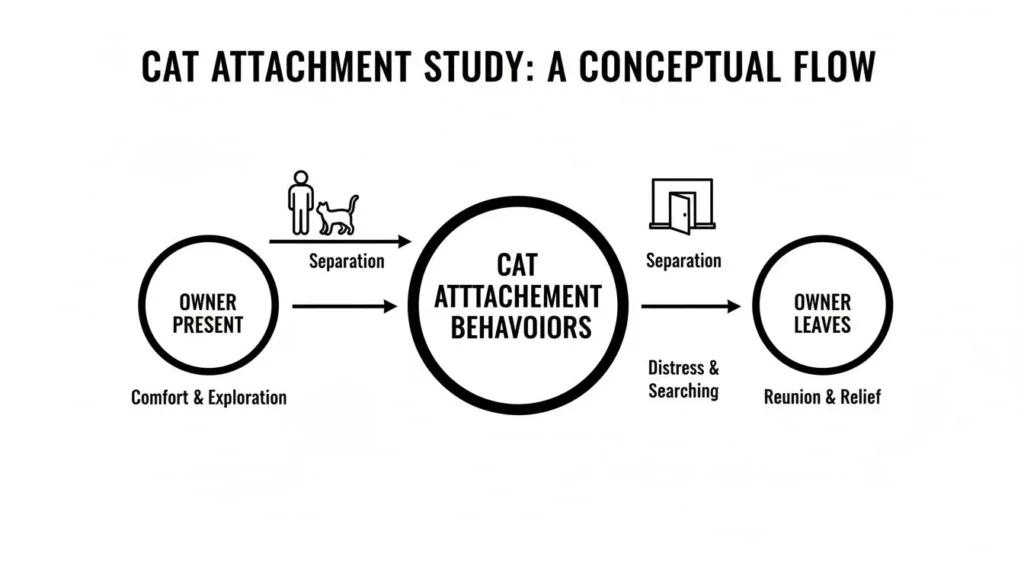
As you can see, securely attached cats use their owners as a home base for confidence. They get a little stressed when their person leaves but seek them out for comfort as soon as they’re back.
Beyond the Cuddles
Affection isn’t just about physical contact. Some of the most profound signs of love are all about proximity and sharing what they have.
“A cat’s love is often demonstrated in quiet companionship. Their choice to simply be in the same room with you, to nap on your laundry, or to follow you from one place to another is a constant, silent vote of confidence and affection.”
For instance, when a cat rolls over and shows you its belly, it’s not always an invitation for a belly rub (a lesson many of us have learned the hard way). It is, however, a massive display of trust. A cat’s stomach is its most vulnerable spot, so exposing it means they see you as zero threat.
Likewise, when your cat brings you a “gift”—whether it’s a favorite toy or, less delightfully, their latest catch—they are sharing valuable resources. It’s the same behavior they’d show to their feline family. They see you as a member of their colony who apparently can’t hunt for themselves and needs to be provided for.
Of course, we’ve spent a lot of time looking at this from the cat’s perspective—digging into the science of their attachments and learning to speak their unique love language. But what about our side of the story? To get the full picture, we have to look at the other half of the relationship.
This isn’t a one-way street. The incredible devotion people feel for their feline friends is a real, powerful, and global phenomenon. And honestly, it’s one of the most compelling pieces of evidence we have that the bond is mutual. When we feel so deeply connected, it’s usually because we’re getting something truly meaningful back.
A Universal Language of Human Attachment
So, how do you even measure something like love for a pet? Scientists often turn to a tool called the Lexington Attachment to Pets Scale (LAPS). Think of it as a way to quantify the emotional weight and significance a pet holds in their owner’s life.
And the results? Across study after study, all over the world, the findings are remarkably consistent: cat owners report deep, meaningful attachments to their pets.
It doesn’t matter if you’re in Spain or the United States; that feeling you have for your cat is a shared human experience. This tells us our connection with cats isn’t just a fluke—it’s something fundamental.
The fact that owners across the world demonstrate such strong feelings of attachment suggests they are receiving something emotionally significant in return. This mutual devotion is the cornerstone of any loving relationship.
Putting Numbers to Our Devotion
The data from these studies really drives the point home. Take a study in the Basque Country of northern Spain, for instance, which used the LAPS to gauge owner attachment. The findings showed that cat owners consistently scored high on the attachment scale—right up there with results from similar studies in Austria, New Zealand, and the UK.
Interestingly, while attachment scores for cat owners sometimes come in just a little lower than for dog owners, the bond is still undeniably strong. In that Spanish study, scores were even higher than those found in Denmark and the USA, which just goes to show that while cultural details might vary, the core connection is always there. You can dig into the fascinating pet attachment research on pmc.ncbi.nlm.nih.gov to see the international comparisons for yourself.
The powerful, positive emotions our cats bring out in us are also a huge boost to our well-being. This bond contributes so much to our mental health, often giving us a sense of calm and purpose in a chaotic world. The simple act of caring for another living being can be an incredibly grounding experience.
If you’re looking for other ways to bring more calm into your life, you might find our guide on how to meditate for stress relief helpful.
Ultimately, the proof is in the people. The way we welcome cats so completely into our lives—as family members, as confidants, as cherished companions—is the strongest argument of all. We invest in their health and happiness because they give us genuine love in return. It’s this shared bond that makes the whole thing so special.
Why We View Cats as Cherished Family Members
The bond we have with our cats runs much deeper than just “pet ownership.” Let’s be honest, for most of us, they aren’t simply animals sharing our space; they are truly part of the family. This isn’t some sentimental exaggeration—it’s a powerful, near-universal feeling that defines the entire relationship.
This deep sense of connection is exactly why we find ourselves asking, “do cats love their owners?” When you see your cat as family, it’s only natural to hope the feeling is mutual. The great news? That feeling is overwhelmingly validated by people all over the world.
A massive international survey by the Human Animal Bond Research Institute (HABRI) and Zoetis found something staggering: a whopping 94% of pet owners across ten major countries see their companions as full-fledged family members. This wasn’t just a Western sentiment; it was a consistent truth in places as culturally different as China, Brazil, and Japan. You can dig into the complete international survey on the human-animal bond from HABRI to see this incredible global consensus for yourself.
The Heart of the Human-Cat Connection
This nearly unanimous view of pets as family is the ultimate proof that the bond goes both ways. We simply wouldn’t pour so much emotion, time, and care into a relationship that felt one-sided. We give them family status because the comfort, affection, and joy they bring into our lives feel real and profound.
And this emotional return on investment pays off in tangible ways. The very same HABRI study reported that 92% of owners saw real improvements in their own mental and physical health, all thanks to their pets.
Thinking of our cats as family isn’t just a sweet idea; it’s a reflection of the huge, positive impact they have on our lives. This global agreement validates the love you feel for your cat, showing that a relationship this beneficial has to be built on a real, mutual connection.
This powerful emotional framework also has a funny way of helping us manage our own well-being. The steady companionship of a cat offers a reliable source of comfort, which can be a game-changer for managing stress. If you’re looking for more strategies on that front, you might find our guide on how to calm anxiety naturally helpful.
In the end, the reason we see our cats as family is simple: they earn that spot in our hearts. Through their subtle but consistent ways of showing love, they forge a bond so strong it enriches our lives in more ways than we can count.
Practical Ways to Strengthen Your Bond with Your Cat

Knowing the science behind feline affection is one thing, but putting it into practice is where the real magic happens. Building a strong bond isn’t about grand gestures. It’s about the small, consistent, and respectful interactions that build trust over time. The good news? You can absolutely deepen the connection you share with your cat.
The entire foundation rests on respecting their very nature. That means you should never force an interaction. Let your cat be the one to initiate contact and decide how long a petting session lasts. When they choose to approach you, it’s a huge sign of trust—forcing a cuddle when they’re not in the mood can undo all that hard work. Think of it as a conversation where you have to listen just as much as you speak.
Build Trust Through Daily Actions
A secure and predictable environment is absolutely essential for making your cat feel safe and loved. Little, consistent actions will always be more effective than occasional, over-the-top bursts of attention.
- Establish Predictable Routines: Cats are creatures of habit. Sticking to consistent feeding times, play sessions, and even your own daily schedule helps them feel secure. It reinforces your role as a reliable source of all good things, from food to comfort.
- Engage in Interactive Play: Get out the wand toy or laser pointer and simulate a hunt. This taps directly into their natural instincts and helps them see you as a fun play partner, not just the person who fills the food bowl.
- Master the Slow Blink: This is a game-changer. When you catch your cat looking at you from across the room, try slowly closing and then opening your eyes. It’s a “cat kiss” that signals you’re relaxed and not a threat. More often than not, they’ll blink back, creating a beautiful moment of mutual trust.
Create a Cat-Friendly Space
The home you share plays a huge part in your relationship. A happy, confident cat is almost always a more affectionate one.
The key to a deeper bond is to think from your cat’s perspective. They need safety, stimulation, and the freedom to choose. When you provide these things, you are speaking their language of love directly.
Make sure to provide plenty of vertical space, like cat trees, perches, and shelves. Cats feel much safer when they can observe their territory from a high vantage point. Giving them a secure retreat ironically makes them more confident about coming down to seek you out for affection. A healthy environment also means a healthy cat. If you notice any signs of illness, it’s crucial to act. You can learn more about common issues like coccidia in cats to stay informed and keep them feeling their best.
By putting these simple strategies into practice, you’ll shift from being just an “owner” to a true partner in your cat’s life. And you’ll prove that cats do love their owners—especially when that love is built on a solid foundation of mutual respect.
A Few Lingering Questions About Cat Love
Even when you understand the science, some questions just stick around. Getting a feel for the little details of feline affection can help you truly appreciate your own cat’s unique way of showing they care.
Let’s clear up a few of the most common worries.
Why Does My Cat Seem More Aloof Than Others?
It’s natural to see a friend’s super-cuddly cat and then look at your own reserved feline and wonder, “Did I do something wrong?” The short answer is no. A cat’s personality is a complex cocktail of early life experiences, individual temperament, and even their genetic background.
Their exposure to humans between two and seven weeks of age is a huge factor. But a cat that seems distant might still be securely attached to you—they just express it differently. For them, love might be choosing to nap in the same room or just showing up at the door when you get home. It doesn’t mean the love isn’t there; it just means they have a different love language.
A cat’s affection isn’t always about climbing into your lap. Quiet companionship is often their most profound way of saying, “I feel safe and happy with you.” Their presence is a deliberate choice, and that’s a powerful sign of their bond.
Is It Really All About the Food?
Ah, the classic “cupboard love” debate. Is their affection just a clever tactic to get to the kibble? While food is a massive motivator for any animal (including us!), the research shows the bond runs much deeper.
The “secure base test” is the smoking gun here. In that study, scared cats ran to their owners for comfort and security, not for a handful of treats. Think about it: most of the classic signs of cat love have nothing to do with the food bowl.
- Purring on your lap during a movie.
- Head-butting your leg while you’re trying to work.
- Kneading on the blanket next to you.
These aren’t transactional behaviors. They’re purely social, designed to reinforce the connection you share.
Can I Make My Cat More Cuddly?
While you can’t completely rewire a cat’s core personality, you can absolutely build trust and encourage more outwardly affectionate behaviors. The secret is simple: respect their boundaries and lean into positive reinforcement. Never, ever force a cuddle.
Your goal is to become the source of all things good. When your cat voluntarily approaches, reward them with a soft, gentle voice or a slow blink. Make time for interactive play every day to strengthen your role as a provider of fun, not just food. Over time, a cat that feels safe, respected, and entertained is far more likely to decide that your lap is the best place in the world to be—all on their own terms.
Discover more from Maxi Journal
Subscribe to get the latest posts sent to your email.