The education technology market was estimated at USD 187.01 billion in 2025, with a projection of USD 437.54 billion by 2033 and a 10.8% CAGR from 2026 to 2033. That scale changes how you should read education technology news. You’re not tracking a niche anymore. You’re tracking a large, fast-moving sector that now affects district procurement, higher-ed governance, workforce training, accessibility planning, and AI policy all at once.
That’s why passive reading doesn’t work. Busy educators and administrators need a short list of reliable sources, each matched to a real job to be done. A K-12 technology director needs different coverage from a faculty developer, and both need something different from a provost or instructional designer.
This guide is built for that reality. It cuts through the noise and maps seven useful sources to specific professional needs, so you can spend less time scanning headlines and more time making decisions. If you also track broader insights for online educators, this list will help you separate trend watching from operational intelligence.
1. EdSurge
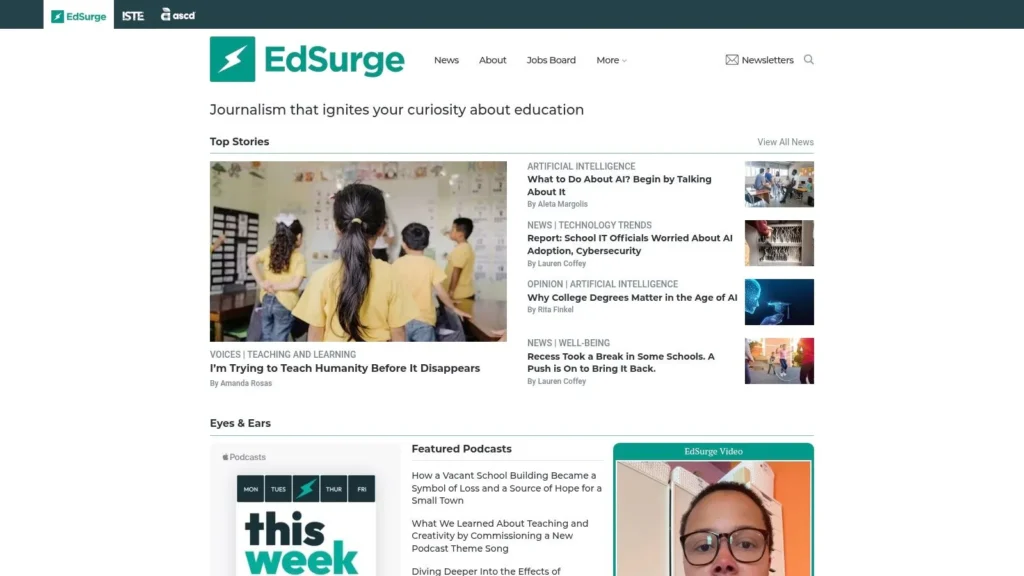
EdSurge is the best all-around pick if your job crosses boundaries. Few outlets move comfortably across early childhood, K-12, and higher education while still sounding grounded in classroom and campus reality. That matters when AI policy, accessibility, digital learning, and vendor change don’t stay confined to one segment for long.
Its value isn’t just speed. It’s translation. EdSurge often frames new developments in a way that helps a principal, CIO, instructional coach, or faculty leader understand what a story means for practice, not just what happened.
Best fit for cross-functional readers
If you wear more than one hat, EdSurge earns a place near the top of your briefing stack.
- Broad topical range: Its coverage spans AI, digital learning, policy, equity, and implementation questions across multiple education levels.
- Useful format mix: News reports, explainers, practitioner perspectives, newsletters, and webinars make it easier to skim first and go deep later.
- Clearer than many peers: Sponsored material is generally labeled, which helps readers judge commercial framing.
Practical rule: Use EdSurge as your first read in the morning when you need orientation, then verify high-stakes procurement or policy implications with a more specialized source.
The main caution is editorial context. Because EdSurge includes practitioner “Voices” and sponsored placements alongside newsroom reporting, you need to distinguish analysis from advocacy. That’s not a flaw by itself. It just means readers should keep one eye on who is speaking and why.
For readers who like broad media diets and want adjacent technology coverage beyond education, EdSurge pairs well with lists of top tech news websites.
2. Education Week
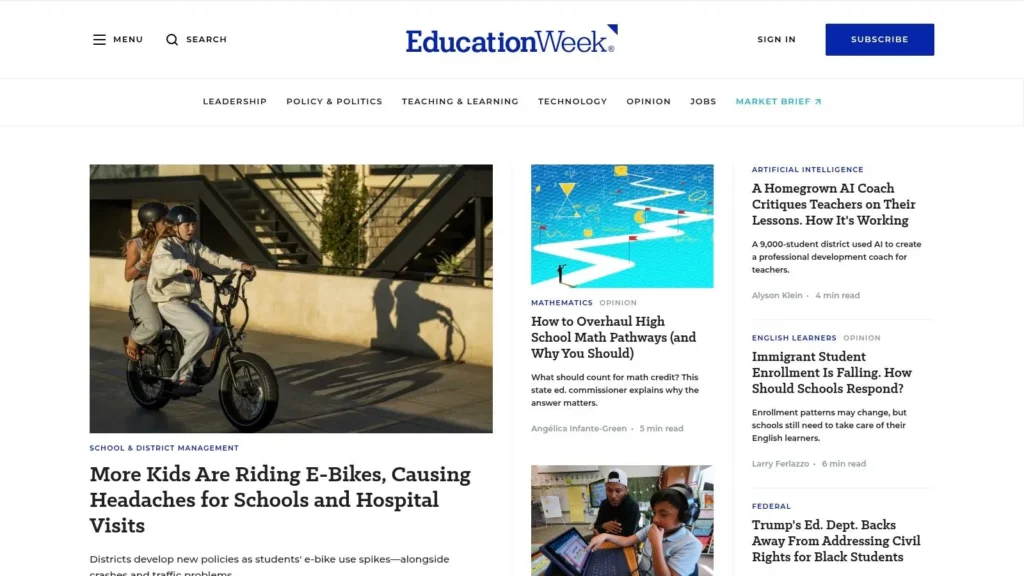
If your world is district governance, school systems, and K-12 policy, Education Week is hard to replace. Its Technology coverage has a distinctly administrative lens. It tends to be more useful for superintendents, district IT leaders, state agency staff, and school board-facing teams than for someone looking only for tool discovery.
That focus lines up with a major shift in the field. In the United States, artificial intelligence became the number one state education technology initiative in 2025, while cybersecurity remained at 21% of state priorities and three out of four states had adopted device restrictions, issued guidance, or were considering them. Education Week is one of the better places to follow what those policy changes look like when they hit districts.
Where it stands out
Education Week is strongest when technology becomes a governance issue.
- District-level reporting: Its stories usually connect technology decisions to staffing, budgets, student policy, and implementation constraints.
- Structured topic hubs: Technology, AI, privacy, cybersecurity, and classroom tech are easier to monitor without digging.
- Useful for leadership teams: It supports conversations with cabinet-level administrators who need context, not just product updates.
District leaders don’t just need to know that AI tools exist. They need to know what guidance, restrictions, and obligations are forming around them.
The tradeoff is access. Some of its most useful reporting and research-related resources sit behind registration or a paywall. Still, if your role includes policy memos, board updates, or strategic planning, it’s often worth the friction.
For administrators also comparing continuing education and reskilling options, this source complements guides to online learning platforms for adults.
3. THE Journal
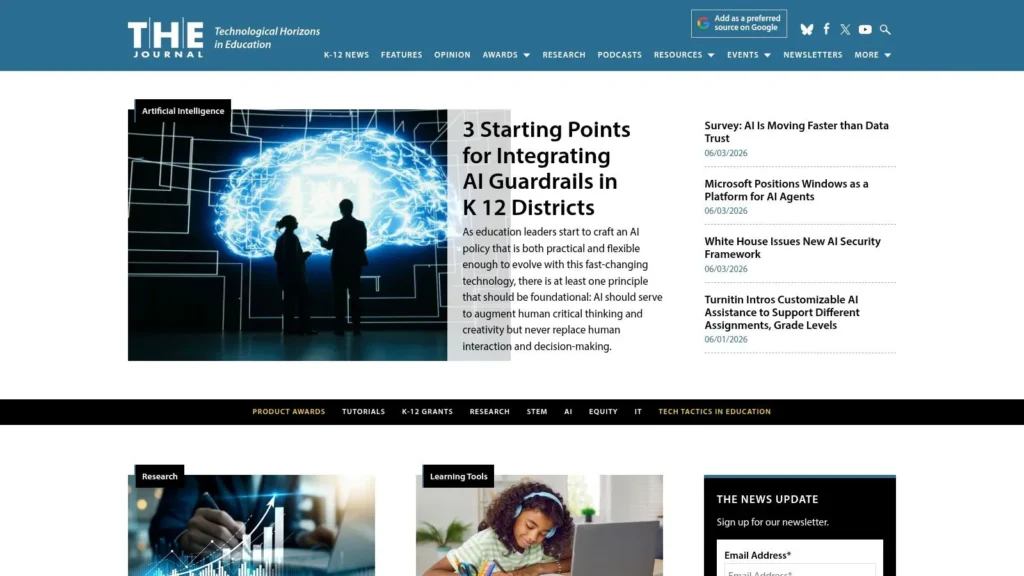
THE Journal serves a narrower but very practical purpose. It’s built for K-12 technology implementation. If Education Week tells you how policy is shifting, THE Journal is more likely to show you what district teams are doing with platforms, devices, security decisions, and classroom systems.
That practical bias makes it especially useful for directors of technology, instructional technology coordinators, digital learning leaders, and curriculum teams that need to monitor vendor movement without getting lost in broad market chatter.
Why district operators keep it in rotation
THE Journal tends to publish in a way that helps operational teams move from awareness to action.
- Implementation-minded coverage: Product rollouts, procurement-relevant updates, AI tools, funding developments, and cybersecurity stories show up with a practitioner lens.
- Role-friendly format: Newsletters and topic streams make it easier to assign scanning responsibility across an IT or curriculum team.
- Good vendor visibility: You’ll often spot emerging narratives in the school technology market before they become mainstream talking points.
The limitation is obvious. It’s not the source I’d recommend as a primary read for higher-ed faculty or campus governance. Its center of gravity is K-12 operations.
That said, many K-12 teams also want adjacent student workflow ideas, especially when device ecosystems and classroom software overlap with learner habits. In that context, it pairs naturally with coverage of productivity apps for students.
4. eSchool News
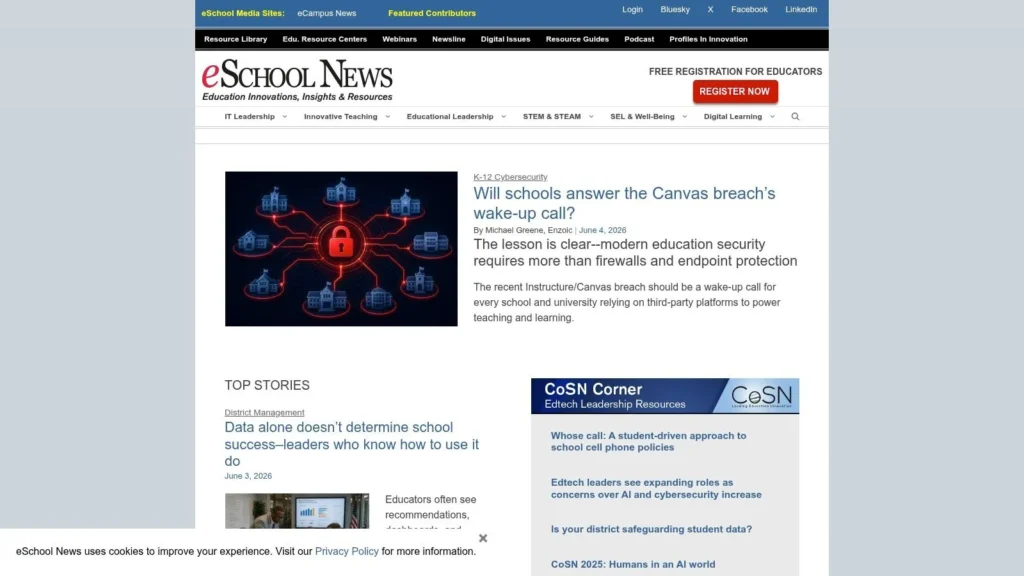
eSchool News is the source to use when you need practical breadth without overcommitting to one education segment. It covers K-20, which makes it useful for readers who sit near the seam between secondary and postsecondary learning, or for administrators who want one feed that touches classrooms, district offices, and campus operations.
Its style is less formal than some legacy publications. That’s a strength when your goal is quick signal detection. You can often scan several pieces fast, identify what matters, and then decide whether a topic deserves deeper reporting elsewhere.
Best use case
eSchool News works well as a scanning layer in your education technology news routine.
- Broad K-20 coverage: It’s helpful when your institution spans multiple learner groups or when your work touches both schools and colleges.
- Practical guides and resource content: Many readers will value the how-to framing and downloadable materials.
- Fast digestion: Topic indexes and newsletters make it easier to monitor legislation, product updates, and teaching practices without a heavy time cost.
The caution is similar to other trade-oriented outlets. Marketing and solutions content can sit close to editorial content, so experienced readers should apply source discipline. If a story seems too aligned with a vendor narrative, confirm it elsewhere before using it in a recommendation memo.
eSchool News proves its worth. It’s not always the final word, but it’s often the fastest way to notice what busy educators are talking about.
5. Inside Higher Ed
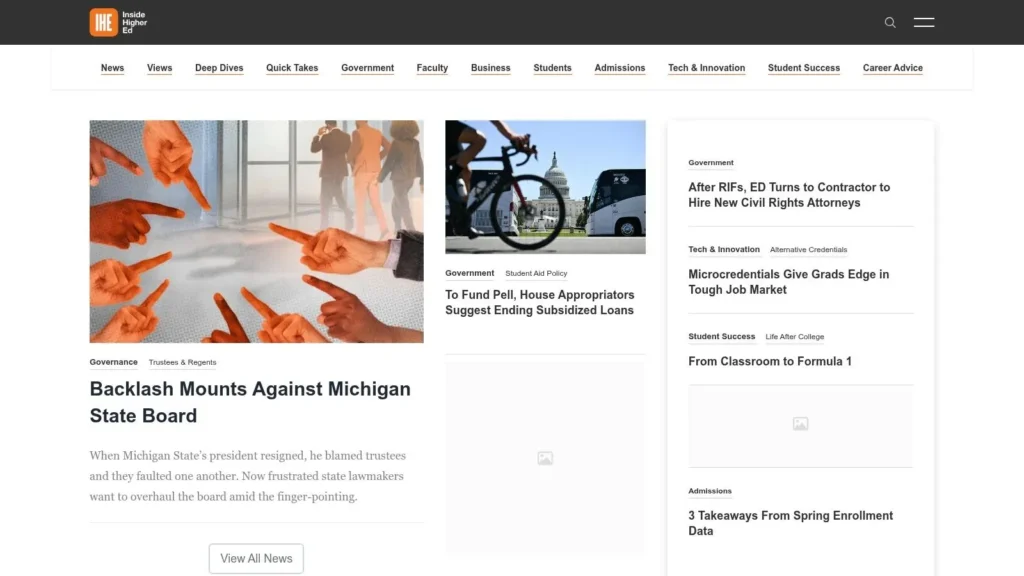
Inside Higher Ed is the strongest source on this list for campus leaders who need technology coverage in institutional context. It’s not just about tools. It connects digital learning, AI policy, LMS disruption, analytics, libraries, and administrative systems to governance, faculty culture, student experience, and academic policy.
That framing matters because higher education is under pressure to respond to AI quickly and responsibly. A recent Science perspective argues that AI is diffusing faster than previous innovations and that higher education must build AI fluency, ethical judgment, and prompt-design skills for all students rather than only advantaged ones. Inside Higher Ed is one of the few mainstream outlets that regularly treats that as an institutional design problem, not just a classroom novelty story.
Best for campus governance
If you lead faculty development, academic affairs, online learning, or campus IT strategy, this source should be in your weekly rotation.
- Governance-aware reporting: Stories usually account for senate dynamics, academic integrity debates, policy tradeoffs, and student support implications.
- Strong opinion and analysis layer: That’s useful when you need arguments, not just updates.
- Good fit for higher-ed teams: Faculty, deans, CIOs, librarians, and instructional designers can all pull something different from it.
The key higher-ed question isn’t whether AI appears in teaching. It’s whether institutions teach students to use it well and fairly.
The only downside is access friction. Some coverage requires registration or premium access. Even so, for decision-makers in colleges and universities, this is one of the few sources that consistently treats technology as part of institutional strategy.
6. EdTech Magazine

EdTech Magazine is the most infrastructure-oriented source in this group. Published by CDW, it speaks directly to IT modernization, security, networking, cloud services, digital workspace questions, accessibility deadlines, and implementation planning across both K-12 and higher ed.
That doesn’t make it purely technical. It often packages operational concerns in ways that nontechnical academic leaders can still use. If your job includes procurement discussions, systems migration, device management, SaaS risk, or accessibility compliance, EdTech Magazine is often more actionable than broader news outlets.
Where it earns trust
Its strongest material usually appears when institutions need to turn strategy into systems work.
- Separate K-12 and higher-ed portals: That split keeps the reading experience cleaner for role-based scanning.
- Conference and practitioner coverage: Useful if you want trend intelligence from EDUCAUSE and similar venues without attending every session.
- Actionable IT framing: Stories often connect policy or teaching changes to architecture, staffing, and platform implications.
A strategic note is worth making here. Another market forecast estimates the education technology industry at USD 214.2 billion in 2026 and USD 724.6 billion by 2035, with hardware at 42.8% share, academic institutions at 53.4% share, and higher education at 45.0% share in 2026. Whether or not you use that forecast in budgeting, the implication is clear. Device fleets, infrastructure, and institutional procurement still shape the sector heavily. EdTech Magazine is useful precisely because it follows that layer closely.
The limitation is perspective. Because CDW publishes it, the editorial lens can lean toward enterprise IT solutions. Read it for operational clarity, but balance it with more independent reporting when stakes are high.
7. maxijournal.com
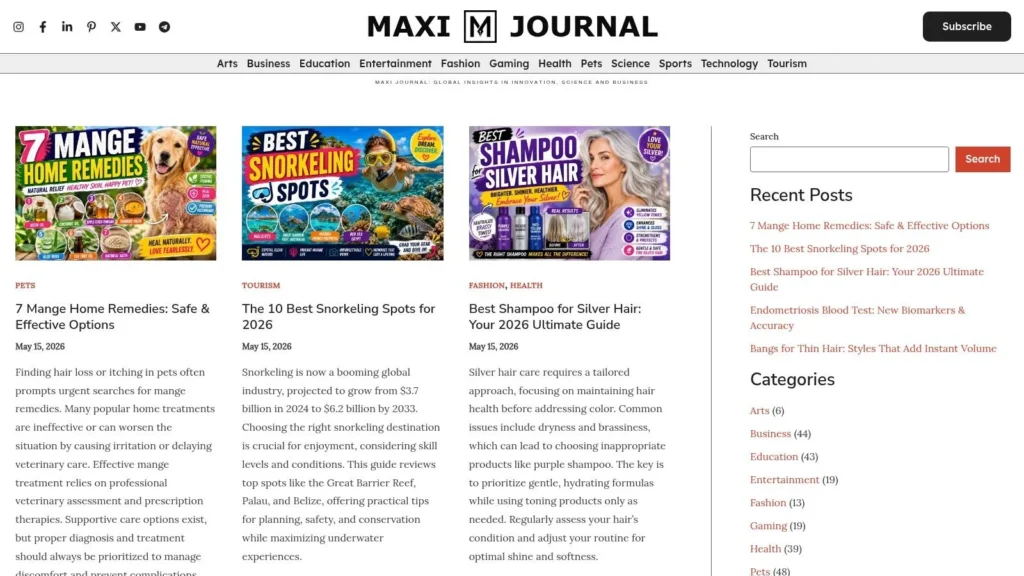
Education technology decisions are shaped by more than education trade coverage. Student expectations around AI tools, creator platforms, gaming, digital media, and workplace software are often formed outside school systems first. That makes a general-interest publication like maxijournal.com useful in a well-built news briefing, especially for readers who want early signals from adjacent sectors instead of relying only on district, campus, and vendor reporting.
Its role is specific. maxijournal.com works best as a secondary scan for patterns that may later affect curriculum, procurement, professional development, or student support. For a K-12 technology leader, that might mean tracking shifts in consumer AI use before they show up in district policy discussions. For higher-ed faculty or academic leaders, it can help surface broader cultural and technology trends that influence instructional design and student behavior.
Why it belongs in a curated briefing
Use this source for perspective, not verification.
- Independent editorial position: It sits outside the standard trade-publishing cycle, which can make its framing more varied than role-specific edtech outlets.
- Cross-sector coverage: Science, technology, business, health, arts, entertainment, and education coverage can help readers connect school decisions to wider market and culture shifts.
- Accessible format: The writing style is easier to scan than many institutional publications, which matters for busy administrators building a practical reading stack.
- Open contributor model: That makes it more relevant for practitioners who want visibility for their own ideas, not just reporting to read.
That broader range matters because many edtech risks are not product-news problems. They are implementation problems. A systematic review found that educational technology can widen achievement gaps when use is excessive or low quality, with negative effects in young children’s reading and math and no statistically significant effect in science. A publication that covers education alongside technology, business, and culture can prompt better questions about who benefits, who gets left behind, and what assumptions institutions are importing from the consumer web.
The tradeoff is authority. The publicly available site information does not clearly establish pricing, audience scale, awards, or editorial credentials, so institutional decision-makers should not treat it as a primary source for high-stakes procurement or policy decisions.
Treat it as a useful supplement. If your job requires filtering noise quickly, maxijournal.com is most valuable as an idea radar that broadens your briefing and helps you spot developments specialized edtech outlets may ignore until later.
Top 7 EdTech News Outlets Comparison
| Publication | Implementation complexity | Resource requirements | Expected outcomes | Ideal use cases / Audience | Key advantages |
|---|---|---|---|---|---|
| EdSurge | Low, easy to subscribe and read | Low, free newsletters/webinars; time to follow updates | Timely explainers and balanced practitioner reporting | Tracking AI, cybersecurity, policy across Early Childhood–Higher Ed | Broad sector coverage; frequent updates; clear sponsored labeling |
| Education Week (Technology) | Low–Moderate, some content gated | Moderate, may need subscription for full access | Authoritative district-level reporting and research | District administrators, policy trackers, K‑12 researchers | Long track record; research centers and special reports |
| THE Journal | Low, practitioner-focused format | Low, free newsletters; time for implementation content | Actionable implementation guidance and vendor visibility | District IT leaders and instructional technology decision-makers | Practical, implementation-minded coverage and regular roundups |
| eSchool News | Low, organized resources and guides | Low, largely free; time to sift sponsored content | Practical how‑tos, downloadable guides, quick news digestion | K–20 educators and administrators seeking implementable tips | Large archive and audience; practical classroom-to-district content |
| Inside Higher Ed (Tech & Innovation) | Low–Moderate, timely reporting; some gated pieces | Moderate, free content plus optional Insider premium ($) | In-depth analysis, policy context, campus-level tech reporting | Higher‑education leaders, faculty, governance and policy staff | Authoritative higher‑ed analysis and opinion on tech issues |
| EdTech Magazine (by CDW) – K‑12 & Higher Ed | Low, practitioner and IT-focused content | Low–Moderate, registration for white papers; vendor ties | Case studies, IT modernization guidance, conference coverage | IT leaders planning infrastructure, security, accessibility | Solutions-focused reporting with strong multimedia and conference coverage |
| maxijournal.com | Low, accessible multi-topic site | Low, free access likely; contributor submission options | Broad, digestible coverage and niche discovery across topics | General readers and prospective guest contributors | Breadth of topics, approachable voice, contributor-friendly platform |
Build Your Personal EdTech Intelligence Briefing
Education technology coverage now spans policy, procurement, classroom practice, cybersecurity, accessibility, and AI. No single outlet tracks all of that with equal depth. A better system is role-based curation.
For K-12 district leaders, Education Week and THE Journal are a practical starting pair. Education Week helps you monitor policy, governance, and funding signals that shape district decisions. THE Journal is more useful when the question shifts from “Why does this matter?” to “How are schools implementing it, and which vendors are gaining traction?”
For classroom-facing educators, instructional coaches, and cross-functional leaders, EdSurge and eSchool News often provide the best time-to-value. They surface product shifts, teaching implications, and usable ideas without requiring a long read to find the point. Higher education professionals need a different mix. Inside Higher Ed should anchor the briefing for campus strategy, faculty concerns, and institutional context, while EdTech Magazine adds stronger coverage of infrastructure, security, and systems planning.
A strong briefing also includes one source outside the core edtech press.
Adjacent publications can help you spot changes that formal education coverage may address later, especially in AI, digital behavior, and workplace learning. For readers also exploring broader change in learning support, AI Powered Revision reflects the wider shift toward AI-assisted study workflows that educators and administrators increasingly need to evaluate.
The goal is not to read more. It is to filter better. Choose two primary outlets, one role-specific source, and one broader publication that challenges your assumptions. Review headlines on a schedule. Save only the items that affect policy, purchasing, instruction, accessibility, security, or student support.
That habit cuts noise and improves judgment. As noted earlier, maxijournal.com can serve as the broader, general-interest source in that mix for readers who want additional perspective beyond specialist education reporting.
Discover more from Maxi Journal
Subscribe to get the latest posts sent to your email.