Some readers are curled up on the sofa with a cat on their lap while they read this. Others are trying to decide whether getting a dog might help with loneliness, stress, or the flat heaviness that can settle over a hard season. Some are already attached to a pet and wondering why the bond feels healing on some days and overwhelming on others.
That mix of comfort and complication is exactly where an honest conversation about mental health and pets has to begin. Animals can bring steadiness, joy, routine, and affection. They can also bring cost, grief, disrupted sleep, caregiving pressure, and worry. Both sides are real.
The Unseen Bond Between Mental Health and Pets
A rough day often changes shape in small ways when an animal is nearby. A dog rests its head on your knee before you’ve said a word. A cat settles beside you when your thoughts are racing. A rabbit keeps nibbling hay in complete peace, and somehow that quiet normalcy helps you breathe more slowly.
Many people recognize that feeling immediately. It isn’t only sentiment. A major U.S. mental health poll found that 86% of pet owners said their pets had a mostly positive impact on their mental health, with 87% of dog owners and 86% of cat owners reporting the same, according to the American Psychiatric Association news release on pets and mental health.
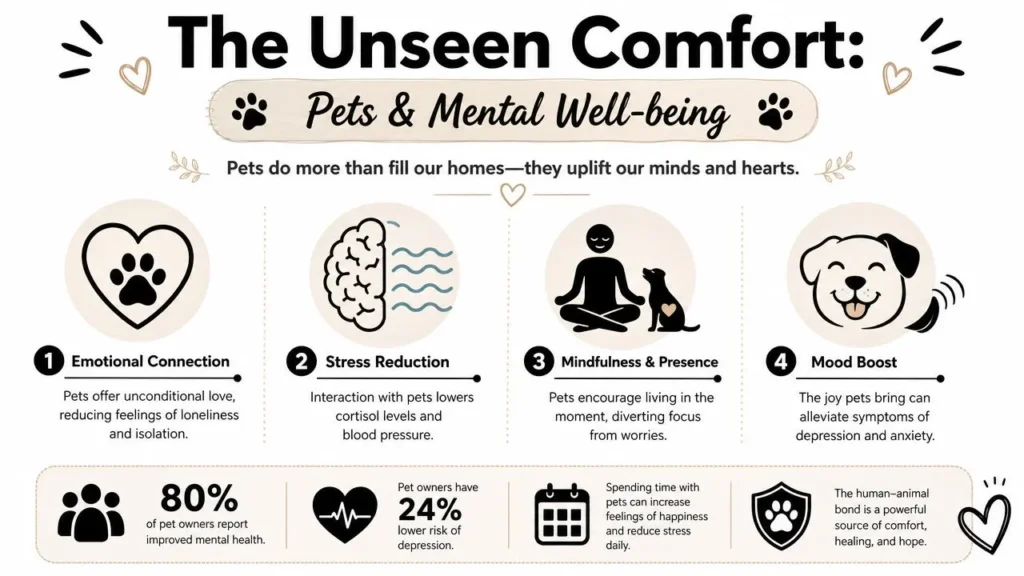
What that comfort often looks like
The bond isn’t always dramatic. It often shows up in ordinary moments:
- After work stress: a dog demands a walk, which pulls you out of your head and into motion.
- During loneliness: a cat’s presence turns an empty room into a shared space.
- In grief or recovery: feeding, grooming, and cleaning create a reason to keep moving through the day.
- When words feel exhausting: pets offer company without requiring conversation.
That last point matters more than many people realize. Human relationships can be wonderful, but they can also ask things from us. Pets usually offer presence first.
Pets often help because they don’t ask you to explain your mood before they sit with you in it.
For some people, the bond also becomes part of identity and advocacy. Small, visible reminders can open conversations that feel hard to start, which is one reason some readers like ways to promote mental health awareness through clothing when their pet has clearly been part of their emotional support system.
Cats add another layer of confusion for many owners because their affection can be subtle. If you’ve ever wondered whether a quiet pet is as bonded to you as an openly clingy one, this guide on whether cats love their owners helps make that behavior easier to read.
Why this bond feels so powerful
The human side of this relationship is simple to describe even when it’s hard to measure perfectly. Pets interrupt isolation. They pull attention toward the present moment. They give affection through contact, routine, and recognition. When life feels emotionally noisy, an animal can provide a form of contact that feels clear and manageable.
Still, “pets are good for mental health” is only the beginning of the story. The better question is why some interactions calm us so quickly, while others don’t.
How Animals Rewire Our Brains for Calm
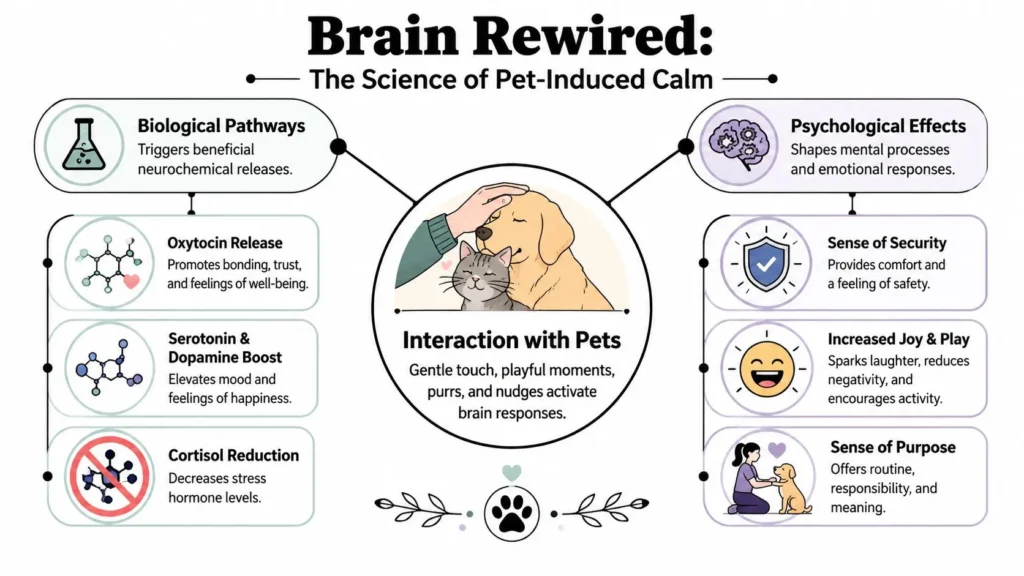
The soothing effect of animals isn’t just a pleasant idea. It has a biological side and a behavioral side. Both matter.
Controlled research on dog interaction found a clear cause and effect pattern. People who directly interacted with a dog experienced a greater decline in anxiety and improved mood than people who only watched a video, according to this controlled study on direct dog interaction and anxiety reduction. That matters because it suggests active contact has more immediate mental health value than passive exposure.
The body response
When people talk about a pet making them feel calmer, they often mean something physical before they mean something philosophical. Their breathing slows. Their shoulders drop. Their attention narrows.
Touch plays a big role. Stroking a dog’s fur, feeling a cat purr against your chest, or throwing a toy and watching a playful return creates sensory feedback that can shift your state. The body receives repeated signals of safety, familiarity, and connection.
That doesn’t mean every pet interaction is relaxing. A barking fit at midnight isn’t calming. A pet emergency isn’t calming. But gentle, familiar contact can be.
A helpful way to think about it is this:
| Type of experience | Likely mental effect |
|---|---|
| Direct interaction | More immediate calming or mood lift |
| Passive watching | Can be pleasant, but often less powerful |
| Shared routine | Builds steadiness over time |
| Stressful caregiving moments | Can increase tension instead of reducing it |
A broader interest in brain science has made many readers more curious about this connection. If you want a bigger picture of how behavior and emotion influence the brain, these recent discoveries in neuroscience give useful context.
The behavior response
Pets also help by changing what you do. That can be just as important as what you feel.
A dog that needs morning care may get you out of bed when your mind wants to stay under the covers. A cat who expects breakfast at the same time each day can anchor your routine. A bird, rabbit, or guinea pig adds caregiving tasks that require attention, sequencing, and follow-through. Those actions can create structure when internal motivation is low.
Later in the day, even brief interaction can reset attention. This short explainer is useful if you want a visual overview of the calming side of animal contact.
Why contact works better than the idea of contact
People sometimes assume that owning a pet guarantees emotional benefit. The research above suggests something more precise. Engagement matters.
- Petting: touch can settle nervous energy.
- Playing: shared activity can interrupt rumination.
- Walking: movement changes both body state and mental focus.
- Care tasks: feeding and grooming create predictability.
Practical rule: If you want the mental health benefit, build moments of real interaction, not just pet ownership in the abstract.
That distinction becomes even more important when people start using terms like companion animal, therapy animal, and emotional support animal as if they mean the same thing. They don’t.
Companion Therapy or Support Understanding the Difference
A lot of confusion around mental health and pets comes from language. People may call any comforting animal a therapy pet. Others assume an emotional support animal has the same role as a service animal. Those misunderstandings can create conflict with landlords, workplaces, schools, and even healthcare providers.
The easiest way to sort it out is to compare the roles side by side.
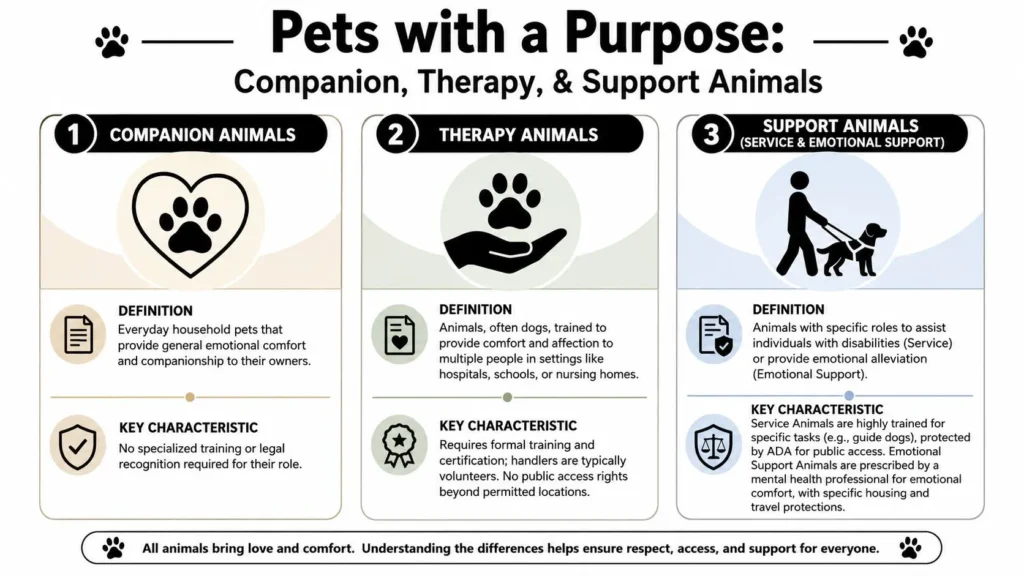
Three roles that sound similar but aren’t
| Animal role | Main purpose | Training | Typical access and use |
|---|---|---|---|
| Companion animal | Everyday comfort, affection, and company for the owner | No special legal role required | Lives as a household pet |
| Therapy animal | Visits or works in settings that support many people | Usually trained and handled for organized visits | Access depends on the institution inviting them |
| Emotional support animal | Provides emotional relief for a person with mental health needs | Not the same as a task-trained service animal | Rights depend on the setting and applicable rules |
Companion animals
This is the broadest category. Your dog, cat, rabbit, bird, or other household pet may be important to your well-being without holding any special legal designation. A companion animal can still be central to emotional health. The difference is that its role is personal rather than formally defined.
For many families, this is enough. The animal offers comfort, routine, affection, and meaning.
Therapy animals
A therapy animal usually works with a handler to support many people, not only one owner. These animals may visit hospitals, schools, care homes, counseling programs, or community settings. Their job is relational and situational. They help create comfort in structured environments.
That role is valuable, but it isn’t the same as living with one person for that person’s individual mental health needs.
Emotional support animals
Public confusion often surrounds the definition of an emotional support animal, or ESA, which is connected to emotional alleviation for a person with mental health needs. In 2024 polling, 88% of emotional support animal owners reported a mostly positive impact on their mental health, compared with 85% of dog owners, 86% of cat owners, and 55% of owners of other companion animals, according to the American Psychiatric Association and AVMA polling update on pets offering mental health support.
That doesn’t mean every animal should be labeled an ESA. It means some owners experience their animals as especially meaningful supports.
If housing questions are part of your decision, this practical guide on truths about ESA housing helps readers understand common misunderstandings before they become stressful disputes.
A pet can matter profoundly to your mental health even if it isn’t a therapy animal or an ESA.
The label should fit the actual role. When people blur those categories, they often end up disappointed or misinformed.
The Risks and Responsibilities We Must Acknowledge
There is a version of the pet story that sounds comforting but incomplete. It says animals reduce stress, improve mood, and make life better. Sometimes they do. Sometimes they don’t. Sometimes they help and strain you at the same time.
That fuller picture matters because unrealistic expectations can hurt both people and animals.

The emotional costs people often underestimate
A pet’s dependence can be grounding. It can also be heavy.
You may need to plan your day around walks, feeding, medication, litter changes, training, and vet visits. If your animal becomes sick, old, reactive, or disabled, the caregiving load can become intense. That can deepen a bond, but it can also add worry, sleep loss, guilt, and financial pressure.
Grief is another part people minimize until they experience it. Loving an animal means living with the knowledge that loss will come. Anticipatory grief can begin during a pet’s decline, long before death.
What the research complicates
A lockdown-era study reported that pet owners were no better off than non-owners on depression, happiness, loneliness, or stress, and that stronger attachment to a companion animal was associated with higher loneliness and depression, according to this summary of lockdown-era findings on pet ownership and well-being.
That result surprises people because it runs against the usual story. But it doesn’t mean pets are harmful. It means the relationship is not simple. People who are already struggling may bond intensely with pets precisely because they are lonely or depressed. In other words, the bond may reflect distress as much as relieve it.
A second caution comes from a population study summarized by Tufts University. It reported that dog and cat ownership was associated with doubled odds of depression, and that among people who were unemployed in 2020/21, 62% had a pet. The same source noted that for unemployed participants, having a dog was associated with twice the odds of depression compared with having no dog, as described in Tufts University’s summary of research linking pet ownership and depression.
A more realistic way to think about pet support
These findings don’t cancel out the comfort many owners feel. They tell us something more useful. Pets are not magic. They interact with the rest of your life.
- If money is tight, pet care can become another source of strain.
- If you’re isolated, a pet may help, but it may not replace human support.
- If you’re depressed, pet routines can help on some days and feel crushing on others.
- If your bond is intense, that may reflect love, vulnerability, or both.
The healthier message is not “pets always improve mental health.” It’s “pets can support mental health when the relationship fits your life, capacity, and support system.”
That is a more compassionate standard. It respects the animal, and it protects the person.
How to Choose a Pet for Your Mental Wellness
Choosing a pet for mental wellness isn’t about picking the cutest face or the most comforting species in theory. It’s about fit. The right fit can create steadiness. The wrong fit can add chaos.
Start with your actual day
Ask yourself what your daily life looks like when you’re doing well, and what it looks like when you’re not. This matters more than your aspirational self.
If your schedule is variable, your energy dips hard, or you travel often, a high-needs animal may create more stress than support. If you crave routine and movement, a dog that requires regular walks might help anchor your day. If quiet companionship suits you better, a cat or another lower-maintenance animal may be a better match.
A quick self-check helps:
- Home reality: Do you have enough space, acceptable housing rules, and tolerance for noise, fur, odors, or mess?
- Time reality: Can you handle feeding, cleaning, exercise, enrichment, grooming, and appointments even during rough weeks?
- Stress reality: When something goes wrong, do you become focused and organized, or overwhelmed and avoidant?
Match the animal to the support you need
Different animals tend to offer different kinds of support.
A dog often brings structure, outdoor time, and active engagement. That can be excellent for people who benefit from movement and routine. It can be terrible for someone whose symptoms make morning function unreliable.
A cat may offer closeness with more flexibility. Some people find that ideal. Others want more overt interaction and become disappointed when a cat’s affection appears on the cat’s timetable.
Small animals, birds, and fish can also be meaningful companions. They may fit smaller spaces or quieter lifestyles. But “small” does not mean “effortless.” Cleaning, habitat setup, enrichment, and species-specific care still matter.
Use a decision lens, not a rescue fantasy
Before choosing, write down answers to these questions:
- What do I want from this bond? Comfort, routine, movement, company, or a sense of purpose?
- What can I reliably give? Time, money, patience, training, and daily care.
- What happens if my mental health worsens for a while? Who helps with the animal then?
Don’t choose a pet based on who you hope to become. Choose a pet based on who can care well for that animal right now.
That approach may feel less romantic. It’s also kinder, and it gives the relationship a better chance to become a source of support instead of an added burden.
Integrating Your Pet into a Wellness Routine
Owning a pet and using the human-animal bond well are not the same thing. Many people get more benefit when they turn ordinary pet care into intentional mental health habits.
Use existing care tasks as anchors
You don’t need a complicated plan. Start with what already happens every day.
Feeding times can become cues for your own meals, medication, hydration, or screen breaks. A morning walk can become a gentle transition into the day instead of a rushed chore. Evening brushing or cuddle time can mark the point when work ends and rest begins.
That kind of pairing works because it links your self-care to something you are less likely to skip.
- Morning walk pairing: Put on shoes, step outside, and notice temperature, sounds, and light before checking your phone.
- Feeding routine pairing: While your pet eats, drink water and take one slow breath cycle instead of scrolling.
- Evening reset pairing: During play or grooming, let that be your signal that the workday is over.
Turn interaction into grounding
Grounding works best when it is sensory and specific. Pets are excellent partners for that.
Notice the weight of a cat settling on your legs. Feel the rhythm of a dog’s breathing while you sit beside them. Listen to tags jingling, paws tapping, or a rabbit chewing hay. Those details pull attention away from spiraling thought and back into the present.
This doesn’t cure anxiety, but it can interrupt escalation. Readers who want broader ideas for building these kinds of habits may also find these mental health self-care tips useful.
Build a short routine you can keep
A sustainable pet-based wellness routine should be small enough to do even on a bad day.
Try something like this:
- Two-minute arrival ritual: Greet your pet, kneel or sit, and focus only on touch and breath.
- One intentional outing: During one walk, leave the podcast off and notice the environment.
- A play break: Use a toy, ball, wand, or training cue as a genuine pause from work pressure.
- Night check-in: As your pet settles, ask yourself what your own body needs before bed.
Shared routine helps most when it is repeatable, not perfect.
The key is not squeezing therapeutic meaning out of every interaction. It’s noticing that your pet already creates openings for calm, movement, and connection, then using those openings on purpose.
When a Pet Is Not Enough
Pets can support emotional health, but they can’t do the whole job. They can’t diagnose depression, help you process trauma in language, or build a treatment plan for panic, addiction, obsessive thinking, or severe grief. They also can’t tell when you are relying on them to avoid human help.
That is why the healthiest view of mental health and pets is additive. A pet may be one stabilizing part of life. Professional care may be another. Friends, family, medication, community, sleep, and routine may matter too.
Consider reaching out to a therapist, counselor, doctor, or other qualified mental health professional if sadness stays with you, anxiety keeps disrupting daily life, you’re withdrawing from people, or caring for your pet feels impossible more often than manageable. Also seek help if the bond with your animal feels less comforting than desperate, or if you’re using the pet to avoid dealing with problems that need human support.
There is no failure in that. In fact, it often protects the relationship with your animal. When you get more support, your pet doesn’t have to carry what a pet was never meant to carry alone.
The most grounded message is simple. Pets can be wonderful companions in healing. They are not replacements for care, treatment, or community. When you combine loving animal companionship with honest self-assessment and timely professional help, you build something much stronger than the old slogan that pets are always good for you.
If you enjoy clear, approachable writing on health, science, pets, and everyday life, explore more thoughtful articles at maxijournal.com.
Discover more from Maxi Journal
Subscribe to get the latest posts sent to your email.