You’ve probably seen it already. A creator on social media scoops a whipped, ivory-colored balm from a jar, rubs it over dry cheeks, and calls it the missing piece in modern skincare. Then the comments split in two directions. One group says beef tallow transformed their skin. The other says putting rendered animal fat on your face sounds absurd.
Both reactions make sense.
Beef tallow moisturizer sits at the crossroads of tradition, trend culture, and skin biology. It isn’t a brand-new discovery, but it also isn’t a miracle ingredient with a deep clinical record. The most useful question isn’t “Is beef tallow good or bad?” It’s “What can it realistically do, and for which skin types does it make sense?”
The Return of an Ancient Skincare Secret
Beef tallow is having a modern comeback, but the ingredient itself is old. Long before lab-designed creams and barrier serums filled store shelves, people used fats, oils, waxes, and salves to soften rough skin and shield it from cold, wind, and dryness. Tallow belongs to that older category of skincare. It’s a traditional animal-fat emollient that has reappeared in the 2020s as people search for simpler formulas and “ancestral” products.
That return creates confusion. When something is old, people often assume it must be safer, purer, or more effective than newer alternatives. Sometimes that’s true. Often it isn’t. “Traditional” tells you where an ingredient came from. It doesn’t tell you how well it has been tested.
A helpful way to think about this trend is to compare it with other cult moisturizers built on heavy, occlusive textures. If you want a good example of how rich, old-fashioned balm formulas are marketed and used today, beautysecrets.agency’s insights for Swiss retailers offer context for why dense, multi-use creams keep attracting loyal followings.
Why the hype feels convincing
Tallow has an easy story to sell. It’s natural. It feels substantial on the skin. It can make very dry areas feel softer fast. That kind of immediate softness is persuasive, especially when someone’s skin feels stripped, flaky, or irritated after overusing exfoliants.
But quick softness and long-term proof aren’t the same thing.
Bottom line: Beef tallow belongs in the category of moisturizers, not proven treatment actives.
That distinction matters because online claims often drift far beyond moisturization. You’ll see promises about wrinkle reversal, acne clearing, and dramatic skin healing. The evidence for those bigger promises is much thinner than the marketing language suggests.
The question that matters most
Understanding beef tallow moisturizer benefits hinges on risk stratification by skin type. A rich, occlusive fat may feel wonderful on very dry skin and very frustrating on skin that clogs easily. That’s why the same jar can earn glowing praise from one person and break out another.
So the smart approach isn’t blind enthusiasm or blanket dismissal. It’s matching the ingredient to the skin in front of you.
What Is Beef Tallow and Why Use It on Skin
You wash your face, put on a rich balm, and the tight, papery feeling fades within minutes. That immediate relief explains a lot of tallow’s appeal. For someone with very dry skin, it can feel protective. For someone who gets clogged pores easily, the same texture can feel like too much.
Beef tallow is rendered beef fat. Rendering means the fat is heated until it separates from water and leftover solids, then purified and cooled into a stable fat. In skincare, that fat is usually whipped into a balm or blended with other oils to change the texture, spreadability, and feel on skin.
Why people put it on skin at all
Skin’s outer layer relies on a mix of water, lipids, and structural proteins. When that surface is dry, over-cleansed, or irritated, fatty products can reduce roughness and make the skin feel more comfortable. Tallow fits into that basic moisturizer role.
A simple analogy helps here. If dry skin is like a brick wall with worn mortar, a rich fat does not rebuild the whole wall from scratch. It adds a coating that makes the surface feel less exposed and slows moisture from escaping too quickly. That is a practical reason to use tallow. It is also why people interested in rose water in simple skincare routines are often drawn to tallow balms too. Both appeal to shoppers who want fewer moving parts.
That does not mean all skin will respond the same way.
What “beef tallow moisturizer benefits” usually means
Online discussions often make tallow sound exotic, but its actual benefits are usually ordinary moisturizer benefits:
- softer-feeling rough patches
- less tightness after cleansing
- a more cushioned, coated feel on very dry areas
- fewer ingredients in some formulas
Those points are established in a general sense because fats and balms can work well as moisturizers. Claims that tallow is uniquely healing, uniquely anti-aging, or automatically better than modern formulations are much less settled. Anecdotes are driving a lot of that enthusiasm.
Why skin type changes the answer
This is the part trend coverage often skips. Texture matters almost as much as ingredient list.
Very dry or mature skin may like a heavier balm because it loses comfort quickly and often benefits from a richer seal on top. Acne-prone or oily skin may find that same richness sits heavily, feels greasy, or contributes to congestion. Sensitive skin falls in the middle. Some people tolerate simple tallow formulas well, while others react to added essential oils, fragrances, or botanicals mixed into the balm.
So “why use it on skin?” has different answers depending on the person. For a dry-skinned reader focused on comfort, the answer may be barrier-friendly richness. For an acne-prone reader, the better answer may be caution, patch testing, or skipping it.
That same skin-type logic also matters when people talk about restoring a damaged skin barrier. A richer product can help some compromised skin feel calmer, but a damaged barrier does not automatically mean every heavy fat is the right choice for every face.
What tallow is, and what it is not
Tallow is best understood as a heavy moisturizer base. It is an animal-derived fat that can soften skin and add occlusion. It is not a proven acne treatment, wrinkle treatment, or medical therapy.
A clearer frame is this:
| Question | Practical answer |
|---|---|
| Is it a moisturizer? | Yes |
| Can it make dry skin feel better quickly? | Often, yes |
| Is it ideal for oily or acne-prone skin? | Sometimes no |
| Is it automatically superior because it is natural? | No |
That balanced view helps keep the ingredient in proportion. Tallow is neither miracle cure nor nonsense. It is a rich, old-fashioned moisturizing option that may suit some skin types much better than others.
The Science of Tallow for Skin Barrier Support
A useful way to understand tallow is to start with the skin barrier itself. The outermost layer of skin is often described as a brick-and-mortar structure. The skin cells are the bricks. The mix of lipids between them acts like mortar, helping keep water in and irritants out.
Moisturizers help that system in different ways. Some mainly soften the rough edges of the surface. Others mainly slow transepidermal water loss, which is the gradual escape of water from skin into the air.
Emollients and occlusives support the barrier differently
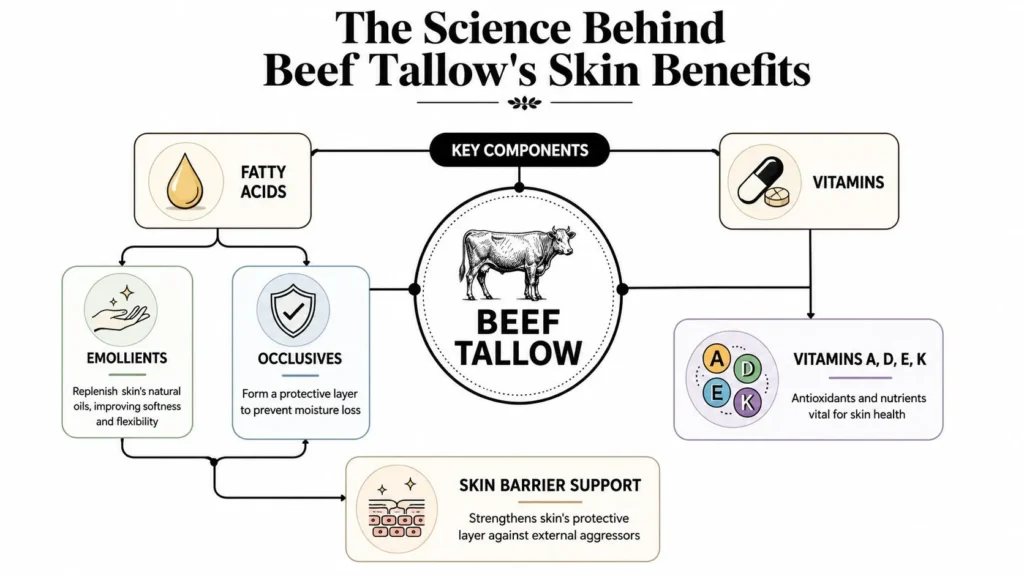
Tallow is relevant here because it behaves as a lipid-rich moisturizer. Its fatty acids can act as emollients, meaning they smooth and soften the skin surface. Its heavier, greasy texture also gives it some occlusive behavior, meaning it forms a coating that slows water loss.
That combination helps explain why tallow often feels comforting on very dry skin. The effect is less like “feeding” skin a miracle nutrient and more like adding patch material over a drafty window. You lose less moisture, so the surface feels calmer and less tight.
Why this can help a stressed barrier
When people talk about a stressed or impaired barrier, they are usually describing skin that stings easily, flakes, feels rough, or loses moisture faster than usual. In that setting, a rich fat can reduce friction and help hold onto existing water.
That does not mean tallow “repairs” skin in a medical sense. A better description is support. It creates conditions that may let dry, irritated skin feel more comfortable while the barrier recovers.
The same logic shows up in broader advice about restoring a damaged skin barrier. Gentle cleansing, fewer irritants, and water-loss control usually matter more than trendy ingredients on their own.
Why skin type changes the result
This is the part many tallow articles skip.
A heavy occlusive layer can be a good match for very dry, wind-chapped, or over-washed skin because those skin types often benefit from stronger water-loss protection. On oily or acne-prone skin, that same richness may feel greasy, trap heat, or sit uncomfortably on the surface. The chemistry is the same. The experience changes because the starting skin condition is different.
Sensitive skin sits in between. Some people do well with plain, minimal formulas. Others react to fragranced or herb-infused versions, so the issue may be the full product, not tallow alone.
What this means in a routine
Tallow usually makes the most sense as a final layer, especially on dry patches or in cold weather. Used this way, it works like a protective glove over chapped hands. It does not rebuild the barrier by itself, but it can reduce further moisture loss while skin settles down.
If your skin is already oily, you may prefer a lighter strategy earlier in the routine. Humectants draw water in rather than coating the skin with a dense lipid film. For comparison, glycerin soap and how it supports hydration shows a different route to moisturization.
For a quick explainer in video form, this overview is useful:
Evidence Versus Anecdote What Research Actually Says
A jar of tallow can collect two very different kinds of praise online. One person says it stopped winter flaking. Another says it erased wrinkles, healed acne, and outperformed every cream they had tried. Those claims do not all carry the same weight.
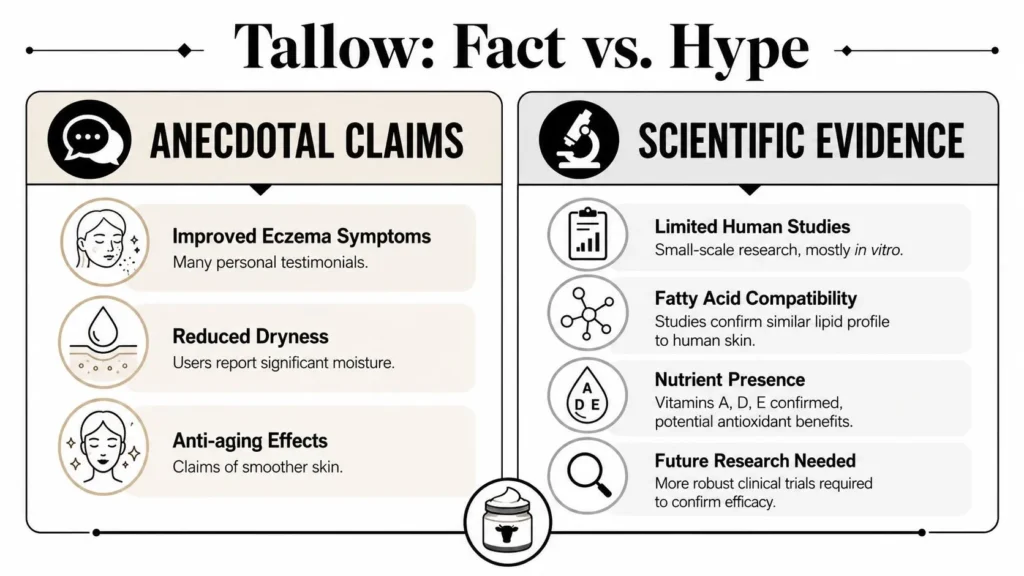
For this ingredient, the clearest support is for basic moisturization. That is a much narrower claim than many viral posts suggest, but it is still useful, especially if your skin problem is dryness rather than acne or photoaging.
What the research supports
A 2024 review in PMC described the most-cited human evidence as a small study in which people using a tallow-containing emulsion reported skin benefits. The same review said tallow showed hydrating and moisturizing properties, along with possible antimicrobial activity (PMC review covering the human study and broader evidence).
That is promising, not definitive.
A good way to read this is to separate “plausible” from “proven.” Tallow is a fat-rich substance, so it makes sense that it can soften skin and reduce dryness by slowing water loss. That part fits both chemistry and user experience. What the research does not show is that tallow has a large, well-replicated clinical record for treating wrinkles, acne, or inflammatory skin disease.
So the evidence-based summary is simple. Tallow may work as a moisturizer. The evidence base is still limited, and broader skin claims go beyond what has been established.
What popular claims oversell
The biggest confusion comes from mixing cosmetic effects with treatment effects. Skin often looks better quickly when a rich balm smooths rough patches and cuts down flaking. That visible change is real, but it is not the same as changing collagen production or clearing clogged pores.
Wrinkle claims are a good example. As noted earlier, experts have pointed out that there is no evidence that tallow works like retinol for wrinkles. Those are very different categories. Retinoids influence skin cell behavior. Tallow mainly acts more like a coating that helps dry skin hold onto water.
Medical News Today also takes a cautious view, describing the evidence for skin use as limited and noting that many claims remain anecdotal, while also pointing out possible side effects such as clogged pores, irritation, and worsening acne in some skin types (Medical News Today’s summary of the limited evidence).
That skin-type detail matters more than trend coverage usually admits. A testimonial from someone with very dry, compromised skin does not transfer neatly to someone with oily, congestion-prone skin. The same heavy film that feels protective on dry cheeks may feel suffocating on a forehead that already produces plenty of oil.
A better way to read testimonials
Testimonials are useful for generating questions, not settling them.
They can tell you that a person felt less tightness, saw fewer flaky patches, or liked the simplicity of the formula. They cannot tell you whether tallow itself was the reason, whether the same result would have happened with petrolatum or shea butter, or whether the product will still look good on that person’s skin after weeks of use.
A practical analogy helps here. If a drafty room feels warmer after you close the window, that does not prove the window has special healing properties. It shows that reducing exposure changed the environment. In the same way, covering very dry skin with a dense lipid layer can improve comfort fast. That does not automatically mean the ingredient has unique anti-aging or acne-fighting powers.
Established facts versus anecdotal claims
| Claim | Best current reading |
|---|---|
| It moisturizes skin | Supported |
| It helps reduce dryness by acting as an occlusive fat | Supported |
| It works like retinol for wrinkles | Not supported |
| It is a good default choice for acne-prone skin | Not supported |
| It may clog pores or feel too heavy for some users | Supported |
The practical takeaway is not that tallow is good or bad across the board. It is that the evidence supports a fairly specific role. For dry skin, the claims are more plausible. For acne-prone or easily congested skin, caution is more justified than hype.
Who Should Use Tallow and Who Should Avoid It
The discussion now turns practical. The biggest mistake people make with tallow is assuming that if it helped someone else, it should help them too. Skin type changes the entire equation.
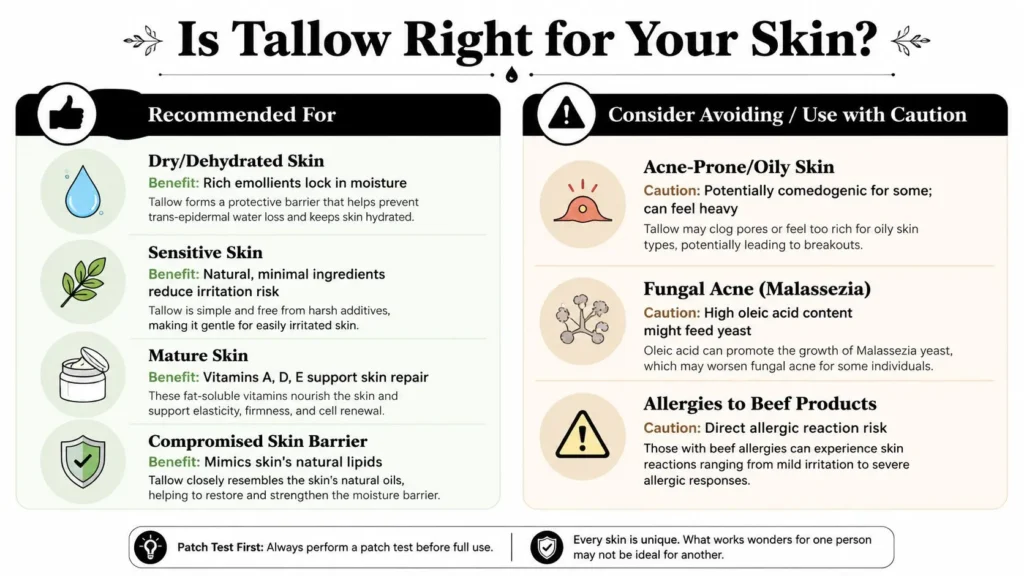
The shortest answer is this. Dry skin gets the green light most often. Acne-prone skin should pause first.
Green light for very dry skin
If your skin is persistently dry, flaky, or rough, a tallow moisturizer may feel comforting. Its richness can help reduce that papery, tight feeling that shows up after washing or cold weather exposure. Some people with mature skin also like dense balms because they make the surface feel more supple and less brittle.
That doesn’t mean tallow is uniquely superior. It means the skin problem and the product texture match.
Good candidates often sound like this:
- Dry all over: Skin feels tight soon after cleansing.
- Patchy dryness: Cheeks, around the nose, or hands become rough.
- Minimalist routine: You want a simple balm and don’t have a history of clogged pores.
Yellow light for sensitive or reactive skin
Sensitive skin is trickier. Some people do well with short ingredient lists, and a plain tallow balm may feel less irritating than fragranced creams. Others react to rich occlusive textures or to extra botanicals mixed into artisanal formulas.
So this group gets a yellow light, not a green one.
You’re not just asking, “Will this irritate me?” You’re also asking, “Will this trap heat, sweat, or other irritants in a way my skin dislikes?”
Red light for oily and acne-prone skin
This is the group most likely to run into trouble.
Dermatology-oriented sources note that tallow may help dry skin, but they also warn that it can be comedogenic and may worsen breakouts for some users. A review of social-media claims also found that evidence is still insufficient to say whether tallow is helpful or harmful for acne, psoriasis, and atopic dermatitis (Prevention’s discussion of who should be cautious with beef tallow).
If your skin clogs easily, produces a lot of oil, or already struggles with inflamed breakouts, a heavy animal-fat balm is a risky experiment.
If your breakouts tend to flare from rich creams, don’t assume tallow will be the exception.
Quick decision guide
| Skin type or concern | Fit |
|---|---|
| Very dry, flaky skin | Better candidate |
| Normal skin in cold weather | Possible candidate |
| Sensitive skin | Cautious patch-test candidate |
| Oily skin | Often poor fit |
| Acne-prone or congestion-prone skin | Often poor fit |
One more overlooked issue
People with a known sensitivity to beef products or animal-derived ingredients should avoid it. That sounds obvious, but trend-driven skincare often encourages people to ignore basic compatibility checks.
A product can be natural and still be wrong for you.
Choosing and Using Beef Tallow Moisturizers
If you decide tallow might suit your skin, the next step isn’t slathering it on. Rich products reward careful use.
What to look for in a product
Read the ingredient list before the front label. Some jars marketed as “pure tallow” contain added essential oils, botanical extracts, or fragrant compounds that may increase irritation risk.
A practical shortlist:
- Unscented or lightly formulated: Better if your skin is reactive.
- Simple ingredient list: Easier to troubleshoot if something goes wrong.
- Creamy or whipped texture: Often easier to spread thinly than a dense block-like balm.
- Reputable maker: Important because fats can vary in quality and handling.
DIY versions appeal to people who want control, but homemade skincare creates more room for inconsistency. Store-bought products from careful formulators may be easier to assess because the texture and ingredient mix are more predictable.
How to patch test it properly
Patch testing matters more with tallow than people think, because the issue may not be instant stinging. It may be delayed clogging.
Use this method:
- Pick a discreet area. The jawline or area near the ear works well.
- Apply a small amount. Use much less than you think you need.
- Repeat for several days. You’re watching for both irritation and clogged bumps.
- Check the texture response. If the area feels greasy, bumpy, or congested, stop.
- Only then try a larger area. Start with the driest part of your face, not the whole face.
How much to use
Less is usually better.
Tallow is rich enough that a very thin layer can do the job. Many people overapply because they’re used to lighter lotions that disappear quickly. With tallow, overapplication can leave skin feeling coated rather than comforted.
A practical routine is to apply a small amount to slightly damp skin at night, especially on dry spots. If your skin likes it, keep it as a targeted moisturizer rather than forcing it into every step of your routine.
When to choose something lighter instead
If your skin is dehydrated but also clog-prone, a lighter hydrator may make more sense. Products centered on humectants, soothing gels, or lighter emulsions often give moisture without the same heavy finish. That’s one reason some people explore simpler hydration-focused ingredients first, such as aloe juice in skin and wellness routines.
Practical rule: Choose tallow when your main problem is dryness. Skip it when your main problem is congestion.
The best outcomes usually come from restraint, not enthusiasm. Treat it like a specialized moisturizer, not a universal cure.
If you like clear, evidence-minded explainers on health, science, beauty, and everyday questions, maxijournal.com is worth exploring. It’s an independent online magazine that publishes approachable articles across health, science, technology, fashion, travel, entertainment, and more, with room for curious readers and prospective contributors alike.
Discover more from Maxi Journal
Subscribe to get the latest posts sent to your email.