Lewis Hamilton’s move to Ferrari looked, on the surface, like a driver changing uniforms. In reality, it was a contract story first and a racing story second, a reminder that in Formula 1, signatures can matter as much as lap time.
Beyond the Finish Line The Secrets of F1 Contracts
Hamilton to Ferrari is the cleanest way to understand why formula 1 driver contracts deserve far more attention than they get. A seven-time champion doesn’t just wake up, choose a red race suit, and switch teams. He moves when timing, influence, options, image value, and legal wording all line up.
That’s why fans often feel blindsided. Teams announce a deal only after months of positioning behind closed doors. Drivers speak carefully. Principals deny, deflect, and stall. By the time a contract becomes public, the main fight is already over.
If you follow transfer rumors in F1, you’ve probably noticed how hard it is to sort signal from noise. The same discipline used in good reporting applies here too, which is why a guide on how to find credible sources for research is surprisingly relevant to motorsport coverage.
Why a driver contract is more like a playbook
A normal fan hears “two-year deal” and thinks job security. F1 teams hear something else. They hear room to adjust. They hear risk control. They hear a way to protect themselves if the car changes, the regulations shift, or the driver stops delivering.
That’s the first mental shift to make. An F1 contract is not just an employment agreement. It’s a strategic battleground.
Teams want flexibility. Drivers want certainty. Both sides want upside. Neither side wants to be trapped.
Practical rule: When an F1 team announces a “multi-year” contract, assume the meaningful details are hidden in the conditions, options, and exit language.
Why secrecy matters so much
These contracts sit at the intersection of sport, celebrity, and corporate value. A driver isn’t only paid to drive. He also sells sponsors, appears in campaigns, attends team functions, and becomes part of a manufacturer’s public identity.
That’s why the documents are so guarded. If one team learns exactly how another structured a release clause or a bonus ladder, it gains insight into that rival’s weak points. The contract stops being private paperwork and becomes competitive intelligence.
This is also why the driver market can feel so unstable even when seats seem “filled.” Signed contracts don’t end negotiations. They often start a new phase of negotiations, one built around performance, politics, and timing.
By the end of a season, the paddock isn’t just asking who was fast. It’s asking who has power, who has options, and who can still force a change.
Deconstructing the Deal Key Contract Components
An F1 contract is often reduced to one number: salary. That’s like judging a race by top speed alone. It misses the setup, the tire life, and the strategy.
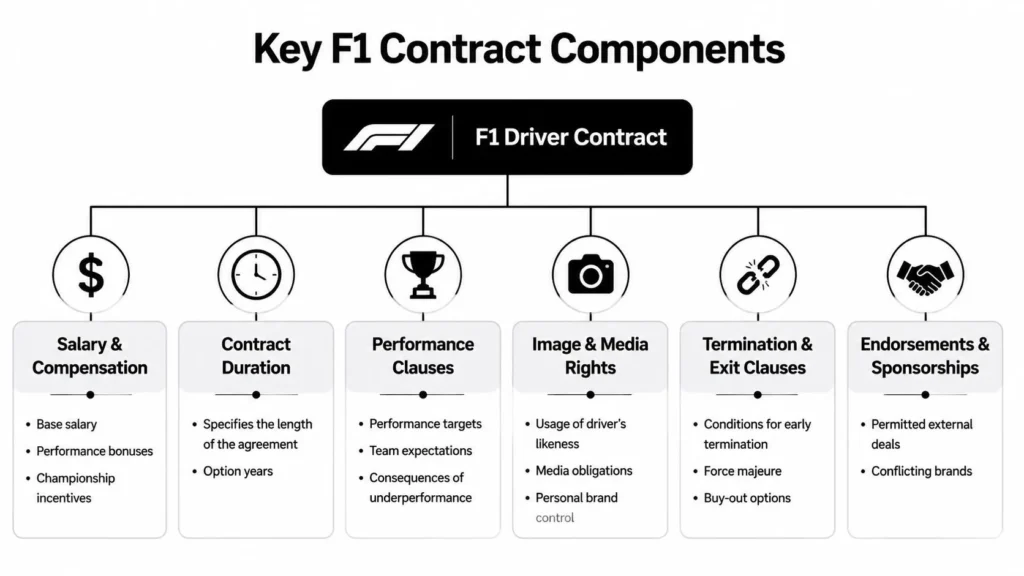
A modern F1 driver deal is built from several moving parts. The verified reporting is clear that these contracts are engineered as risk-mitigation instruments prioritizing team control, with core elements including base salary, performance bonuses, image rights, and structures such as the 1+1 deal seen in examples like George Russell’s Mercedes extension, as discussed in this analysis of F1 contract structures.
The term
The term is the contract’s length. But in F1, the public version and the practical version are often different.
If a deal is described as “1+1,” it usually means one guaranteed year plus an option for another. That option matters more than the headline. If the team controls it, the driver has less security. If the driver controls it, the balance shifts the other way.
It’s like renting a house where only one side decides whether the lease continues. The house is the same. The power isn’t.
Base salary and bonuses
The base salary is the fixed amount. This is the part most fans latch onto because it’s simple and easy to compare.
Then come performance bonuses. These work like a game achievement system. Hit the target, earn more money. Miss it, and the contract suddenly looks less glamorous.
Some deals reward podiums, points, championships, or other measurable outcomes. That creates a split structure: guaranteed money for showing up, extra money for delivering results.
Image rights
Readers often get lost, because it sounds abstract. It isn’t.
A driver’s image rights cover the commercial use of his face, name, helmet, voice, and likeness on team gear, sponsor campaigns, cars, and media materials. In simple terms, the team isn’t just hiring a racer. It’s licensing a personal brand.
If salary is the paycheck, image rights are the merchandising and advertising permission slip.
A top driver doesn’t only bring pace. He brings a marketable identity that sponsors can attach to.
Performance clauses and exit clauses
These are the pressure points of the agreement. A team may tie continued employment, options, or compensation to benchmarks. If the driver misses them, the team may gain freedom to change plans without treating it as a clean breach.
That’s why fans are often shocked when a “signed” driver loses a seat. The surprise usually comes from treating the contract as unconditional when it was conditional all along.
A useful way to read these clauses is to ask three questions:
- What triggers a review: Poor results, conduct issues, or a wider competitive drop.
- Who gets the decision power: The team, the driver, or both.
- What happens after trigger activation: Extension, payout, release, or renegotiation.
Confidentiality and sponsor restrictions
F1 contracts also limit what people can say and who they can work with commercially.
A team may protect sensitive technical information, private negotiations, and sponsor conflicts. That means a driver can’t always sign whatever personal endorsement he wants if it clashes with a team partner. The contract has to define those boundaries.
Here’s the simplest way to remember the full package:
| Contract element | What it really does |
|---|---|
| Term | Controls time and option power |
| Base salary | Guarantees fixed pay |
| Bonuses | Rewards measurable results |
| Image rights | Monetizes the driver’s brand |
| Exit clauses | Creates legal escape routes |
| Confidentiality | Protects secrets and sponsor value |
An F1 contract is less like a standard job offer and more like a layered operating manual for the relationship.
How F1 Driver Deals Are Actually Made
By the time a contract is announced, the actual work has already happened in hotel suites, team factories, paddocks, and lawyer calls. The deal on paper is the end product of a bargaining contest.
Leverage decides the shape of the deal
In F1, contract duration is determined by a driver’s negotiating power. Verified reporting notes that elite drivers such as Max Verstappen can negotiate multi-year deals with exit clauses linked to car performance, while others end up with shorter 1+1 arrangements such as George Russell’s 2026+1 because the 2026 regulation shift increases uncertainty, as outlined by Formula 1’s contract overview.
That tells you something important. Contract length is not just about trust. It’s about negotiating strength under uncertain conditions.
If a driver is indispensable, he can demand protections. If a team thinks replacement is easy, it keeps more control.
Who sits at the table
These negotiations usually involve more than a driver and a team principal. Managers, lawyers, senior executives, and sometimes commercial specialists all have a role.
Each person is solving a different problem:
- The driver’s side wants security, upside, and freedom if the team slips.
- The team principal wants performance and roster flexibility.
- Lawyers turn broad ambitions into enforceable wording.
- Commercial staff care about sponsor fit, media obligations, and image usage.
This is why contract talks can drag on even when both sides seem to want the same outcome. They may agree on the destination and still disagree on the exits, conditions, and control points.
The 1+1 battle
A 1+1 contract sounds tidy, but it can hide a power struggle.
If the team holds the option, the driver is effectively in a long audition. If the driver holds the option, the team is the one that must keep proving itself. A driver-side option says, “Give me a competitive car, or I can leave.” A team-side option says, “Perform, or we reserve the right to pivot.”
That’s why fans should never stop at the years listed in a headline.
The most important word in many F1 contracts isn’t “years.” It’s “option.”
A useful parallel comes from career negotiations outside motorsport. If you’ve ever read advice on how to negotiate a salary offer, the same principles apply in a more extreme form here: know your alternatives, know your value, and know which clause controls the future.
Regulation changes distort every conversation
The 2026 rules matter not just for engineers, but for lawyers. A team can’t be fully sure who will build the best car under a new framework. A driver can’t be fully sure whether his current team will still look attractive once the new cycle begins.
That uncertainty pushes both sides toward conditional structures. Shorter commitments, more options, and more trigger points start to make sense. The contract becomes a hedge against the unknown.
Here’s the negotiating logic in plain language:
- A top driver asks for escape routes if the project falls away.
- A team asks for review rights if the driver underdelivers.
- Both sides soften the headline with hidden conditions.
That’s not distrust. It’s the sport acting rationally.
The Rules That Shape F1 Contracts
Even the cleverest contract can’t exist outside the wider rules of Formula 1. Teams negotiate with each other, but they do it inside a framework set by the FIA, the commercial structure of the sport, and the eligibility requirements that determine who can even enter the market.
The super licence as a gatekeeper
Start with the FIA Super Licence. Before a driver can sign for an F1 race seat in a meaningful way, he has to be eligible to race. That sounds obvious, but it has major contract consequences.
A junior driver may look talented enough for a team to want him now, yet the contract still has to account for whether he can lawfully take the seat. That turns youth deals into staged agreements. A team may lock in a prospect early, then structure the path around testing, reserve duties, or future promotion.
The super licence works like the sport’s entry passport. Without it, a promising driver may have commercial value and development value, but not immediate race-seat value.
Why regulation cycles matter so much
Rule changes shape the bargaining environment. Engineers talk about new regulations in terms of chassis balance, power units, or aerodynamic concepts. Contract negotiators talk about the same rules in terms of uncertainty.
When teams don’t know who will nail the next era, they often avoid total commitment. Drivers do the same. The result is a market full of carefully hedged promises.
That’s why contract language often reflects a simple underlying fear: what if this team is no longer competitive when the technical reset arrives?
Contracts in F1 don’t just respond to performance. They respond to uncertainty about future performance.
Team budgets and practical limits
There’s also the commercial reality of team spending. Even without turning every negotiation into a spreadsheet exercise, one point is easy to grasp: a team has to balance what it pays drivers against the rest of the operation and its competitive priorities.
That pressure affects who gets long-term confidence and who gets conditional deals. A team may gladly pay a premium for a proven champion because that driver offers pace, prestige, and sponsor value at once. For other drivers, the same team may prefer a more flexible structure.
A contract in F1 is never only about talent. It’s about talent fitted into a regulatory and financial ecosystem.
Modern F1 Contracts by the Numbers
The theory becomes visible once you compare a champion, a superstar veteran, a rising contender, and a rookie, making the logic of formula 1 driver contracts much easier to see.
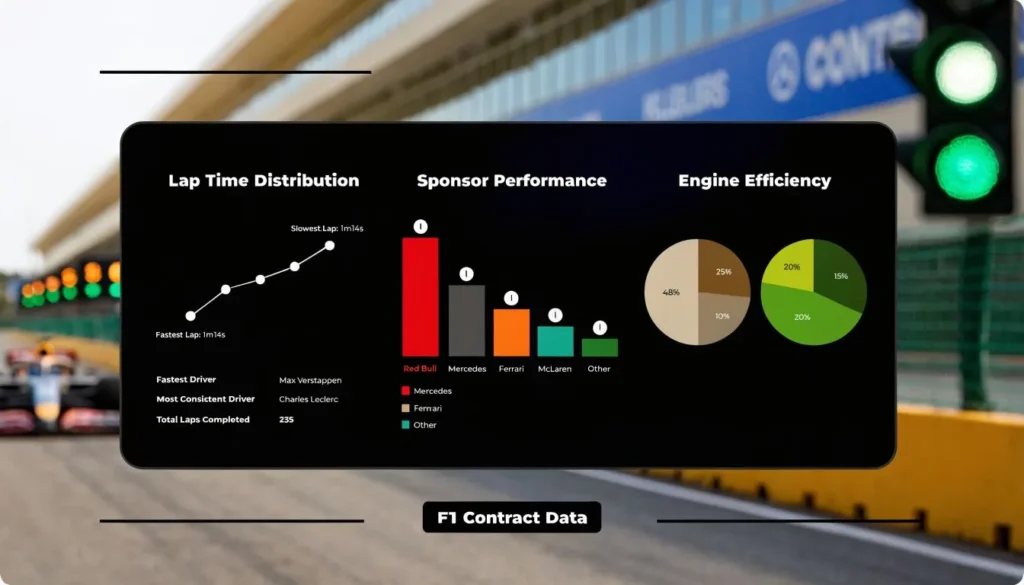
Verified reporting on the projected 2026 market says Max Verstappen is set to earn a $65 million base salary plus $11 million in bonuses at Red Bull, while rookie Isack Hadjar may earn a $3 million base with $2 million in bonuses. The same report says 14 of 22 driver contracts expire by the end of 2026, and that the move to 22 seats changes bargaining power across the grid, especially for the middle tier, according to this 2026 salary and contract report.
What the top of the market looks like
Verstappen’s deal tells you what maximum influence looks like. Massive base pay, major bonus potential, and a long horizon all signal that Red Bull treats him as central to the whole project.
Lewis Hamilton’s Ferrari contract sits in a different category. The verified data says he commands $70 million at Ferrari through 2026. That number reflects more than pure lap time. It reflects status, brand power, and the unique market force of a seven-time world champion changing teams.
Lando Norris shows a third model. The verified data lists him at $18 million base at McLaren through 2027, totaling $57 million with bonuses. That structure captures the logic of a team investing in a leading driver while still tying a meaningful share of reward to outcomes.
What the lower end tells us
Now compare those names with entry-level deals. Hadjar’s reported structure is far smaller. Gabriel Bortoleto is listed at $2 million flat at Audi in the same verified data set.
That doesn’t mean rookies are unimportant. It means their contracts usually reflect uncertainty. Teams are buying potential, not yet proven dominance.
Here’s a clean comparison:
| Driver | Team | Reported structure |
|---|---|---|
| Lewis Hamilton | Ferrari | $70 million through 2026 |
| Max Verstappen | Red Bull | $65 million base plus $11 million bonuses |
| Lando Norris | McLaren | $18 million base through 2027, $57 million total with bonuses |
| Pierre Gasly | Alpine | $10 million base |
| Isack Hadjar | Red Bull | $3 million base plus $2 million bonuses |
| Gabriel Bortoleto | Audi | $2 million flat |
Why the 22-seat grid doesn’t automatically help drivers
Fans often assume more seats means more opportunity and stronger bargaining power for drivers. That’s only partly true.
The move from the old 20-seat grid to 22 full-time seats changes supply. It creates more openings, but it also gives teams more flexibility. If a mid-tier driver asks for too much, another candidate may be waiting. Extra seats can reduce scarcity for some drivers rather than increase power across the board.
That’s why market analysis matters. It’s not enough to compare salary figures in isolation. You have to evaluate them against the wider environment, much like any serious exercise in benchmarking performance indicators.
Bigger markets don’t always create stronger workers. Sometimes they create stronger buyers.
The contract cliff at the end of 2026
The most important takeaway from the verified numbers may be the concentration of expiry dates. With 14 of 22 contracts due to expire by the end of 2026, the market looks unusually fluid.
That kind of cliff creates a chain reaction. Teams can wait. Drivers can posture. Rivals can apply pressure behind the scenes. A single move near the top can trigger a cascade below.
This is why the paddock often feels one rumor away from reshuffling. In a market with that many expiring deals, almost every serious negotiation affects three or four others.
The Hidden World of Buyouts and Arbitration
Fans ask the same question every time a driver switch gets messy: if he has a contract, how can he leave? The short answer is that in F1, enforceability is often private, conditional, and negotiable.
The verified reporting says F1 driver contracts rely on private arbitration rather than public courts, which is a major reason why, in practice, “almost no driver or seat is safe.” The same reporting says 85% of contracts are honored, while teams still retain control through performance metrics and team-side options, as explained in ESPN’s analysis of contract enforcement in F1.
Why arbitration changes everything
Private arbitration keeps disputes quieter than normal litigation. That matters in a sport where timing, sponsor confidence, and technical planning are all sensitive.
A court fight is public and slow. Arbitration is more contained. Teams prefer that because they can resolve conflicts without dragging every private clause into open view.
For fans, though, it creates confusion. You hear that a contract exists. Then a driver leaves, a payout happens, or a settlement is reached, and very little is explained in public.
Buyouts are the sport’s divorce settlements
A buyout is easiest to understand as a pre-negotiated price for ending the relationship early, or as a practical settlement that emerges when one side wants out badly enough.
That doesn’t always mean a dramatic firing. Sometimes it means a team wants flexibility. Sometimes a driver sees a better seat elsewhere. Sometimes both sides know the relationship is no longer working and would rather pay for clarity than continue with mutual frustration.
In that sense, an F1 contract is not a prison. It’s a framework for deciding what the exit will cost and who has the power to force it.
Why “signed” doesn’t mean “safe”
Performance clauses re-enter the narrative at this stage. A team often does not need to terminate a contract in the manner fans might assume. It may only be necessary to activate a clause, rely on a benchmark, or exercise a team-held option included in the original deal.
That creates the impression of sudden instability, but from a legal point of view it may have been built into the contract from the start.
Here’s the practical hierarchy:
- Best-case for a driver: Strong results, commercial value, and clauses that preserve his exit rights.
- Best-case for a team: Clear benchmarks, team-side options, and private dispute resolution.
- Most fragile scenario: A mid-grid driver with limited bargaining power and a contract full of conditional protections for the team.
In Formula 1, a contract usually answers one question only partially: who controls the next move?
The deeper lesson
The hidden world of arbitration and buyouts reveals the true character of formula 1 driver contracts. They are not stable declarations of loyalty. They are negotiated risk maps.
Teams use them to protect performance and preserve flexibility. Drivers use them to secure pay, status, and escape routes when the project weakens. The legal document matters, but so do the politics around it, the competitive context, and the willingness of both sides to settle privately.
That’s why a contract announcement should never be treated as the last word. In F1, it’s often just the formal opening position.
If you enjoy clear, approachable breakdowns of complex topics in sport, business, science, and culture, explore more independent writing at maxijournal.com. It’s a good place to find fresh commentary, practical explainers, and thoughtful blog posts for curious readers.
Discover more from Maxi Journal
Subscribe to get the latest posts sent to your email.