The surprising part of the latest fusion power breakthrough isn’t that scientists got fusion to work. It’s that they did, and we still remain far from plugging fusion into the grid.
That sounds contradictory until you separate a lab success from a power plant. In one of the headline-making experiments, the fuel produced more fusion energy than the lasers delivered to the target. That was historic. But the full machine still consumed far more energy to make the shot happen. The achievement was real. So is the gap that remains.
That gap is where the most important story lives. Fusion is no longer just a physics dream or a sci-fi promise. Multiple labs in multiple countries have now crossed meaningful milestones. What matters in 2026 is less whether fusion is possible in principle, and more whether engineers can turn brief, extreme demonstrations into systems that run reliably, survive harsh conditions, breed their own fuel, and deliver electricity at a competitive cost.
A Star in a Bottle Becomes Real
Fusion stopped being pure speculation once researchers showed, in a real experiment, that the fuel itself could give back more energy than was delivered directly to ignite it.
For years, “fusion is coming” sounded like a promise that kept sliding into the future. That bred a fair amount of public eye-rolling. What changed is not that scientists suddenly learned the basic physics. It is that they crossed a benchmark the field had chased for decades and did it in a way that forced people outside the lab to pay attention.
At the U.S. National Ignition Facility, researchers fired powerful lasers at a tiny fuel pellet and got a burst of fusion energy larger than the laser energy that reached the target. That target-level gain is the milestone behind many recent headlines. If you want a plain-language primer on how nuclear fusion generates energy, it helps to start there before asking the bigger question of whether such shots can become a power plant.
That distinction matters more than the headline number.
A lab demonstration is like proving an engine can make a car’s wheels turn on a test stand. A commercial plant has to do far more. It must run repeatedly, convert that energy into electricity, protect its machinery from extreme neutron damage, handle fuel systems, control costs, and stay online for long stretches. Fusion has cleared an important science bar. The engineering bars are still much higher.
Why this changed the conversation
The shift is subtle but important. Researchers are no longer asking only whether fusion reactions can be triggered under controlled conditions. They have shown that a carefully designed experiment can produce a meaningful energy gain in the fuel package itself.
That gives the field more credibility. It does not settle the commercial case.
Big idea: The central question has shifted from “can fusion produce net gain in a tiny experiment?” to “can an entire machine turn that result into steady, affordable electricity?”
That is where the timeline will primarily be decided. Materials, maintenance cycles, heat extraction, tritium supply, and machine efficiency sound less glamorous than lasers and plasmas, but those pieces determine whether fusion becomes infrastructure or remains a brilliant lab achievement.
Why ordinary readers should care
Fusion attracts so much interest because the prize is unusually large. In principle, it offers abundant electricity without carbon emissions at the point of generation and with a different waste profile from conventional fission. If engineers can make it practical, the effects would extend well beyond utility bills. Heavy industry, hydrogen production, grid stability, and energy security could all change with it.
Readers also need a realistic picture of what “breakthrough” means. A short-lived pulse of success is real progress. It is not the same thing as a machine a utility company would finance and run for decades.
To understand why plasma behaves so differently from ordinary gases in these experiments, Cryonos’ cryogenic insights on plasma offer a useful plain-language refresher.
The more useful question now is not whether fusion is impressive. It clearly is. The real test is whether today’s record-setting shots can be turned into repeatable industrial systems that survive harsh conditions and deliver power at a price the grid can accept.
The Science of Fusing Atoms for Energy
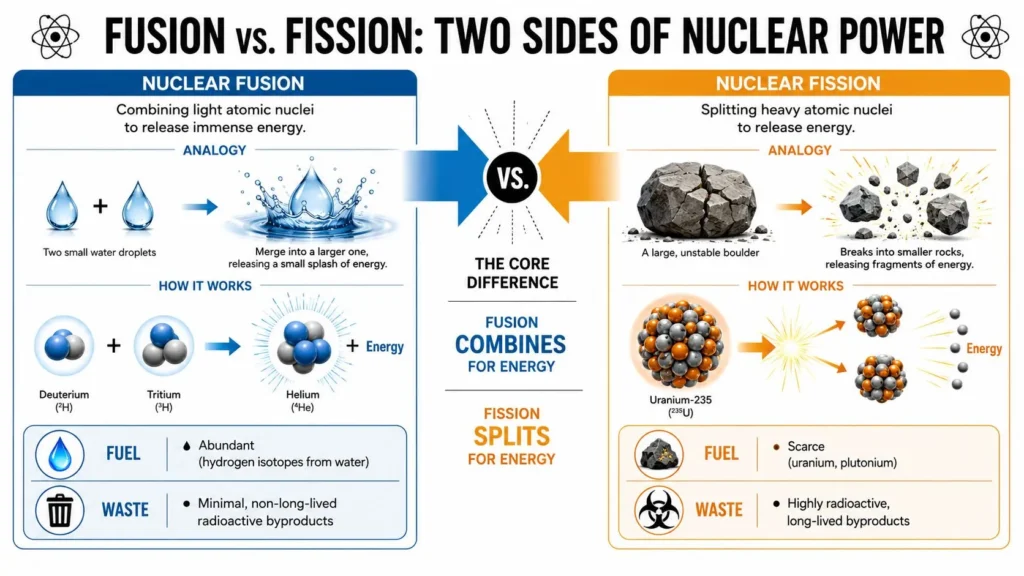
Fusion is the opposite of the nuclear process generally understood. Fission splits a heavy atom. Fusion combines light atoms. In both cases, a small amount of mass turns into a large amount of energy.
A useful analogy is water droplets. If two tiny droplets merge into one, the final droplet is more stable. In fusion, two light atomic nuclei combine into a more tightly bound nucleus, and the leftover energy is released. Scientists usually focus on forms of hydrogen because they are the easiest fusion fuels to work with in experiments.
Why fusion is so hard
If fusion is natural in stars, why can’t we copy the Sun?
Because the Sun cheats. It has immense gravity. On Earth, researchers have to replace gravity with technology. They must heat fuel until it becomes plasma, a state of matter in which electrons are stripped from atoms, and then keep that plasma hot and dense enough for nuclei to collide and fuse.
If you want a clear refresher on plasma itself, Cryonos’ cryogenic insights on plasma offer a useful plain-language description of why this state of matter behaves so differently from solids, liquids, and ordinary gases.
Two main ways to do it
Researchers have pursued two leading strategies.
| Approach | Simple analogy | What it tries to do |
|---|---|---|
| Magnetic confinement | A magnetic Thermos | Hold superhot plasma in place with magnetic fields so it doesn’t touch the reactor walls |
| Inertial confinement | A laser squeeze | Crush a tiny fuel pellet so quickly and intensely that fusion happens before the fuel flies apart |
Magnetic confinement is the world of tokamaks and stellarators. These devices try to control plasma with powerful magnetic fields because no solid container can directly hold matter that hot.
Inertial confinement is the world of giant laser systems like NIF. Instead of holding plasma for long periods, it compresses a tiny pellet so violently that fusion occurs in a short burst.
For a simple companion explainer on the basic mechanism, this plain-language guide to how nuclear fusion generates energy is a good quick read.
Why magnets have become central
One underappreciated shift is that fusion timelines aren’t changing only because of better physics theory. They’re changing because of better hardware.
Many articles describe fusion as one global race, but the more revealing question is which enabling technologies are moving fastest. High-temperature superconducting magnets have become central to compact reactor designs, and MIT/CFS reported reaching a 20-tesla field in a prototype magnet, which they said validated the SPARC design path, as described in this MIT and CFS discussion of superconducting magnet progress. The appeal is straightforward: stronger magnets can help create smaller machines, and smaller machines may be easier to build and finance.
That doesn’t solve fusion by itself. It does change the shape of the problem.
Decoding the Recent Fusion Power Breakthrough
Fusion’s recent breakthrough was real. It was also easy to misunderstand.
The experiment that drove the headlines happened at the National Ignition Facility, or NIF, a machine that looks far more like a precision physics instrument than a prototype power station. That detail matters because the result answered one question very well, while leaving several harder engineering questions unresolved.
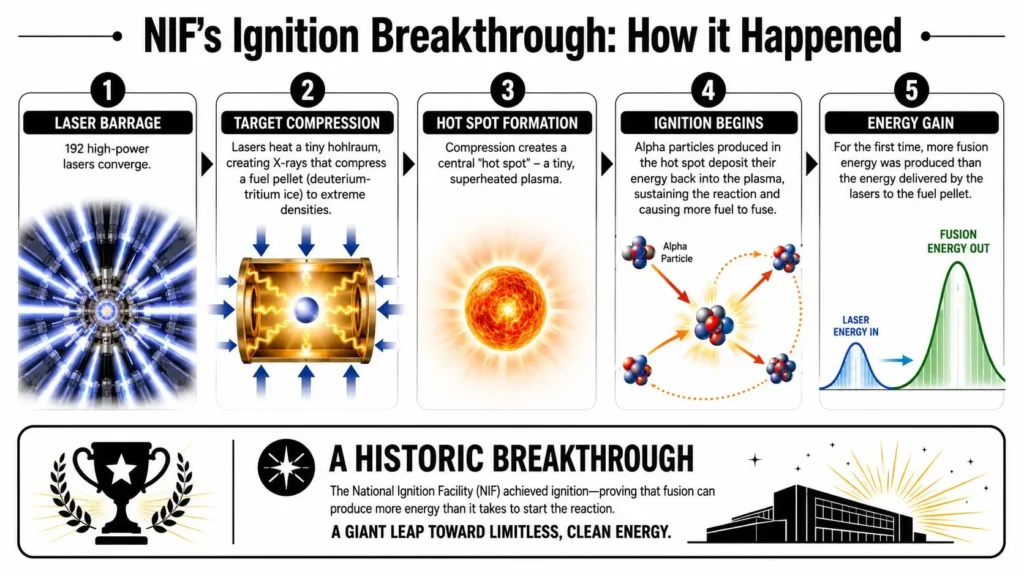
At the center of each shot is a tiny fuel capsule. NIF’s lasers do not shine on that capsule in the manner sunlight warms a surface. They trigger a carefully staged implosion. The outer layer blasts outward, and by Newton’s third law the rest of the pellet is driven inward, squeezing the fuel so hard and so fast that a small central hot spot forms. If conditions are right, fusion reactions in that hot spot produce energetic particles that heat nearby fuel and keep the burn going briefly.
What ignition meant in practice
As noted earlier, NIF’s headline result showed target-level energy gain. In plain language, the fusion fuel released more energy than the laser pulse that struck the target. Later shots strengthened the case that this was a repeatable physical achievement rather than a laboratory fluke.
That was a genuine milestone in fusion science.
It showed that researchers could create the conditions for ignition in a controlled experiment, which had been a long-standing goal. For physicists, that is like proving an aircraft wing can generate lift in a wind tunnel after decades of design work. You have demonstrated the principle. You have not built a commercial airliner.
A short visual summary helps if you’ve never seen the setup in action:
What headlines often blurred
The confusion came from the phrase “net energy gain.” In everyday language, that sounds like a power plant that can run itself and send electricity to the grid. In NIF’s case, the phrase referred to a narrower comparison inside the experiment.
The fuel capsule won its local energy contest. The whole facility did not operate like an efficient generator of electricity.
That distinction is the heart of the fusion story. A commercial plant would need to do much more than produce an impressive burst inside a target. It would need to fire repeatedly, recover useful heat, turn that heat into electricity, and do it with machinery that survives years of punishing conditions. It would also need to do so cheaply enough to compete with other power sources.
Put differently, the breakthrough solved a physics problem at small scale and short duration. The remaining barriers are engineering problems at industrial scale and long duration.
A fusion target can produce a winning result inside the experiment while the full machine still falls far short of practical power generation.
That is why the recent breakthrough deserves both excitement and caution. It moved fusion out of the realm of “maybe this can work” and into “this physical process can work.” The harder question now is whether materials, repetition rate, fuel handling, maintenance, and plant economics can turn that momentary success into a machine on the grid.
Major Players and Global Fusion Projects
Fusion research now looks less like a single race and more like a relay. Different machines carry the baton for different parts of the problem. One experiment may prove a burst of fusion is possible. Another may show that superhot plasma can be held in place long enough to matter. A third may test whether the plumbing, magnets, fuel cycle, and maintenance systems can work together inside something that starts to resemble a real power plant.
That division of labor matters because “breakthrough” can mean very different things.
A useful way to sort the field is by what each project is trying to prove. Some facilities are physics experiments first. They ask whether the plasma can behave the way theory predicts under extreme conditions. Others are engineering testbeds. They ask whether a machine can repeat the trick reliably, with hardware that survives more than a headline-making moment.
China’s EAST tokamak is a good example of progress that sounds technical but has clear practical meaning. It has become known for long plasma runs at very high temperatures, which is a test of control and endurance rather than a bid to make electricity tomorrow. Europe’s JET, the Joint European Torus in the UK, showed strong fusion heat output in a large magnetic-confinement machine. ITER, the multinational project under construction in France, is meant to go a step further by combining many of the subsystems a future plant would need in one place. As the World Nuclear Association overview of fusion milestones notes, EAST sustained plasma at 120 million degrees Celsius for 101 seconds in 2021, later reported higher energy turnover in longer plasma operations, and JET produced 59 megajoules of fusion heat over five seconds in 2022.
Those milestones are easy to misread if they are stripped of context. Long duration is not the same as grid-ready power. High fusion output is not the same as an economical plant. But each result answers a different piece of the same larger question: can fusion move from a controlled scientific event to an industrial machine that runs day after day?
Here is the practical role each major project plays:
- NIF: showed that inertial confinement can produce target-level energy gain in a single shot.
- EAST: pushed magnetic confinement toward longer, hotter plasma operation.
- JET: demonstrated that a major tokamak could deliver substantial fusion heat.
- ITER: aims to test integrated reactor-scale systems, which is much closer to the kind of evidence utilities and grid planners would eventually care about.
Private companies add another layer to the picture. Some are building compact tokamaks with newer superconducting magnets. Others are pursuing alternate designs that try to simplify the reactor or reduce cost. Startups can move quickly on design choices and fundraising. Public labs and multinational projects usually carry more of the slower work on validation, materials testing, and operating data.
That split is one of fusion’s most important realities. Physics can advance in dramatic jumps. Commercial power usually arrives through slower engineering gains, better materials, and years of learning what breaks.
Hard Hurdles on the Path to Grid Power
The most important reality check in fusion is simple. A target isn’t a power plant.
That sentence sounds obvious, yet it gets lost every time headlines compress months of technical context into one phrase about “net gain.” The dramatic result at NIF happened at the level of the fuel target. Commercial electricity requires the entire facility to come out ahead after accounting for everything needed to run it.
Target gain isn’t facility gain
A major benchmark in fusion research is the move from plasma stability records to genuine energy-gain demonstrations. But the distinction matters. In December 2022, NIF produced about 3.15 MJ of fusion output from 2.05 MJ of laser input, while the full facility still required roughly 400 MJ to run the shot, according to Yale Environment 360’s explanation of the NIF energy balance. That means the target succeeded, but the plant-scale energy balance did not.
Here is the cleanest comparison:
| Level | Question | NIF 2022 result |
|---|---|---|
| Target level | Did the fuel release more energy than the lasers delivered to it? | Yes |
| Facility level | Did the whole installation produce more usable energy than it consumed? | No |
Practical rule: When you hear “fusion achieved net gain,” ask “At what level?”
The three hardest engineering problems
Even after the physics works, engineers face a brutal environment.
Materials under neutron bombardment: Fusion reactions produce high-energy neutrons that slam into reactor structures. Over time, those particles can damage, embrittle, and alter materials. A reactor wall isn’t just a wall. It’s a part that must survive repeated punishment without becoming a maintenance nightmare.
Tritium breeding: One of fusion’s favored fuels is tritium, and a practical reactor can’t rely forever on externally supplied fuel. It has to breed more tritium inside the system, usually by using lithium-containing blankets that interact with neutrons. That’s a fuel-cycle challenge, not just a plasma challenge.
Heat extraction and plant efficiency: A future fusion reactor must do more than create a hot plasma. It has to move heat into turbines or other conversion systems efficiently, repeatedly, and safely. The grid doesn’t buy scientific beauty. It buys dependable electricity.
Why engineering may decide the real timeline
Physics tells scientists whether fusion can happen. Engineering decides whether civilization can use it.
A fusion machine has to be maintainable, repairable, and economically coherent. It has to fire or operate often enough to matter. It has to replace worn components without becoming a monument to downtime. Those are the reasons many sober fusion researchers now spend as much time discussing alloys, blankets, pumps, magnets, and manufacturing as they do discussing plasma equations.
What a Fusion-Powered Future Looks Like
If fusion reaches the grid, its biggest effect may be psychological before it is technical. Modern societies behave as if energy scarcity is permanent. They build politics, infrastructure, and industrial strategy around that assumption. Fusion challenges it.
A working fusion economy would not mean free energy, and it would not erase the need for solar, wind, storage, transmission, or efficient buildings. It would mean something more practical and probably more valuable: a new source of firm, low-carbon power that can complement the rest of the energy system rather than fight it.
What changes if fusion succeeds
The environmental appeal is easy to grasp. Fusion promises large-scale electricity generation without the direct carbon emissions associated with burning fossil fuels, and it aims to avoid the long-lived waste profile people commonly associate with conventional fission. That combination explains the enduring interest.
The economic implications are just as large. Cheap and reliable electricity changes the cost structure of desalination, hydrogen production, advanced manufacturing, and energy-intensive computing. Countries that currently depend heavily on imported fuels could gain more room to maneuver.
Fusion’s real promise isn’t magic abundance. It’s a tougher, cleaner, more flexible power system.
Why fusion would join the grid, not replace it
A fusion plant would still be a large industrial machine. It would need cooling systems, transmission links, maintenance planning, and policy support. In other words, fusion wouldn’t cancel the existing energy transition. It would become one more major tool inside it.
That matters because electricity systems work best as portfolios. Solar produces power when the sun shines. Wind produces power when weather cooperates. Batteries shift energy over shorter periods and help manage variability. If you’d like a quick refresher on the storage side of that picture, this plain-language explainer on how lithium batteries work is useful context.
Fusion’s likely role is different. It would be valued less as a miracle and more as a dependable backbone source, particularly if future reactors can run with high reliability and manageable operating costs.
The geopolitical shift
Fusion could also weaken one old rule of global politics: that access to concentrated energy resources determines strategic power. Countries would still differ in industrial capacity and technical skill, but the map of energy dependence could look less rigid.
That’s one reason fusion research carries such unusual symbolic weight. It isn’t only about cleaner electrons. It’s about whether humanity can manufacture one of the deepest foundations of modern life rather than extract it.
From Lab to Lightbulb The Timeline to Commercial Fusion
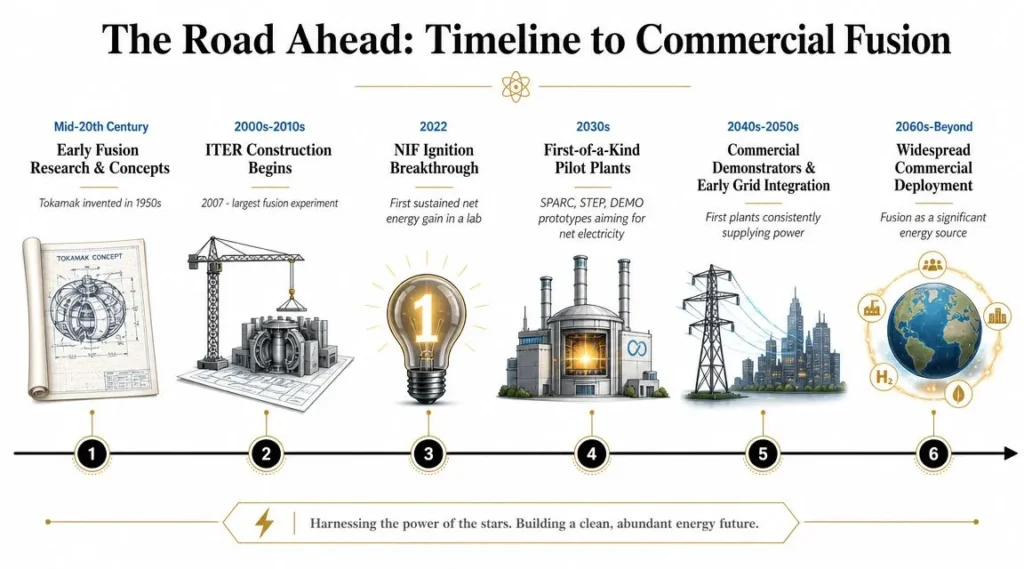
The next chapter in fusion won’t be won by a single dramatic shot. It will be won by integration.
ITER is explicitly built to test the integrated technologies, materials, and physics needed for commercial fusion-based electricity, which differs from producing more energy in a pulse, according to the Idaho National Laboratory discussion of what commercial fusion still requires. That same explanation points to the unresolved practical hurdles that still determine the timeline: materials, tritium breeding, and neutron damage.
What to watch instead of hype
A realistic roadmap is less about one date and more about a sequence of proof points.
- Prototype validation: Can new reactor concepts show that their core design choices work under realistic operating conditions?
- Integrated fuel cycle testing: Can a machine handle tritium responsibly and breed enough fuel for sustained operation?
- Materials qualification: Can reactor-facing components survive neutron exposure long enough to support a practical maintenance schedule?
- Electricity conversion: Can a system turn fusion heat into grid power reliably, not just occasionally?
In this context, modern computational tools may matter as much as any single experiment. Better simulation, design iteration, and materials screening can shorten some parts of the engineering loop. If you’re curious how researchers think about digital tools for materials selection, this materials informatics platform guide gives useful context for the kind of software-assisted decision-making that increasingly supports hard-tech development.
The honest timeline
The clearest way to think about fusion in 2026 is this:
Scientific proof is no longer the only question. The dominant question is industrialization.
Some pilot plants may arrive before full commercial maturity. Some concepts will look brilliant in tests and stumble in maintenance. Others may appear less glamorous but prove easier to scale. That is normal in the history of energy systems.
For readers trying to follow the field without getting lost in hype, a good rule is to separate three stages:
- Physics success
- Engineering success
- Commercial success
Fusion has clearly advanced in the first category. Parts of the second are coming into view. The third remains open.
For science journalism itself, that distinction matters. This guide to what science communication is and why it matters is a useful reminder that public understanding improves when writers explain not just what happened in the lab, but what it means outside it.
If you want more clear, accessible explainers on science and technology without the jargon overload, visit maxijournal.com. It’s a smart place to keep up with complex topics made readable, and a welcoming platform for curious readers and prospective contributors alike.
Discover more from Maxi Journal
Subscribe to get the latest posts sent to your email.