You’re probably here because you’ve watched your cat lie perfectly still while the tail keeps going. The ears are calm. The paws aren’t moving. Yet the tail tip gives a tiny flick, or the whole tail starts swishing as if it has a separate agenda.
That makes a lot of owners ask the same question. Do cats have control of their tails?
The short answer is yes, but not in a simple all-or-nothing way. A cat’s tail is both a tool and a signal. Cats can move it deliberately for balance, position it during social greetings, and adjust it with striking precision. At the same time, some tail motion comes from reflexes, pain responses, or emotional arousal that isn’t fully conscious in the way we usually think of “deciding” to move a body part.
That mix is what makes tail behavior so interesting, and so easy to misread. A raised tail may be intentional. A puffed tail may happen fast as fear takes over. A twitching tip may reflect focus, irritation, or internal tension that the cat isn’t carefully “choosing” like a person raising a hand.
If you understand the machinery behind the movement, the behavior suddenly makes more sense. The anatomy explains the motion. The motion helps explain the mood. And once you see those two pieces together, your cat’s tail stops looking mysterious and starts looking like one of the most expressive parts of the feline body.
The Mystery of the Twitching Tail
A cat sitting on the windowsill often looks like pure stillness, until the tail gives the game away. The end may tap lightly. The whole tail may sway in slow arcs. Sometimes it lashes hard enough to make you think your cat is angry, only for the cat to remain in place, staring at a bird outside.
That’s where people get tripped up. They assume tail movement must mean one thing. It doesn’t.
Some movements are deliberate signals. A cat may carry the tail upright when approaching a familiar person. Some are automatic reactions. A sudden noise can trigger a sharp twitch before the cat has even turned its head. Others sit in the middle. An irritated swish may reflect a real emotional state that spills into body language without careful intention.
Practical rule: A cat’s tail is best understood as part joystick, part flag, and part reflex indicator.
That’s why the answer to “do cats have control of their tails” is more nuanced than many pet owners expect. Cats usually do have meaningful control over tail position and movement. But the tail also broadcasts what the nervous system is doing in real time. Fear, frustration, concentration, and physical adjustment can all show up there.
If you’ve ever wondered why your cat’s tail seems to “talk” even when the rest of the body stays quiet, you’re noticing something real. The tail often reveals internal activity before the face or voice does.
The Anatomy of Tail Control
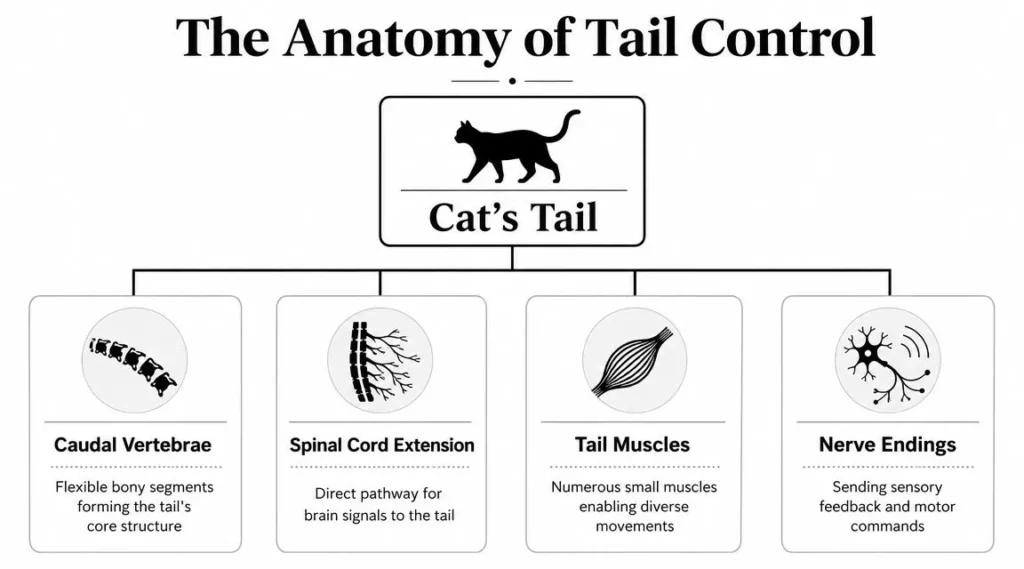
A cat’s tail isn’t a decorative extra attached to the back end. It’s a continuation of the body’s central framework. One major reference notes that the tail is an extension of the spine with 19 to 23 vertebrae and that it’s controlled by a complex system of muscles, ligaments, tendons, and nerves from base to tip, which allows for substantial voluntary control over movement, according to Cats Protection’s explanation of why cats have tails.
Why the tail moves so precisely
Think of the tail less like a loose rope and more like a segmented instrument. Each bony section contributes flexibility. The soft tissues coordinate the pull and release. The nerves carry messages in both directions. The brain sends commands out, and the tail sends information back.
That matters because cats don’t just move the whole tail as one piece. They can change the angle at the base, add a curve through the middle, and flick the tip separately. To us, that can look effortless. Under the surface, it’s a coordinated mechanical event.
A useful analogy is a crane with many joints and cables rather than a broomstick. The structure is stable, but it can also make very fine adjustments.
What owners often misunderstand
People sometimes assume short tails mean poor control. That isn’t necessarily true. A breed with a naturally shorter tail can still use the tail it has in meaningful ways. If you’re curious how tail length varies in different cats, the American Bobtail breed profile gives a helpful overview of one naturally short-tailed breed.
Here’s the key idea:
- Bones provide structure: The vertebrae create the flexible framework.
- Soft tissues create motion: Muscles, tendons, and ligaments help shape the movement.
- Nerves create timing: Signals allow quick, targeted adjustments.
- Feedback creates accuracy: The body constantly updates position and tension.
A cat’s tail works because anatomy and nerve control are tightly linked. It isn’t waving randomly behind the cat.
Once you know that, many behaviors become easier to read. A tail held high isn’t just a shape. It’s a posture produced by a living structure with active control.
Voluntary Signals vs Involuntary Reflexes
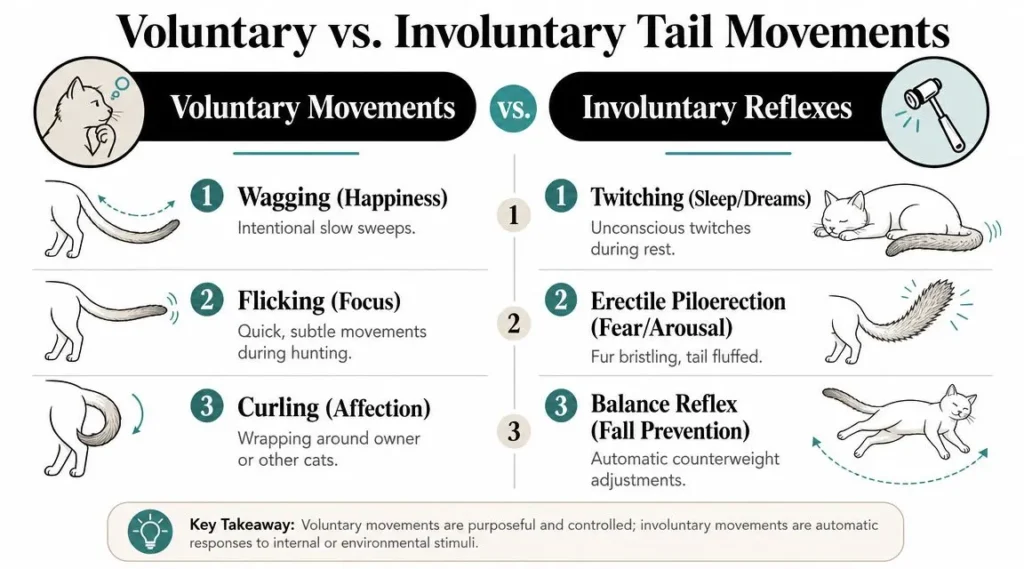
The clearest way to understand tail control is to stop treating it like a yes-or-no question. It’s better to think in categories. Some tail movements are chosen. Some are automatic. Some are driven by emotion so quickly that they feel like both.
A useful summary from Petcube’s discussion of cat tail control is that cats have partial but highly precise voluntary control. They can intentionally lift, curl, and swish the tail for balance and signaling, but some movements are reflexive or emotion-triggered rather than fully conscious.
Movements cats likely mean to make
A cat approaching you with the tail upright usually isn’t producing that posture by accident. The same goes for a tail wrapped around the body during rest, or a controlled slow swish while watching a toy.
These are the kinds of motions owners often notice:
| Type | What it tends to look like | Why it happens |
|---|---|---|
| Greeting posture | Tail carried high | Social signal |
| Focused movement | Slow tip twitch or measured swish | Attention on prey, toy, or sound |
| Positioning | Tail shifted during movement or sitting | Body coordination |
Movements that happen more automatically
Now compare those with a startled jerk after a slam from the next room, or a suddenly puffed tail during fear. Those reactions can happen fast because the nervous system is designed for quick protection.
There’s also a middle zone. Irritation often lives there. A cat who has had enough petting may begin flicking the tail before moving away. That flick reflects emotion, but the cat may not be consciously “composing” the message. The body is leaking information.
If you’ve ever wondered why a sleeping cat’s tail twitches, that same gray area applies. Light tail movements can happen during rest without a fully deliberate choice. Related body sensitivity also raises questions for many owners, especially when touch changes behavior, which is why people often ask about things like whether cats are ticklish.
Don’t read every tail movement as a sentence your cat chose word by word. Sometimes it’s more like a reflex, or an emotional accent mark.
That’s the practical takeaway. Cats do control their tails, but control exists on a spectrum.
The Tail as a High-Precision Balance Tool
Tail language is often the primary focus. Balance is just as important, and in some situations it’s the better answer to the question of why the tail is moving at all.
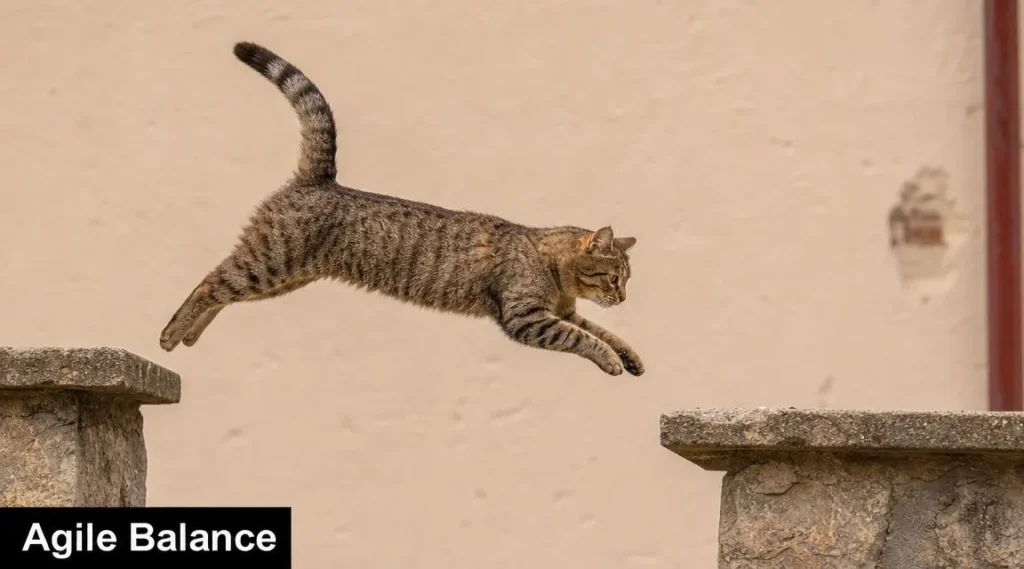
When a cat walks a narrow fence, climbs a high surface, or lands from a jump, the tail acts like a movable counterweight. According to Neakasa’s explanation of feline tail biomechanics, during dynamic balance tasks such as walking on narrow ledges or jumping, the tail can be actively repositioned to reduce rotational error and stabilize the body.
Think of a tightrope walker
A tightrope walker uses a pole to shift weight and stay centered. A cat uses the tail in a similar way, although the mechanics are built into the body rather than carried in the hands.
If the cat’s body starts rotating one way, the tail can shift to help counter that motion. The movement may be quick and subtle. You might barely notice it. But that tiny adjustment can help the cat stay aligned.
Where owners can see it at home
You don’t need a slow-motion camera to spot this. Watch for tail use during everyday movement:
- Jumping onto furniture: The tail often changes position as the cat rises and lands.
- Walking along a narrow edge: The tail may extend and make small corrections.
- Fast turns during play: The tail can help the body stay organized as direction changes.
This functional role is one reason tail injuries matter so much. A painful or compromised tail can interfere with comfort, movement, and confidence. A cat may still walk, but the body loses part of its built-in balancing system.
The tail isn’t just for expression. In motion, it behaves like a steering and stabilizing device.
That’s also why a tail can move when the cat isn’t trying to “say” anything to you. During a leap, the tail’s job may be mechanical first and communicative second. If owners only think in terms of emotion, they can miss this entire side of feline biology.
Decoding Your Cat’s Tail Language
Once you know the tail has both muscular control and reflexive input, the language gets easier to read. Not perfect, but easier. Tail position is meaningful, yet it only makes sense when paired with the rest of the cat.
One peer-reviewed study of cat-cat interactions found that a tail-up approach was more often associated with rubbing than with nose sniffing, which supports the idea that tail carriage can be an intentional social signal. The same study found ear position to be an even stronger predictor of interaction outcomes, with p < 0.0001, as described in this open-access paper on feline social signals.
Tail shapes that owners commonly see
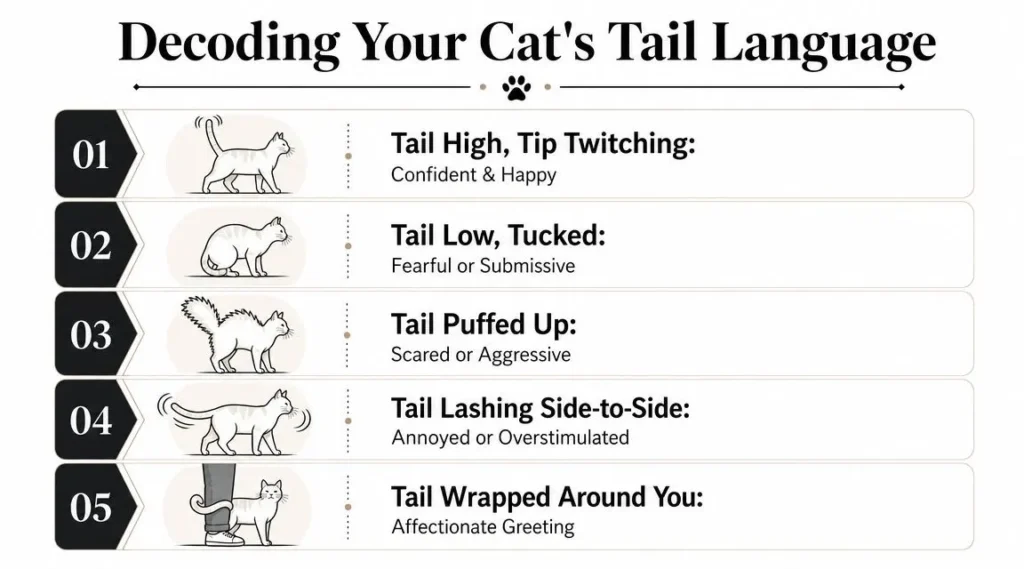
A few patterns come up again and again in homes.
- Tail high: Often seen in confident, social approaches.
- Tip twitching: Can suggest alert focus or mild agitation, depending on the moment.
- Low or tucked tail: Often points to unease, fear, or withdrawal.
- Puffed tail: A classic arousal display, usually linked with fear or defensive intensity.
- Rapid side-to-side lashing: Often a warning sign that the cat is overstimulated or annoyed.
For a quick visual refresher, this short clip can help you match movement with mood cues:
Context changes the meaning
A high tail in a relaxed cat is different from a high tail attached to stiff legs and hard staring. A flicking tail during toy play is different from a flicking tail during petting.
Here’s a simple way to read the whole cat:
| Tail clue | Check next | Why it matters |
|---|---|---|
| Upright tail | Ears and body softness | Friendly confidence looks loose, not rigid |
| Fast lash | Eyes, ears, and distance from trigger | Helps separate play arousal from annoyance |
| Tucked tail | Posture and hiding behavior | Confirms fear or discomfort |
| Puffed tail | Back, fur, and escape options | Shows defensive readiness |
If your cat seems tense in the home environment, behavior support can matter just as much as decoding signals. Resources like Leashes & Litterboxes’ expert cat care advice can help owners think through stress reduction in practical ways.
People also tend to interpret tail behavior through a very human lens. That can lead to confusion about affection, attachment, and what cats are trying to communicate to us. If you’ve wondered how tail signals fit into the bigger relationship, you may also enjoy reading about whether cats love their owners.
A tail never tells the whole story by itself. Read the ears, eyes, posture, and situation with it.
Common Tail Myths and When to See a Vet
One of the biggest myths is that a cat wagging its tail means the same thing as a dog wagging its tail. It doesn’t. Cats often move the tail most dramatically when they’re focused, conflicted, irritated, or physically adjusting their balance. A moving tail can signal pleasure in some moments, but it shouldn’t be treated as a universal sign of happiness.
Another myth is that all tail motion is intentional. As you’ve seen, some motion reflects emotion or reflex more than deliberate choice. That doesn’t make the movement meaningless. It just means owners should stop asking, “Did my cat decide to do that?” and start asking, “What does this movement tell me about the cat’s body and state right now?”
Myths worth dropping
- “A twitching tail always means anger.” Sometimes it does. Sometimes it means concentration.
- “If the tail is moving, the cat wants more petting.” In many cats, increasing tail action during petting is a sign to pause.
- “A droopy tail is just a personality quirk.” It can be, but a new or persistent change deserves attention.
Signs that deserve veterinary attention
Normal tail language changes from moment to moment. Medical concerns tend to look different. Call your veterinarian if you notice patterns such as:
- Persistent limpness: A tail that suddenly hangs and stays that way can point to injury.
- Pain with touch: If your cat cries, flinches, or tries to bite when the tail is handled, pain is likely involved.
- Swelling, wounds, or obvious trauma: These need prompt medical evaluation.
- A marked change in movement: If the tail stops moving normally or your cat seems unable to position it comfortably, don’t wait.
- Compulsive chasing or attacking of the tail: Repeated self-directed behavior can reflect discomfort, skin problems, stress, or another issue.
Owners also make a common mistake here. They reach for home medication before finding the cause. That’s risky, especially with over-the-counter products. If you’ve wondered about common drug-cabinet choices, read this first on whether you can give your cat Benadryl.
New pain, new weakness, or a sudden tail posture change is a medical clue, not just a behavior note.
The best rule is simple. If a tail change looks abrupt, painful, or persistent, treat it as a health question.
The Tale of the Tail A Summary
A cat’s tail is one of the best examples of how anatomy and behavior meet. It isn’t just expressive. It’s engineered. The vertebrae, soft tissues, and nerve pathways give cats the ability to position the tail with fine control, and that control supports both movement and communication.
That’s why the answer to do cats have control of their tails is yes, with an important qualifier. Cats usually have substantial control, but not every tail motion is fully deliberate. Some movements are chosen social signals. Some help with balance. Some are quick emotional or reflexive responses that show you what the nervous system is doing in the moment.
For owners, the most useful habit is observation without oversimplification. Don’t rely on a single tail wag “translation.” Watch the ears. Watch the eyes. Notice whether your cat is greeting, hunting, resting, climbing, or trying to leave. The tail makes more sense when you read it as part of the whole cat.
If you do that, the twitching, curling, swishing tail stops being a mystery. It becomes a running commentary on balance, mood, and physical state. And once you start noticing those patterns, you’ll understand your cat more clearly and respond with better timing, more empathy, and fewer mixed signals.
If you enjoy clear, approachable explainers on pet behavior, science, health, and everyday questions, visit maxijournal.com for more readable articles that turn tricky topics into practical answers.
Discover more from Maxi Journal
Subscribe to get the latest posts sent to your email.