Yes, cats are ticklish, but not in the way that makes humans laugh. They feel a light, sometimes irritating sensation called knismesis, not the laughter-inducing tickle known as gargalesis.
If you’ve ever stroked your cat’s belly, touched a paw, or brushed along the lower back and seen a sudden twitch, kick, or quick turn of the head, you were probably seeing that response in real time. Many owners read those moments as playful, affectionate, or confusingly mixed, and all three can seem true at once.
That’s why the pertinent question isn’t only “are cats ticklish.” It’s also, “What kind of sensation are they feeling, and how can I tell whether they like it?” Once you understand that difference, your cat’s reactions start making a lot more sense.
The Tickle Test What Really Happens When You Pet Your Cat
You run your hand along your cat’s side. Everything seems fine. Then your cat’s skin ripples, a back foot lifts, or the tail starts flicking. It looks a little like being tickled, but it doesn’t look anything like human laughter.
That observation is accurate. Cats do react to certain touches as “ticklish,” but their response is usually a surface-level sensory reflex rather than a playful laugh response. In plain language, they feel light-touch sensitivity.
Why the reaction looks so odd
Cats are built to notice tiny changes on their skin. A faint movement could be dust, an insect, loose fur, or something more bothersome. Their nervous system often answers with a twitch, a turn, grooming, or a quick withdrawal.
That’s why a cat may seem fine one second and done with your hand the next. The reaction can be fast and automatic.
Cats often answer touch with body language before they answer with sound.
What owners often confuse
People commonly mix up three different things:
- Pleasure from petting: Your cat leans in, stays soft, and wants more.
- Ticklish sensitivity: Your cat twitches, shifts, or reacts to light touch.
- Overstimulation: Your cat has had enough and may swat, bite, or leave.
Those can overlap. A cat might enjoy chin rubs, tolerate a few strokes near the back, and dislike any touch on the paws. That doesn’t make the cat moody. It means different body areas send different messages to the brain.
The key is to stop thinking of “ticklish” as a joke and start thinking of it as information. Your cat’s body is telling you what feels safe, neutral, or irritating.
Not All Tickles Are Created Equal Knismesis vs Gargalesis
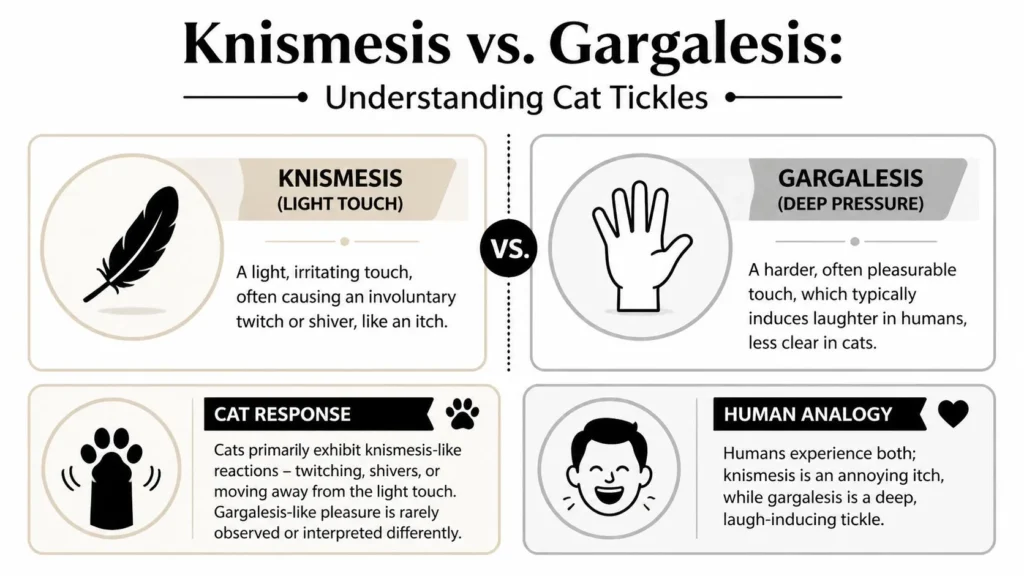
The easiest way to understand feline ticklishness is to split the word tickle into two different sensations.
One is the faint, itchy, “something’s on me” feeling. The other is the deeper, laughter-triggering kind humans associate with tickling under the ribs or feet. Cats only appear to experience the first kind.
What knismesis means
Knismesis is a light-touch sensation that often creates an itch, shiver, skin twitch, or urge to move. Veterinary explanations of feline ticklishness describe cats as experiencing knismesis across mammals, while lacking the laughter-linked form called gargalesis, and note that this light-touch response helps animals detect parasites such as fleas or ticks on the skin, prompting grooming and protective behavior, as explained in TrustedHousesitters’ discussion of whether cats are ticklish.
A simple human comparison helps. If a hair slides across your arm or you feel a bug crawling on your leg, you don’t usually laugh. You brush it away. That’s the same basic category of sensation.
For a cat, that response has survival value. A light stimulus on the skin can mean “check this spot now.”
What gargalesis means
Gargalesis is the deeper, more intense form of tickling associated with laughter in humans and other primates. It’s the kind people usually mean when they ask whether an animal is “really ticklish.”
Cats don’t seem to show that same laughter-type response. They may kick, twist, grab with their paws, or turn suddenly, but that isn’t the same thing as enjoying a joke-like tickle. It’s much better understood as sensory processing and defense.
Practical rule: If your cat’s reaction looks more like “remove that sensation” than “keep going,” treat it as a boundary.
Why this distinction matters at home
Owners often misunderstand their cat’s signals. A twitch can look cute. A bunny-kick can look playful. A sudden head turn can seem like attention-seeking. Sometimes it is playful. Sometimes it isn’t.
A better question than “Does my cat like being tickled?” is, “What is this touch asking my cat’s nervous system to do?”
Use this quick comparison:
| Sensation | What it feels like | Typical response |
|---|---|---|
| Knismesis | Light, superficial, slightly irritating | Twitching, skin rippling, grooming, moving away |
| Gargalesis | Deeper tickle associated with laughter | Seen in humans and primates, not typical in cats |
Once you view are cats ticklish through that lens, your cat’s behavior stops being mysterious. It becomes readable.
A Cat Owner’s Guide to Common Tickle Spots
Some body areas are more sensitive than others. If your cat reacts dramatically in one spot and not another, that’s normal. Cats don’t experience their whole body equally.
The most sensitive areas often combine one of two things. They either have a lot of tactile sensitivity, or they protect a body part your cat considers vulnerable.
The places that usually get the biggest reaction
Paws and belly stand out most clearly. According to Cats.com’s explanation of feline ticklishness, paw pads and belly skin can be highly sensitive, with up to 200,000 mechanoreceptors per cm² in sensitive zones, and touching these areas can trigger toe-spreading or withdrawal in 70 to 80% of observed cats. The same source explains that this sensitivity acts as an early-warning system against ectoparasites.
That fits what many owners see every day. A cat may tolerate head and cheek petting for a long time, then instantly pull the paw away or clamp down on a belly touch.
A quick map of likely trouble spots
Low-fur and exposed areas tend to be more reactive. That doesn’t mean every cat hates being touched there. It means you should approach those zones with more respect.
| Zone | Reason for Sensitivity | Common Positive Reaction | Common Negative Reaction |
|---|---|---|---|
| Paws | Dense touch receptors and protective reflexes | Brief tolerance, paw relaxation | Pulling away, toe spreading, grabbing |
| Belly | Vulnerable area with strong defensive instincts | Relaxed stretch in very trusting cats | Kicking, swatting, sudden roll and bite |
| Base of tail | Sensitive skin and strong sensory feedback | Leaning in, purring, raised hindquarters | Skin rippling, tail lashing, overstimulation |
| Ears and nose area | Exposed, low-fur regions | Gentle acceptance in calm cats | Head turn, flinch, retreat |
| Chin and cheeks | Social touch zone, often comfortable for petting | Leaning in, rubbing, purring | Turning away if overstimulated |
The spots people misread most
The belly causes the most confusion. A cat who shows the belly is not always asking for a belly rub. Very often, it’s a sign of trust and relaxation, not an invitation.
The base of the tail can also fool people. Many cats seem to enjoy a few strokes there, then become overstimulated quickly. That sharp switch from pleasure to irritation is common in sensitive zones.
If you want a safer default, start with cheeks, chin, and the side of the face. Those areas are usually easier to read and less likely to trigger a defensive reflex.
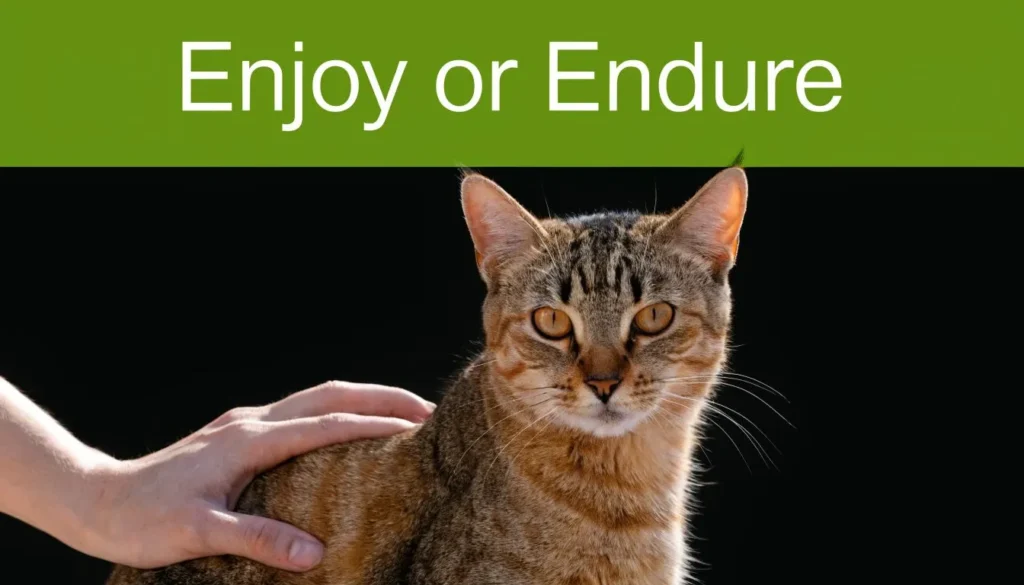
Is Your Cat Enjoying It or Enduring It
Your cat won’t tell you with words. The answer is in posture, muscle tone, tail movement, and whether the cat stays engaged or starts trying to escape the interaction.
That means the best skill you can build isn’t “how to pet better.” It’s how to read earlier.
Signs your cat is probably comfortable
A content cat usually looks soft, not just still. Stillness can mean relaxation, but it can also mean tolerance.
Look for combinations like these:
- Leaning into your hand: The cat is actively participating.
- Slow blinking: A relaxed social signal.
- Gentle purring: Often a good sign when paired with loose posture.
- Relaxed whiskers and ears: Nothing looks tense or pulled back.
- Returning for more contact: The cat repositions to keep the interaction going.
If you’re curious about how cats show attachment more broadly, this guide on whether cats love their owners gives useful context for reading affection outside of petting alone.
Signs your cat wants you to stop
Discomfort can start subtly. Many cats give small warnings before they escalate to swatting or biting.
Watch for these changes:
- Tail flicking or thumping: Often a rising irritation signal.
- Skin twitching or rippling: The touch may feel too stimulating.
- Ears turning sideways or flattening: Your cat is getting defensive.
- Head turns toward your hand: A warning that the next step might be a nip.
- Sudden grooming after touch: Sometimes a reset after an unwanted sensation.
- Walking away: This is a clear no.
A cat who leaves the interaction has already answered your question.
The tricky signals people misread
Purring doesn’t always equal pleasure. Some cats purr when they’re content, and some purr to calm themselves when they feel conflicted or stressed. That’s why purring only counts as a positive sign when the rest of the body looks relaxed too.
A belly-up pose can also be misleading. Owners often see exposed belly, reach in, and get grabbed. The cat wasn’t being deceptive. The human read trust as permission.
When in doubt, focus less on one signal and more on the full pattern. A soft body plus engagement usually means yes. Tension plus twitching usually means no, or at least “not there.”
How to Safely Test Your Cat’s Tickle Response
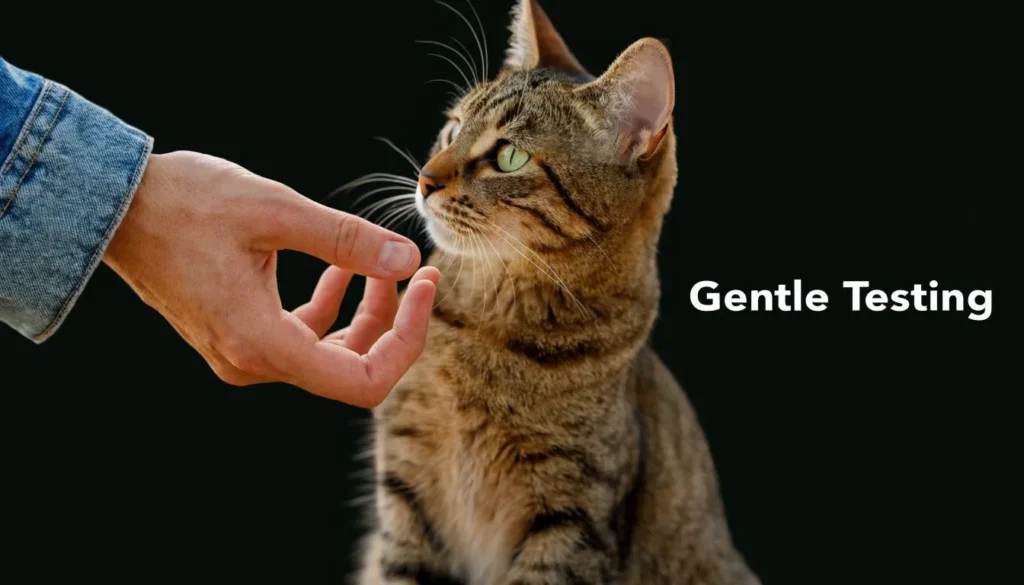
If you want to find out whether your cat has sensitive spots, do it gently and do it like a conversation. You ask with a light touch. Your cat answers with body language.
That approach matters because repeated unwanted touching can teach a cat to avoid hands altogether.
Start only when your cat is already relaxed
Don’t test sensitivity when your cat is fast asleep, hiding, eating, or wound up from play. Choose a calm moment when the cat has already approached you or accepted petting.
A good setup looks simple:
- Pick a familiar setting. Sofa, bed, or favorite chair.
- Begin with a known safe area. Cheeks or chin are better than paws or belly.
- Use one finger or a very light stroke. You’re checking sensitivity, not massaging.
- Pause immediately after. The pause is where you learn the most.
If your cat is older, very young, or has changed behavior over time, context matters. Age can affect tolerance, mobility, and patience, which is why owners often find it helpful to compare behavior with life stage using a cat age in human years guide.
Use the least amount of touch that gets an answer
Think feather-light, not firm pressure. A brief touch is enough to show you whether that area is neutral, pleasant, or too much.
Try this pattern:
- Touch once.
- Watch for two seconds.
- Repeat only if the cat remains soft and engaged.
- Stop at the first sign of irritation.
Gentle testing should feel boring, not provocative. If you’re trying to “get a reaction,” you’re already pushing too far.
Some owners find it easier to watch another calm handling example before trying it themselves:
Know when not to test at all
Skip the experiment if your cat has skin irritation, recent injury, sudden sensitivity, or a history of defensive biting. In those cases, what looks like ticklishness may be discomfort.
Also skip repeated testing on areas your cat clearly dislikes. You don’t need to confirm a boundary ten times. Once is enough.
The safest goal isn’t to discover every ticklish spot. It’s to learn where your cat feels comfortable being touched and where your cat wants distance.
When Tickling Points to a Health Problem
Sometimes a touch response is just a touch response. Sometimes it’s a clue that something is wrong.
A cat who has always disliked paw handling may be sensitive. A cat who suddenly flinches when you touch the back, obsessively grooms one area, or reacts sharply to contact that used to be fine deserves a closer look.
Red flags worth taking seriously
Normal sensitivity tends to be consistent. Medical discomfort often shows up as change.
Pay attention to things like:
- New touch aversion in one spot
- Excessive grooming or chewing at the skin
- Frequent skin rippling with agitation
- Visible redness, scabs, or hair loss
- A strong reaction when being picked up or stroked
- Behavior changes such as hiding or irritability
Parasites are one possibility. Skin irritation, allergies, infection, and pain can also make a cat seem “ticklish” when the problem is tenderness.
Why pushing through is a bad idea
If a cat associates your hand with discomfort, the behavior problem can grow even after the medical issue is treated. The cat learns that touch predicts something unpleasant.
That’s why restraint, repeated belly touching, or trying to “desensitize” a painful area on your own can backfire. If you suspect medication might help, don’t guess from the medicine cabinet. Read guidance on whether you can give your cat Benadryl and speak with your veterinarian before giving anything.
Sudden sensitivity is medical until proven otherwise.
A simple rule works well here. If the reaction is new, intense, or focused in one place, stop testing and schedule a veterinary exam.
Frequently Asked Questions About Feline Ticklishness
Are some cats more ticklish than others
Yes. Individual cats vary a lot in touch tolerance. Temperament, past handling, age, current stress level, and body area all shape how a cat responds.
That’s why one cat melts into cheek rubs and another dodges a hand immediately. The variation is normal.
Are Sphynx cats more ticklish
They might be, but strong data is lacking. Rover’s discussion of feline ticklishness notes a useful open question around whether hairless breeds such as the Sphynx may react more strongly because they lack protective fur, and veterinary insights suggest exposed skin may amplify tactile responses, though empirical research is still missing, as described in Rover’s article on whether cats are ticklish.
So the careful answer is this: possibly, but not proven. If you live with a hairless cat, assume the skin may be more reactive and let the cat set the limit.
Why do some cats love belly rubs while others attack
Because belly exposure and belly handling are not the same thing. A cat may roll over because it feels safe near you, wants to stretch, or is signaling trust. Touching that area can still trigger a protective reflex.
Some cats enjoy brief belly rubs. Others never will. Neither response is abnormal.
Does purring mean my cat likes being tickled
Not always. Purring can happen during comfort, anticipation, uncertainty, or self-soothing. Read it alongside the rest of the cat’s body.
If the cat is loose, leaning in, and staying close, purring is more likely a good sign. If the cat is twitching, tense, or trying to leave, the purr doesn’t override those signals.
Should I try to make my cat tolerate sensitive spots
Only when there’s a practical reason, and only gently. Paw handling for nail trims or brief belly contact for health checks can be useful, but forcing touch for curiosity usually isn’t worth it.
Your cat doesn’t need to enjoy every kind of contact. A respectful relationship is built by learning the yes, noticing the no, and believing both.
If you enjoy practical, science-based pet guides like this one, maxijournal.com publishes approachable articles across pets, health, science, and everyday questions curious readers ask. It’s also a welcoming place for readers who like clear explanations and for contributors who want to share thoughtful, useful writing.
Discover more from Maxi Journal
Subscribe to get the latest posts sent to your email.