You’re probably here because the FedEx Cup playoffs show up on TV, in a betting app, or in a fantasy golf slate, and the format feels harder to grasp than the playoffs in football or basketball. A golfer wins one week, another player still seems alive the next week, and then by the final event people start talking about points, bonuses, and playoff pressure all at once.
That confusion is normal. Golf doesn’t have a simple bracket, and that’s why so many fans ask the same question: how do the fedex cup playoffs work?
The cleanest way to think about it is this. The PGA Tour season is a long race. The FedEx Cup playoffs are the sprint at the end. Players spend months earning their place, then the postseason narrows the field until one player finishes the year as champion.
Welcome to Golf’s Postseason
Sunday afternoon in late summer can feel strange if you are new to the FedEx Cup. A player near the top of the leaderboard is chasing a tournament win, another golfer a few groups behind is trying to save his season, and the broadcast keeps showing standings that seem to change with every birdie. The tension is real, but it does not look like a normal playoff bracket.
That difference is the point.
The FedExCup gave the PGA Tour a true postseason and a reason for the final stretch of the year to feel connected. Instead of treating each event as a separate island, the format turns the closing weeks into a race with checkpoints, pressure, and consequences that carry from one tournament to the next.
Why fans get hooked on it
Team-sport fans usually expect a simple path: qualify, advance, survive. The FedEx Cup creates that same pressure, but it does it with standings instead of head-to-head matchups.
A better comparison is airport security with fewer and fewer gates open. Early in the season, players are building enough points to get into the terminal. Once the playoffs begin, the room tightens fast. A hot week can move a player from danger to safety, while one flat tournament can send him home. That is why every round starts to matter in two ways at once. Players are trying to shoot the lowest score that week, but they are also fighting for position in a larger race.
That second layer is what makes the format so interesting for fantasy players and bettors. In a regular event, you mostly care about who can win. In the FedEx Cup playoffs, motivation changes the board. One golfer may be protecting a strong position. Another may need an aggressive finish just to keep playing next week. Those different incentives can shape strategy, scoring swings, and even how much risk a player takes late on Sunday.
It also adds weight to the sport’s flash moments. A late-season roar after an approach lands inches away carries more than highlight value, much like the drama around a PGA Tour hole in one that suddenly changes a tournament and the mood around it.
The easiest way to follow the FedEx Cup is to watch for movement, not matchups. Who is safely through, who is on the line, and who needs a big finish?
The big picture
Three ideas make the whole format easier to read:
- Players build their case over the full season. The playoffs reward months of results, not one good week.
- The field keeps shrinking. Each playoff stop increases the pressure because fewer spots remain.
- The final stretch rewards both consistency and timing. A player who peaks late can change his year quickly, which is why the standings feel volatile and why fans keep checking them.
Once you see the FedEx Cup as a race with shrinking margins, the postseason starts to make sense. It also becomes much more fun to watch.
Earning Your Way into the Playoffs
The FedEx Cup playoffs start long before the first playoff event. Every regular-season start gives players a chance to add points, improve their standing, and avoid a stressful finish to the summer.
What matters here is the idea, not a complicated formula. Players spend the season building a points total through their results, and the highest-ranked group earns a playoff spot. That setup gives ordinary weeks extra meaning. A finish that looks modest on the leaderboard can still matter a lot if it moves a player a few places closer to safety.
The pressure is easiest to understand near the cutoff. A player sitting comfortably inside the line can plan with a longer view. A player hovering near the edge has a different problem. One missed cut or one strong Sunday by a rival can change the whole picture, which is why late-season events feel so tense for fans, fantasy players, and bettors tracking who still has something major to play for.
How players build a playoff case
Golf uses points here the way other sports use standings. You are not trying to beat one team for a division title. You are trying to stack enough good finishes over months to stay ahead of a large pack.
Players usually get into the playoffs in one of three ways:
- Steady accumulation: A run of solid finishes keeps a player climbing without needing many headline wins.
- A late charge: One hot stretch near the end of the regular season can rescue a year that looked flat.
- Top-end results: Big finishes give players room to breathe and make the rest of the schedule less desperate.
That last part is why the format rewards more than just talent. It rewards timing, consistency, and schedule management.
For readers who follow majors more closely than the week-to-week PGA Tour race, the logic is similar to how players qualify for the Masters. Access has to be earned. The difference is that the FedEx Cup measures that over a season instead of through a small set of invitation paths.
What players are trying to accomplish
A golfer’s regular season is really a balancing act. He wants enough points to reach the playoffs, but he also wants to arrive there from a position of strength rather than barely squeezing in.
That leads to a few strategic goals:
- Keep collecting points: Every made cut and every high finish can matter over time.
- Avoid empty stretches: Several quiet weeks in a row can push a player toward the bubble.
- Peak without waiting too long: Form in July and August can change a season fast.
- Protect future opportunities: Strong regular-season play affects more than playoff entry. It can shape schedule options and job security.
For fans, the standings become more interesting than a normal leaderboard at this stage. You are not only asking, “Who can win this tournament?” You are also asking, “Who needs this week more?” That second question often tells you who may play aggressively, who may settle for safer targets, and who becomes a much more interesting fantasy or betting option because the incentives are so different.
Simple rule: Before a player can chase the FedEx Cup title, he has to earn his way into the postseason through his regular-season points total.
That is why the playoffs feel earned rather than random. August drama is built on months of work, and the players near the line carry the most volatility into the postseason.
The Three Playoff Events and Progressive Cuts
A player can spend months earning his way into the postseason and still be one ordinary week away from going home. That is what gives the FedEx Cup Playoffs their shape. The format is short, but it creates real pressure because the field keeps shrinking.
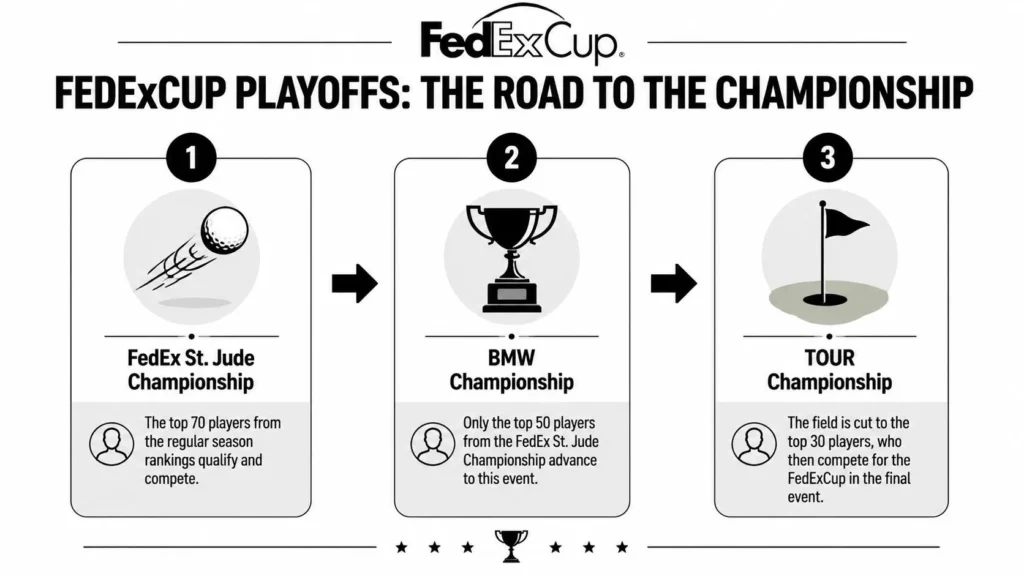
The postseason has three events. It starts with 70 players, drops to 50 after the first event, then to 30 after the second. By the time the TOUR Championship arrives, the field is limited to the players who kept earning their way forward.
The playoff path
The easiest way to read it is like a staircase. Each week removes another layer of the field.
| Event | Who starts there | What happens next |
|---|---|---|
| FedEx St. Jude Championship | Top 70 from the regular season | Field narrows to 50 |
| BMW Championship | Top 50 after the first playoff event | Field narrows to 30 |
| TOUR Championship | Top 30 after the second playoff event | FedEx Cup champion is crowned |
That setup matters because it changes what players are trying to do. In a normal tournament, a golfer may focus only on winning that week. In the playoffs, many players are playing two contests at once. They are chasing the event leaderboard while also trying to stay above the elimination line in the season standings.
Why the first two events feel so tense
The FedEx St. Jude Championship is the widest doorway, but it still closes quickly. Players near the bottom of the 70 are often in a simple race. They do not need a perfect week. They need a week good enough to avoid losing ground to the players around them.
The BMW Championship tightens everything further. By then, the field is smaller, the margin for error is thinner, and the target is clearer. A player hovering around 28th, 30th, or 33rd is not just thinking about birdies. He is thinking about what each shot could mean for his entire season, his TOUR Championship berth, and the attention he gets from fantasy managers and bettors tracking live projections.
That is why playoff broadcasts keep showing projected positions. The standings are moving while the tournament is still being played, and one late birdie can change who advances.
These are not ordinary cuts
This part trips up a lot of fans. The playoff cuts are mostly between tournaments, not the usual halfway cut inside a tournament.
A simple comparison helps. A regular tournament cut is like making it to the weekend. A playoff cut is like making it to the next round of the postseason. A player can finish all four rounds, post a respectable result, and still be eliminated because too many others passed him in the standings.
That creates a different kind of pressure. Every hole matters, but the consequences stretch beyond that one event. For fans, that makes the sweat line more interesting than usual. For fantasy and betting, it adds another layer because motivation is not equal across the field. One player may be protecting a place inside the top 30, while another has to attack flags just to keep his season alive.
The result is a playoff format that feels closer to elimination sports than a standard week on the PGA Tour. Survive the checkpoint, and you move on. Slip at the wrong time, and your season ends.
How Playoff Points Create Excitement and Volatility
A player can spend months building a solid season, then watch one playoff week change the entire picture.
That swing is baked into the format. The first two playoff events award 2,000 points to the winner, which is roughly quadruple the 500 points from a standard tour win, according to ESPN’s FedEx Cup playoff format explainer. The same report says one victory can move a player 20 to 30 spots in the standings.
Why those points matter so much
The regular season rewards consistency over time. The playoffs add a sprint element. A player who was good for months but never dominant can suddenly jump into contention with one big finish.
That is the whole point of the design. If playoff points were only a little bigger than regular-season points, the standings would barely move and the postseason would feel like a formality. By making the rewards much larger, the PGA Tour creates a race that can still turn late.
A simple way to read it is this: regular-season points build your position, but playoff points can redraw it. That is why telecasts keep flashing projected standings during the round. Fans are not just watching who is leading the tournament. They are watching whose season is changing in real time.
Why volatility is good for fans
Golf usually asks for patience. The FedEx Cup playoffs add urgency.
One hot week can rescue a season. One average week can leave a player exposed. That tension makes the leaderboard feel wider than usual, because the most important action is not always at the top of the tournament. Sometimes it is happening around 12th place, where a few birdies can mean a jump into the top 30 or a slide out of it.
For viewers, that creates more than score-watching. It creates consequence-watching. You start caring about who can make a move, who needs to protect position, and who has enough upside to change the whole bracket of possibilities.
Why fantasy players and bettors pay close attention
This part often gets left out of basic explainers, but it is one of the most interesting features of the format.
In fantasy golf, playoff points change how you value risk. A steady player who usually finishes 18th might help in a normal week, but in the playoffs a high-variance player can be more attractive because a win or near-win changes everything. Ceiling matters more when the reward for first place is so outsized.
Betting markets feel that pressure too. A golfer entering the playoffs from 40th in the standings may carry more upside than his season-long profile suggests if the course fits him and he has the kind of birdie-making game that can produce a spike week. On the other hand, a player sitting comfortably near the top may approach a tournament differently if his main goal is to stay safely inside the next cutoff.
That strategic layer matters for fans as well. You are not only asking, “Who is playing well?” You are also asking, “Who needs to chase?” and “Who can afford patience?” Those questions make live betting, fantasy decisions, and even simple leaderboard watching more interesting.
Strategic effects you can actually feel
- Winning upside gets priced differently: A golfer with real first-place potential becomes more valuable because the standings reward a true breakthrough.
- Middle-of-the-pack finishes lose some shine: A decent week helps, but it may not be enough if a player needs a large jump.
- Course fit can create outsized opportunity: If a course matches a player’s strengths, that week can change his entire postseason.
- Motivation is uneven across the field: Some players are protecting position. Others need to attack from the opening round.
- Live projections become part of the contest: Fans, fantasy players, and bettors are tracking movement, not just score.
Practical rule: In the first two playoff events, focus on players who can change their season, not just players who are likely to finish respectably.
That is what gives the FedEx Cup playoffs their charge. The points system turns a golf tournament into a moving target, where one round can alter standings, strategy, fantasy value, and betting interest all at once.
The Tour Championship’s Unique Starting Strokes
Sunday at East Lake can look strange if you are new to the FedEx Cup. One player appears to be several shots ahead before he has even hit his first tee shot, while another starts the week trying to make up ground immediately. That is not a graphic error. It is the format.
The Tour Championship uses a Starting Strokes system. The 30 players who reach East Lake do not begin at even par. They start the tournament at different scores based on where they rank in the FedEx Cup standings when the field is set.
Here is the basic setup fans need to know:
- FedEx Cup No. 1 starts at 10-under
- No. 2 starts at 8-under
- No. 3 starts at 7-under
- No. 4 starts at 6-under
- No. 5 starts at 5-under
- Nos. 6 through 10 start at 4-under
- Nos. 11 through 15 start at 3-under
- Nos. 16 through 20 start at 2-under
- Nos. 21 through 25 start at 1-under
- Nos. 26 through 30 start at even par
A simple way to read that system is this: the playoffs spend two events sorting the field, and East Lake begins with that sorting already built into the scoreboard. A player who has had the best postseason run earns a head start. A player who sneaks into the final 30 still has a path to the title, but he starts several shots back.
That head start matters because the Tour Championship is still a regular 72-hole stroke-play event once play begins. The starting score is added to whatever each player shoots over four rounds. If the top seed starts at 10-under and then plays East Lake in 2-under for the week, he finishes at 12-under. If someone begins at even par and shoots 9-under on the course, he finishes at 9-under.
That is why the format creates immediate pressure. The leaders are protecting an advantage they earned. The players lower in the standings cannot wait around for Sunday. They often need to attack earlier, take on more risk, and chase birdies because they are already behind before the first round starts.
For fans, this changes how you watch the leaderboard. In a normal tournament, everyone begins from the same line. At East Lake, the leaderboard is part reward and part competition. It works a bit like a playoff race in other sports where a strong regular season earns home-field advantage. The match still has to be won, but the better position gives you a real edge.
That also makes East Lake unusually interesting for fantasy players and bettors. A golfer who starts at 8-under is not the same proposition as one who starts at even par, even if their recent form looks similar. You are weighing two things at once: who is playing the best golf, and who already owns a scoreboard advantage. That split creates volatility, because a hot player can erase part of the gap quickly, but the head start is large enough to shape the whole week.
Why the format can feel confusing at first
The confusion usually comes from mixing two questions together. One question is, “Who played best over the season and the first two playoff events?” The other is, “Who is playing best at East Lake this week?” Starting Strokes combines those answers into one final scoreboard.
So if a player begins at 10-under and wins by two, he did not necessarily shoot the lowest raw score for the week. He won the FedEx Cup under the format that rewards both playoff position and performance at East Lake. Once you know that, the leaderboard makes much more sense.
This short video gives a quick visual overview of the playoff concept and why the finale gets so much attention.
How the FedEx Cup Champion Is Crowned
By the time Sunday arrives at East Lake, the race is simpler than it first appears. The FedEx Cup champion is the player who finishes with the lowest overall score after 72 holes, and that total already includes the Starting Strokes each player brought into the week.
That last part is the key.
The TOUR Championship leaderboard is not starting from scratch. It begins with built-in advantages based on FedEx Cup position, then adds each player’s score over four rounds. So if one golfer starts at 10-under and another starts at 4-under, the second player has to beat him by at least six shots during the week to finish ahead in the FedEx Cup race.
A concrete example helps. Say Player A begins the TOUR Championship at 8-under. Player B begins at 2-under. Over four rounds, Player B shoots five shots better than Player A in raw golf score. Player B still loses the FedEx Cup by one, because Player A’s six-shot head start was part of the competition from the opening tee shot.
That is why fans sometimes need to separate two scoreboards in their heads. There is the raw score for the week, and there is the FedEx Cup score that includes Starting Strokes. The title goes to the second one.
For viewers, that makes Sunday easier to follow than older formats that required points math after the round. If a player sits alone at the top of the TOUR Championship leaderboard when the final putt drops, he is the FedEx Cup champion. The formula is already baked into the board.
It works a lot like a postseason team earning an advantage before kickoff. In football, fans understand that seeding shapes the path to a title, as in this explainer on how playoff qualification changes the road for teams like the Chiefs. The FedEx Cup applies that same idea inside the final event itself. Better work before East Lake creates a scoring cushion, not just a spot in the field.
That design has real strategic consequences. A player near the top can play with more patience because his margin already exists on the card. A player starting farther back often has to chase birdies earlier, which raises both upside and risk. For fantasy players and bettors, that distinction matters. You are not only asking who will post the best raw score this week. You are asking whether that score will be enough to overcome the starting gap.
So the crowning rule is straightforward:
- The TOUR Championship is 72 holes
- Each player begins with Starting Strokes based on FedEx Cup position
- Those starting numbers count in the final total
- The lowest combined score at the end wins the FedEx Cup
The champion is not the player who shoots the lowest raw score at East Lake. The champion is the player who finishes lowest on the adjusted leaderboard everyone can see from the first round onward.
Common FedEx Cup Questions Answered
The easiest way to understand the FedEx Cup is to treat it like a postseason race with checkpoints. Players are not only trying to post a good score that week. They are trying to stay alive for the next stop, improve their starting position for East Lake, and avoid one bad week ending the chase.
That layered pressure is why the format can feel confusing at first and so compelling once it clicks.
Are there cuts during FedEx Cup playoff tournaments
There is no traditional Friday cut inside a playoff event. If a player gets into a playoff tournament, he plays all four rounds.
The actual cuts happen between events. A golfer can finish Sunday, sign his card, and still miss the next tournament because his season position was not high enough after the standings updated.
A simple way to view it is this: the tournament has no in-event cut line, but the playoffs still have elimination rounds.
Do players still get paid at the TOUR Championship
Yes. Players are paid, but that money is handled differently from standard official PGA Tour prize money.
For casual fans, that may sound like bookkeeping. For golf history talk, fantasy formats, and betting conversations, it matters because the Tour Championship is tied to the season-long race, not just one standalone week. The event is deciding a champion and distributing bonus money within that larger structure.
Why does the format create so much late-season drama
Because every round can change two things at once. A player is chasing that week’s finish, and he is also fighting for his season path.
That makes the standings volatile in a way normal tournaments are not. One strong week can move a player into the next event or improve his position enough to change how aggressively he plays later. One poor stretch can force a golfer into riskier decisions because he no longer has the luxury of waiting for birdies to come naturally.
Fans from other sports usually recognize the feeling quickly. The same tension shows up in any postseason format where qualification changes strategy, like tracking whether the Chiefs have clinched a playoff path. The FedEx Cup just expresses that tension through points, placements, and changing pressure from week to week.
What’s the easiest way to follow it as a new fan
Use a three-part checklist:
- First, check who is still alive. The field keeps shrinking, so survival matters as much as score.
- Next, watch the bubble. Players near the advancing line often face the toughest decisions because they need enough points to keep going.
- Then, at East Lake, pay attention to starting position and live score together. That tells you who can stay patient and who has to attack.
If you follow those three ideas, the format becomes much easier to read. You are watching a mix of survival, seeding, and final execution, which is why the FedEx Cup feels different from a normal PGA Tour event.
If you enjoy plain-English sports explainers like this one, maxijournal.com publishes approachable writing across sports, education, science, entertainment, travel, business, and more. It’s a good place to find fresh commentary, simple FAQs, and clear blog-style guides without the jargon.
Discover more from Maxi Journal
Subscribe to get the latest posts sent to your email.