The noise changed before the football did. Outside the stadiums, Brazil sang, argued, marched, and demanded answers. Inside them, the world cup 2014 brazil team carried a burden that no tactical board could fully absorb.
A Nation’s Expectation and a Team Under Siege
Brazil did not enter its home World Cup as just another favorite. It entered as a national institution asked to repair the national mood. That distinction matters, because it changes how every missed pass, every nervous clearance, and every awkward post-match interview is received.
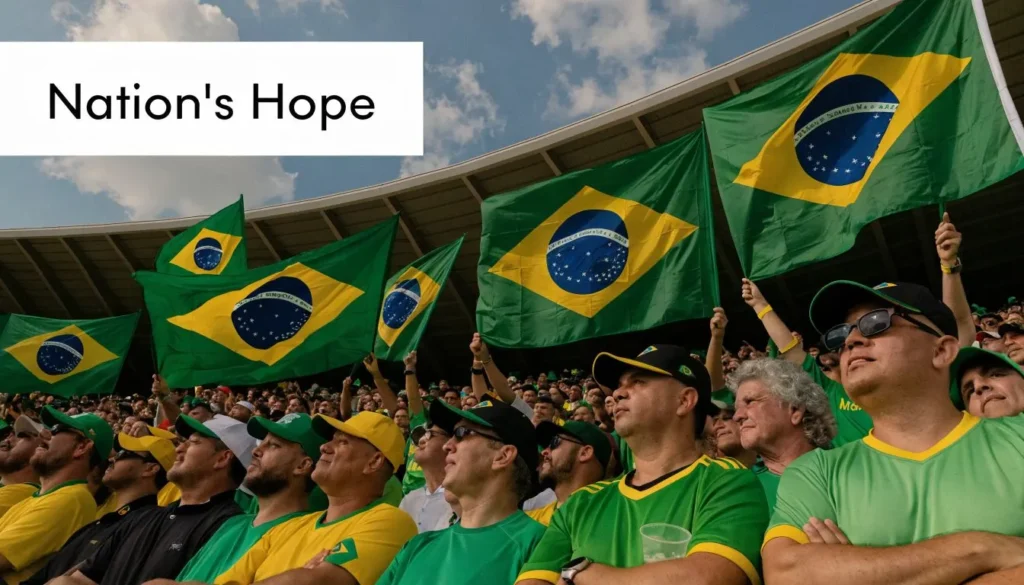
The colors were familiar. The atmosphere wasn’t. The tournament unfolded while massive “There won’t be a Cup” protests across Brazil criticized billions in public spending on stadiums while public services suffered, a political and social backdrop documented in coverage of the 2014 protests in Brazil. That unrest didn’t automatically decide matches, but it changed the emotional climate around them. The players weren’t merely representing a football team. They were being cast as symbols in a national argument.
Football as pressure valve
Home tournaments often create a simple story. The host gets energy from the crowd, rides the mood, and becomes stronger. Brazil’s case was harder than that. The support was immense, but it came attached to expectation so intense that it could feel like surveillance.
A nation wanted joy. A divided public also wanted justification.
Practical rule: When a team becomes a vessel for national repair, ordinary sporting pressure turns into something less manageable.
That context helps explain why the emotional temperature around Brazil always seemed slightly too high. Victories did not calm the atmosphere for long. Draws felt accusatory. Even celebrations carried strain.
One reason this still fascinates journalists is that it sits at the border between sport and public life. Readers who follow broader civic storytelling can see the same tension in forms of reporting that center people on the ground, not just official narratives, as in this look at citizen journalism and public storytelling. Brazil in 2014 was a football tournament, but it was also a national broadcast of unresolved anxiety.
The shirt became heavier
Brazil’s shirt has always carried myth. It carries memories of genius, swagger, invention, and a style that the world recognizes before the ball has even settled. At home, that mythology became a demand for emotional rescue.
The dangerous part was that the team often looked like it understood this too well. The performances were urgent rather than free, dutiful rather than spontaneous. A side that should have moved with authority often moved with tension.
That is the first key to understanding the tournament. Before Germany exposed Brazil’s tactical and emotional faults in the semi-final, the country had already built a stage on which any failure would feel historic. The players entered it under siege, adored by millions and squeezed by the same millions at once.
The Official 2014 Brazil Squad and Scolari’s Plan
Luiz Felipe Scolari built a squad that tried to reconcile two Brazilian instincts. One was old and romantic: trust your gifted attackers, let decisive players shape big moments. The other was harder and more conservative: stay compact, defend with force, and control the emotional rhythm of matches.
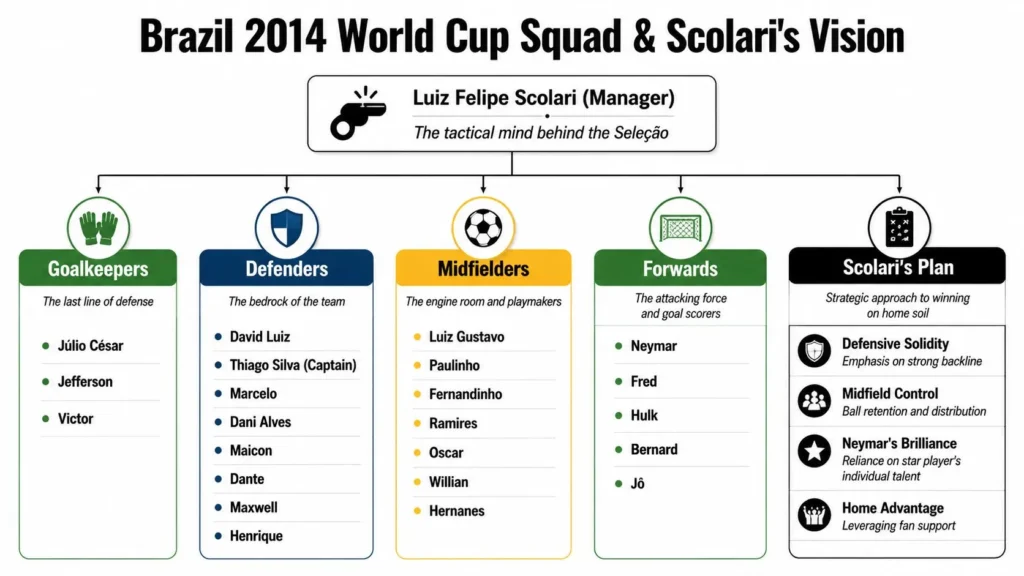
The official squad reflected that balancing act. It had established names, workers, and a few players expected to carry creative responsibility.
The 23-man squad
| Unit | Players |
|---|---|
| Goalkeepers | Júlio César, Jefferson, Victor |
| Defenders | David Luiz, Thiago Silva, Marcelo, Dani Alves, Maicon, Dante, Maxwell, Henrique |
| Midfielders | Luiz Gustavo, Paulinho, Fernandinho, Ramires, Oscar, Willian, Hernanes |
| Forwards | Neymar, Fred, Hulk, Bernard, Jô |
Scolari’s idea was clear enough on paper:
- Defensive base: Build from Thiago Silva’s leadership and the experience around him.
- Midfield work: Use runners and ball-winners to protect transitions.
- Creative release: Allow Neymar and attacking support players such as Oscar, Hulk, and Willian to decide matches.
- Crowd factor: Turn home emotion into momentum rather than panic.
That looked coherent before the tournament. It looked less coherent once matches began demanding improvisation.
Why Felipão chose pragmatism
Scolari was never hired to stage an aesthetic exhibition. He was hired to win on home soil. His reputation suited that mission. He preferred structure, emotional commitment, and role clarity over ornamental possession.
Brazil’s plan wasn’t built around dominating every phase with the ball. It was built around surviving pressure, generating moments for decisive attackers, and trusting the force of the occasion. That made Neymar the hinge of the whole design. If he accelerated, combined, or improvised in the final third, Brazil had lift. If he was crowded out, the attack could become stiff.
The squad made sense if the tournament stayed stable. Once instability arrived, Brazil had fewer solutions than a host with this talent should have had.
The composition of the squad mattered at this stage. There were excellent players in it, but not enough natural conductors. Too often, the team had energy without orchestration. It had runners, tacklers, and emotional leaders, but not enough calm distributors who could slow a match and rearrange its pattern.
The hidden weakness in the plan
Scolari’s system depended on several conditions holding at once:
- The back line had to remain emotionally composed.
- The midfield had to screen danger without getting stretched.
- Neymar had to be available as both creator and emotional center.
If one piece cracked, the others would be tested more severely than they were designed for. That’s the difference between a resilient favorite and a fragile one. Strong teams can lose a star and still preserve their shape. Fragile teams lose a star and discover that shape was partly an illusion.
For readers interested in the physical side of tournament preparation, squad planning always intersects with durability and workload management, which is why discussions around preventing sports injuries in elite competition are never far from the football itself. Brazil’s campaign would eventually show how quickly a tactical plan can unravel once absences strip away its anchors.
Brazil’s Rocky Path to the Semi-Final
On the surface, Brazil’s run to the last four looked solid enough for a host nation. In reality, each round added strain. The team kept advancing, but it rarely imposed itself with the calm of a side in control of its own tournament.
That distinction mattered in Brazil in 2014. Every match carried more than football pressure. The team was playing inside a country split between World Cup celebration and anger over public spending, transport, policing, and inequality. The shirt still carried enormous symbolic weight, but the old relationship between the Seleção and the public was less secure than the mythology suggested. Brazil were not only trying to win. They were trying to reassure a nation that no longer found reassurance easy.
A group stage that never settled the nerves
The results in the group were acceptable. The performances were less convincing.
Brazil opened with a win over Croatia, but the game was tense and emotionally charged rather than technically authoritative. Against Mexico, the attack became predictable, with too much of the play funneled into hopeful acceleration instead of well-constructed openings. The win over Cameroon brought goals and temporary relief, yet it still did not erase the sense that Brazil were depending on emotional surges more than sustained command.
That pattern showed up in the technical profile of the tournament as well. Analysts in a PubMed study on performance indicators from the 2014 FIFA World Cup found that winning teams were separated more clearly by shot accuracy than by physical output. Brazil had intensity, crowd force, and transition moments. They were less reliable when matches demanded precision, control of tempo, and patient occupation of space.
The concern was not that Brazil lacked talent. It was that their football often became rushed at the exact moments when elite tournament sides usually slow the game down and choose better options.
Progress built on emotion and margins
By the end of the group stage, Scolari’s team had established a clear identity, but it was an unstable one. Brazil could press the emotional temperature of a match upward very quickly. They could also get dragged into that same heat.
A short reading of those three games makes the point:
- Croatia: Brazil found a result under intense national scrutiny, but the performance carried anxiety from the first whistle.
- Mexico: The side had territory and pressure in spells, yet too few clean solutions near goal.
- Cameroon: Brazil attacked with greater freedom, though defensive control still came and went.
The route forward was real, but the authority of a champion was not. Brazil advanced because they had superior individuals in decisive moments and because home support could tilt the emotional balance of a game. Their structure still looked vulnerable once matches became complicated.
Chile and Colombia changed the mood of the campaign
The round of sixteen against Chile was the first clear sign that Brazil were surviving the tournament as much as shaping it. The match ended in a penalty shootout after Chile hit the bar late in extra time. A team carrying confidence usually leaves that kind of tie with renewed clarity. Brazil left it with visible tension.
Then came Colombia, a quarter-final that sent Brazil through while stripping away two pillars at once. Thiago Silva’s suspension removed the captain and organizer of the back line. Neymar’s injury removed the team’s main source of improvisation, ball progression, and emotional release. The victory was significant, but it came with a cost that exposed how narrow Brazil’s margin for error had become.
By then, the campaign had produced the same warning in different forms:
| What Brazil consistently showed | What Brazil still struggled to sustain |
|---|---|
| Competitive intensity | Control of rhythm |
| Individual interventions | Collective fluency |
| Emotional commitment | Tactical calm under stress |
That is why the semi-final cannot be treated as a sudden break from an otherwise healthy tournament. Brazil had been accumulating pressure for weeks. The social climate around the host nation heightened every wobble, and the football itself offered too few mechanisms for regaining control once emotion took over. The path to the semi-final was successful in the narrow sense. In a deeper sense, it was a record of a strong team reaching the brink while showing signs that its balance could give way.
The Mineirazo A Deconstruction of the 7-1 Collapse
The semi-final began like an emergency. Brazil attacked the occasion before it understood the game. Germany, calm and exact, waited for spaces that kept opening wider.
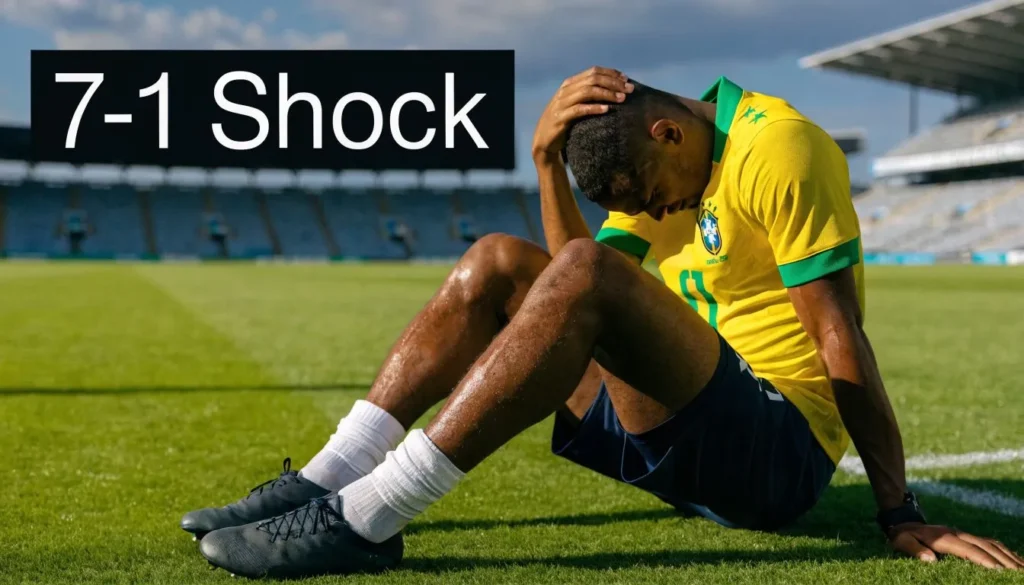
What followed has been replayed so often that the scoreline can obscure the mechanism. The humiliation wasn’t only that Brazil lost heavily. It was that the team lost all relationship to space, sequence, and emotional order.
Tactical collapse or psychological collapse
This debate still sits at the center of the match. Many saw a team that mentally shattered after the opening damage. That reading has force. Tim Vickery captured the immediate implosion starkly, writing that “from the moment that Brazil conceded the first goal, the entire team fell to pieces”, in his analysis of South American football and Brazil’s crisis.
But that isn’t the whole picture. The deeper question is whether the mind failed first, or whether the structure was already weak enough that one shock could wreck it. I think the answer is both, and in a specific order. Brazil’s tactical arrangement was unstable. Germany’s early success then turned instability into panic.
Once Brazil chased the game emotionally, the midfield stopped acting as a midfield. Distances widened. The defense no longer defended in connected phases. It reacted in fragments.
The identity crisis underneath the score
The strongest reading of the 7-1 isn’t that it was a freak collapse. It’s that the match exposed a larger uncertainty in Brazilian football. Brazil wanted to play with national emotion, but it no longer possessed the older Brazilian habit of using technique and improvisation to control chaos. Nor had it fully become a colder, modern machine.
So what was it?
It was a side caught between traditions. It had the symbolism of old Brazil and some of the pragmatism of newer Brazil, but not enough composure to merge the two under the most intense stress.
The 7-1 became unforgettable because it looked like a tactical malfunction and an identity crisis at the same time.
A replay of the match still shows that sequence clearly:
Why the game spun beyond recovery
Several forces converged at once.
- Leadership disruption: Brazil lacked its suspended captain, Thiago Silva, and lost the emotional and technical center that might have imposed order.
- Creative absence: Without Neymar, the attack lost its primary outlet and emotional reference point.
- Collective overreaction: Players began trying to fix the game individually, which only damaged the team’s shape further.
- German precision: Germany punished every lapse with ruthless technical clarity.
The world remembers the emotional devastation, and rightly so. Yet the more revealing part is this: teams don’t usually disintegrate that completely unless the emotional shock lands on top of tactical fault lines already running through the side. Brazil did not break for no reason. It broke where it was already cracked.
Player Spotlights Tragedies and Turning Points
Tournaments this heavy don’t belong only to systems. They attach themselves to faces. The world cup 2014 brazil team is remembered through individuals who became stand-ins for hope, guilt, grief, or frustration.

Neymar as burden and release
Neymar was the player who made Brazil look lighter. Every time he received the ball, the team seemed to exhale. That alone tells you how dependent the side had become on one attacker to provide imagination and emotional lift.
His injury altered more than the team sheet. It removed the player most capable of turning a rigid possession into something dangerous and personal. Once he was gone, Brazil didn’t merely lose talent. It lost a mood.
For younger readers trying to understand why dribblers matter so much in tournament football, the basics still hold. A player who can eliminate a marker changes the geometry of an entire move, which is why learning from guides on soccer dribbling techniques and close control helps explain the premium placed on attackers like Neymar.
Thiago Silva and the missing governor
Thiago Silva’s absence in the semi-final mattered because he wasn’t just a defender. He was a governor. He organized the emotional speed of the back line. He knew when to compress space, when to calm a sequence, and when to absorb pressure instead of chasing it.
Without him, Brazil’s defense became louder and less coherent. The line had players of quality, but not the same authority over the match’s rhythm.
Some captains lead with speeches. Others lead by preventing the game from becoming frantic. Brazil missed the second kind.
David Luiz and the image of chaos
David Luiz became the human image of the collapse because his style was already dramatic. He played with heart close to the surface. In a stable match, that could look heroic. In an unstable one, it could look reckless.
During the semi-final, he seemed to embody the team’s disorder. He chased moments rather than controlling zones. That wasn’t his failure alone. It was the failure of a collective system. But football often personalizes disaster, and Luiz became one of its symbols.
Fred and the easy scapegoat
Fred’s tournament became a lesson in how hosts choose scapegoats when the attack loses fluency. He was judged not only for what he did, but for everything supporters wanted the No. 9 to represent. Movement, menace, certainty, authority. When Brazil’s attack stalled, he looked like the most obvious target.
That was too simple. The problem ran behind him as much as through him. Service was uneven. The structure around the striker lacked variety. But scapegoats are rarely chosen for accuracy. They are chosen because they make collective disappointment easier to narrate.
The Lasting Legacy of the 2014 World Cup Team
On the night Brazil fell apart in Belo Horizonte, the damage did not stay inside the stadium. It spilled into a country that had already been arguing with itself about what this World Cup meant. The tournament had been sold as a national celebration, yet it unfolded against years of public anger over spending, inequality, and political priorities. By the time the team collapsed, the defeat felt larger than sport because Brazil had loaded the squad with more than tactical responsibility. It had asked them to restore confidence in the national image.
That burden matters when judging the legacy of the 2014 side. This was not just a talented team that lost badly. It was a team carrying the weight of a host nation under scrutiny, while also representing a football culture still unsure what version of itself it wanted to be. Brazil were no longer the old masters of spontaneous superiority, but they had not built a clear modern identity either. Scolari’s group lived in that gap.
The record of the tournament, as noted earlier, captured part of the shock. Brazil conceded at a rate that turned a painful campaign into a historic warning. Yet the deeper consequence was ideological. For years, debates around the national team often drifted into nostalgia. After 2014, nostalgia looked less like pride and more like avoidance.
What 2014 changed
The semi-final altered the argument around Brazil in three lasting ways.
- Style became a question of function, not sentiment. Beautiful football could no longer be discussed as inherited property. It had to be coached, organized, and made durable under pressure.
- Defensive order entered the center of the national conversation. Brazil had often treated structure as support work for the artists. In 2014, structure became the story.
- The shirt lost part of its old intimidation. Opponents still respected Brazil’s history, but history stopped acting as protection when the game turned unstable.
That final shift was profound. Germany did not only beat Brazil. They exposed how thin the line was between authority and memory. Once the match ran away, the aura went with it.
Some of the reaction pushed toward an easy argument. Either Brazil should return to pure improvisation, or surrender that tradition and become a colder, more European team. That framing missed the problem. Brazil’s failure came from the absence of synthesis.
| Old demand | New demand | Better answer |
|---|---|---|
| Play beautifully | Play efficiently | Play clearly, with technique inside structure |
That is the harder task, and also the more honest one. It asks for youth development that prizes decision-making as much as flair, coaches who can build collective habits without draining personality, and selection choices based on balance rather than symbolism.
Main takeaway: The 2014 team did not collapse because Brazil cared too much about artistry or too little about it. It collapsed because the side had no settled football identity once emotion stopped carrying it.
That is why the memory still stings. The team reached a home World Cup semi-final, but left behind a sense of rupture rather than continuity. Brazil saw that national myth could still fill the stands, but it could not organize midfield distances, calm a frantic back line, or protect a group from the pressure of representing a restless country. If 1950 became a national scar, 2014 became a national argument. It forced Brazilian football to ask not how to recover the past, but what kind of future it wanted.
If you enjoy grounded sports analysis, cultural commentary, and independent writing that connects football to wider public life, explore maxijournal.com. It publishes approachable commentary across sports, science, culture, business, travel, entertainment, and more, and it’s also a place for curious readers and prospective contributors who want fresh, well-structured articles every day.
Discover more from Maxi Journal
Subscribe to get the latest posts sent to your email.