Nearly half of the 12 rounds produced little sustained offense, which helps explain why a night sold as boxing’s richest event still left a large share of viewers unsatisfied. The mayweather pacquiao fight generated extraordinary money and attention, but the action itself was defined by control, caution, and range management rather than the kind of back-and-forth drama fans had imagined for years.
The financial side was historic. The sporting experience felt narrower. That gap is the key to understanding why the bout still sparks debate long after the pay-per-view records stopped mattering.
Inside the ropes, Floyd Mayweather Jr. imposed the terms with familiar precision. He kept Manny Pacquiao at the end of his lead hand, stepped off at angles before exchanges could develop, and forced Pacquiao to reset instead of attack in volume. Pacquiao had bursts, especially when he could close distance behind quick entries, but too many of those moments ended with Mayweather tying him up, pivoting away, or making him reach. A fight built on fantasy turned into a lesson in denial.
That outcome should not have surprised anyone who had followed both careers closely. Mayweather had spent years turning elite opponents into hesitant ones, and Pacquiao’s best work historically came when exchanges opened up and his rhythm could build. Against an opponent who refused to give him those conditions, the spectacle depended on tactical tension more than visible damage. For readers who follow major fights through Maxi Journal’s sports coverage and event analysis, this remains one of boxing’s clearest examples of hype colliding with style.
The result was not a robbery of entertainment so much as a predictable consequence of the matchup. Boxing’s most profitable night became a case study in how defensive command, ring geography, and shot selection can decide everything while leaving the crowd wanting more.
Fight of the Century The Mayweather vs Pacquiao Story
More than four million pay-per-view buys turned Floyd Mayweather Jr. versus Manny Pacquiao into a commercial event on a scale boxing had never seen. By the opening bell at the MGM Grand Garden Arena on May 2, 2015, the bout carried the weight of years of argument, mythmaking, and delayed gratification.
Mayweather arrived unbeaten and still defined by control. Pacquiao entered as the sport’s most accomplished pressure fighter of his era, an eight-division champion whose offense had shaped the public image of what an action star in boxing should look like. That contrast sold the night. It also set up the disconnect that still defines it.
What the audience bought was not only a championship fight. It was the promise of release after years of buildup, the belief that two rival versions of greatness would finally collide in a way that settled every barbershop debate at once.
For readers who follow the broader culture of combat sports and major events in the sports section at Maxi Journal, this fight remains one of the clearest examples of hype outgrowing style. The anticipation suggested violence, momentum swings, and dramatic exchanges. The matchup itself pointed somewhere else. Mayweather had built a career on reducing elite opponents to cautious, low-volume versions of themselves, and Pacquiao’s best work had always depended on rhythm, angles, and repeated entries.
Two icons, two expectations
Mayweather represented efficiency. He won rounds with positioning, timing, and shot selection, often by taking away the exchange before it could fully begin. Pacquiao represented pace. His appeal came from sudden attacks in clusters, the sense that one opening could become three punches and then six.
Those identities created the event’s tension. They also created its disappointment.
The public expected a firefight because both names were large enough to blur the styles attached to them. In reality, this was a meeting between a fighter who specialized in controlling geography and another who needed chaos, or at least continuity, to build offense. Once Mayweather established distance and forced Pacquiao to reset, the emotional script that had sold the event no longer matched what was happening in the ring.
That is why the mayweather pacquiao fight remains so divisive. Its financial success suggested a defining spectacle. Its tactical reality produced a disciplined, often cautious contest in which the better ring manager dictated terms and the crowd felt the gap between cost and entertainment almost round by round.
The Five-Year Wait Why It Took So Long
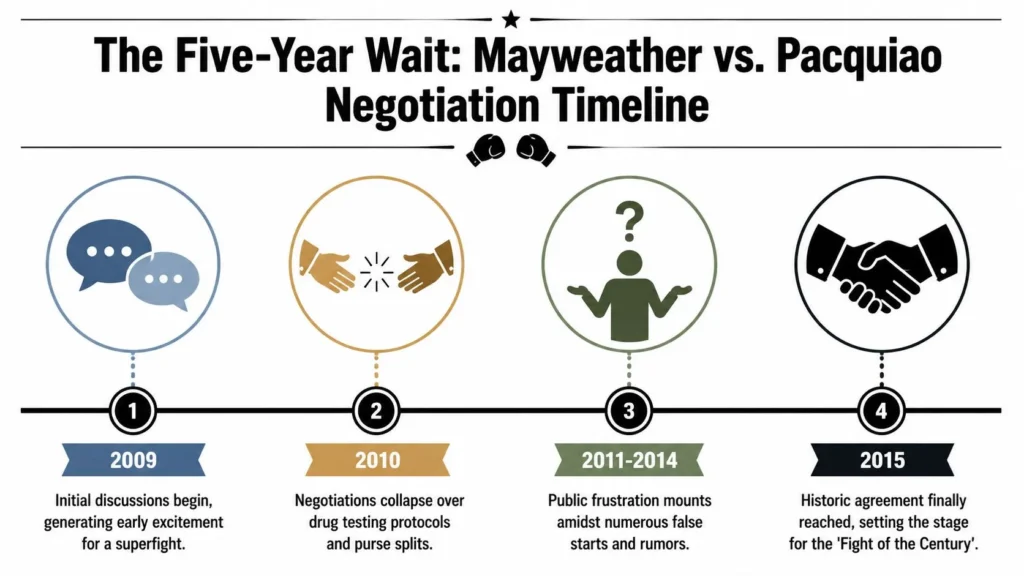
By the time the contracts were signed, the business story had become almost as important as the boxing. Years of failed talks had turned Mayweather vs. Pacquiao from a matchup into a referendum on an era, and that shift helps explain why the event later felt so profitable and so unsatisfying to so many viewers.
For long stretches, the fight existed as rumor, accusation, and negotiating theater. Drug-testing disputes dominated one phase. Revenue splits and control of the promotion shaped another. HBO and Showtime, usually competitors, had to find a way to share a single event. Every delay added one more layer of intrigue, but it also moved the bout further away from the version fans had first imagined.
Why the delay mattered
Time changed the fight before the opening bell ever rang.
In the late 2000s, Pacquiao was still operating at a pace that could overwhelm elite opponents in extended exchanges. Mayweather, even then, preferred control over volume, but age tends to sharpen that instinct rather than soften it. As the bout drifted into 2015, the likely range of outcomes narrowed. The older the fighters got, the less likely they were to produce the sustained chaos that had fueled the public fantasy.
The negotiation itself also altered how fans judged the eventual result. This was no longer just champion against champion. It was promoter against promoter, network against network, fan base against fan base. A normal superfight can survive a tactical chess match. One sold as the final answer to years of argument usually cannot.
Several forces kept the bout stalled:
- Testing disputes: Arguments over blood testing and competitive fairness became public and personal.
- Promotional conflict: Top Rank and Mayweather Promotions had different incentives, different timelines, and different pressure points.
- Broadcast rivalry: HBO and Showtime had to cooperate on a scale boxing rarely asks of competing networks.
- Strategic patience: Both sides believed waiting could improve their bargaining position.
Delay increased the business upside and narrowed the sporting upside
That is the tradeoff at the center of this fight.
The longer Mayweather and Pacquiao remained apart, the more the event grew as a commercial object. The ring, though, rarely rewards mythology. It rewards timing, health, and tactical fit. By 2015, fans were still buying the memory of what each man had once looked like in his most explosive moments, while the actual contest was far more likely to be shaped by caution, distance control, and selective exchanges.
That gap matters. It explains why the mayweather pacquiao fight could set financial records and still leave a large part of the audience cold. The event promised release after years of buildup. The styles, at that stage of their careers, pointed toward restraint.
The earnings reflected how massive the promotion had become. Public reporting at the time described it as the richest fight in boxing history, with total revenue exceeding $600 million and a purse structure that heavily favored Mayweather, as reported by Forbes. Those figures help measure the scale of demand. They also underline the central irony. The market paid for an eruption. The matchup was drifting toward control.
The long delay created pressure that no tactical performance could fully satisfy. Fans wanted a winner, but they also wanted confirmation that the years of argument had been worth it. Once the fight finally arrived, Mayweather only had to win on the scorecards. The audience expected something much harder to deliver. They wanted closure and spectacle in the same night.
When the announcement finally came, it landed like international news because the fight had outgrown sports-page framing. That transformation made the event feel historic before a punch was thrown. It also guaranteed that a disciplined, strategically conservative bout would be judged against a much louder script than the fighters were ever likely to follow.
Inside the Ropes A Round-by-Round Recap
The opening rounds carried the tension of a crowd waiting for confirmation. Was Pacquiao’s speed still enough to crack Mayweather’s timing? Could Mayweather keep the center of the fight where he preferred it, at a distance where exchanges began and ended on his terms? The first answer came quickly. Mayweather looked calm. Pacquiao looked urgent.
Early rounds
Mayweather spent the opening stretch establishing tempo rather than chasing damage. He worked behind the jab, shifted his feet to his right, and kept Pacquiao from setting the southpaw attacks that usually arrived in waves. Pacquiao had moments where his feet and hands suggested danger, but danger and scoring aren’t the same thing against Mayweather.
The visual pattern became clear early. Pacquiao would advance, Mayweather would subtly change the line, and the exchange would end with Mayweather either touching him first or making him miss enough to blunt the moment. To a ringside judge, that matters. To a paying crowd waiting for sustained combat, it can feel like interruption.
The middle stretch
Pacquiao’s best passages came when he pressed with conviction and forced the pace briefly upward. Those were the moments that kept hope alive in the arena. When he managed to close distance, the fight hinted at the version people had imagined for years.
But Mayweather’s response was immediate. He rarely gave the same look twice in succession. He’d meet a forward burst with a lead hand block, step out, then answer with a straight right or a jab that reset the picture. Pacquiao wasn’t being dominated by raw aggression. He was being denied continuity.
A useful way to understand the middle rounds is to see them as a series of nearly successful Pacquiao advances. Nearly successful isn’t enough against a fighter who treats each round like an accounting exercise. Mayweather kept producing cleaner, clearer moments, which is why the fight felt close in atmosphere to some viewers but not especially close on the scorecards.
Pacquiao generated tension. Mayweather generated conclusions.
How the pace kept slipping away
As the fight wore on, Pacquiao had to work harder to create the same opportunities. That fatigue wasn’t only physical. It came from repeatedly having to restart offense after Mayweather interrupted the first phase of an attack.
Three things stood out in live terms:
- Pacquiao’s surges were short. He could threaten a round without fully seizing it.
- Mayweather’s counters looked simple. Their simplicity made them easier for judges to reward.
- The crowd reacted to effort. Judges tend to react to effectiveness.
That’s one of the central reasons the mayweather pacquiao fight produced such divided immediate reactions. From the seats and from television, Pacquiao’s forward movement looked like ambition. From a scoring standpoint, Mayweather’s economy looked like control.
Late rounds
The championship rounds settled into a familiar shape. Pacquiao still searched, but the fight no longer looked discoverable. Mayweather had mapped it. He knew where the exits were, when to tie up the action, when to put a jab into Pacquiao’s face, and when to let a right hand punctuate a sequence.
In those late moments, the emotional center of the bout shifted. The question was no longer whether Pacquiao could break through consistently. It was whether he had enough dramatic moments left to alter perception. He didn’t.
Mayweather’s confidence grew as the finish approached. He wasn’t reckless. He never needed to be. His late-round composure said something important about the fight’s true balance. He didn’t look like a boxer surviving a dangerous puzzle. He looked like a boxer who had already solved it.
What viewers remember, and what actually happened
Many fans remember the bout as oddly uneventful. That memory is fair, but it needs a second thought. The fight lacked the sustained exchanges the public wanted because one man kept killing them before they could form. The uneventfulness wasn’t empty space. It was manufactured by superior command.
That distinction matters. A dull fight can come from timidity. This one came from tactical authority.
By the final bell, the arena had seen what it had paid for in one sense and not at all in another. It had seen greatness. It just hadn’t seen the kind of greatness that makes people leap off couches and forget the clock.
The Masterclass A Tactical Breakdown
Mayweather didn’t beat Pacquiao by being busier. He beat him by deciding where the fight existed. That’s a deeper form of control than punch output alone, and it’s the core reason the mayweather pacquiao fight felt so frustrating to viewers who expected long exchanges.
Range was the real battleground
Mayweather’s strategy centered on superior range control, keeping himself consistently outside Pacquiao’s most effective striking distance and forcing inefficient combinations, as described in this technical video analysis of the fight’s range battle and positional control. That sounds abstract until you watch what it did in practice. Pacquiao’s offense depends on entering range with momentum, drawing reactions, and then exploiting the disorder that follows. Mayweather prevented the disorder.
He did it with small choices that changed everything:
- Foot placement to the right: This blunted the line for Pacquiao’s left hand from the southpaw stance.
- Lead hand management: Mayweather used his lead side to disrupt vision and timing before exchanges fully formed.
- Layered defense: He didn’t rely on a single move. He blocked, leaned, feinted, and answered.
The result was a fight in which Pacquiao often looked as if he was beginning attacks from slightly too far away. That small gap is everything at elite level. It turns combinations into reaches and pressure into pursuit.
Why the defense felt like offense
Mayweather’s defensive architecture had a second effect. It created immediate counter chances. A lead hand block wasn’t only a shield. It was a trigger. Once Pacquiao’s attack touched the guard or fell short, Mayweather’s rear hand was already in position to answer.
That’s why spectators sometimes misread his style. They see a boxer avoiding action when he’s arranging it. He wasn’t running from exchanges. He was editing them.
Good defense doesn’t just reduce damage. It decides which punches count and which moments judges remember.
Later in the fight, that pattern became educational. Pacquiao’s famous bursts didn’t disappear because he stopped trying. They disappeared because the first and second beats of the sequence kept being interrupted. A flurry only looks dangerous when the opponent remains where the flurry expects him to be.
A helpful visual reference sits below.
The hidden reason fans felt shortchanged
The tactical brilliance created a viewing problem. Casual audiences tend to value visible escalation. They want momentum to build. Mayweather specializes in preventing build. He turns dramatic situations into manageable ones.
That’s why the fight’s commercial success and public disappointment were linked, not separate. The exact qualities that made Mayweather a safe bet in the ring made him a risky proposition for a crowd expecting spectacle. When the opponent was Pacquiao, a fighter associated with violence through angles and combinations, the contrast felt even sharper.
This is the larger lesson from the bout. Fans weren’t wrong to expect drama. They were wrong about the kind of fighter Mayweather becomes when the pressure is greatest. He becomes even more disciplined, not more adventurous.
The Fight by the Numbers Punch Stats and Paydays
The numbers strip away sentiment. They don’t capture atmosphere, but they do clarify control. In the mayweather pacquiao fight, the statistical record matched the visual truth of the night. Mayweather was not only more composed. He was more effective.
The punch statistics
According to ESPN’s report on the CompuBox totals from the fight, Mayweather landed 148 of 435 punches for 34 percent accuracy, while Pacquiao landed 81 of 429 for 19 percent accuracy. ESPN also noted that Mayweather’s 81 landed power punches nearly equaled Pacquiao’s total landed punches for the entire fight.
That tells the story better than almost any highlight package. Pacquiao threw almost as much as Mayweather but got far less for the effort. Volume without connection doesn’t win elite fights. Precision does.
| Statistic | Floyd Mayweather | Manny Pacquiao |
|---|---|---|
| Total punches landed | 148 | 81 |
| Total punches thrown | 435 | 429 |
| Accuracy | 34% | 19% |
| Power punches landed | 81 | Nearly matched by Mayweather’s total in that category |
| Overall effect | Cleaner, more efficient offense | Lower output success |
What the stats reveal that viewers missed
Some fans experienced the bout as closer than the numbers indicate because Pacquiao was the aggressor for stretches. Aggression can shape memory. Accuracy shapes scorecards.
A few details sharpen the point:
- Mayweather’s efficiency: He landed far more while throwing fewer punches.
- Pacquiao’s offensive disruption: His usual rhythm never settled into sustained production.
- Power shot gap: Mayweather’s power punching was productive enough to define exchanges even without constant pressure.
For readers interested in the economics behind combat sports mega-events, this split between action and earnings echoes wider patterns in fight business, much like the financial questions raised in this look at what Dana White paid to buy UFC. A spectacle can dominate commercially even when the in-ring product divides opinion.
The paydays
The financial side is the other half of the fight’s legacy. Mayweather and Pacquiao delivered a historic event as a business proposition even if the action didn’t satisfy everyone emotionally. The bout’s enormous revenue and purses turned it into a benchmark for modern combat sports promotion.
The key point isn’t just that the fight made a lot of money. It’s that the event proved boxing can package anticipation itself as a premium product. Fans weren’t paying only for punches landed. They were paying for closure, scale, and the privilege of witnessing a debate become official.
The Verdict and The Controversy
Officially, the result left little room for confusion. Wikipedia’s summary of the judges’ cards and fight scoring shows scores of 118-110, 116-112, and 116-112 for Mayweather. That spread reflected broad agreement, not a split interpretation of a razor-thin bout.
Why the cards were decisive
The scores make sense once you accept what judges reward. They don’t score anticipation. They score clean punching, effective aggression, defense, and ring generalship. Mayweather checked more boxes more often.
The same summary notes that Pacquiao landed double-figure punch totals in only three of the twelve rounds, which speaks to how thoroughly Mayweather disrupted his rhythm. That matters because rhythm is often how Pacquiao wins rounds. Without sustained combinations, he had to rely on isolated bursts.
The shoulder issue and the reaction
After the fight, debate intensified around Pacquiao’s shoulder condition. For disappointed viewers, that became an immediate alternate explanation for the performance. For Mayweather supporters, it sounded like an excuse after a clear defeat.
Both reactions are easy to understand. Fans who had waited years wanted a reason the fight failed to ignite. A physical limitation offered one. But even if you grant that Pacquiao wasn’t at his best, the official verdict still rests on what happened in the ring that night. Judges don’t score hypothetical versions of a fighter.
The controversy survived because it served an emotional need. It gave disappointed fans a way to separate the event they bought from the fight they got.
There’s also a more uncomfortable truth. The injury discussion became so central because many people struggled to accept that the tactical answer was simpler than the dramatic one. Mayweather prevented Pacquiao from fighting his fight. That explanation isn’t as satisfying as a hidden impediment, but it aligns with the visible pattern of the bout.
Why disappointment lingered
Public disappointment wasn’t mainly about the score. It was about expectation. Had this same fight happened without half a decade of buildup, fans might have called it a disciplined, one-sided championship performance. Instead, they judged it against mythology.
That’s why the mayweather pacquiao fight remains controversial even though the official verdict itself is not. The dispute isn’t over who won. It’s over whether the night delivered what history had promised.
The Legacy of the Superfight
The mayweather pacquiao fight didn’t save boxing, and it didn’t ruin boxing. It exposed boxing. It showed how the sport can sell suspense at a scale few others can match, while also reminding everyone that the ring answers only to style, timing, and control.
What it did for Mayweather
For Mayweather, the bout strengthened a legacy that was always likely to divide observers. He left with the official win and with his undefeated image reinforced. Yet the same performance that confirmed his greatness also reminded critics why they found him hard to love. He could dominate a historic stage without giving the crowd the emotional release it wanted.
That’s a rare kind of sporting power. He made command look colder than conquest.
What it meant for Pacquiao
For Pacquiao, the loss didn’t erase what made him special. It did, however, alter the unresolved fantasy around him. Before this fight, many supporters could imagine him as the one great chaos agent capable of overwhelming any system. After it, that possibility became historical fiction.
He remained beloved because he had always represented action, daring, and vulnerability in a way Mayweather never did. Fans often forgive a losing fighter when they recognize his ambition.
The blueprint it left behind
The event’s deepest legacy may be commercial. It became a model for the modern mega-event, where the negotiation, announcement, and cultural conversation grow almost as important as the contest itself. Boxing had always understood hype. This fight industrialized it.
That’s one reason it still holds attention years later. It wasn’t only a championship bout. It was a referendum on patience, branding, and what audiences think they’re buying when they purchase access to history. Readers who enjoy stories about iconic sports relationships and legacies may find a similar sense of enduring public fascination in this look at Andre Agassi and Steffi Graf.
In the end, the mayweather pacquiao fight stands as a rare event where the financial record and the emotional review moved in opposite directions. It was a masterpiece of promotion and a clinic in control. It was also a reminder that the loudest fight in the world can end with one boxer making almost no noise at all.
If you enjoy sharp, approachable writing on sports, culture, business, and more, explore maxijournal.com for fresh commentary and new stories published across a wide range of topics.
Discover more from Maxi Journal
Subscribe to get the latest posts sent to your email.