You’ve poured your heart into a manuscript—or you have that one brilliant idea that just won’t let you go. Now comes the big question: what’s the next step? Getting a book into the hands of readers isn’t a one-size-fits-all journey.
The path you choose will define your entire experience as an author. In 2026, there are three main routes you can take: the well-trodden road of traditional publishing, the entrepreneurial world of self-publishing, or the balanced middle ground of hybrid publishing.
Let’s clear the air: there’s no single “best” option. The right choice for you hinges on your personal goals, your book’s specific niche, and just how much control you want to have over your career. It’s all about finding the perfect fit.
The Three Main Publishing Routes
Each path comes with its own set of trade-offs, timelines, and opportunities. Understanding them is the first real business decision you’ll make as an author.
Traditional Publishing is what most people picture when they think of getting published. The process usually involves finding a literary agent who then pitches your manuscript to major publishing houses like Penguin Random House or HarperCollins. If they acquire your book, they’ll cover the costs of editing, cover design, printing, distribution, and marketing. You typically get a cash advance and then earn royalties on sales, but you’ll have less say in creative decisions and earn a smaller slice of the revenue.
Self-Publishing puts you in complete control. As an indie author, you act as your own publisher, managing everything from hiring editors and designers to marketing and distribution through platforms like Amazon KDP or IngramSpark. This route offers total creative freedom and much higher royalty rates, but it also means you fund the entire project yourself. It’s a path for the true “author-entrepreneur.”
The biggest change in the industry is seeing the author as a business owner. Self-publishing isn’t a fallback anymore; it’s a strategic choice to own your intellectual property, control your launch schedule, and maximize your long-term earning potential.
Hybrid Publishing sits between these two worlds. A hybrid publisher operates like a partner. You invest in the cost of production, but in return, you get their professional expertise and access to their distribution network. The key difference from a “vanity press” is that hybrid publishers are selective and have a curated list. This model often lets you keep higher royalties than a traditional deal while getting professional support.
This comparison table breaks down the core differences to help you see which path aligns with your priorities.
Publishing Paths at a Glance
| Factor | Traditional Publishing | Self-Publishing | Hybrid Publishing |
|---|---|---|---|
| Upfront Cost | None. Publisher pays you an advance. | You pay for all services (editing, design, etc.). | You pay a fee to the publisher for services. |
| Creative Control | Low. Publisher has final say on title, cover, and edits. | High. You have complete control over all aspects. | Medium. It’s a partnership, with shared decisions. |
| Time to Market | Slow. Often 18–24 months after signing a contract. | Fast. You can publish as soon as the book is ready. | Moderate. Faster than traditional, slower than DIY. |
| Royalty Rate | Low. Typically 5-15% of net receipts. | High. Usually 40-70% of the list price. | Medium. Higher than traditional, lower than self-publishing. |
| Distribution | Wide. Access to major bookstores and retailers. | Wide, but requires you to manage platforms (KDP, IngramSpark). | Varies by publisher, but often includes bookstore access. |
| Validation | High. Vetted by agents and editors at a major house. | Depends on sales, reviews, and awards. You build it yourself. | Medium. Vetted by the hybrid publisher’s editorial team. |
Ultimately, weighing these factors against your own goals will illuminate the best path forward for your book.
To give you a better visual, this decision tree can help you walk through the key questions.
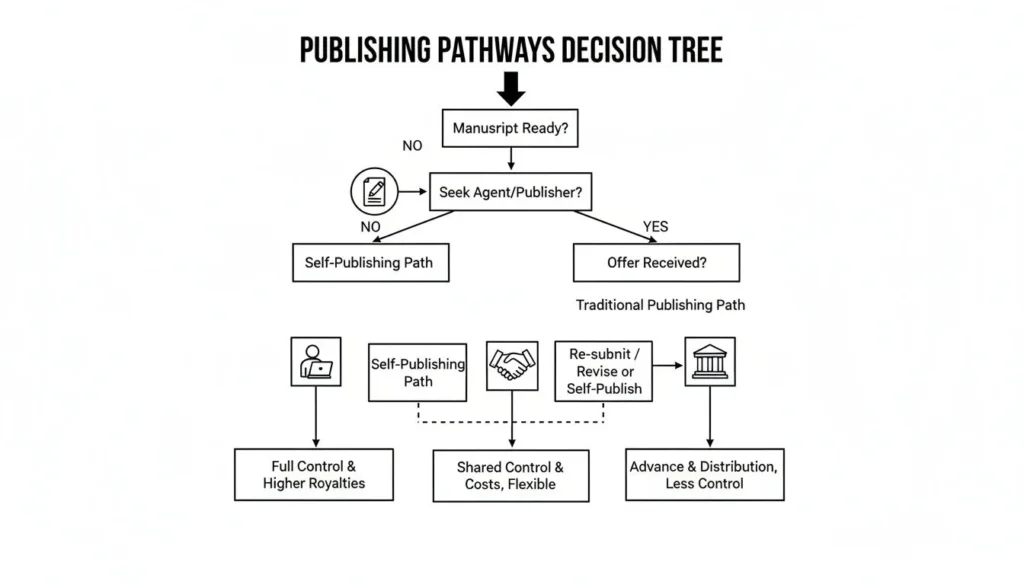
This chart shows how things like your budget, desire for creative freedom, and how quickly you want to publish can point you toward the right model. No matter which route you take, building an audience is crucial, and our guide on how to start a blog is a great place to begin that process.
Finishing that first draft is a massive milestone. But as any seasoned writer will tell you, that’s the starting line, not the finish. The real craft of becoming a published author happens in the revision trenches.
This is where you transform raw clay into a sculpture. It’s not about just fixing typos; it’s about deliberately shaping your story, deepening your characters, and making every sentence pull its weight. This is what separates a finished draft from a manuscript that’s ready to sell.
The Self-Editing Mindset
Before you even think about showing your work to someone else, you have to become its first and toughest editor. This initial pass is all about the big picture—the architectural blueprint of your book.
First, put the manuscript away. Seriously. Stick it in a drawer for at least two weeks, though a month is even better. This time away gives you the critical distance you need to see the story with fresh eyes, warts and all.
When you come back to it, you’re hunting for major structural issues:
- Pacing and Structure: Does the story sag in the middle? Do certain scenes feel rushed or out of place? Where does the momentum die?
- Plot and Subplots: Are there any glaring plot holes or story threads you forgot to tie up? Does every subplot serve the main narrative and resolve in a satisfying way?
- Character Arcs: Do your protagonists actually change or grow? Is their journey believable and compelling from start to finish?
- Point of View (POV): Is your POV consistent? More importantly, is it the most effective POV for the story you’re telling?
At this stage, ignore the temptation to tinker with individual sentences. You’re looking for the foundational cracks. Be ruthless. If a character, a scene, or even a whole chapter doesn’t serve the core story, it needs to go.
Sourcing and Managing Feedback
Once you’ve done your own heavy lifting, it’s time for a reality check from outside eyes. Getting feedback from beta readers is an absolutely essential step, but you have to manage the process to make it productive.
Choose your readers carefully. Your mom or your best friend might be great for moral support, but you need people who actively read in your genre and aren’t afraid to give you honest, constructive criticism.
Don’t just ask them, “So… did you like it?” That question is useless. Give them specific things to look for:
- Tell me exactly where you got bored or felt the urge to skim.
- Was the protagonist’s motivation clear and believable to you?
- Did the ending feel earned? Why or why not?
This kind of targeted questioning gives you actionable notes you can actually use. Remember, you don’t have to take every piece of advice. Your job is to spot the patterns in the feedback and use those insights to make your manuscript stronger without sacrificing your voice.
A book is never truly finished. I still think about my 5 books and what I would do to improve them. The key is to know when it’s strong enough to move forward, and honest beta readers are essential for reaching that point.
The Role of a Professional Editor
While self-editing and beta feedback are crucial, a professional editor provides a level of expertise that can be the difference between a rejection pile and a contract offer. They are the secret weapon of the publishing world, trained to spot the subtle issues that writers and even dedicated readers often miss.
There are different types of editing, and knowing which one you need is key:
| Type of Editing | Primary Focus | When to Use It |
|---|---|---|
| Developmental Edit | Big-picture elements: plot, character arcs, structure, and pacing. | After your major self-edits, when you need an expert opinion on the core story. |
| Line Edit | Sentence flow, word choice, tone, and the overall rhythm of your prose. | When the story structure is solid, but the writing itself needs to be polished until it shines. |
| Copyedit | Grammar, spelling, punctuation, and catching inconsistencies (e.g., character’s eye color changing). | The final cleanup phase, right before formatting. This is about technical perfection. |
Hiring an editor is a serious investment. But it’s often the single most important one you can make, whether you’re hoping to catch an agent’s eye or stand out in a crowded self-publishing market. If you’re stuck in the creative mud before you even get to this point, our guide on how to overcome writer’s block might help you push through. Every book presents its own challenges, but navigating them is what the journey to becoming a published author is all about.
Mastering the Traditional Publishing Gauntlet

When you picture being a published author, do you see your book on a shelf at Barnes & Noble? If so, you’re dreaming of traditional publishing. This is the classic path, the one that comes with professional validation from gatekeepers and the undeniable thrill of landing a real book deal. It’s a tough road, no doubt, and it can feel like a labyrinth when you’re just starting out.
The first, and most critical, hurdle is getting a literary agent. Think of an agent as your business partner and your champion in the industry. They’re the ones who will get your manuscript past the “no unsolicited submissions” barrier and onto the desks of editors at major publishing houses. Without one, you’re essentially locked out.
But finding an agent isn’t a numbers game. Sending your manuscript to every agent you can find is a fast track to a full inbox of rejections. The real work is in the hunt—finding the right agent who is actively looking for a book just like yours.
Finding and Vetting Literary Agents
Your agent search should start with focused, strategic research. Don’t just Google “literary agents.” You need to dig into the resources the pros use to see who’s selling what, right now.
- Publisher’s Marketplace: This is the bible of the publishing industry. A subscription lets you see real-time deal announcements, so you can find agents who are selling books in your genre to editors you’d love to work with.
- QueryTracker: An absolute lifesaver for organizing your submissions. It’s also a massive, searchable database of agents, their submission guidelines, and what they’re looking for.
- Manuscript Wish List (#MSWL): Keep an eye on this hashtag on social media. Agents will post exactly what they’re dying to see in their inbox, giving you a perfect opening to query them.
As you build your list, it’s time to vet each agent. Go to their website and look at their client list. Do you recognize the authors? More importantly, do their books feel like they belong on the same shelf as yours? An agent with a stellar record selling hard sci-fi probably isn’t the right person to champion your cozy mystery, no matter how successful they are.
Crafting a Query Letter That Gets a Yes
Your query letter is everything. It’s your first impression, your sales pitch, and your audition all rolled into one. Its only job is to be so compelling that it makes a busy agent stop scrolling through hundreds of emails and request your manuscript.
A winning query letter breaks down into three essential parts:
- The Hook: Start with a one- or two-sentence pitch that immediately establishes the character, the conflict, and the stakes. Make it irresistible.
- The Mini-Synopsis: In a short paragraph (around 200-250 words), walk the agent through the core plot. Introduce your protagonist, their goal, the primary obstacle, and what will happen if they fail. Don’t give away the ending, but give them enough to be intrigued.
- The Bio: A brief section about you. Include any relevant writing credits, explain why you’re the right person to tell this story, and state the manuscript’s vitals: title, genre, and word count.
Pro Tip: Always, always personalize your query. Mention a book they represent that you loved, or reference a specific #MSWL tweet. It shows you’ve done your homework and aren’t just spamming the industry. That tiny bit of effort can make all the difference.
Navigating Rejections and Offers
Get ready for an emotional ride. Rejection is a fundamental part of this process; I don’t know a single traditionally published author who wasn’t rejected dozens, if not hundreds, of times. The secret is to reframe it. A rejection is a business decision, not a judgment on your talent. The agent might have a similar book, or the market might be soft for your genre. It’s usually not personal.
When an agent loves your manuscript, they will offer representation. This is a massive milestone, so celebrate it! You’ll get on the phone with them to talk about their vision for your book and your career. It’s also completely professional to let any other agents who have your manuscript know you have an offer. This can often light a fire under them to read and respond quickly.
Once you sign, your agent takes over. They’ll polish your submission package and send it to a curated list of editors. If an editor makes an offer, your agent negotiates everything on your behalf—the advance (your upfront payment), royalty rates, and subsidiary rights like film or foreign translations. This is where having an expert in your corner becomes truly invaluable.
Taking Control With Self-Publishing and Hybrid Models

While the prestige of traditional publishing is undeniable, it comes at a cost: control. For authors who want to own their careers, dictate their timelines, and keep a much larger slice of the royalties, going indie is no longer a plan B. It’s a powerful business move.
This is the path of the author-entrepreneur.
It requires a total mindset shift. You’re not just the writer anymore; you’re the CEO of your own book. That means you’re in charge of everything from production and distribution to marketing. The freedom is incredible, but so is the responsibility.
The numbers don’t lie. A 2025 author survey revealed a massive industry pivot: 77% now identify as self-published, with another 17% choosing a hybrid route. That leaves just 5% as strictly traditional. This isn’t an accident—it’s a conscious move by authors to reclaim their rights and pricing power. You can see the complete data in these insights into self-publishing for authors.
The Self-Publishing Blueprint
Self-publishing puts you completely in control. You call all the shots, from the cover art to the price tag. The key to success, though, is producing a book that looks and feels every bit as professional as one from a major publishing house. This is not the place to cut corners.
Your first job is to build your production team. This is where you’ll invest your budget, and it’s the most important money you’ll spend.
- Professional Editing: This is absolutely non-negotiable. You’ll need a developmental editor to look at the big picture, a line editor to polish your prose, and a copyeditor to catch every last typo.
- Cover Design: People do judge a book by its cover. A professional designer who knows your genre is essential for getting readers to click “buy.”
- Interior Formatting: Nothing screams “amateur” like a poorly formatted ebook or a clunky print layout. Hire a professional to ensure a seamless reading experience.
With your book files finalized, it’s time for distribution. The two heavyweights you need to know are Amazon Kindle Direct Publishing (KDP) and IngramSpark.
| Platform | Best For | Key Feature |
|---|---|---|
| Amazon KDP | Tapping into Amazon’s massive customer base for both ebooks and print. | Simple to use, with ebook royalty rates up to 70%, plus direct access to Amazon’s marketing tools. |
| IngramSpark | Getting your print book into a wider network of bookstores, libraries, and online retailers. | Makes your book orderable by physical stores, opening the door to real-world shelf space. |
Most savvy indie authors use a combination of both. They publish directly on Amazon KDP for maximum Amazon revenue and use IngramSpark to reach everywhere else, creating a truly global sales footprint.
As an indie author, you are in a direct relationship with your readers. You control the timeline, allowing you to publish multiple books a year and build a loyal following much faster than the traditional 18-24 month cycle.
Understanding Hybrid Publishing
What if you want the high royalties and creative freedom of an indie author but still want the expert support of a publisher? That’s the gap hybrid publishing aims to fill. But you have to tread carefully.
A legitimate hybrid publisher acts like a partner. You pay a fee to cover the costs of production, and they provide professional editing, design, distribution, and marketing support. The key difference from traditional publishing is that you retain your rights.
You must learn to spot the difference between a real hybrid publisher and a vanity press.
- Hybrid Publishers Are Curated: They have standards. They review submissions and will reject manuscripts that aren’t a good fit or don’t meet their quality bar. They only make money if your book sells.
- Vanity Presses Publish Anyone: If you can write the check, they’ll print your book, no matter the quality. Their business is selling services to authors, not selling books for authors.
Before you even think about signing a hybrid deal, do your research. Talk to other authors they’ve published. Grill them on their distribution channels and ask for concrete examples of their marketing efforts. A reputable hybrid will be completely transparent. This path offers a compelling middle ground, blending the support of a publisher with the entrepreneurial spirit of an indie.
Building Your Author Platform to Sell More Books
Whether you sign with a major publisher or choose the indie route, there’s a hard truth every writer has to face: writing the book is only half the work. Publishers—whether that’s a big NYC house or you, yourself—need one thing: an audience to sell to.
This is where your author platform becomes critical.
Think of your author platform as your total reach—your visibility, your reputation, and the direct connection you have with potential readers. It’s not about vanity metrics or follower counts. It’s about building real trust and having a direct line to people who are genuinely excited for your book’s release.
The best part? You can start laying this groundwork today, long before your manuscript is even finished. Don’t think of it as a chore. See it as building the engine for your entire author career.
Your Digital Headquarters: An Author Website
Your author website is your professional home on the internet. It’s the one space you have complete ownership of, safe from the changing tides of social media algorithms. For any serious author, a clean, professional website is non-negotiable.
You don’t need anything fancy. Focus on these four essential pages:
- Home: This should be a clear, welcoming landing page that introduces you and immediately points visitors to your latest book (or the one you’re currently writing).
- About: Your story matters. A compelling bio helps readers connect with the person behind the words. For a truly great one, check out our guide on how to write an author bio.
- Books: Create a dedicated page for each book. Include a high-quality cover image, an enticing description, and obvious links to buy it.
- Contact: Make it simple for readers, media, or agents to get in touch.
A simple design that reflects your personal brand is always more effective than a cluttered site. Its job is to cement your professionalism and act as the central hub for everything you do.
The Most Powerful Tool: Your Email List
If your website is your home, your email list is your direct line to your most loyal readers. It is, by far, the most valuable marketing tool you will ever build. Social media platforms can vanish or change the rules overnight, but your email list belongs to you.
To get people to sign up, you need to offer them a small gift in return. This is often called a lead magnet. It just has to be something your ideal reader would actually want.
A few ideas to get you started:
- A free short story or a deleted chapter from your novel.
- A practical checklist or a resource guide related to your book’s topic (perfect for non-fiction).
- Exclusive access to behind-the-scenes content about your writing life.
The goal is to give someone an irresistible reason to hand over their email. Once they’ve subscribed, focus on building the relationship with valuable, interesting updates—not just a constant stream of “buy my book” emails.
Authentic Social Media and Strategic Visibility
Social media can feel like a massive time-sink, so be strategic, not exhaustive. You don’t need to be everywhere. Just pick one or two platforms where your target audience hangs out and actually engage with them. Are your readers on TikTok’s BookTok scene, scrolling Instagram, or active in niche Facebook groups? Go there.
The goal isn’t to shout “Buy my book!” into the void. It’s to have authentic conversations, share your passion for your genre, and build real connections. Let readers get to know the person behind the pages.
Beyond your own channels, strategic guest appearances can be a game-changer. The global book market is projected to hit $142.72 billion by 2025, yet poor marketing is why an estimated 80% of authors never gain traction. Guest posting is a powerful way to beat those odds. Contributing a piece to a respected journal, for example, can build your credibility long before your book is out. You can find more on these critical book sales statistics and author challenges.
This kind of outreach lets you “borrow” authority. When you appear on an established blog or podcast, you’re being introduced to an audience that already trusts the source. It’s one of the fastest ways to grow your own platform and make sure your book launch doesn’t happen in a silent room.
Frequently Asked Questions About Becoming an Author

Let’s be honest, the road to getting published is filled with questions. It’s easy to get lost in the ‘what-ifs’ and unknowns. We’ve been there. Here are some straightforward answers to the questions we hear most often from aspiring authors.
How Much Does It Cost to Publish a Book
The financial side of publishing is a tale of two very different paths. Knowing the costs (or lack thereof) upfront is critical for setting your expectations.
With traditional publishing, the direct cost to you is essentially zero. In fact, it’s the other way around—the publisher pays you an advance. Your real investment is time and a whole lot of it: time spent writing, revising, and finding an agent.
Self-publishing, on the other hand, means you’re the entrepreneur. You foot the bill for everything. A solid starting budget is anywhere from $2,000 to over $5,000, based on your book’s needs.
Your non-negotiable expenses will be:
- Professional Editing: This is the single most important place to spend your money. Expect to pay between $1,000 and $3,000 for a comprehensive edit of a full manuscript.
- Cover Design: A cheap cover screams amateur. A professional, genre-appropriate cover is vital and can run from $300 to $1,000.
- Formatting and Marketing: Don’t forget interior layout (around $200-$500) and setting aside a budget for your initial launch ads or promotions.
How Long Does It Take to Get Published
Patience is more than a virtue in publishing; it’s a requirement. The traditional route is a marathon, not a sprint, and can easily stretch out over several years.
Here’s a typical timeline for the traditional path:
- Querying Agents: Finding the right agent to represent you can take 6 months to 2+ years of sending out queries.
- On Submission: Once you sign with an agent, they’ll shop your book to editors. This part of the waiting game can take another 6-12 months.
- Production: After you land that book deal, it still takes about 18-24 months for editing, design, printing, and distribution before your book hits shelves.
When you self-publish, you’re in the driver’s seat. Once your manuscript is professionally edited and formatted, you can get your book live on platforms like Amazon KDP in just days. This speed and control is a huge draw for many authors.
Do I Need a Big Social Media Following
This is probably the number one source of anxiety for new writers, but the answer isn’t a simple yes or no. It really depends on what you’re writing.
If you’re writing non-fiction, a strong author platform is a huge asset. Publishers want to see you already have a built-in audience and are seen as an expert in your niche.
For fiction, it’s much less of a dealbreaker. What agents and editors truly care about is the story. A phenomenal manuscript from an author with 100 followers is infinitely more compelling than a so-so book from someone with 100,000. Your primary job is to write an unforgettable book.
At maxijournal.com, we’re all about giving writers a platform to shine, whether you’re just starting out or have been at this for years. If you want to get your work in front of an engaged audience and build your writing portfolio, explore our submission guidelines and see if we’re the right fit for you.
Discover more from Maxi Journal
Subscribe to get the latest posts sent to your email.