A business plan is so much more than a document you create once and forget about. It’s the blueprint that gives your vision structure, proves your value to others, and maps out exactly how you plan to win. Think of it less like a chore and more like your first big strategic victory.
Why Your Business Plan Is Your Ultimate Strategic Tool

Let’s get one thing straight: a business plan isn’t just a formal document collecting dust on a shelf or a hoop you jump through for a bank loan. A great business plan is a living, breathing strategic tool. It’s your compass in a crowded market, guiding your decisions and keeping your entire team aimed at the same target.
This guide is built around that exact idea—we’re creating a practical roadmap, not just filling out a template.
Get Your Vision Down on Paper
Let’s say you’re launching a new digital content platform focused on independent music. Without a plan, your ideas are probably all over the place. You want to feature artists, offer exclusive interviews, and maybe sell some merch. A business plan forces you to connect those dots into a coherent strategy.
Writing it all down makes your vision real. It pushes you to answer the tough questions before you spend a dime:
- Who is our real audience? (Die-hard indie fans? Aspiring artists? Both?)
- What makes our platform truly different from what’s already out there?
- How will we actually make money? (Subscriptions, ad revenue, or affiliate sales?)
This clarification process is the first—and arguably most important—benefit of creating your plan. It turns a fuzzy idea into a solid blueprint for what comes next.
Secure the Resources You Need to Grow
A solid plan is your ticket to getting the resources you need, whether that’s funding from investors, top-tier talent, or key partnerships. For investors, your business plan is the primary evidence that you’ve thought through every angle of your venture. It shows you understand your market, your finances, and your path to actually making money.
A business plan isn’t just a formality—it’s a prerequisite for serious conversations. It demonstrates you’ve done the homework and respect an investor’s time and money.
The numbers don’t lie. Nearly 70% of venture capitalists say they won’t even consider investing in a startup that doesn’t have a formal business plan. Showing up without one pretty much signals you’re not ready for the big leagues. You can dive deeper into this and other investor expectations over at Upmetrics.
Your business plan needs to speak the right language for your audience. The story you tell a VC is different from the one you tell a loan officer.
Tailoring Your Business Plan for Different Audiences
| Audience | Primary Focus | Key Questions They Ask |
|---|---|---|
| Investors (VCs, Angels) | Scalability & High ROI. They want to see a massive market opportunity and a clear path to a 10x or more return. | “How big is the market?” “What’s your unfair advantage?” “What’s the exit strategy?” |
| Lenders (Banks) | Risk Mitigation & Cash Flow. They care about your ability to repay the loan, so they focus on financial stability. | “Can you make the monthly payments?” “What collateral do you have?” “How realistic are your financial projections?” |
| Internal Team | Alignment & Execution. The plan is a roadmap to keep everyone on the same page and moving in the same direction. | “What are our Q3 goals?” “Who is our target customer?” “What’s my role in making this happen?” |
A well-crafted plan is adaptable. You’re not rewriting it from scratch for each audience, but you are adjusting the emphasis to highlight what matters most to them. This shows you understand their priorities and increases your chances of success.
Writing an Executive Summary That Demands Attention
Think of your executive summary as the movie trailer for your business. It’s the very first thing an investor or lender will read, and you’ve got maybe a minute—tops—to convince them the rest of the plan is worth their time. It has to be sharp, persuasive, and strong enough to make them lean in.
This isn’t the place to dump every single detail. Your job is to tell a powerful, high-level story that hits all the right notes. It needs to stand on its own, giving a complete snapshot of your venture that gets the reader excited from the very first sentence.
The Four Pillars of a Powerful Summary
I’ve seen hundreds of executive summaries over the years, and the great ones always nail four key elements. Get these right, and you’ll have a summary that not only grabs attention but also builds immediate credibility.
Your summary must quickly and clearly answer these four questions:
- The Problem: What real-world pain point or unmet need are you addressing?
- Your Solution: How, exactly, does your business solve this problem in a unique way?
- The Opportunity: Who is your customer, and just how big is this market?
- The Financials: What are your key financial goals, and how much funding do you need to get there?
Structuring your story this way creates a logical flow that’s easy to follow and hard to forget. It’s a lot like writing a knockout cover letter; you have to prove your value right away. For more on that, check out our guide on how to write a cover letter that actually works.
An Example in Action
Let’s bring this to life. Imagine a startup called “ConnectSphere,” which is building a private social network for apartment communities. A weak summary would just say, “ConnectSphere is a social app for neighbors.” That’s true, but it’s flat and uninspiring.
Now, let’s build a much stronger narrative using our four pillars.
The Problem: Urban loneliness is a growing crisis. Over 60% of apartment dwellers say they feel disconnected from their neighbors. For property managers, this translates directly to low resident retention, costing them thousands each year in turnover.
Our Solution: ConnectSphere is a private social platform designed for apartment buildings that turns anonymous hallways into vibrant communities. With features like a shared tool library, building-specific event calendars, and a marketplace for trusted local services, we help residents build real connections.
The Opportunity: Our initial focus is on mid-to-high-rise residential buildings in major U.S. cities, a market we’ve calculated as a $500 million Serviceable Obtainable Market (SOM). We’ll partner with property management firms who desperately need a modern tool for resident retention.
The Financials: We’re projecting profitability in Year 3 with $5 million in annual recurring revenue. To make this happen, we are seeking $750,000 in seed funding to expand our engineering team and launch in three new metropolitan areas.
See the difference? This version tells a complete story. It starts with a relatable problem, offers a smart solution, quantifies the market opportunity, and states a clear financial ask. This is how you write an executive summary that doesn’t just get skimmed—it gets meetings.
Conducting Market Analysis That Uncovers Real Opportunity
A powerful market analysis does more than just fill a section of your business plan; it proves you’ve found a profitable corner of the world that you can realistically win. This is where you move beyond broad industry stats and show a deep, nuanced understanding of the specific environment where your business will live or die.
Anyone can find a report saying an industry is growing. That’s easy. Your job is to prove that your business can actually capture a piece of that growth. This means getting specific and defending your numbers with credible research. It shows investors you aren’t just dreaming—you’ve done the hard work.
The best strategies flow from a clear understanding of the problem you’re solving, your unique solution, and the market that needs it.
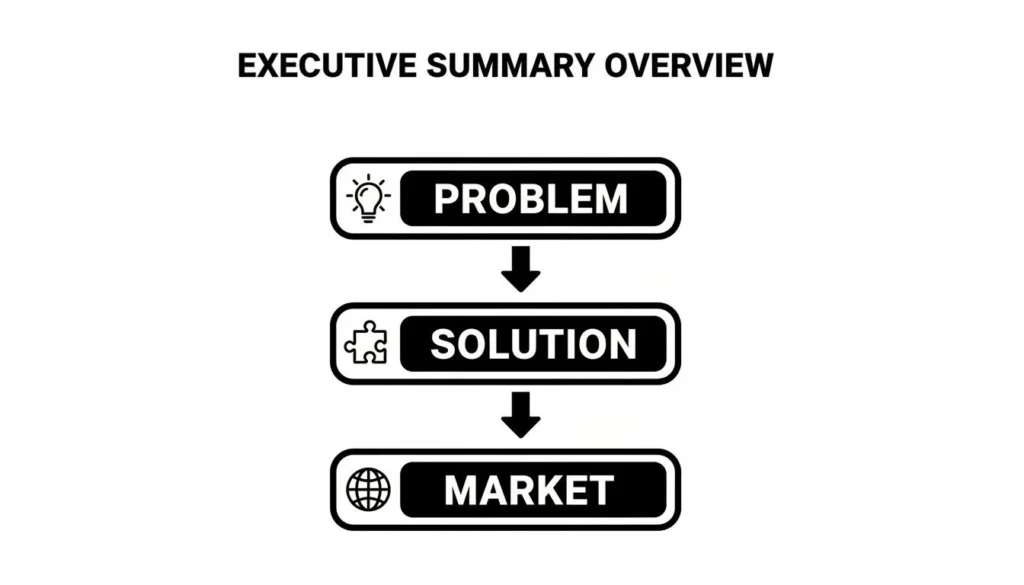
This simple hierarchy is key: a viable market only exists if you have a compelling solution for a real problem.
Defining Your Market Size
To build a convincing case, you need to break down the market into three distinct layers. This approach—TAM, SAM, and SOM—is the industry standard for a reason. It maps out a realistic path from the total potential to what you can actually achieve.
- Total Addressable Market (TAM): Think of this as the total global demand for a product or service. For a new coffee shop, the TAM would be the total amount spent on coffee worldwide. It’s a huge, mostly theoretical number, but it sets the big-picture context.
- Serviceable Available Market (SAM): This is the portion of the TAM you can realistically reach with your business model and sales channels. Our coffee shop’s SAM might be the total amount spent on coffee within its specific city.
- Serviceable Obtainable Market (SOM): Here’s where it gets real. This is the slice of the SAM you can capture in the near future, factoring in your competition, budget, and team. For the coffee shop, this could be 5-10% of coffee drinkers within a five-block radius.
Investors zero in on your SOM. It’s the most credible indicator of your short-to-medium-term revenue potential. A well-defended SOM shows you’re grounded in reality, not just big-picture fantasy.
Your business plan must clearly define each of these and explain the data you used to get there. Sources might include census data, industry reports, or local business associations.
Analyzing Your Competitors Strategically
A competitive analysis isn’t just a list of other businesses in your space. It’s a strategic deep-dive into their strengths and, more importantly, their weaknesses. You’re hunting for the gaps they’ve left open—gaps your business is perfectly designed to fill.
Don’t just name your competitors. For each one, you need to ask:
- What’s their pricing strategy? Are they a premium, budget, or mid-tier option?
- How do they market themselves? What channels do they use? What’s their core message?
- What do their customers say? Scour online reviews (Google, Yelp, social media) for recurring complaints or praises. A common complaint is a golden opportunity.
For example, let’s say you’re launching a new project management tool. You find that customers of the leading competitor constantly complain about its clunky user interface. Boom. Your key selling point becomes “the project management tool that’s actually easy to use.” Effective marketing is everything here. You can learn more about targeting these exact pain points by checking out these digital marketing tips for small business.
Building Detailed Customer Personas
Finally, you need to bring your target audience to life. Generic descriptions like “millennials” or “small businesses” are useless. Instead, you need to build detailed customer personas—fictional profiles that represent your ideal buyers.
A solid persona goes much deeper than just demographics.
- Goals: What are they trying to achieve in their life or work?
- Pain Points: What frustrations or challenges do they face that your product solves?
- Motivations: What drives their purchasing decisions? Is it price, quality, convenience, or status?
- Watering Holes: Where do they spend their time online? Think specific blogs, forums, or social media groups.
Creating 2-3 detailed personas ensures that every part of your business—from marketing to product development—is laser-focused on the people you actually want to reach. It makes your entire strategy more coherent and, ultimately, much more effective.
Detailing Your Operations and Management Team
An idea is only as strong as the team executing it, and an operational plan is the playbook that team will follow. This part of your business plan is where you prove you have both the people and the processes to turn your vision into a profitable reality.
Investors often say they back people first and ideas second. This is your chance to show them they’re betting on the right team. It’s about demonstrating not just who is on your team, but how you will all work together to build, sell, and deliver your product or service.
Showcasing Your Management and Leadership
It’s time to introduce the key players. This isn’t just a list of names and titles; it’s a story about proven expertise. For each core member of your leadership team, you need to write a short, impactful bio.
Focus on their most relevant accomplishments. Did your CFO guide two previous startups to successful exits? That’s a massive credibility boost. Did your head of marketing grow a user base by 300% in their last role? Highlight that specific metric.
The goal is to draw a straight line from each person’s unique experience to the challenges your business will face. An organizational chart can be a great visual tool here, clearly showing who reports to whom and outlining the core areas of responsibility.
For each key team member, make sure to cover:
- Role and Responsibilities: What is their exact function in the company?
- Relevant Experience: What past wins prove they can excel in this role?
- Unique Contributions: What specific skills or network are they bringing to the table?
This section is all about building trust. You’re telling the reader that you’ve brought together a team with the right mix of skills to navigate the journey ahead.
Mapping Your Day-to-Day Operations
After establishing who will run the business, you need to explain how it will run. The operations plan gets into the nitty-gritty of your business model, detailing the daily workflows required to create and deliver your product or service.
Think through your entire value chain. For a physical product, this means detailing your supply chain, manufacturing process, inventory management, and distribution logistics. Where do you get your materials? How do you assemble the final product?
For a software or service business, you’ll outline your development lifecycle, technology stack, and customer support procedures. What project management tools will you use to keep development on track? Speaking of which, detailing your choice of tools shows serious foresight. If you’re exploring options, you might want to look into the top project management tools for startups to bolster your operational strategy.
Your operations plan should answer a simple question for the reader: “Do they have a clear, logical, and efficient way to run this business?” Vague descriptions are a red flag; specificity builds confidence.
A modern operations plan also has to be smart about efficiency. For instance, The Hackett Group reports that global business services workloads are expected to jump 15% by 2026, but budgets aren’t keeping up. A savvy business plan anticipates this.
You could show you’re ahead of the curve by planning to use AI for automated content tagging to speed up publishing, or by forecasting staffing needs to manage new workflows—a move 48% of midsize firms are already making.
By detailing these workflows, you transform your business plan from a collection of ideas into a credible, real-world guide for success.
Building Financial Projections That Inspire Confidence

If your operations plan is the “how,” your financial projections are the “how much.” This is where the rubber meets the road—where every strategic decision, from market analysis to your management team, gets translated into dollars and cents. For investors, this section is often the main event. It’s the quantitative heart of your plan, showing them precisely what a return on their investment could look like.
Let’s be clear: vague or wildly optimistic numbers are the fastest way to get your plan tossed in the “no” pile. The goal here isn’t to paint a fantasy of overnight success. It’s to build a logical, defensible financial story that inspires confidence. This means showing your work and grounding every single projection in the research and strategy you’ve already laid out.
The Three Core Financial Statements
Your financial story is told through three essential documents. Each one offers a different lens on your company’s financial health, and together, they paint a complete picture. Investors will cross-reference all three to see if your story holds up.
- The Income Statement (P&L): This is your profitability report card. It shows your revenue, subtracts all your costs and expenses, and reveals your net income (or loss) over a specific period—usually a month, quarter, or year.
- The Cash Flow Statement: For a startup, this is arguably the most critical statement of all. It tracks the actual cash moving in and out of your business, showing if you have enough money in the bank to pay your bills. Profit is one thing; cash is survival.
- The Balance Sheet: This provides a snapshot of your company’s financial position at a single point in time. It all boils down to a simple, powerful formula: Assets = Liabilities + Equity.
These three statements are intertwined. Your net income from the P&L, for example, feeds into your cash flow statement and ultimately impacts your balance sheet. Using dedicated business plan software can handle these connections for you, which is a lifesaver for preventing errors.
Developing Realistic Revenue Forecasts
Your revenue forecast is the engine of your entire financial model. A classic rookie mistake is grabbing a huge market size number and claiming you’ll capture just 1% of it. This is a “top-down” approach, and investors can see it coming from a mile away. It tells them nothing about how you’ll actually make money.
A far more credible path is the bottom-up forecast. You start with tangible, specific drivers that you can actually control.
For instance, if you’re launching a subscription service, it might look like this:
- Estimate your monthly marketing spend and your average cost to acquire a single customer.
- Based on that, calculate how many new customers you can realistically sign up each month.
- Multiply that customer count by your subscription price to get your monthly revenue.
This approach is so much more powerful because it’s directly tied to your operational plan and marketing budget. It shows you’ve thought through the actual mechanics of generating sales.
A bottom-up forecast tells a story an investor can follow and question. It moves the conversation from “I don’t believe your numbers” to “What happens if your customer acquisition cost is 10% higher?”—a much more productive discussion.
Estimating Costs and Finding Your Break-Even Point
Once you have a handle on revenue, it’s time to detail your costs. They generally fall into two buckets:
- Startup Costs: These are the one-time hits you take before you even make your first sale. Think legal fees, deposits, equipment purchases, and initial inventory.
- Operating Expenses: These are the ongoing costs of keeping the lights on. This includes salaries, rent, marketing spend, and software subscriptions.
With your revenue and costs projected, you can run a break-even analysis. This is a non-negotiable calculation. It tells you the exact sales volume you need to hit to cover all your costs and reach a profitability of zero. Knowing this number is fundamental—it defines your risk and helps you set realistic sales targets.
A modern business plan also looks ahead. For example, a digital media company might project strong revenue from entertainment subscriptions, where there’s 64% profit optimism, to balance out slower growth elsewhere. That same plan could model 20-40% efficiency gains from integrating AI into its workflows—a key selling point for the executive summary. As you build your plan, it’s smart to stay on top of how other businesses are preparing for the future, with insights like those from The Hackett Group offering a valuable perspective.
By combining realistic revenue forecasts, detailed costs, and a firm grip on your break-even point, your financial section transforms from a spreadsheet into a compelling argument for your business’s future.
Avoiding Common Business Plan Mistakes
Knowing what not to do when writing your business plan is every bit as important as knowing what to do. I’ve seen countless promising ventures get shot down because of a few easily avoidable mistakes. These aren’t just typos; they’re fundamental flaws that scream “risk” to investors and lenders.
The good news? These errors are almost always the same ones, repeated over and over. If you know what the biggest red flags are, you can sidestep them entirely and turn potential deal-breakers into green lights.
Overly Optimistic and Unsubstantiated Financials
This is probably the single biggest mistake I see. Entrepreneurs often present financial projections that feel more like a fantasy novel than a serious forecast. Believe me, investors have seen it all, and they can spot an unrealistic “hockey stick” growth chart from a mile away. Your numbers have to tell a believable story that’s directly tied to the rest of your plan.
A classic example is the “we’ll just capture 1% of a billion-dollar market” argument. That’s a lazy, top-down approach that nobody buys. Instead, you have to build your projections from the bottom up. Link them directly to your marketing budget and operational plans.
If you claim you’ll land 10,000 customers in your first year, you need to show the math. What’s your marketing spend? What conversion rates are you projecting? What does the sales funnel that gets you to that number actually look like?
Your financial section isn’t about throwing out big numbers. It’s about proving you have a credible, step-by-step plan to actually hit them. Big projections without a realistic path are just wishful thinking, not strategy.
A Vague Understanding of the Market and Competition
Another major pitfall is a shallow market analysis. Just saying your industry is “large and growing” is table stakes—it’s not enough. You have to prove you have a deep, almost obsessive, understanding of the specific niche you plan to own. This means digging way past the surface-level data.
So many plans treat the competition like an afterthought, too. A simple list of your competitors is useless. A strong plan dissects them strategically:
- Their weaknesses: What are their customers complaining about in online reviews? That’s your opening.
- Their pricing: How does your pricing stack up? Are you the value choice, the premium option, or something else entirely?
- Their blind spots: Which customer segment are they ignoring that you can serve exceptionally well?
A plan that claims “we have no competition” is an immediate turn-off. It tells an investor you either haven’t done your homework or, even worse, there’s no actual market for what you’re selling. Acknowledging your rivals and clearly explaining how you’ll beat them shows you’re a sharp, realistic founder.
Lack of Focus and a Muddled Business Model
Your business plan needs a laser-sharp focus. Entrepreneurs are naturally overflowing with ideas, but a plan that tries to be everything to everyone is a plan that’s doomed to fail. You can’t be a high-end, premium brand and a low-cost, budget option at the same time.
For instance, I once read a plan for a new restaurant that described itself as offering “gourmet fast-casual dining with a family-friendly atmosphere and a late-night cocktail bar.” An investor has no idea what to make of that. Who is the actual customer? What is the core identity of this business?
Your business model, your value proposition, and your target audience have to be perfectly in sync. Every single section of your plan should reinforce this core focus. When things get muddled, it signals a lack of strategy—a huge risk for anyone thinking about funding you. Getting this right is a crucial part of learning how to create a business plan that actually gets results.
Your Top Business Plan Questions, Answered
As you dive into writing your business plan, a few common questions are bound to pop up. Let’s tackle some of the ones I hear most often from entrepreneurs.
How Long Should My Business Plan Be?
There’s no magic number, but a good rule of thumb is to aim for 20-30 pages, not counting the appendices. If it’s just for your own internal strategy, a much shorter, “lean” plan can work perfectly well.
What really matters isn’t the page count. Investors value clarity and strong, data-backed arguments far more than sheer length. A dense, 50-page document that’s hard to follow is much less effective than a tight, 25-page plan that gets straight to the point.
How Often Should I Update My Business Plan?
Think of your plan as a living document, not a “set it and forget it” project you file away. It’s your strategic guide.
You should give it a thorough review at least annually. More importantly, revisit it anytime something significant happens—like landing a major new client, facing a serious new competitor, or making a big pivot in your strategy.
A business plan should be a dynamic tool, not a static document. Regularly updating it ensures it remains a relevant and powerful guide for managing your company’s growth and navigating market changes.
What Is the Most Important Section for Investors?
Hands down, investors always start with the Executive Summary. That single page is your pitch—it determines whether they’ll even bother reading the rest.
If you hook them there, they’ll typically jump to two other key areas. First, the Management Team. They want to know if you are the right people to pull this off. Second, the Financial Projections. This is where they see the potential return on their investment. Your team and your numbers have to be rock-solid.
Discover more from Maxi Journal
Subscribe to get the latest posts sent to your email.