
Finding an incredible flight deal isn’t a matter of luck. It’s a skill. And like any skill, it’s built on the right strategies—primarily, being flexible with your dates and destinations. It’s time to stop searching aimlessly and start approaching every flight search with the confidence that you’re not leaving money on the table.
The Pro Traveler’s Mindset for Finding Cheap Flights
High prices shouldn’t be what keeps your travel plans grounded. The real secret to consistently finding cheap flights isn’t some mythical hack; it’s a fundamental shift in how you think about booking. Seasoned travelers know that airlines use complex, dynamic pricing models that constantly adjust fares based on demand, time, and a million other little factors. Instead of fighting that system, you can learn to make it work for you.
The core principle is surprisingly simple: flexibility is your single greatest asset. When you’re locked into specific dates and a non-negotiable destination, you’re at the mercy of the airlines. You’re a price-taker. But the moment you open up your options, you gain leverage. This guide will show you how to build that strategic mindset from the ground up, moving past common myths to focus on what actually gets you a better deal.
Embrace a Flexible Approach
The most powerful tool you have is the ability to bend your plans. A rigid mindset like “I have to fly from JFK to LAX on Friday, June 10th” is the fastest way to pay a premium. Airlines know exactly when people want to travel—weekends, holidays, school breaks—and they price those tickets accordingly.
Your goal is to fly when and where others aren’t. Think about making these kinds of adjustments:
- Fly Mid-Week: The cheapest days to fly are almost always Tuesday, Wednesday, and Saturday. Just shifting your departure from a popular Friday to a Wednesday can often slash the price significantly.
- Explore “Shoulder Seasons”: Travel just before or after the peak season rush. A trip to Europe in May or September is often way cheaper than in July, but the weather is still incredible.
- Consider Nearby Airports: Don’t just search from the biggest international hub. Smaller, regional airports can have surprisingly lower fares, especially if they’re serviced by budget carriers.
The single biggest mistake travelers make is searching with a fixed destination and rigid dates. Flip the script. Ask yourself, “Where can I go for my budget on these dates?” or “When is the absolute cheapest time to visit my dream destination?” This simple change in perspective immediately unlocks a world of cheaper possibilities.
Understand the Booking Calendar
Timing is everything, and I’m not just talking about your travel dates. The day you actually book your flight matters. While the old “book on a Tuesday” rule isn’t a magic bullet, there’s truth to it. Historical data consistently shows that booking mid-week can save you up to 15% on average compared to booking on a weekend.
Why? Airlines often launch sales early in the week and adjust prices after seeing the weekend’s booking demand. A recent analysis found that Tuesday bookings were 12-15% cheaper on domestic routes, with average savings hitting $40 per ticket on longer flights. For a deeper dive into these trends, you can explore some of IATA’s air travel analysis.
For a real-world example, a quick search on Google Flights shows just how dramatically prices can swing from one day to the next for the exact same route.
This calendar view is your best friend. It instantly highlights the cheapest days in green, making it dead simple to see how much you can save by adjusting your departure or return by just a day or two.
Mastering the Art of Booking at the Right Time
Everyone thinks booking a flight as far in advance as possible is the key to a low price. It’s a nice idea, but it’s rarely true. Airlines usually open up their calendars about 11 months out, but the initial fares they post are often sky-high. They’re targeting the hyper-organized planners who will pay a premium just to lock in their dates.
On the other end of the spectrum, waiting until the last minute is a guaranteed way to empty your wallet. Prices climb dramatically in the final two weeks before a flight takes off. This is when airlines cash in on last-minute business travelers and anyone else without the luxury of flexibility.
The real secret is finding the “Goldilocks zone”—that perfect window where prices are just right.
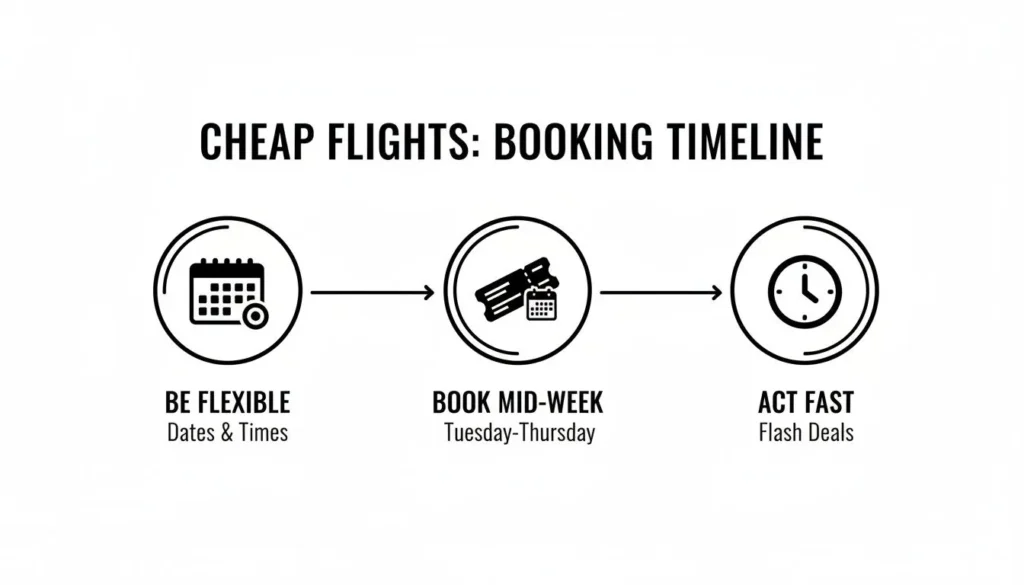
This really drives home the point: your calendar and your willingness to be flexible are the two most powerful tools you have for saving money on flights.
Pinpointing the Booking Sweet Spot
So, where exactly is this magical booking window? It shifts a bit depending on where you’re flying, but decades of fare data show some very clear patterns.
For domestic flights within your own country, the sweet spot is generally 1 to 3 months before you plan to leave. During this period, airlines have a decent handle on demand but still have plenty of seats to fill, which keeps prices competitive. It’s the best balance of low fares and low risk.
When you’re looking at international travel, you need to give yourself a longer runway. The prime booking window here is typically 2 to 8 months in advance. Long-haul routes have more complicated pricing, and getting in ahead of the curve is crucial. If you wait until you’re inside that three-month window, you’ll likely just watch prices climb.
Pro Tip: Flying during peak season like summer or Christmas? Add another month or two to these windows. For high-demand holidays, you’ll want to book 4-6 months out for domestic travel and a solid 7-10 months out for international trips to avoid the worst of the price hikes.
Harnessing the Power of Shoulder Seasons
One of my favorite travel hacks is flying during the shoulder seasons. These are the weeks just before or just after a destination’s peak tourist rush. You still get fantastic weather, but you get to enjoy it with fewer crowds and much lower prices on both flights and hotels.
Let’s break it down with some real-world examples:
- Dreaming of Italy? Ditch the sweltering, crowded chaos of July and go in May or September instead. The weather is gorgeous, the ancient sites are more manageable, and you can easily save hundreds of dollars on flights from the US.
- Need a Caribbean getaway? Skip the Christmas price surge and look at late April or early November. You’ll dodge the holiday crowds and the peak of hurricane season, finding a perfect blend of sunshine and savings.
- Hitting the slopes in Colorado? The crowds thin out and prices drop in early December (before the holiday rush) and again in April as the season winds down. You can find much better deals on flights into Denver or Vail.
The savings here aren’t trivial. A round-trip flight from New York to Rome in mid-July can easily top $1,200. But that exact same route in mid-September often plummets to the $650-$750 range. By simply shifting your trip by a few weeks, you can slash your airfare by nearly 50%. Your calendar isn’t just a grid of dates; it’s a strategic tool for unlocking serious savings.
Uncovering Hidden Fares with Advanced Search Tactics
The best flight deals often live just outside the boundaries of a standard round-trip search. To truly master how to find cheap flights, you have to start thinking like a travel hacker and look beyond the obvious routes. This is where we pull back the curtain on the strategies that uncover fares most travelers never even see.

These pro-level moves take a little more creativity, but the payoff can be massive. We’re talking about transforming your itinerary from ordinary to extraordinary while keeping your budget firmly intact.
Go Beyond the Round Trip Search
Most of us instinctively punch in a simple round-trip search. The problem? This often locks you into higher prices with a single airline and its partners. Two of the most powerful alternatives are the multi-city and open-jaw searches. You’ll find these features on most flight search engines, and they let you build custom itineraries that can be both cheaper and way more convenient.
An open-jaw ticket is when you fly into one city and out of another. For example, flying from New York to Paris but returning to New York from Rome. This is an absolute game-changer for European backpacking trips or any journey where you plan to travel overland between cities. It saves you the time and money of having to backtrack to your arrival city just to catch your flight home.
A multi-city search takes this a step further, letting you piece together multiple one-way flights into a single booking. This is perfect for things like island hopping in Southeast Asia or hitting several cities on one continent.
Consider Nearby and Secondary Airports
Don’t get tunnel vision on the major international hub. One of the simplest yet most effective tactics is to check prices for smaller, secondary airports near your origin or destination. Budget airlines often avoid the high landing fees at major airports, opting for these less-congested alternatives instead.
- London: Instead of Heathrow (LHR), check fares to Gatwick (LGW), Stansted (STN), or Luton (LTN).
- New York City: Look beyond JFK and LaGuardia (LGA) to Newark (EWR) or even smaller airports like Stewart (SWF) and Islip (ISP).
- Paris: Orly (ORY) and Beauvais (BVA) can offer huge savings over Charles de Gaulle (CDG).
The savings can be pretty substantial. A flight from Orlando to London might be 25% cheaper landing at Gatwick instead of Heathrow. Of course, you’ll need to factor in the cost and time of ground transportation, but more often than not, the savings are well worth the extra bus or train ride.
The Art of Combining One-Way Tickets
Sometimes, the ultimate travel hack is to build your own “round trip” by buying two separate one-way tickets, often on different airlines. Flight search aggregators are getting better at spotting these, but they don’t always catch the best combinations, especially when it involves mixing major carriers with regional budget airlines.
I once needed to fly from Montreal to Sydney. The round-trip options were all north of $1,500. I got creative and found a one-way flight on a budget carrier from Sydney to Honolulu for $300 and another one-way from Honolulu back to Montreal on a U.S. airline for about $450. This piecemeal approach saved me over $700 and even gave me a fantastic five-day stopover in Hawaii.
This method requires careful planning. Leave ample time between flights—ideally a full day or more—as the airlines have no obligation to rebook you if a delay on your first flight causes you to miss your second.
The Risky Business of Hidden-City Ticketing
Now for a more controversial strategy: hidden-city ticketing, also known as “throwaway ticketing.” The concept is simple: you book a flight from City A to City C that has a layover in City B, but your real destination is City B. You just get off the plane at the layover and discard the final leg of the journey. It works because it can sometimes be cheaper to book a longer flight with a connection than a direct flight.
But this tactic comes with some serious risks:
- Carry-on only: Your checked luggage will almost certainly be sent to the final destination (City C). You can’t do this with checked bags.
- Airline penalties: Airlines explicitly forbid this. If you get caught, they can shut down your loyalty account, cancel your return ticket without a refund, or even ban you from flying with them.
- Itinerary changes: If the airline reroutes your flight and skips your intended layover city, you’re completely out of luck.
Websites like Skiplagged are built to find these fares, but you should proceed with extreme caution. For most travelers, the potential savings just aren’t worth the considerable risks.
Choosing the Right Tech to Hunt for Deals
Forget about manually checking airline websites one by one. That’s a relic of the past. Today, the secret to snagging the cheapest flights lies in your digital toolkit—knowing which powerful search engines and alert systems to use and when. It’s all about letting the right technology do the heavy lifting for you.
The world of flight search tools is crowded, but a few key players consistently rise above the rest. I think of them as my core team: Google Flights for its incredible speed and calendar views, Skyscanner for its unmatched flexibility, and Momondo for its knack for digging up obscure deals. Each one has a specific job, and together, they make sure I never miss a deal.
Your Go-To Flight Search Engines
Not all flight search engines are created equal. Some are built for speed and broad exploration, while others are masters at piecing together complex itineraries. Knowing which one to pull out of your back pocket for a specific search is what separates the pros from the amateurs.
Here are the heavy hitters you should bookmark right now:
- Google Flights: Absolutely unbeatable for speed and discovery. Its calendar view and date grid instantly lay out the cheapest days to fly over an entire month. This is my first stop when my dates are flexible and I’m just starting my research.
- Skyscanner: A true powerhouse for flexibility. Skyscanner’s “Everywhere” search is a game-changer if you’ve got the travel bug but no destination in mind. It shows you the cheapest places you can fly from your home airport. It’s also fantastic at including budget carriers that other engines sometimes overlook.
- Momondo: The master of the meta-search. Momondo casts an incredibly wide net, scanning a massive number of sources, including smaller online travel agencies (OTAs) you’ve never heard of. It often unearths prices that are just a few bucks cheaper than anywhere else. It’s the tool I use for my final price check before pulling the trigger.

With so many great tools available, it can be tough to decide where to start. Here’s a quick breakdown to help you match the right engine to your search style.
Comparing the Best Flight Search Engines
A side-by-side look at the top flight search tools, breaking down their best features and ideal use cases for your travel style.
| Tool | Key Feature | Best For |
|---|---|---|
| Google Flights | Instant price calendar & date grid | Quickly finding the cheapest days to travel when your dates are flexible. |
| Skyscanner | “Search Everywhere” function | Discovering the cheapest destinations to fly to from your home airport. |
| Momondo | Broad OTA & airline aggregation | Doing a final, comprehensive price check to find the absolute lowest fare. |
Each of these tools offers a unique advantage. Using them in combination—starting broad with Google Flights and finishing with a deep dive on Momondo—is a surefire way to cover all your bases and feel confident you’re getting the best price.
Let the Deals Come to You with Price Alerts
Who has time to run the same search over and over again? The smart money is on setting up price alerts and letting technology do the monitoring for you. As soon as you have a specific route and a rough timeframe, create alerts on both Google Flights and Skyscanner.
You’ll get an email the second the price drops, giving you a chance to jump on it. This is absolutely critical, because the best deals—especially those rare “mistake fares”—can vanish in a matter of hours. Setting one up is easy: just run your search and look for a button that says “Track prices” or “Get price alerts.”
A personal tip: I always set alerts for a few variations of my trip. If I want to fly to Lisbon in May, I’ll set up separate alerts for the first, second, and third weeks of the month. This simple trick dramatically increases my odds of catching a sudden fare drop in at least one of those windows.
Curated Deal Services for the Hidden Gems
Beyond your own active searching, a more passive approach can deliver some incredible, unexpected wins. Services like Going (formerly Scott’s Cheap Flights) and Dollar Flight Club have teams of real people whose entire job is to hunt down mistake fares and unadvertised sales.
The concept is simple: you tell them your home airport(s), and they email you when an amazing deal pops up. While the free versions are great, the premium subscriptions often pay for themselves with just one booked trip. The deals they unearth are often 40-90% off what you’d normally pay.
For instance, a premium member might get an alert for a round-trip flight from Chicago to Tokyo for $550 when it typically runs over $1,200. These services are especially valuable for long-haul international flights, where the savings can be massive. They cut through all the noise, delivering only the best deals straight to your inbox.
Turning Points and Miles into Your Next Flight
The cheapest flight is always going to be the one you get for nearly free. That’s the magic of travel rewards—turning the money you already spend on things like groceries and gas into a boarding pass for your next adventure. This isn’t some complex, risky game of credit card churning. It’s just a smarter way to make your money work for you.
The whole strategy is built on loyalty programs and, more importantly, flexible points. Forget being locked into one airline. With programs like Chase Ultimate Rewards or American Express Membership Rewards, you’re collecting a kind of universal travel currency. These points can be transferred to dozens of different airline partners whenever you’re ready to book.
Understanding Airline Alliances
A huge mistake I see people make is thinking their miles with one airline are only good for that airline. Not true. Most major carriers are part of one of three global airline alliances. Getting your head around these partnerships is the secret to unlocking incredible value and finding award seats you’d never spot otherwise.
- Star Alliance: This is the big one, with carriers like United, Lufthansa, Singapore Airlines, and Air Canada. Points you earn with United can book a flight on any of its 25+ partners.
- oneworld: Another major player, featuring American Airlines, British Airways, Qantas, and Cathay Pacific. Your AAdvantage miles from American could land you a seat on Japan Airlines flight to Tokyo.
- SkyTeam: Home to Delta, Air France, KLM, and Korean Air. This network is especially solid for getting to and around Europe and Asia.
What does this actually mean for you? You could earn miles on a simple domestic United flight and then turn around and redeem them for a business-class seat on Turkish Airlines. It opens up a massive global network, which dramatically boosts your odds of finding an available award seat where you want to go.
The Power of Flexible Points
Airline-specific miles are good, but flexible credit card points are fantastic. They offer the ultimate freedom. You’re not tied to a single airline’s program or one alliance. You can just sit on your points, wait for the perfect redemption opportunity to pop up, and pounce—no matter which airline is offering it.
Let’s say you’re trying to get from New York to Paris. You can hunt for award availability across all three alliances. If a great deal appears on Air France (SkyTeam), you transfer your points there. But if the best flight is actually on United (Star Alliance), you can send your points there instead. That agility is what makes finding cheap award flights a reality.
A single sign-up bonus from a card like the Chase Sapphire Preferred can easily get you 60,000 points or more after hitting the minimum spend. That’s often enough for a round-trip ticket to Europe or the Caribbean right there. Just by putting your normal, everyday purchases on the card and paying it off each month, you’re essentially earning a free flight.
Spotting High-Value Redemptions
Not all point redemptions are created equal. The name of the game is getting the most value for each point, a metric we call “cents per point” (CPP). I always aim for at least 1.5 cents of value for every point I use.
For instance, if a flight costs $300 in cash, but the airline wants 50,000 miles for the same ticket, you’re only getting 0.6 cents per point. That’s a terrible deal. But if you find an international business class ticket that costs $4,000 for 120,000 miles, you’re getting a stellar 3.3 cents per point.
To find these sweet spots, focus your searches on:
- International business and first-class seats: This is where you’ll consistently find the most outsized value.
- Last-minute domestic flights: Cash prices can be astronomical for last-minute trips, but award rates sometimes stay stable, leading to a great CPP.
- Flights during peak holidays: When cash fares for Christmas or summer travel go through the roof, using points can save you a fortune.
When you combine a basic understanding of alliances with the flexibility of transferable points, your regular spending becomes a powerful engine for finding incredibly cheap—or even free—flights.
Your Top Questions About Finding Cheap Flights, Answered
Even after you’ve got the basics down, the world of flight pricing can still feel like a puzzle. When you’re trying to figure out how to find cheap flights, a few questions pop up again and again.
Let’s cut through the noise and tackle the most common ones. These are the practical, no-fluff answers you need before you hit “book.”
Is It Really Cheaper to Book Flights on a Tuesday?
This is one of the oldest travel myths in the book, and frankly, it’s outdated. The short answer is: not really.
Years ago, there was some truth to it when airlines manually loaded fares mid-week. But today, sophisticated algorithms adjust prices constantly based on live demand. A fare can change in minutes, any day of the week.
Instead of obsessing over the day you book, focus on the day you fly. Flying on a Tuesday, Wednesday, or Saturday is almost always cheaper than leaving on a busy Friday or returning on a packed Sunday. That has a much bigger impact on your wallet than when you click the purchase button.
My best advice? Stop trying to time the market. Set up price alerts using tools like Google Flights or Skyscanner. Let them do the work 24/7. When a price drops into your target range—whether it’s Tuesday at 2 PM or Saturday at midnight—that’s your moment to book.
How Far in Advance Should I Book a Flight?
There’s absolutely a “Goldilocks zone” for booking flights—not too early, not too late. One of the biggest mistakes I see people make is booking a year out. Airlines know early birds value certainty and will happily charge them a premium for it.
On the other hand, waiting until the last minute (inside of two weeks) is a guaranteed way to overpay. That’s when airlines jack up prices to catch desperate business travelers.
Here are the sweet spots I always aim for:
- Domestic Flights: Start your serious searching 1 to 3 months before you plan to leave. This window is typically where you’ll find the lowest prices.
- International Flights: You need a longer runway here. The prime booking window is between 2 and 8 months out. If you’re planning a trip during peak season, like summer in Europe, lean closer to that 8-month mark.
These are the periods when airlines are actively competing for your business, before seats start to fill up and prices begin their inevitable climb.
Should I Clear My Cookies or Use a VPN?
The fear that airlines are jacking up prices just because you’ve searched a route before is a bit overblown. While websites absolutely use cookies, a sudden price jump is far more likely because a cheaper fare class just sold out or the airline raised prices across the board. It’s usually not personal.
That said, there’s a simple, effective habit to adopt: always search in an incognito or private browsing window. It’s a clean slate every time, preventing any cookie-based tracking from potentially influencing what you see.
As for using a VPN to fake your location? For most people, it’s not worth the hassle. While you might occasionally find a small price difference by appearing to book from another country, the savings are often minimal and don’t justify the complexity. Incognito mode gets you 99% of the way there.
Are Budget Airlines Actually a Good Deal?
Sometimes they are, but you have to be disciplined and do the math. Airlines like Spirit, Ryanair, and Frontier are masters of the “unbundled” fare. They lure you in with a stunningly low base price that feels too good to be true.
And it often is. That rock-bottom price is just the ticket to get on the plane. Everything else costs extra:
- Picking a seat
- Bringing a carry-on bag
- Checking a bag
- Printing a boarding pass at the airport
- Even a bottle of water on board
Before you fall for that initial low price, go through the entire booking process. Add up the “total cost” with every single add-on you’ll realistically need. You’ll often find that a standard economy ticket on a major airline—which includes a carry-on and a seat assignment—is a better value and a far more pleasant experience.
At maxijournal.com, we’re dedicated to bringing you fresh perspectives and actionable advice on everything from travel to technology. For more guides and daily articles designed to inform and inspire, explore our latest posts at https://maxijournal.com.
Discover more from Maxi Journal
Subscribe to get the latest posts sent to your email.


Pingback: Top 10 Affordable Honeymoon Destinations for 2026
Pingback: Your Guide to Understanding Dog Training Cost - Maxi Journal
Pingback: Practical Guide to Starting Your Travel Blog the Right Way