
If you want to get better at public speaking, the work begins long before you ever step on stage. It starts with preparation and structure. A well-organized talk is your roadmap; it cuts down on anxiety and lets you focus on connecting with your audience, not fumbling for your next point.
This foundation is what frees you up to deliver your message with real impact.
Building Your Foundation for Confident Speaking
The journey from a nervous speaker to a confident one doesn’t start with some magic trick on stage. It begins with the quiet, focused work of building a solid plan. It’s a common myth that great speakers are just born that way. The truth? Confidence is a direct result of knowing your material inside and out.
This isn’t about memorizing a script word-for-word. That often sounds robotic anyway. It’s about internalizing your core message so deeply that you can speak about it with natural authority, as if you’re just having a conversation.
This prep work is your best defense against stage fright. In fact, research suggests that solid preparation can slash those pre-speech jitters by as much as 90%. This allows you to walk out and make a strong first impression in the first 27 seconds.
To get a handle on the key components of this process, think about it in terms of three core pillars.
The Core Pillars of Effective Speech Preparation
A structured approach to preparation can turn a bundle of nerves into a confident, engaging presentation. Below is a breakdown of the essential pillars that make all the difference.
| Pillar | Core Action | Key Benefit |
|---|---|---|
| Crafting the Outline | Build a logical skeleton for your talk (Hook, Problem, Solution, Action). | Provides a clear roadmap, preventing rambling and ensuring a logical flow. |
| Weaving in Stories | Integrate relevant anecdotes and examples for each key point. | Makes abstract concepts tangible and creates an emotional connection with the audience. |
| Polishing the Conclusion | Design a memorable and actionable closing statement. | Leaves a lasting impression and ensures your core message resonates. |
By mastering these three areas, you’re not just preparing content; you’re building a platform for a confident and powerful delivery.
Start with a Powerful Outline
Before you even think about opening PowerPoint or Google Slides, you need a blueprint. A clear outline is the skeleton of your presentation. It ensures your ideas flow logically from one to the next, building a cohesive argument. Winging it is a recipe for rambling, losing your audience, and—worst of all—forgetting your most important points.
Your outline doesn’t have to be some complex, formal document. A simple, time-tested structure works for almost any talk:
- The Hook: Kick things off with a compelling story, a shocking statistic, or a question that makes people lean in.
- The Problem: Clearly state the challenge or question you’re here to address. Why should they care about this right now?
- The Solution / Main Points: This is the heart of your talk. Break it down into three to five key arguments or steps. Keep it simple.
- The Call to Action: What do you want your audience to do, think, or feel after hearing you? End with a clear, memorable, and actionable takeaway.
Weave in Memorable Stories
Facts tell, but stories sell. While data and logic are crucial for building credibility, it’s the stories that make your message stick. A well-placed narrative can bring a complex idea to life, forge an emotional connection, and make your entire presentation far more engaging.
Look at your main points. Can you back each one up with a short, relevant anecdote? It could be a personal experience, a case study from your industry, or even a compelling historical example. The goal is to make your abstract ideas feel real and relatable. Sometimes, just getting started is the hardest part. If you’re feeling stuck, you might find some useful strategies in this guide on how to overcome writer’s block.
The most effective speakers don’t just present information; they create an experience. By structuring your talk around a clear framework and enriching it with stories, you transform a monologue into a compelling journey for your audience.
Craft a Conclusion That Resonates
How you end your speech is just as critical as how you begin. A weak, fizzled-out conclusion can undo all the great work you just did. Your goal is to leave the audience with a crystal-clear takeaway and a lasting impression.
Avoid the temptation to trail off with a simple “thank you” or “any questions?” Instead, bring it all home. Summarize your core message in one powerful sentence. Reiterate your call to action. A great technique is to circle back to the story or idea you opened with, creating a satisfying sense of closure for the audience.

This kind of deliberate structure ensures your message sticks with people long after you’ve left the stage.
Commanding the Stage with Voice and Body Language

Once you’ve got a solid structure for your talk, it’s time to shift your focus from what you’re saying to how you’re saying it. This is where a good message becomes a memorable one. While your words deliver the logic, it’s your voice and body that carry the emotion, authority, and genuine connection.
We’ve all been there—obsessing over the perfect script. But the research tells a different story. The impact of a message breaks down to roughly 55% body language, 38% vocal tone, and a surprisingly small 7% from the words themselves. If you want to dive deeper into these stats, novoresume.com has some great insights.
This doesn’t mean your words don’t matter, but it’s a huge reminder that mastering your delivery is how you truly own the stage.
Harnessing the Power of Your Voice
Your voice is the most immediate tool you have for keeping people engaged. A flat, monotone delivery can suck the life out of the most fascinating topic. On the other hand, a dynamic voice can make a simple data point feel like a major revelation. This isn’t about faking a radio announcer’s voice; it’s about using your natural voice with real intention.
A few practical exercises can make a world of difference:
- Vocal Warm-Ups: Your vocal cords are muscles, so warm them up. Before you speak, try humming, doing some lip trills (like a horse), or running through tongue twisters like “red leather, yellow leather.” It helps with clarity and keeps your voice from cracking when the pressure is on.
- Pace Variation: We all tend to speed up when we’re nervous. Record yourself practicing a chunk of your talk and just listen. Do you rush through everything? Try consciously slowing down for your key points and picking up the pace a bit when you’re telling a more energetic story.
- The Strategic Pause: Never underestimate the power of silence. A well-timed pause right before a critical statistic or after a powerful statement gives the audience a beat to process what you just said. It also makes you look far more confident and in command.
Mastering Your Body Language
Your body is communicating long before you say your first word. Open, confident body language signals that you’re credible and trustworthy. Fidgeting, slouching, or crossing your arms can betray nerves and undermine your entire message. The goal is to make every movement purposeful.
I always tell people to ditch the old “make eye contact” advice. It often just leads to awkward staring contests. Instead, try what I call the “lighthouse” technique. Slowly scan the room, letting your gaze rest on different people for just a few seconds at a time. This brings everyone into the conversation without making anyone feel like they’re under a microscope.
This one small shift can transform a one-way lecture into a shared experience.
Adopting a Confident Stance and Gestures
How you stand and what you do with your hands can make or break your credibility. A solid physical foundation helps you feel more grounded, which in turn helps you project authority.
It all starts with a confident stance. Plant your feet about shoulder-width apart, with your weight balanced. This doesn’t just look stable; it opens up your diaphragm for better breathing, which is your best friend for managing nerves and projecting your voice. Avoid the nervous sway or leaning on one leg.
Next up: purposeful hand gestures. So many speakers don’t know what to do with their hands, so they shove them in their pockets or clasp them behind their back. Use them to help you communicate.
- Use open palms to show honesty and build rapport.
- Count on your fingers when you’re listing points to make it easy to follow.
- Use your hands to illustrate size or direction when telling a story.
Just try to keep your gestures within the “strike zone”—that space between your shoulders and your hips. This keeps the focus on your message without becoming a distraction. By weaving these vocal and physical techniques into your delivery, you’ll see a massive improvement in your impact.
Designing a Practice Routine That Actually Works
Great speakers aren’t born; they’re made through intentional, focused practice. Simply reading your notes over and over isn’t a strategy—it’s just memorization, which often leads to a stiff, unnatural delivery. A good practice routine is what builds the muscle memory you need to internalize your message and spot the weak points in your talk before your audience does.
A powerful routine transforms your speech from a list of points you need to remember into a story you can’t wait to tell. It’s the difference between reciting lines and having a confident, authentic conversation. This process is all about building familiarity, not robotic perfection.
Record Yourself to Become Your Own Coach
This is the one tip that most people avoid, and it’s also the one that delivers the biggest results. It can feel awkward to watch or listen to yourself, but it provides objective feedback that you simply cannot get otherwise. Honestly, it’s the fastest way I’ve seen people improve.
Recording yourself is a game-changer for spotting the things you don’t realize you’re doing. You’ll instantly notice:
- Filler Words: How often do you really say “um,” “ah,” or “like”? The recording doesn’t lie.
- Pacing and Timing: Are you rushing through important points or dragging out a story? A recording helps you feel the natural rhythm of your speech.
- Body Language: Do you fidget, sway, or stare at the floor? Video reveals the non-verbal cues your audience will see.
Start small. Record just a three-minute segment of your talk. Don’t aim for perfection; just get it on camera. Watch it back three times: once for content, once for vocal delivery, and once for body language. You’ll learn more in those ten minutes than in an hour of just reading your notes.
Find a Test Audience for Real-World Feedback
Practicing alone is essential, but at some point, you need to simulate the pressure of a live audience. This is where a small, trusted group comes in. It could be a few colleagues, friends, or a family member who will give you honest, constructive feedback.
Presenting to even one or two people changes the dynamic entirely. It forces you to make eye contact, manage your nerves, and adapt to having other human beings in the room. This low-stakes environment is the perfect training ground for the real thing.
After your practice run, don’t just ask, “How was it?” Ask specific questions. Try things like, “What was the single most memorable point?” or “Was there any part where you felt your attention drifting?” This kind of targeted feedback is far more actionable.
This step helps bridge the gap between solo rehearsal and live delivery, making the actual event feel much less intimidating. For more on building skills through structured practice, you might be interested in our guide on how to learn a new language.
Create a Practice Timeline
Intentional practice needs a plan. Think about the greats—Winston Churchill was known for practicing his speeches obsessively, sometimes rehearsing a single key phrase up to 20 times. Today’s top-tier professional speakers might aim for nearly 100 practice runs to achieve a delivery that feels completely seamless and natural. You can explore more about the dedication of great speakers and find other insights on novoresume.com.
Your timeline doesn’t need to be quite that intense, but it absolutely should be structured. Here’s a sample schedule that works well for most talks:
- One Week Out: Focus on content and structure. Do full run-throughs to make sure your key messages flow logically. This is your window for making major edits.
- Three Days Out: Now, shift your focus to delivery. Practice in front of a mirror or record yourself again. This is where you work on vocal variety, pacing, and gestures.
- The Day Before: Do one or two final, complete run-throughs. Don’t cram. The main goal now is to build confidence and trust that you know your material inside and out.
- The Final Hour: Don’t rehearse the whole thing. Just review your opening and closing lines, do some vocal warm-ups, and take a few deep breaths. Your job now is to get into a calm, focused state of mind.
Adapting Your Delivery for In-Person and Online Stages
Being a truly effective speaker today means you have to master two completely different stages: the physical one in front of a live audience and the digital one framed by your webcam. While the core of a good speech doesn’t change, how you deliver it absolutely does. The energy you bring to a room just doesn’t translate through a screen without a few smart adjustments.
Knowing how to pivot your style isn’t just a “nice-to-have” skill anymore; it’s essential. A live audience gives you instant feedback—you see the nods, hear the laughs, and make real eye contact. A virtual audience? You have to learn how to create that same engagement in a vacuum. To succeed in both arenas, you need a different game plan for each.
Mastering the In-Person Experience
When you’re physically in the same space as your audience, your entire presence is part of the performance. It’s not just what you say; it’s how you command the room from the moment you step on stage.
- Microphone Technique: Think of the mic as an extension of your voice, not a barrier. Hold it a steady distance from your mouth and speak through it, not directly at it. Whatever you do, don’t tap it or let it drift down to your chest—that’s a surefire way to make your volume fade in and out.
- Slide Management: Your slides are your backup dancers, not the lead singer. Use “presenter view” so you can see your notes while the audience only sees the slide itself. More importantly, turn away from the screen often. Make a point to connect with people in different sections of the room.
- Using the Stage: Don’t plant your feet in one spot. Purposeful movement keeps the energy high. Try walking to one side of the stage as you’re making a key point, then move to the other as you transition to a new idea. This makes your presentation feel more dynamic and alive.
Focusing on these physical elements will help you create a much more connected and memorable experience for everyone in the room.
Excelling in the Virtual Arena
Presenting online basically turns you into the producer of your own show. That little digital window on the screen is your stage, and every single detail matters. The goal is to project energy and professionalism right through the lens.
Think of your camera lens not as a piece of glass, but as the eyes of your most important audience member. Looking directly into it creates a powerful illusion of one-on-one eye contact, making each person feel like you’re talking directly to them.
A professional-looking setup is non-negotiable here. Make sure your background is clean and uncluttered. Your main light source should be in front of you, not behind, otherwise you’ll look like a silhouette. And please, put your camera at eye level so you’re not looking down on your audience.
Engaging a remote audience is its own unique challenge. Since you can’t read their body language, you have to build interaction directly into your talk.
- Launch polls to get a quick read on opinions or to check if everyone’s following along.
- Ask direct questions and tell people to pop their answers in the chat.
- Vary your vocal tone even more than you would in person to keep things interesting and convey enthusiasm.
- Use shorter, punchier sentences to maintain momentum and keep everyone’s focus sharp.
No matter the format, you have to adapt your practice routine. A structured process of recording yourself, testing your talk, and setting a clear timeline will help you stay on track and nail the delivery.
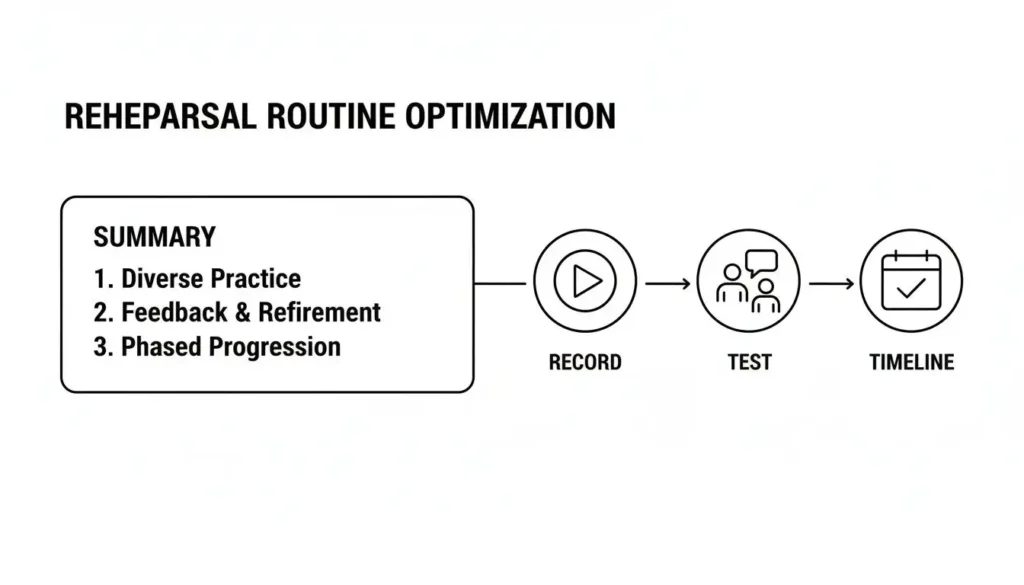
This kind of rehearsal process helps you tackle the specific technical and engagement hurdles of any speaking environment. New tools are even making this easier. For instance, virtual reality training helps 34% of users improve dramatically by simulating an audience without any real-world pressure. You can find more cool facts like this in a great roundup of public speaking statistics on novoresume.com.
To help you keep everything straight, here’s a quick checklist comparing the key differences in preparation.
| Preparation Area | In-Person Focus | Virtual Focus |
|---|---|---|
| Environment | Arrive early to walk the stage and test the A/V setup. | Test your camera, mic, lighting, and internet connection an hour before. |
| Body Language | Use the whole stage, make broad gestures, and move with purpose. | Focus on posture, facial expressions, and hand gestures within the camera frame. |
| Eye Contact | Scan the entire room, making eye contact with different people. | Look directly into the camera lens to simulate eye contact with everyone. |
| Visual Aids | Design slides for a large screen; high contrast and minimal text. | Ensure slides are readable on small screens; use more interactive elements. |
| Engagement | Read the room’s energy; ask for a show of hands or verbal responses. | Proactively use polls, chat, and Q&A features to build interaction. |
| Vocal Delivery | Project your voice to the back of the room; use a consistent microphone technique. | Use a quality external microphone; vary your pitch and tone more to convey energy. |
Whether you’re standing on a physical stage or sitting in front of a camera, the goal is the same: connect with your audience. By tailoring your approach, you can deliver a powerful message no matter where you are.
Overcoming Common Public Speaking Hurdles
No matter how much you’ve prepared, sooner or later, something will go wrong. The projector bulb will burn out, your slides will freeze, or someone will lob a question from the cheap seats that completely derails your train of thought. It happens.
The mark of a true pro isn’t about giving a flawless presentation—it’s about how you handle the inevitable bumps in the road. This is where you build real credibility. A speaker who can gracefully navigate chaos shows they’re not just reading from a script; they’re confident, adaptable, and genuinely in command of their topic.
Taming the Beast of Stage Fright
Let’s tackle the elephant in the room first: glossophobia, the fear of public speaking. If the mere thought of standing in front of an audience makes your palms sweat and your heart race, you’re in good company. This is an incredibly common fear, with studies showing 75% of the global population shares this anxiety. In the UK, that number inches up to 77%. You can dive into the full research on novoresume.com to see just how universal this feeling is.
That feeling is your ancient “fight-or-flight” response kicking in. Your brain reads the sea of faces as a potential threat and hits the adrenaline button. The goal isn’t to kill this feeling—it’s to harness it.
A simple mindset shift can make all the difference. Instead of thinking, “I’m so nervous,” tell yourself, “I’m excited to share this.” The physical sensations of nervousness and excitement are almost identical. By reframing the feeling, you can turn that adrenaline into energy instead of dread.
Here are a few practical techniques I’ve seen work wonders for calming those pre-speech jitters:
- Box Breathing: This is a go-to for Navy SEALs for a reason—it works. Inhale slowly for a count of four, hold your breath for four, exhale for four, and then hold again for four. A few cycles of this will physically slow your heart rate and bring a sense of calm.
- Progressive Muscle Relaxation: You’re probably holding tension in places you don’t even realize. Start with your toes: tense them up for five seconds, then completely release. Work your way up your body—calves, thighs, abs, arms—tensing and releasing each muscle group.
- Remember Your “Why”: Shift your focus from yourself to your audience. Why are you here? You’re here to give them something of value—knowledge, inspiration, a solution. When you make it about serving them, your self-consciousness starts to fade. For more strategies on managing this kind of stress, our guide on mental health and self-care tips is a great resource.
Navigating Unexpected Interruptions
Beyond the nerves inside your head, the world outside can throw you some serious curveballs. A dead microphone or a glitchy slide deck can feel catastrophic, but your reaction is what the audience will remember.
Technical Glitches
When technology fails—and it will—don’t freeze up. The best approach is to acknowledge it with a little humor. “Well, it looks like the tech gods have decided to test our improv skills today.” Have a backup plan. Knowing your material well enough to speak for a few minutes without your slides is a lifesaver while someone scrambles to fix the issue.
Difficult Questions
The Q&A can feel like a minefield. If you get a hostile or completely off-topic question, the key is to stay cool. Use a bridging phrase to politely redirect. Something like, “That’s an interesting perspective, and it actually brings me back to the core issue of…” allows you to regain control without being dismissive.
Going Blank
It happens to the best of us. You’re mid-sentence, and suddenly… nothing. Your mind is a total blank. The absolute worst thing you can do is panic. Instead, just pause.
Take a slow sip of water. Casually glance at your notes. This small moment of silence feels like an eternity to you, but to the audience, it just looks like you’re collecting your thoughts.
If you’re really stuck, turn it into an interactive moment. “Let me pause here for a second. What’s been the most useful takeaway for everyone so far?” This brilliant little trick not only buys you time to reset but also re-engages the room, turning a potential stumble into a moment of connection.
Your Public Speaking Questions, Answered
As you start putting these techniques into practice, some common questions are bound to come up. These are the little sticking points that can throw anyone off their game, no matter how much they’ve prepared. Let’s tackle them head-on with some practical, real-world advice.
Think of this as your go-to guide for those “what do I do when…” moments. Getting better at public speaking is all about making small, consistent fixes, and solving these common problems is a massive step forward.
How Can I Stop Saying “Um” and “Like” So Much?
The first move is simply noticing you’re doing it. Most of us have no idea how often we lean on filler words like “um,” “ah,” or “you know” until we’re forced to listen to ourselves. So, the first step is to record yourself giving a quick, off-the-cuff talk about anything at all. Then, brace yourself and listen back.
Once you’re aware of the habit, the trick is to consciously replace the filler word with a silent pause. That’s all a filler word is—a panicked attempt to fill the silence while your brain plays catch-up. By learning to embrace a quiet moment, you not only cut out the “ums” but you also sound more deliberate and confident.
A short, intentional pause is one of the most powerful tools a speaker has. It gives your audience a beat to process what you just said and adds weight to what’s coming next. It instantly turns nervous energy into perceived authority.
What’s the Best Way to Memorize a Speech Without Sounding Like a Robot?
Here’s the secret: stop trying to memorize the script. Instead, internalize the structure. Memorizing every single word is a recipe for disaster. Not only does it sound stiff and unnatural, but if you forget a single word, the whole sentence (and your confidence) can completely fall apart.
Focus on knowing your key points inside and out. For each main part of your talk, be crystal clear on:
- The one core idea you need to get across.
- The story, stat, or example you’ll use to back it up.
- The smooth transition that will lead you to the next point.
You’re memorizing the roadmap, not the turn-by-turn directions. When you practice, deliver the content in your own words each time. This approach keeps your delivery feeling fresh and conversational, giving you the flexibility to connect with the audience instead of just reciting lines from memory.
How Do I Make My Virtual Presentations More Engaging?
Keeping an audience hooked through a screen takes a lot more conscious effort than it does in person. You’re fighting against a digital wall, so you have to work harder to build that connection. First thing’s first: your tech setup. Good lighting and clear audio aren’t just nice-to-haves; they are non-negotiable.
Next, you have to intentionally dial up your energy. Your voice needs more modulation, and your facial expressions need to be a bit bigger to convey enthusiasm through the camera. Most importantly, build interaction into the presentation from the start.
Don’t save all the questions for the end. Every few minutes, do something that pulls your audience back in:
- Launch a quick poll.
- Ask a question and have people type answers in the chat.
- If it’s a smaller group, call a few people out by name.
And a huge one: look directly into the camera lens when you’re speaking. This creates the illusion of direct eye contact and makes every single person feel like you’re talking right to them.
How Quickly Can I Actually See Improvement in My Speaking?
You can feel a real difference in your confidence and delivery almost immediately, simply by committing to better preparation. Just knowing you have a solid, well-structured outline is a huge anxiety killer.
With consistent, focused practice—even just 15-20 minutes a day—you can expect to sound more fluid and feel far less nervous within just a few weeks. The key is deliberate practice. That means recording yourself, rehearsing tricky sections in front of a mirror, or running through your talk for a friend. While true mastery is a lifelong journey, you’ll be surprised how quickly you can make meaningful, confidence-boosting progress.
At maxijournal.com, we believe in the power of clear, confident communication. Explore our curated articles at https://maxijournal.com to find more insights on professional development, technology, and the arts to help you share your ideas with the world.
Discover more from Maxi Journal
Subscribe to get the latest posts sent to your email.


Pingback: Tips for Writing a Cover Letter That Stands Out to Employers
Pingback: Essential Video Marketing Strategies for 2026 Growth
Pingback: Effective Strategies for Employee Engagement and Performance