
To beat writer’s block, you have to figure out what’s really stopping you. Is it fear? Perfectionism? Just plain exhaustion? Once you know the enemy, you can pick the right weapon. This isn’t about forcing yourself to type—it’s about understanding the psychological tripwire so you can disarm it and get your creative process back on track.
Understanding the Roots of Your Writer’s Block
Before you can tear down a creative wall, you need to know what it’s made of. Writer’s block isn’t just a simple case of “not having ideas.” It’s that deep, frustrating feeling of staring at a blank page while your mind feels just as empty.
And you’re not alone. It’s a surprisingly common struggle. One study found that a staggering 94% of first-year students hit this wall, with 24% feeling stuck almost constantly. It doesn’t stop after school, either. Between 55-64% of U.S. PhD candidates take over a decade to finish their dissertations, often due to this exact kind of creative paralysis. You can dig into more of the data on how this affects writers at lumivero.com.
The real key to breaking through is knowing what kind of block you’re dealing with. It’s crucial to tell the difference between a minor creative slump and a persistent, soul-crushing blockage.
Differentiating Your Blockage
Not all stalls are created equal. A temporary dip might last a few hours and get fixed with a quick walk outside. A deeper block, on the other hand, requires a bit more digging. The first step is to check in with yourself and diagnose what you’re feeling. Most of the time, it boils down to one of these culprits:
- Fear: This is the big one. The anxiety that your work won’t be good enough, that people will judge it harshly, or that you have nothing new or interesting to say.
- Perfectionism: This is the trap of trying to get every single word perfect on the first go. It leads to obsessively editing the same sentence for an hour instead of just getting the story down.
- Burnout: This is pure mental and emotional exhaustion. Your creative well has run dry, and trying to force anything out of it feels impossible. This is where solid self-care strategies for writers are non-negotiable.
This decision tree can help you quickly figure out what’s holding you back.
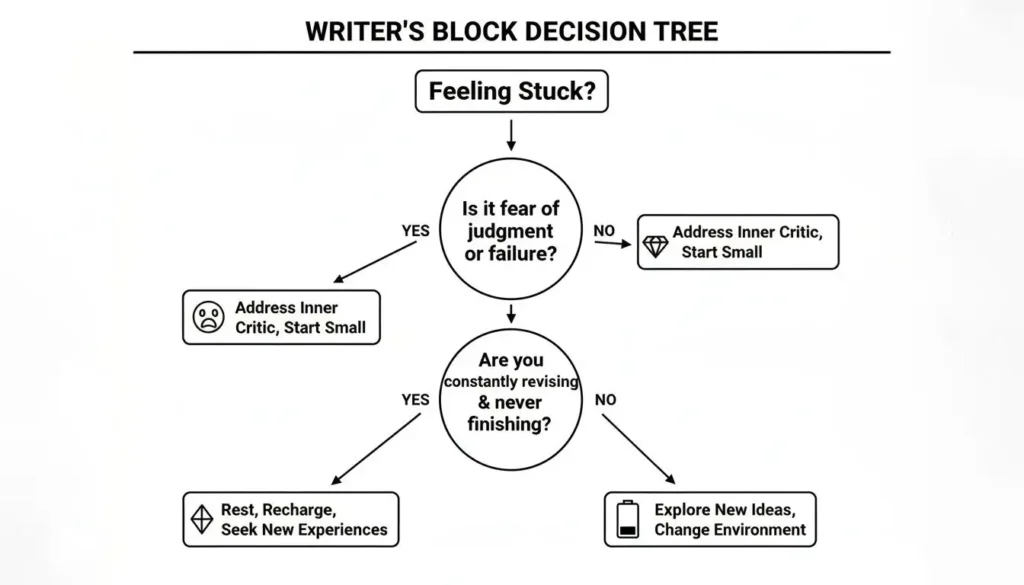
As you can see, the path forward starts by naming the core emotion behind your block. Once you know if you’re wrestling with fear, perfectionism, or burnout, you can start using the right tactics to fight back.
Taking Targeted Action
When you’re feeling stuck, it’s easy to get overwhelmed. To make it simpler, here’s a quick way to diagnose what you’re feeling and what your very first move should be.
Quick Diagnosis Your Writer’s Block Type and First-Aid Kit
| If You’re Feeling… | You Might Be Experiencing… | Your Quick First-Aid Action |
|---|---|---|
| Anxious, insecure, or avoidant | Fear | Write down your absolute worst-case scenario. What’s the most terrible thing that could happen if you write poorly? Then, write the best-case scenario. Getting it out of your head and onto the page often shrinks the fear. |
| Obsessive, critical, or stuck on one sentence | Perfectionism | Set a timer for 15 minutes and write pure garbage. The goal is to produce nonsense, get words on the page without judgment, and break the “it has to be perfect” cycle. This is often called a “freewrite.” |
| Exhausted, uninspired, or emotionally drained | Burnout | Step away from the screen completely. Go for a walk, listen to music, read a chapter of a book for pleasure, or do anything unrelated to your project. Your brain needs a genuine break to refuel. |
Once you have a clearer picture, you can take immediate, targeted action. The solution isn’t a one-size-fits-all approach; it’s about matching the remedy to what’s actually wrong.
The goal is to refine your process, not just force out words. Understanding why you’re stuck is more powerful than simply trying to write through the resistance.
By treating this experience as a puzzle to be solved rather than a personal failing, you take back control. Every writer, from a brand-new blogger to a seasoned novelist, runs into these hurdles. The difference is that experienced writers have learned how to diagnose the problem and pull the right tool from their toolkit to fix it.
Immediate Strategies to Get Words on the Page

We’ve all been there: staring at that blinking cursor on a blank page while a deadline screams in the background. In moments like these, you don’t need a philosophical debate about creativity. You need an emergency kit.
These are the fast-acting, break-glass-in-case-of-emergency techniques to jolt your brain out of its stalemate. The goal here isn’t to write the perfect draft. It’s just to get something—anything—on the page to build momentum.
Embrace the Power of Timed Sprints
The sheer size of a project can be paralyzing. “Write a 2,000-word article” feels like a mountain. “Write for 25 minutes” feels like a small hill you can actually climb. This is where a simple timer becomes your best friend.
The Pomodoro Technique is a classic for a reason—it just works.
- Set a timer for 25 minutes. No more, no less.
- Write. That’s it. Don’t stop to edit, don’t look up a “quick fact,” don’t check your email. Just get words down.
- Take a 5-minute break when the timer dings. Get up, stretch, walk around.
- Do it again. After four of these sprints, give yourself a longer break of 15-30 minutes.
This method gamifies the process and lowers the stakes. Anyone can focus for just 25 minutes. It forces you to push past that initial resistance, which is often the hardest part of writing.
Give Yourself Permission to Write Badly
Perfectionism is the best friend of writer’s block. We try to edit and create at the same time, strangling our ideas before they can even breathe. The solution? Intentionally write a terrible first draft.
I’m talking about the “zero draft.” This version is for your eyes only. It’s a complete brain dump of every messy thought, half-baked idea, and awkward sentence in your head. The only rule is zero judgment allowed.
Your first draft is just you telling yourself the story. It doesn’t have to be perfect. The goal is simply to have something to work with. Editing a bad page is infinitely easier than editing a blank one.
Think of it like a sculptor who needs a big, ugly lump of clay before they can start shaping it into something beautiful. Your zero draft is that raw material.
Let’s say you’re a tech writer trying to explain blockchain. A zero draft might look like this: “Ok so it’s a digital notebook thing everyone can see but nobody can erase. It’s made of blocks I guess? Chained together so it’s secure. Have to explain miners and nodes but that part is confusing.”
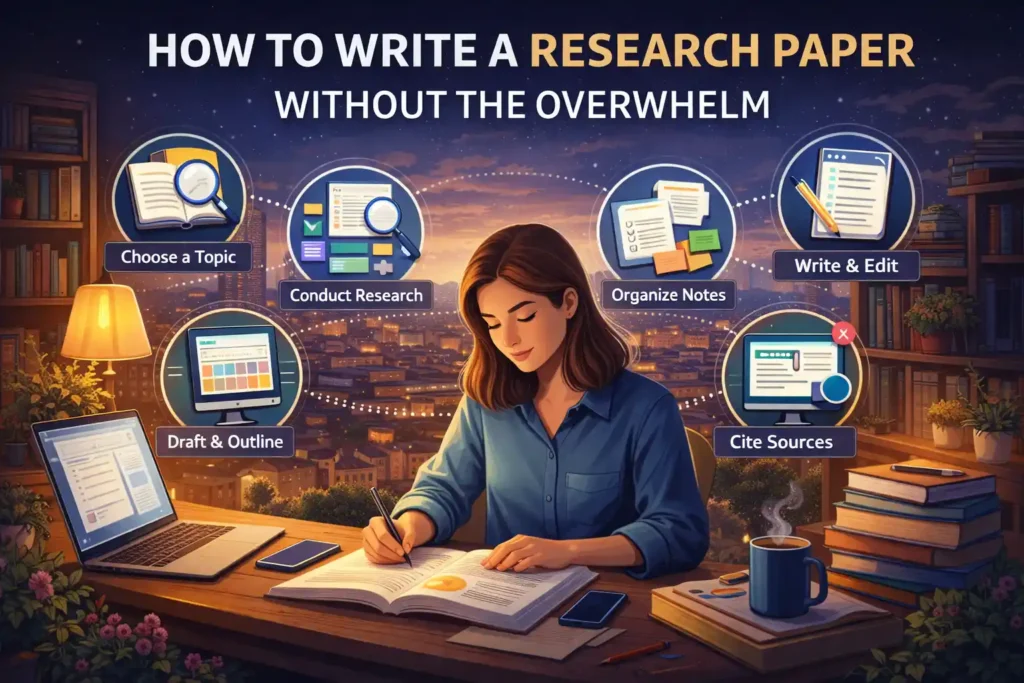
It’s conversational and clunky, but it’s a start. Now you have ideas on the page you can refine, define, and structure. It’s a far less intimidating process than trying to nail a perfect explanation from the get-go, especially for complex topics. If this is a familiar struggle, our guide on how to write a research paper without the overwhelm might offer some more help.
Unleash Your Thoughts with Freewriting
Freewriting is another powerful way to sneak past your inner editor. It’s a bit like a zero draft but even more fluid and stream-of-consciousness. The entire point is to just keep your fingers moving.
- Set a timer for 10 or 15 minutes.
- Start writing about your topic. If you can’t, write about anything. The weather, your breakfast, your frustration with writing.
- Do not stop moving your pen or typing. If you get stuck, literally write, “I’m stuck I don’t know what to write” over and over until a real thought pops out.
- Ignore spelling, grammar, and all the rules. This is about pure output.
Think of freewriting as stretching before a run. It warms up your writing muscles, loosens your thoughts, and often uncovers angles or ideas you didn’t even know you had. By separating creation from evaluation, you can break the logjam and get the words flowing again.
Building a Resilient Long-Term Writing Routine

Quick fixes can get you out of a jam, but if you want to stop writer’s block before it starts, you need a different game plan. It’s all about shifting from reactive panic to proactive habit-building. A solid, long-term routine is your absolute best defense against the creative paralysis that stalls so many projects.
Inspiration is fickle. Don’t wait for it. Instead, build a system that practically forces creativity to show up for work. This means treating writing less like a mystical performance and more like a daily practice, just like playing an instrument.
The core of this practice is simple: consistency over intensity. Those frantic, all-night writing sessions fueled by caffeine and a looming deadline? That’s a one-way ticket to burnout. The most productive writers I know built their careers on the back of small, sustainable, daily efforts.
The Power of Small, Consistent Sessions
The thought of writing every single day can feel overwhelming, I get it. But the goal isn’t to churn out a masterpiece each time you sit down. It’s about building a cognitive habit. When you write at the same time and in the same place consistently, you’re literally training your brain to switch into creative mode on command.
This isn’t just theory. Research going all the way back to the 1980s showed that writers who committed to daily, structured sessions with small quotas finished their work 50% faster than those who waited for big, open blocks of time. Fear is a huge paralyzer; studies also found that writers who obsessively delete and revise as they go have 40% less output than writers who just let the messy first draft happen. You can dig into the research behind these structured writing tactics on digitalcommons.unf.edu if you’re curious.
This is exactly why setting a small, almost ridiculously achievable daily goal is so powerful. Aim for just 15 minutes of writing. Or 100 words. The win isn’t in the word count; it’s in the simple act of showing up.
Consistency is the engine of creativity. By making writing a non-negotiable part of your day, you transform it from a daunting task into a simple, repeatable action.
Design Your Personal Writing Ritual
A writing ritual is just a sequence of small actions you perform right before you write. Think of it as a powerful psychological trigger that tells your brain, “Okay, time to shut out the noise and focus.” It’s the warm-up before the main event.
Your ritual needs to be personal and simple. No need for elaborate ceremonies.
- Set the Scene: Tidy your desk. Close all those distracting browser tabs. Put your phone in another room (seriously, do it).
- Engage Your Senses: Maybe you brew a specific kind of tea, light a candle with a scent you love, or put on a curated “writing playlist.”
- Prime Your Mind: Read a few pages from an author who inspires you. Review your notes from yesterday. Or just take two minutes to meditate and clear your head.
For example, a blogger I work with starts every session by putting on noise-canceling headphones, opening their project management tool to look at the article outline, and then freewriting for five solid minutes on the topic before ever touching the main draft. That sequence builds a reliable on-ramp to their writing zone.
Schedule Your Writing Like an Appointment
Let’s be honest: if your writing time isn’t on your calendar, it doesn’t exist. Vague intentions like “I’ll write this afternoon” are the first things to get pushed aside by emails, chores, or the latest notification.
You have to schedule your writing sessions with the same seriousness as a doctor’s appointment. No-shows aren’t an option.
This isn’t about finding two hours every single day. A 30-minute block is incredibly effective if it’s protected and consistent.
Here’s a sample weekly structure you can adapt to fit your own process:
| Day | Task (30-60 Minutes) | Purpose |
|---|---|---|
| Monday | Research & Outline | Gather your materials and create a clear roadmap. |
| Tuesday | Draft Section 1 | Get the initial ideas down. No editing allowed. |
| Wednesday | Draft Section 2 | Keep the momentum going and build the body. |
| Thursday | Draft Section 3 | Finish the first pass of all your major points. |
| Friday | Edit & Refine | Polish your draft for flow, clarity, and errors. |
This approach turns a huge, intimidating project into a series of small, manageable daily tasks. It stops overwhelm in its tracks and builds a steady sense of progress—which is one of the best motivators there is.
Mastering the Mindset Behind the Block
Let's be honest. The blinking cursor isn't the real monster here. Most of the time, writer's block isn't a writing problem at all—it's a thinking problem. The real battle is happening inside your own head.
This kind of paralysis is almost always rooted in the psychological hurdles we build for ourselves. Fear, perfectionism, that nagging inner critic… they're the true culprits. To really beat writer's block for good, you have to go deeper than quick tips and tricks. It's about managing your mindset and reframing how you see the entire writing process.
Confronting Your Inner Critic
Every writer has one. It’s that voice in your head that loves to whisper (or shout) that your work is garbage, your ideas are unoriginal, and you're just a fraud who's about to be found out. This voice is the fuel for perfectionism, the reason you might spend an hour tweaking a single sentence instead of just getting the story down.
But here’s the thing: you don't need to silence this critic. You just need to stop letting it drive.
Think of it as a backseat driver who has terrible advice. You can acknowledge it's there, but you're the one with your hands on the wheel. A fantastic technique borrowed from cognitive-behavioral therapy (CBT) is to actively reframe that negative self-talk.
So when your critic says, "This paragraph is a complete mess," you can consciously push back with, "This is a first draft. Its only job is to exist. I'll make it pretty later."
The goal isn't to kill your inner critic. It's to demote it from an all-powerful judge to a whiny consultant whose opinion you can absolutely ignore. This simple shift in power is everything.
Overcoming the Fear of the Blank Page
That gut-wrenching fear of not being good enough is paralyzing. It often shows up as impostor syndrome, making you feel like you're just one wrong word away from being exposed. This fear absolutely thrives on high stakes and the immense pressure to create something brilliant right out of the gate.
The solution? Lower the stakes. Drastically.
Give yourself explicit, written-down-if-you-have-to permission to be imperfect. A science writer, for example, might be frozen by the fear of getting a complex detail wrong. Instead of seeing their first draft as a final verdict on their expertise, they can reframe it as an "initial exploration"—a sandbox to play with ideas, ask questions, and yes, even make mistakes.
Here are a few mental shifts that can make a world of difference:
- From Product to Process: Stop obsessing over word count or quality. Instead, focus on the simple act of showing up and writing for a set amount of time. That's the win.
- From Performance to Practice: Treat each writing session like a low-stakes rehearsal, not a final performance in front of a sold-out crowd.
- From Judgment to Curiosity: Approach your topic with genuine curiosity. What can you discover as you write? This transforms the pressure of "knowing it all" into the joy of "finding out."
Embracing these shifts turns writing from a stressful ordeal into an adventure. If you're struggling with these feelings, it can also be incredibly helpful to check out broader mental health and self-care tips, because these practices are essential for any creative professional.
Building Genuine Writing Confidence
Confidence isn't something that magically appears one day. It's something you build, brick by brick, through action. Every single time you write—even when it's hard and the words feel clunky—you're casting a vote for your identity as a writer.
The trick is to collect small, consistent wins.
Forget setting a huge, intimidating goal like "write the whole chapter today." Instead, aim for something tiny and ridiculously achievable, like, "I'm going to write one good sentence." Once you've done that, try for another. These little successes create a positive feedback loop that proves to your anxious brain that you can do this.
Ultimately, mastering your writing mindset comes down to treating yourself with the same compassion you'd offer a friend. Acknowledge that it's hard. Celebrate the effort, not just the outcome. And remember that every single word you manage to get down on the page is an act of courage.
Practical Exercises to Jumpstart Your Writing
Sometimes, the best way to get unstuck is to just stop trying so hard to write. The pressure we put on ourselves to create something polished right out of the gate is often what paralyzes us in the first place.
Think of these exercises as a creative gym. They're designed to lower the stakes, silence that nagging inner editor, and simply get your fingers moving again. The goal here is momentum, not perfection.
Engage Your Senses to Find New Words
We often get trapped in our own heads, wrestling with abstract ideas until the words feel stale. The fastest way out of that loop is to ground your writing in the physical world. Sensory writing forces you to stop thinking and start observing—a shortcut to unlocking fresh descriptions and unexpected ideas.
Try one of these quick prompts right now:
- Sound Only: Describe the room you're in using only what you hear. Don't name the source of the sound, just the sound itself. Is it a low hum? A distant rumble? A sharp, sudden click?
- Smell and Taste: Write a quick paragraph about your morning coffee or tea. Focus only on the aroma and how it feels on your tongue. Is it earthy and smooth, or sharp and bitter?
- Texture: Grab an object from your desk. A pen, a mug, a sticky note. Describe it using only your sense of touch. Is it cool, grainy, slick, or surprisingly heavy?
These exercises work so well because there's no right or wrong answer. They pull you out of an intellectual rut and back into the tangible world, which is where all the best details are hiding.
The point isn't to write something profound. It's to prove to yourself that the well of words isn't actually dry; you just need to drop the bucket in a different spot.
Break the Blank Page with Constraints
Staring at a blank page with infinite possibilities can feel less like freedom and more like a threat. The fix? Give yourself some rules. Constraints are paradoxically liberating because they shrink your focus and turn the whole act of writing into a game.
This approach, known as constraint-based writing, eliminates the pressure of choice. Instead of worrying about what to write, your brain gets busy solving a puzzle.
A classic example is the "Gadsby" challenge, inspired by the 1939 novel written entirely without using the letter 'E'. You don't have to be that extreme, but try applying one of these simple constraints to your next paragraph:
- The Missing Letter: Write a 50-word paragraph without using the letter 'a'. This forces you to dig for creative synonyms and rethink your sentence structure.
- Sentence Length Rule: Write a paragraph where every single sentence is exactly five words long. No more, no less. It creates a punchy, rhythmic effect you might even want to use later.
- The Dialogue Box: Write a short conversation between two people, but they can only speak in questions.
By focusing on the puzzle, you forget to be anxious about the quality of the writing. And more often than not, the results are surprisingly creative.
Use Genre-Specific Prompts to Get Relevant Ideas
General writing prompts are great for a warm-up, but they can feel a bit random. A prompt about a magical forest isn’t going to do much for a tech blogger trying to explain a new software update.
Tailored prompts give you a relevant starting point, making the exercise feel less like a detour and more like a productive first step.
Sometimes, all you need is a little nudge in the right direction. Use these tailored prompts to kickstart your writing in some of our most popular categories.
Genre-Specific Writing Prompts to Spark Your Next Idea
| Category | Prompt Example |
|---|---|
| Technology | Explain a complex concept like cloud computing or an API to a grandparent. Use simple analogies and avoid jargon. |
| Arts & Culture | Describe the feeling of your favorite song without ever naming the artist, the title, or any of the lyrics. |
| Travel | Write about a place you’ve visited from the perspective of a single object, like a worn-out suitcase or a postcard. |
| Business | Draft an email to a difficult client, but write it with extreme, over-the-top politeness and empathy. |
| Health & Wellness | Describe the physical sensation of taking a deep, calming breath in the middle of a stressful day. |
These little games are designed to be quick, fun, and surprisingly effective. The next time you feel stuck, don't just stare at the screen. Pick one and play for ten minutes. You might just break the paralysis and strengthen your creative muscles in the process.
Your Writer's Block Questions, Answered
Even with a full bag of tricks, a few nagging questions about writer's block always seem to pop up.## Your Writer's Block Questions, Answered
Even with a full bag of tricks, a few nagging questions about writer's block always seem to pop up. Getting a handle on these specifics can make all the difference when you're staring down a blank page.
Let’s clear up some of the most common uncertainties. Think of this as the final part of your toolkit—the part that demystifies the whole frustrating experience.
How Long Does Writer's Block Typically Last?
This is the million-dollar question, isn't it? The honest answer is that it varies wildly. A block can last for a few hours, a few days, or in tougher cases, for months or even years. There's no standard timeline because the duration is tied directly to what's causing it.
A block stemming from simple exhaustion might lift after a good night's sleep. But a block rooted in deep-seated perfectionism or major burnout? That’s going to take a more focused, sustained effort to unravel.
The key is to not just sit around and wait for it to pass.
The goal isn't to endure writer's block; it's to actively shorten its lifespan. Waiting is a losing strategy. You have to diagnose the cause and apply the right remedy to break the cycle.
Think of it like being sick. A cold might clear up in a few days on its own, but a more serious infection needs a specific treatment plan. Your job is to become the doctor of your own creative process.
Does Writer's Block Affect Professional Authors?
Absolutely. It’s an equal-opportunity pain that hits writers at every level, from aspiring bloggers to household names. Getting blocked isn't a sign that you’re not a "real writer" or don't have what it takes.
In fact, some of the greats have been incredibly open about their struggles.
- Maya Angelou famously rented a sparse hotel room just for writing, creating a strict ritual to keep the words flowing.
- Neil Gaiman has talked about how he jumps between projects—from a novel to a comic book script—to keep his mind fresh and avoid getting stuck in a rut.
- Ernest Hemingway had a simple rule to prevent getting stuck: "Always stop when you are going good." He knew that leaving a little something in the tank for the next day made it infinitely easier to start again.
The difference between a pro and an amateur isn't that one never gets blocked. The pro has just built a system for dealing with it when it inevitably shows up.
Should I Force Myself to Write or Take a Break?
This is the classic dilemma, and the right answer depends entirely on why you're stuck. Pushing through can be the perfect solution or a recipe for disaster. You have to figure out the "why" before you can choose the "what."
When a Gentle Push Is the Answer:
If your block is coming from a place of fear, procrastination, or perfectionism, a little bit of structured discipline is often the best medicine. This isn't about brute force. It's about using a technique like the Pomodoro method to commit to just 25 minutes of writing. That small, manageable goal is usually enough to break the inertia without feeling overwhelming.
When a Strategic Break Is Essential:
On the other hand, if you're dealing with genuine burnout, mental exhaustion, or emotional depletion, forcing yourself to write is like trying to run on a broken leg. You'll only make it worse. In these cases, taking a break isn't lazy—it's productive.
A strategic break isn't about zoning out on the couch. It’s about actively refilling your creative well. Take a walk in the woods, visit an art museum, read a book purely for fun, or get lost in a great album. Do something that recharges your mind without adding more pressure.
What If I've Tried Everything and Am Still Stuck?
Okay, so you've tried the prompts, you've taken the walks, you've set the timers… and you're still stuck. If this goes on for weeks or even months, it’s probably a sign that the problem is deeper than your daily habits.
First, take a hard look at the project itself. Are you still passionate about this idea? Has the angle gone stale? Sometimes, a stubborn block is just your gut telling you that the project isn't working or needs a serious overhaul.
Second, get an outside perspective. Talk it out with a trusted friend, a mentor, or someone in your writing group. Just explaining the problem out loud can sometimes reveal the solution, and another person can often spot the blind spots you're missing completely.
Finally, if the block is tangled up with serious anxiety, depression, or crippling self-doubt, it might be time to seek professional help. A therapist or a coach who works with creative people can give you the tools to tackle those deeper psychological hurdles.
At maxijournal.com, we understand the creative process. Explore our curated articles across arts, technology, and more to find your next spark of inspiration. Check out our diverse collection of writing today at https://maxijournal.com.
Discover more from Maxi Journal
Subscribe to get the latest posts sent to your email.

Pingback: Essential Cooking Advice: 10 Tips for Kitchen Newbies
Pingback: Tips for Writing a Cover Letter That Stands Out to Employers
Pingback: Top 12 Productivity Apps for Students to Master Coursework
Pingback: 10 Essential SEO Tips for Beginners to Improve Rankings 2026
Pingback: Become a Technology Contributor and Share Your Expertise
Pingback: Master Public Speaking: From Fear to Effective Delivery
Pingback: Find Your Motivation to Learn a Language and Achieve Fluency