Traveling sustainably is about more than just reusable water bottles and carbon offsets. It’s a fundamental shift in how we approach our adventures—moving from being a passive tourist to an active, conscious participant in the places we visit.
It’s about making deliberate choices that protect the environment, genuinely support local people, and strengthen their economies. This way of thinking turns your trip from a simple vacation into a positive force for good.
The Shift to More Mindful Journeys
We’re seeing a real move away from just ‘ticking boxes’ on a trip. The old model of simply showing up is fading, replaced by a deep-seated desire to explore with purpose and leave a positive footprint.
This isn’t about making travel harder or less fun. In fact, it’s about unlocking a richer, more rewarding way to experience the world. To get there, it helps to think about sustainable travel through a simple framework of three core pillars.
Understanding the Three Pillars
At its heart, sustainable travel is a balancing act. It’s about ensuring your presence helps, not harms. Thinking about your trip through this lens makes it much easier to see where you can make a real difference.
Here’s a quick breakdown of how these pillars work together to guide your decisions, turning abstract ideas into real-world actions.
The Three Pillars of Sustainable Travel
| Pillar | What It Means for Your Trip | Quick Action Example |
|---|---|---|
| Environmental Protection | Minimizing your impact on the natural world by conserving resources, reducing waste, and cutting down on your carbon footprint. | Choose a direct flight or overland travel, pack a reusable water bottle, and turn off lights and A/C when you leave your room. |
| Community Empowerment | Respecting local customs and traditions, ensuring that the people who call a place home benefit directly from your visit. | Hire a local guide, learn a few phrases in the local language, and ask permission before taking photos of people. |
| Positive Economic Impact | Making sure the money you spend stays within the local community, supporting small businesses and entrepreneurs. | Eat at family-run restaurants instead of international chains, and buy souvenirs directly from the artisans who made them. |
Looking at your trip through these three pillars gives you a clear, simple framework for making conscious choices on your next adventure.
This shift toward mindful travel isn’t just a niche trend; it’s a powerful movement, and younger travelers are leading the charge.
The data backs this up. A 2026 outlook from Deloitte shows that younger generations are making sustainability a non-negotiable part of their plans. A whopping 42% of Gen Z and 38% of millennials actively take green actions—everything from booking eco-certified hotels to purchasing carbon offsets. That’s double the rate of boomers and a full 10 points higher than Gen X. This growing awareness is pushing the entire travel industry to step up its game.
Planning Your Trip with a Lighter Footprint
The most impactful part of a sustainable trip happens before you even start packing. Smart, upfront planning is what turns good intentions into genuine, positive change on the ground.
It all starts with where you decide to go. Look for destinations that are actively managing tourism’s impact, not just talking a good game.
Research Beyond the Mainstream
You’ll need to dig a little deeper than the usual tourist traps. Instead of a generic search like “things to do in Lisbon,” try something more specific like “community-based tourism in Portugal” or “local eco-tours near Lisbon.” This simple tweak in your search terms can connect you with operators that ensure your money stays within the community.
Your timing also matters. A lot. Traveling during the shoulder season—that sweet spot right before or after the peak tourist rush—is a game-changer. You’ll find fewer crowds, and you’ll be putting less pressure on local resources, from water systems to public transit.
Technology can be a huge help here. Using some of the best travel apps for planning can uncover locally-owned businesses and hidden gems that bigger travel sites often overlook.
Spotting Greenwashing and Finding Genuine Eco-Labels
As “sustainability” becomes a travel buzzword, you’ll see a lot of “greenwashing”—businesses making big environmental claims that are misleading or flat-out false. It’s on us to be savvy travelers.
Vague claims like “eco-friendly” or “green” without any proof are a major red flag. A truly sustainable operation will be proud to show you exactly how they’re making a difference.
Here’s what to look for as proof:
- Specific Details: Do they openly talk about their water conservation, waste reduction programs, or use of renewable energy?
- Community Focus: Do they make it a point to hire local staff, source local food and products, and invest in the community?
- Recognized Certifications: Keep an eye out for credible, third-party seals of approval. Certifications like Green Globe, EarthCheck, or B Corp require businesses to meet strict, verified standards.
This infographic gives you a great visual for how your choices create a positive cycle.
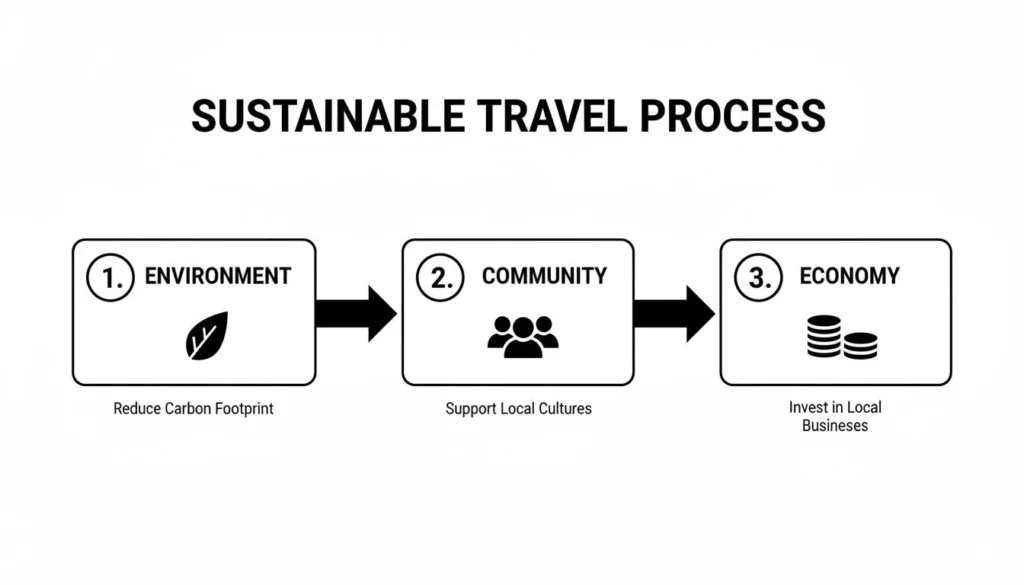
As you can see, sustainable travel isn’t a single action. It’s a loop where protecting the environment, supporting the community, and making fair economic choices all feed into each other. When you plan your trip with these three pillars in mind, you’re not just having a vacation—you’re actively contributing to a healthier planet and stronger communities.
Choosing Low-Impact Transport and Eco-Conscious Stays

When it comes to your trip’s footprint, two decisions tower above all others: how you get there and where you stay. Making smart choices here is one of the most powerful things you can do, and it often leads to far more memorable travel.
Your mode of transport has the single biggest impact on your travel carbon footprint, bar none. While flying is sometimes the only way, for any regional journey, ground travel is almost always the greener path.
Seriously, consider taking the scenic route. Swapping a short-haul flight for a train or bus slashes your emissions. A train journey from Paris to Amsterdam, for example, pumps out about 90% less CO2 per passenger than flying the same route. Plus, you actually get to see the countryside.
This isn’t just a niche idea anymore; it’s a major shift in how people travel. A growing awareness of climate impact is driving huge demand for low-impact options like integrated public transit and better cycling infrastructure. A European Commission analysis even names this a key megatrend shaping the future of tourism. You can read more about future travel patterns on their site.
Smart Flying When You Must
Let’s be real: sometimes flying is the only practical choice. When that’s the case, you can still make a dent in your impact with a few key strategies.
Prioritize Direct Flights: Takeoff and landing are the most fuel-intensive parts of any flight. A non-stop route cuts one of those cycles entirely, making it far more efficient than connecting.
Choose Efficient Airlines: Do a little digging. Look for airlines that are open about their investments in newer, fuel-efficient aircraft and their use of Sustainable Aviation Fuels (SAFs).
Pack Light: Every pound counts. Lighter luggage means less fuel gets burned. It’s a simple equation, so challenge yourself to pack only what you truly need.
Finding Genuinely Eco-Conscious Stays
Just like your flight, your choice of accommodation matters. The goal here is to find places that do more than just ask you to reuse your towels. We’re looking for real commitment, not just green-tinted marketing.
Over the years, I’ve developed a personal vetting process to find the real gems. I’ve stopped searching for “hotels” and now look for terms like “eco-lodges,” “certified B Corp hotels,” or “homestays with sustainability practices.” It’s a simple trick that helps filter out a lot of the noise.
A truly eco-conscious hotel will be transparent about its initiatives. If their website only has vague promises without any specific details on water, energy, or waste programs, I move on.
Once a place looks promising, I dig for concrete proof. Do they have solar panels, a rainwater harvesting system, or an on-site garden that supplies their restaurant? Do they make a point to highlight their local hiring and sourcing policies? These are the hallmarks of a business that is genuinely invested.
By supporting them, you’re voting with your wallet for a better, more thoughtful way to explore the world.
Packing Smart and Living Mindfully on the Ground

Once your boots hit the ground, your everyday habits become your greatest asset for traveling more sustainably. This is where the small stuff really adds up, and it all begins with how you pack—or, perhaps more accurately, what you choose not to pack.
Switching to a zero-waste mindset when you’re packing is one of the simplest wins. With just a handful of reusable items, you can almost entirely sidestep the endless cycle of plastic bottles, coffee cups, and flimsy shopping bags that unfortunately plague so many stunning places.
My Go-To Zero-Waste Travel Kit
After years of refining my kit, I’ve whittled it down to a few core items that make a huge difference in cutting down waste without adding a ton of weight to my bag. These have become absolute must-haves for me, no matter if it’s a quick city break or a multi-week adventure. And if you’re looking for more ways to lighten your load, our guide on how to pack light for Europe is packed with tips.
Here’s the simple kit that I swear by for traveling more consciously.
| Item | What It Replaces | Personal Tip |
|---|---|---|
| Collapsible Water Bottle | Single-use plastic water bottles. | I love the collapsible silicone ones—they’re amazing space-savers. I always fill mine up at a water fountain right after clearing airport security. |
| Travel Coffee Cup | Disposable coffee and tea cups. | A lot of cafes will even give you a small discount for bringing your own cup. Just make sure you get one with a solid, leak-proof lid. |
| Compact Tote Bag | Plastic shopping bags for groceries or souvenirs. | Find a small nylon or canvas tote that folds up into its own little pouch. It takes up virtually no room in your bag. |
| Solid Toiletries | Miniature plastic bottles of shampoo, conditioner, and soap. | Shampoo and conditioner bars last forever and you never have to worry about liquids exploding in your luggage. It’s a game-changer. |
| Bamboo Utensil Set | Plastic cutlery for market lunches or street food. | Most sets come in a little fabric wrap that keeps them clean and easy to find in your daypack. |
This simple setup has become my foundation for leaving a lighter footprint wherever I go.
Conserving Resources in Your Accommodation
Your mindful habits shouldn’t stop once you’ve unpacked. How you act in your hotel room or rental directly impacts local resources, particularly water and energy. The best approach is to treat your accommodation like a temporary home and show it the same respect.
A single hotel guest can use up to 200 gallons of water per day—a figure that can be two to four times higher than what a local resident uses. Your small habits can bring this number way down.
Try to adopt these simple but incredibly effective habits:
- Respect the Towel: Hang your towels up after you use them. It’s the universal sign to housekeeping that you’re happy to use them again, which saves a massive amount of water and energy on laundry.
- Lights and A/C Off: Get into the rhythm of turning off every light and the air conditioning each time you walk out the door. There’s really no point in cooling an empty room.
- Shorter Showers: Keep your shower time in check, especially when you’re in a place where water is a precious and limited resource.
Individually, these actions might seem minor. But when they’re practiced by millions of travelers around the world, they create a powerful, positive wave of conservation. It’s a huge part of how to travel sustainably every single day of your trip.
Connecting with Culture and Supporting Local Economies
Let’s be real: truly sustainable travel goes way beyond just the environment. It’s about people. It’s about forging genuine connections and making sure your trip leaves a positive mark on the communities that host you. This is where a simple vacation transforms into a meaningful exchange.
The goal is simple: put your money directly into the hands of locals. This means actively looking for businesses owned and run by the people who live there. Think about that small, family-owned restaurant on a quiet side street or the independent guide who shares stories no guidebook could ever tell. When you spend your money this way, it stays in the community, helping to fund schools, support families, and preserve the very culture you traveled to see.
Investing Directly in the Community
Making this happen is easier than you might think. It really just starts with a shift in your mindset. Instead of automatically heading to a familiar global chain, make a conscious effort to find a local gem.
Here are a few practical ways to funnel your travel budget into the local economy:
- Eat at Locally-Owned Restaurants: Ditch the big fast-food chains. Find the places where the owners are in the kitchen and the recipes have been passed down for generations. The food is almost always better, and your money directly supports a local family.
- Hire Independent Guides: A local guide can offer insights you just can’t get anywhere else. You’ll get a richer, more personal experience, and your fee goes straight to an entrepreneur, not a large corporation.
- Shop at Local Markets: When you’re looking for souvenirs, skip the generic tourist traps. Head to a craft market and buy directly from the artisans. You’ll walk away with a unique, handmade treasure and the satisfaction of knowing the creator was paid fairly. You’ll find that many of the best places to travel in the world are built around these vibrant local hubs.
This entire approach is the foundation of an exciting movement in tourism called regenerative travel. The core idea is to leave a destination even better than you found it. This isn’t just a niche concept; it’s becoming a major trend for 2026, with the World Travel & Tourism Council highlighting it as the next frontier of sustainability. In fact, recent studies show that nearly two-thirds of global travelers want their spending to benefit the local communities they visit. You can discover more insights about regenerative travel on Nayara Resorts’ blog.
Engaging with Culture Respectfully
Connecting with people is about more than just where you spend your money. It’s also about showing cultural awareness and genuine respect. This not only deepens your own travel experience but also shows your hosts that you value their customs and way of life.
A respectful traveler is a welcome traveler. Small gestures of cultural humility go a long way in building bridges and creating positive interactions.
Always remember that you’re a guest in someone else’s home. A few simple actions can demonstrate your respect and open doors to much more authentic and rewarding connections.
Key Actions for Respectful Engagement:
- Learn Key Phrases: You don’t need to be fluent, but learning basics like “hello,” “thank you,” and “excuse me” in the local language is a powerful sign of respect. It immediately shows you’re making an effort.
- Understand Social Etiquette: Do a little homework before you go. Research local customs around greetings, dining etiquette, and tipping. For instance, in some cultures, showing the soles of your feet is considered rude. Knowing these small details matters.
- Ask Before Photographing: This is a big one. Always ask for permission before taking a picture of someone, especially children. A simple gesture and a smile are often all you need. If they decline, respect their decision and move on.
By making these practices a core part of your travel habits, you’re not just learning how to travel more sustainably—you’re becoming a more thoughtful and considerate global citizen.
Your Questions on Sustainable Travel Answered
Even experienced travelers have questions when trying to make their trips more sustainable. It’s a learning process, and it’s easy to wonder if you’re getting it right. I’ve been there.
This is where we tackle some of the most common questions and concerns. The goal is to give you clear, honest answers that make sustainable travel feel less like a chore and more like a natural part of your adventures.
Is Sustainable Travel Always More Expensive
That’s one of the biggest myths, and the simple answer is no. While you can certainly find high-end eco-resorts with premium price tags, many sustainable choices will actually save you money.
Think about it. Choosing overland travel like trains instead of short-haul flights, staying in a locally-owned guesthouse, or eating at a fantastic local market often costs much less than the tourist-trap alternatives. Even carrying a reusable water bottle saves you a few dollars a day.
It’s about shifting where your money goes—from large international chains to authentic local experiences, which are almost always more affordable and definitely more memorable.
How Can I Tell If a Business Is Truly Eco-Friendly
This is a great question, especially with greenwashing—when companies make misleading claims about their environmental practices—becoming more common. You have to look for specific details, not just vague promises.
I’ve learned to play detective. I check their website for real information on their practices. Do they talk about their water conservation, waste management, or renewable energy sources? Do they highlight how they hire locally or partner with community projects? Specifics are a good sign.
Vague claims like “we’re eco-friendly” should raise a red flag. Real commitment comes with proof. Look for established third-party certifications like Green Globe, EarthCheck, or B Corp, which hold businesses to strict, verifiable standards.
Beyond that, I always read recent reviews from other travelers. They’re a fantastic source of truth, giving you a real-world look at whether a business actually practices what it preaches.
What Is the Single Most Impactful Thing I Can Do
If you want to make the biggest dent in your travel footprint, focus on transportation. Nothing else has a bigger impact.
When possible, take a train or bus instead of flying, especially for any journey under 500 miles. The carbon savings are enormous. If flying is unavoidable, prioritize these two things:
- Book Direct Flights: Most fuel is burned during takeoff and landing. A nonstop flight is always more efficient than connecting.
- Fly Economy: First and business class seats take up far more space, reducing the number of people on the plane and increasing the carbon footprint for each passenger.
After transportation, the next most powerful thing you can do is be mindful of where you spend your money. Every dollar you put into a locally-owned business helps ensure the community benefits directly from your visit.
Can My Individual Choices Really Make a Difference
Yes. It’s a classic “drop in the ocean” feeling, but those individual drops create a powerful current.
Every time you book a sustainable hotel or refuse a plastic bag, you’re sending an economic signal. You’re voting with your wallet for the kind of travel industry you want to support. This collective demand is what forces businesses to change.
When enough of us choose the eco-lodge, hire the local guide, and support community-based tourism, the entire industry has to adapt. Your trip matters. Your choices matter. You are part of the solution.
At maxijournal.com, we believe in the power of conscious choices, whether in travel, technology, or the arts. We’re dedicated to bringing you thoughtful writing that helps you engage with the world more deeply. Explore more stories and ideas at https://maxijournal.com.
Discover more from Maxi Journal
Subscribe to get the latest posts sent to your email.