Saturn has 274 natural satellites, according to NASA’s Saturn fact sheet. That count reframes a comparison of Mars and Saturn: you’re not comparing a small planet with a large one. You’re comparing rocky terrain that preserves clues to ancient water with an entire planetary system where rings, moons, and atmospheric motion offer different ways to study how worlds work.
Mars and Saturn Side by Side
Mars and Saturn at a glance
| Feature | Mars | Saturn |
|---|---|---|
| Planet type | Rocky terrestrial world | Gas giant |
| Equatorial diameter | About 6,780 km, about 53% of Earth | About 120,500 km, about 9 times Earth |
| Mean density | About 3.9 times water | About 0.70 g/cm³ |
| Length of day | About 24 hours 39 minutes | About 10.7 hours |
| Length of year | About 687 Earth days | About 29.4 Earth years, approximately 10,756 Earth days |
| Surface gravity | About 3.7 m/s², about 38% of Earth | No solid surface |
The diameter row gives you scale, but planet type tells you more about what scientists can investigate. Mars offers exposed rock, sediment, and terrain. Saturn offers an enormous atmosphere and a surrounding system whose moving parts must be studied together.
Day length and year length describe different motions. A day tracks rotation, while a year tracks an orbit around the Sun. Saturn can therefore spin quickly while taking much longer to complete its solar journey, without any contradiction.
Read density as a clue to composition
Density is the structural clue: Mars is substantially denser than water, while Saturn’s average density is lower than water’s. A large diameter doesn’t imply a compact, rocky body.
Average density combines everything inside a planet into a single measure. It doesn’t mean every layer has the same density, and it doesn’t describe what a spacecraft would encounter at a particular depth. Used carefully, though, it helps explain why these worlds require such different mental models.
The surface-gravity row needs similar care. Mars has ground where an explorer could stand and measure weight. Saturn’s missing solid surface makes a simple standing-on-the-ground comparison misleading, but it certainly doesn’t mean Saturn lacks gravity.
For mission planning, the useful question isn’t which planet looks more impressive in a size chart. It’s where an instrument can operate and what evidence it can collect. Composition, atmospheric conditions, and surrounding moons determine whether scientists need a rover examining a rock, a probe sampling gas, or an orbiter tracking an entire system.
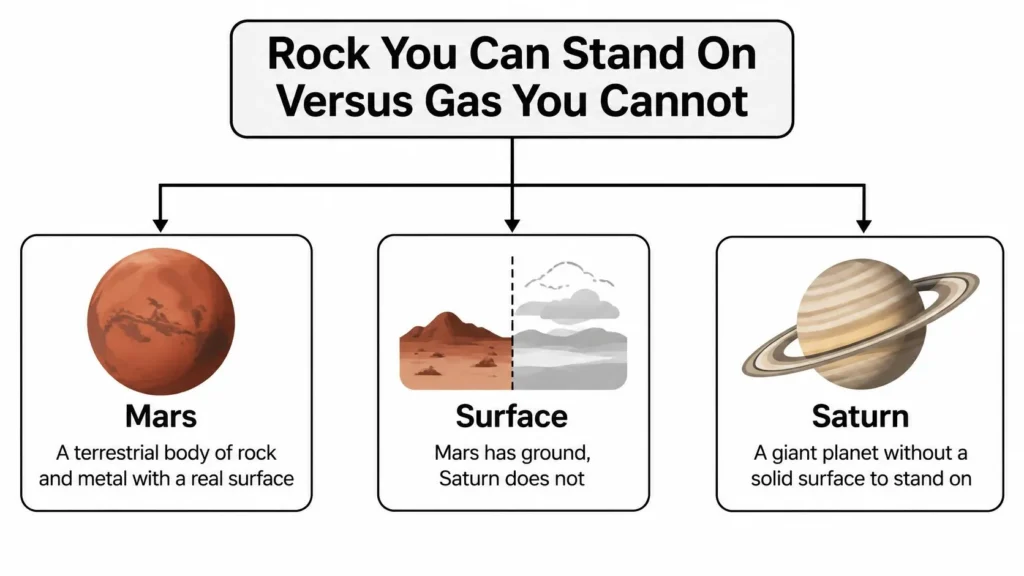
Rock You Can Stand On Versus Gas You Cannot
On Mars, an arriving explorer would encounter a recognizable category of terrain: ground beneath the vehicle, a horizon, rocks, slopes, and dust. The surroundings would be hostile, but the basic relationship between machine and terrain would be familiar. A wheel can press against soil, and a drill can cut into a sample.
Mars is a terrestrial planet, a body of rock and metal with a distinct surface. Its reddish appearance comes from oxidized iron minerals, although color alone doesn’t tell scientists exactly when or under what conditions those minerals formed.
A landscape is a scientific archive
A rocky surface preserves relationships that instruments can investigate directly. Scientists can compare a mineral with the material around it, examine whether sediment sits above older rock, and ask how erosion altered the scene. Location matters because an isolated chemical measurement rarely explains an entire geological history.
Olympus Mons and Valles Marineris illustrate the range of Martian geology, from volcanic construction to deep canyons. They’re reminders that Mars isn’t merely a dusty sphere. Its terrain records different processes that researchers must distinguish rather than compress into a single story.
For readers comparing planets like Earth, this is the useful starting point: a rocky classification describes physical structure, not comfortable living conditions. A planet can have solid ground without offering breathable air or a stable environment for people.
Saturn has no landing floor
At Saturn, descending through the clouds doesn’t lead to a shoreline or exposed bedrock. The surrounding material becomes increasingly compressed with depth. A probe encounters changing atmospheric conditions rather than a place where it can park and begin surface work.
The bathtub comparison is a density illustration, not a literal ocean in which someone could float Saturn.
Calling Saturn a gas giant also shouldn’t suggest an empty cloud with no substantial interior. The distinction is that it lacks the accessible solid surface needed for conventional landing operations.
That structural difference defines the work. Geology and resource prospecting suit direct investigation on Mars, while measurements of atmospheric layers and deepening pressure suit Saturn.
Air Pressure Wind and What a Craft Must Survive
Mars’s surface pressure is below 1% of Earth’s average, and its atmosphere is 95.3% carbon dioxide, according to JPL’s Mars at a Glance. That thin air affects both arrival and surface operations. A spacecraft must handle the atmosphere it encounters, not just the terrain it hopes to reach.
Engineering limits set by each atmosphere
| Constraint | Mars | Saturn |
|---|---|---|
| Main gases | Carbon dioxide, about 95.3% | Hydrogen and helium |
| Pressure | Surface pressure under 1% of Earth’s average | Rises continuously with depth |
| Temperature anchor | Large surface swings, little heat retention | Temperature varies with atmospheric depth |
| Motion hazard | Dust storms and weak braking | Strong winds in the upper atmosphere |
| Practical mobility | Wheels, legs, or drills on terrain | Orbiters, atmospheric probes, magnetosphere studies |
Mars requires protection inside and outside
Thin air gives a spacecraft less atmosphere to use for aerodynamic braking. Engineers must coordinate deceleration, navigation, and touchdown on terrain whose local hazards may be uncertain before arrival.
On the surface, little heat is retained by the atmosphere, so vehicles need thermal control. Dust can settle on exposed mechanisms and instrument openings, making dust mitigation part of the design.
A human habitat adds pressure retention. Its structure must maintain a suitable internal environment while shielding occupants from external conditions and radiation. A familiar day length does not make those demands Earth-like.
Saturn requires a different operating strategy
Saturn’s temperature and pressure change with atmospheric depth. A probe descending through the clouds encounters changing conditions, while strong winds carry it through a moving atmosphere rather than over a fixed geological map. Instruments must collect measurements as the probe moves, and increasing depth brings more severe pressure.
The mobility row describes different mission designs, not interchangeable vehicles. A Mars rover can revisit nearby terrain or choose another drilling location. A Saturn orbiter can repeatedly observe changing clouds or study interactions around the planet.
Mars offers defined terrain beneath very thin air; Saturn offers a deep, moving atmosphere with no accessible ground. The engineering challenges differ because one world permits surface work, while the other calls for measurements from orbit or during descent.
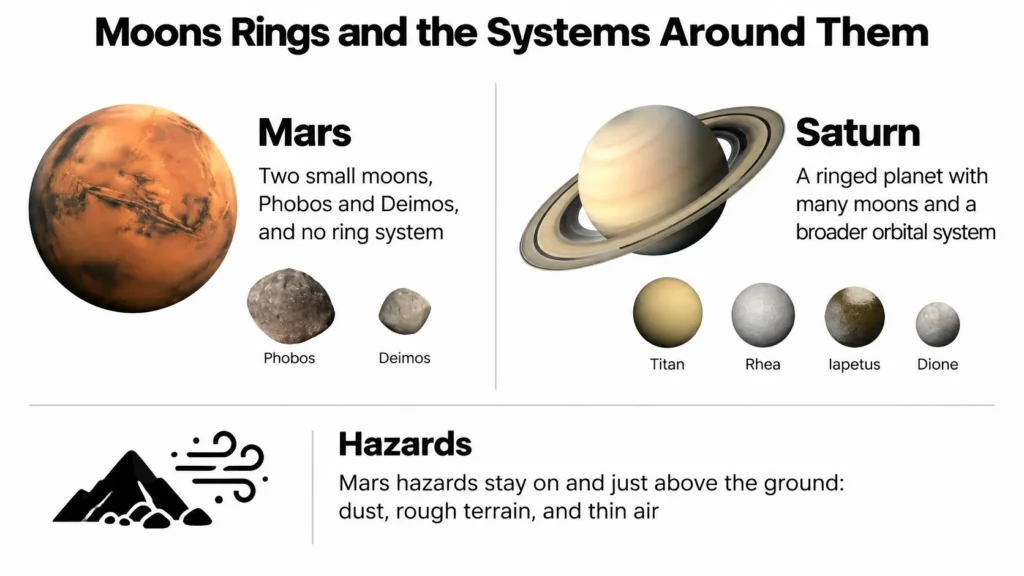
Moons Rings and the Systems Around Them
Saturn’s rings span roughly 282,000 km across, while the main rings are typically about 10 m thick, according to NASA’s Cassini ring science overview. That contrast helps explain why the rings are a system of their own: an enormous spread of orbiting particles, packed into a vertically narrow structure.
Moons and rings compared
| Feature | Mars | Saturn |
|---|---|---|
| Natural satellites | 2, Phobos and Deimos | 274 |
| Ring system | None | Water ice, rock, and dust in thousands of ringlets |
| Ring reach | Not applicable | Roughly 282,000 km across |
| Main-ring thickness | Not applicable | Typically about 10 m |
| Particle scale | Not applicable | Smaller than sand up to mountain-size |
| Standout targets | Surface geology on the planet | Enceladus jets and Titan |
A ring isn’t a rigid disk attached to a planet. Its particles follow individual orbits, while the material forms bands, edges, and gaps. Most of the particles are water ice mixed with dust and rock.
Why thin rings still demand careful navigation
Thin rings can still pose a collision risk. A spacecraft crossing a particle-rich band faces a different hazard from one passing through a relatively clear gap. Engineers therefore need to map where material is concentrated, not just identify the visible outline of the rings.
The rings also affect what instruments can observe. Optical depth describes how strongly material along a line of sight blocks light. Dense bands and sparse regions can therefore produce very different observations.
Mars has no comparable ring system to account for. Its surface geology presents a different set of questions: where to study exposed materials and how features vary across the terrain.
Enceladus and Titan expand the comparison
Enceladus’s jets contain water vapor and organic particles, offering a way to investigate chemistry associated with an ocean-world environment. Titan is a different chemical laboratory: researchers examine its ingredients and processes without assuming that every interesting moon must resemble Earth.
Mars operations emphasize sustained work at geological sites. Saturn-system operations examine relationships among rings, moons, atmospheric behavior, and the surrounding magnetic environment.
Saturn’s scientific scope extends beyond the planet itself. The rings and moons interact with their surroundings, making the system a laboratory for studying chemistry, possible ocean environments, and orbital dynamics.
How Exploration Reached Mars and Saturn
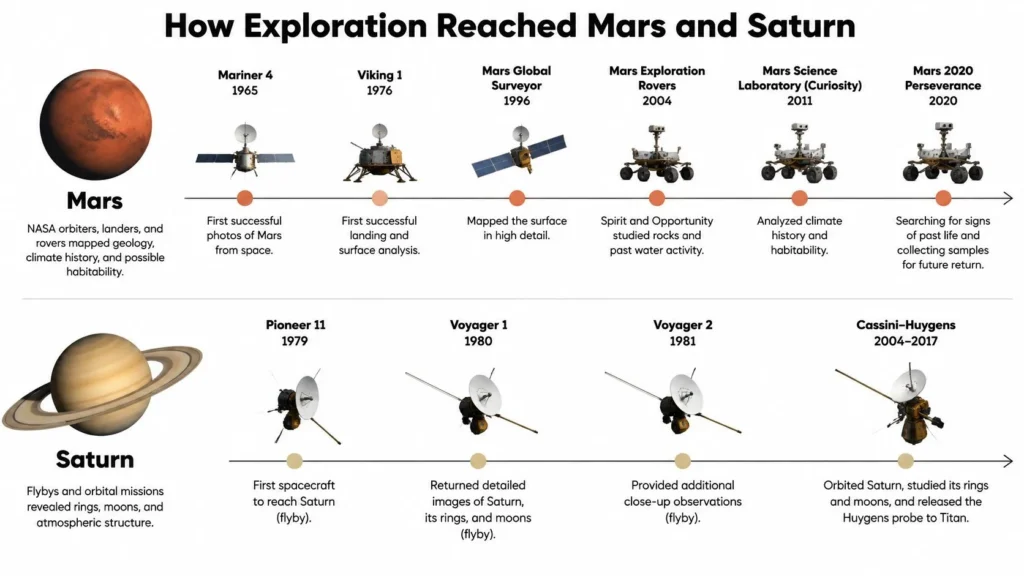
Mars exploration has developed as a continuing investigation with complementary vantage points. Orbiters provide regional context, landers measure conditions at particular locations, and rovers connect observations across accessible terrain. Each approach helps scientists interpret what the others can’t resolve alone.
That combination is especially useful when investigating ancient water. A feature seen from orbit can suggest a promising setting, but close measurements are needed to examine its materials. Surface results then gain meaning from their position within the broader environment.
From brief encounters to sustained observation
Saturn’s exploration followed a different sequence: initial flybys established close-up knowledge, then a long orbital mission allowed repeated observations. NASA’s Saturn facts records Pioneer 11’s first close observation in September 1979, Voyager 1 and Voyager 2 flybys in 1980 and 1981, and Cassini’s orbital mission from July 1, 2004, to September 15, 2017, during which it completed 162 moon flybys over 13 years.
The chronology has a clear progression:
- 1979: Pioneer 11 provided the first close encounter.
- 1980: Voyager 1 continued the flyby investigation.
- 1981: Voyager 2 added another close observational opportunity.
- 2004: Cassini began sustained orbital exploration.
- 2017: Cassini’s mission ended after its extended investigation of the system.
Repeated visits change the questions
A flyby gives researchers a valuable but restricted encounter. An orbiter lets them plan follow-up observations, compare conditions over time, and approach different targets under different viewing geometries. Cassini’s investigations of Saturn’s atmosphere, rings, Enceladus, and Titan benefited from that sustained access.
Mars’s landed campaign offers a different kind of continuity. Researchers can connect local geology with climate history and assess whether particular settings could once have supported microbes. Evidence of flowing water establishes environmental history, not the discovery of organisms.
Mission design also connects science to manufacturing. Readers curious about how spacecraft components are made can explore additive manufacturing for spacecraft through American Additive Manufacturing, while keeping the scientific requirement separate from any particular fabrication choice.
For a broader introduction to the vehicles and methods involved, these space exploration facts offer another starting point. The central distinction remains scientific: Mars investigations reconstruct past surface environments, while Saturn-system investigations examine planetary evolution, potential subsurface oceans, and chemistry relevant to life’s ingredients.
What Each World Is For in Solar System Science
Ancient Mars needn’t have been continuously warm to have been wet. A 2025 NASA-supported study identified ferrihydrite in Martian dust and rocks, an iron mineral that can form in cool water, according to NASA’s account of the ferrihydrite finding. That finding complicates the familiar picture of a comfortably Earth-like planet that dried out.
Ferrihydrite can form at lower temperatures than minerals such as hematite. Its presence therefore supports investigating cooler wet conditions, rather than assuming that liquid water required a persistently warm global climate. It doesn’t, by itself, settle every question about ancient temperature or the duration of wet episodes.
Separate water evidence from life evidence
Scientists must distinguish between identifying a process and reconstructing an entire environment. A water-related mineral offers evidence about chemical formation conditions. A channel or sedimentary feature offers evidence about how water interacted with terrain.
Neither category is automatically a biological finding. To move from a potentially habitable setting to a claim of life, scientists need evidence that specifically supports biology and withstands plausible nonbiological explanations.
Ancient habitability isn’t the same as a planet that was permanently comfortable or known to be inhabited.
The present-day contrast matters too. Mars’s atmosphere is now too thin and cold to sustain surface liquid water for long periods. A geological record of abundant ancient water doesn’t mean similar conditions persist today.
Compare environments rather than promises
Saturn’s system poses another habitability question. Scientists aren’t looking for comfortable ground on the giant planet. They’re investigating whether environments associated with its moons combine water, useful chemistry, and conditions relevant to biological processes.
Organic particles deserve careful interpretation here. Organic doesn’t mean biological: finding carbon-bearing chemistry isn’t equivalent to finding an organism. Its importance lies in what scientists can learn about available ingredients and the processes that transform them.
The practical choice follows your subject:
- Climate history: Use Mars to investigate how minerals and landforms constrain a rocky planet’s past.
- Ocean-world chemistry: Use Saturn’s moons to examine environments that needn’t resemble a sunlit terrestrial surface.
- Engineering habitability: Separate naturally occurring conditions from the systems people would have to build to survive.
That last distinction also matters when considering how long terraforming Mars could take. Evidence that a planet once had potentially habitable environments doesn’t establish that humans could readily recreate them.
Mars and Saturn are most useful as different laboratories. One preserves accessible clues in rock; the other offers a collection of atmospheric, icy, and chemical environments whose significance depends on asking the right question.
Pick Mars or Saturn for the Question You Have
Choose Mars for questions that need geological context. If you want to understand red soils, altered minerals, sediment, or the practical work of examining rocky terrain, it’s the more relevant comparison. A sample’s position and relationship to nearby material can matter as much as its chemical composition.
Mars also suits questions about how engineers select a landing site and keep instruments operating on terrain. Don’t confuse that relevance with ease: a recognizable scene can still demand specialized equipment and careful environmental protection.
Choose the system when interactions matter
Choose Saturn for questions about gas giants, rings, orbital dynamics, and ocean-world chemistry. The useful object of study may be a particle band, a moon’s emitted material, or a changing atmospheric pattern rather than the central planet in isolation.
For example, a reader interested in how scientists infer conditions beneath an icy exterior should focus on the relevant moon and the measurements available from it. A reader interested in spacecraft routes through orbiting debris should focus on ring structure and trajectory design.
The mismatches are equally useful. Mars is the wrong model for a hydrogen-and-helium giant or a broad ring system. Saturn is the wrong model for a habitat resting on exposed planetary ground.
Turn curiosity into a focused next step
- Record the surprising comparison. Choose the entry in the opening table that most changed your expectations, whether that was density, rotation, or the absence of a solid surface.
- Translate it into a question. Ask what that property changes for an instrument, a vehicle, or the interpretation of possible habitability.
- Follow a relevant explainer. Read a mission account or current sky guide focused on your chosen target, and distinguish observations from interpretations.
A good comparison doesn’t need a winner. It needs a defined question and evidence capable of answering it. Match the planet to the evidence you need: surface minerals for Mars, and ocean-world investigations and system-scale ring dynamics for Saturn.
For more approachable explanations of planets, spacecraft, and the science behind everyday headlines, visit maxijournal.com. Explore its science and technology writing, then choose a topic that follows your question, from rocky-world geology to the engineering of space exploration.
Discover more from Maxi Journal
Subscribe to get the latest posts sent to your email.