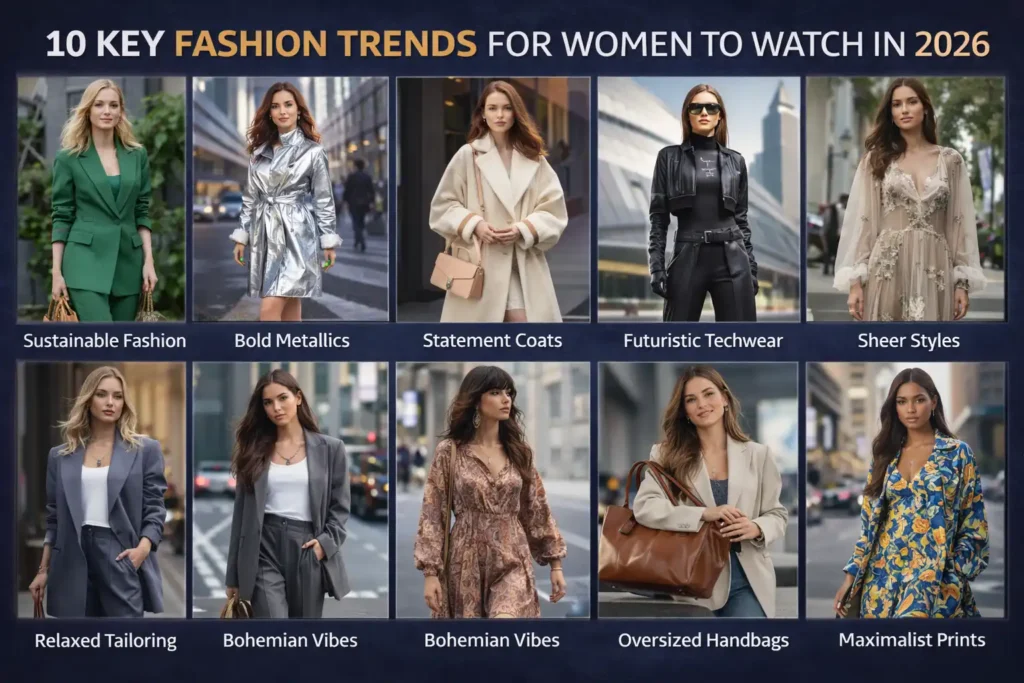
The most popular advice on maximalist fashion style is wrong. You’re told to add another print, another layer, another necklace, as if boldness were a shopping total. It isn’t. A maximalist outfit works when its excess is coordinated, with one element leading and the rest supporting it, and it fails when every piece shouts at the same volume.
Think of it as a modular system of visual intensity. You can raise or lower that intensity with color, volume, texture, or a single accessory, without buying a new wardrobe or looking like you’re in costume.
What Maximalist Fashion Style Really Means
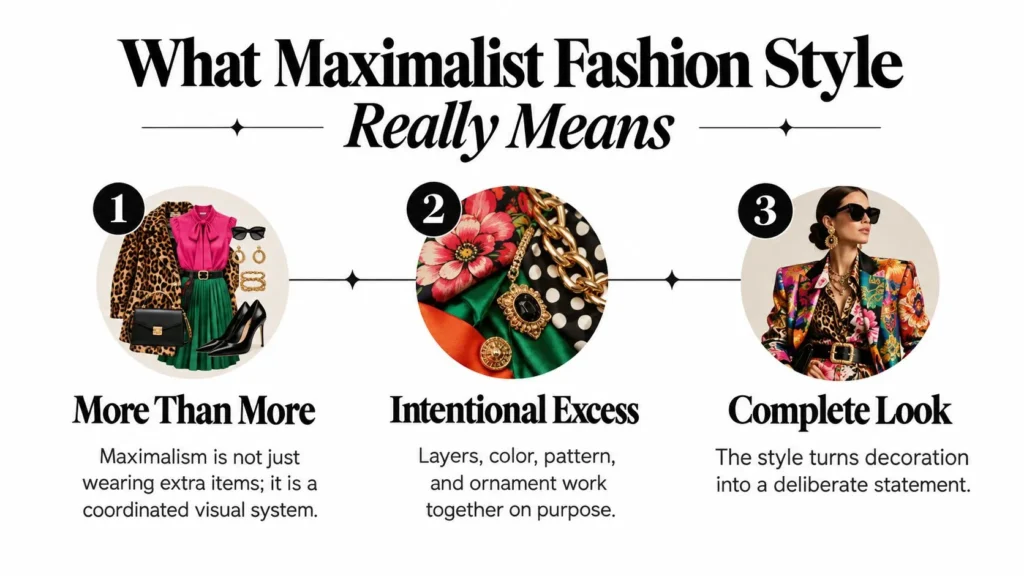
Maximalism doesn’t mean wearing everything you own at once. It’s a deliberate arrangement of spectacle, eclecticism, extravagance, and varied visual references so the density reads as a statement, not an accident. A cobalt blazer, a striped shirt, and leopard shoes can cohere if cobalt and black repeat across the outfit. Without that repetition, the same three pieces just compete.
That distinction matters because readers often confuse quantity with intention. You can wear a lot and look muted if everything’s beige and flat. You can wear very little and look maximalist if a sculptural red shoe or an oversized brocade jacket carries the whole look.
A Pendulum, Not a Single Decade
Maximalist fashion style wasn’t invented on social media, and it wasn’t invented in the 1980s either. The Museum at the Fashion Institute of Technology’s 2019 exhibition Minimalism/Maximalism traced the interplay between the two approaches from the 18th century through contemporary fashion, showing excess and restraint repeatedly alternating. Ornament rises, then people tire of it and strip back, then restraint feels dull and decoration returns.
The 1980s were a loud swing toward excess. Thierry Mugler and Gianni Versace used exaggerated silhouettes, vivid color, and elaborate surface treatments linked to power dressing, where wide shoulders and saturated color signaled confidence at a glance. Postmodern fashion in that period also merged sartorial signs and motifs that had previously been kept separate, so a sharply cut jacket could sit alongside theatrical print without apology.
The counter-swing followed in the 1990s. Helmut Lang and Martin Margiela promoted austerity, while Prada developed an approach described as invisible luxury, where quality hid in cut and fabric rather than decoration. Neither pole won permanently, which is the point.
Maximalism is a recurring cultural response to restraint, not a personal quirk and not a one-season trend.
That history gives you permission to be selective today. If you’re drawn to a magenta wide-leg trouser with a sharp black blazer, you’re not copying a runway stunt. You’re working in a long tradition where conspicuous presentation alternates with understatement, and where bold dressing communicates status, mood, and cultural references at the same time. The wearable question isn’t whether maximalism is “in.” It’s how much visual density you want, and where you want the eye to land first.
The Core Principles of Maximalist Dressing
A useful analogy is cooking. Pattern, volume, and color are like heat, salt, and acid. You can use all three, but if you max out every dial, you can’t taste anything clearly.
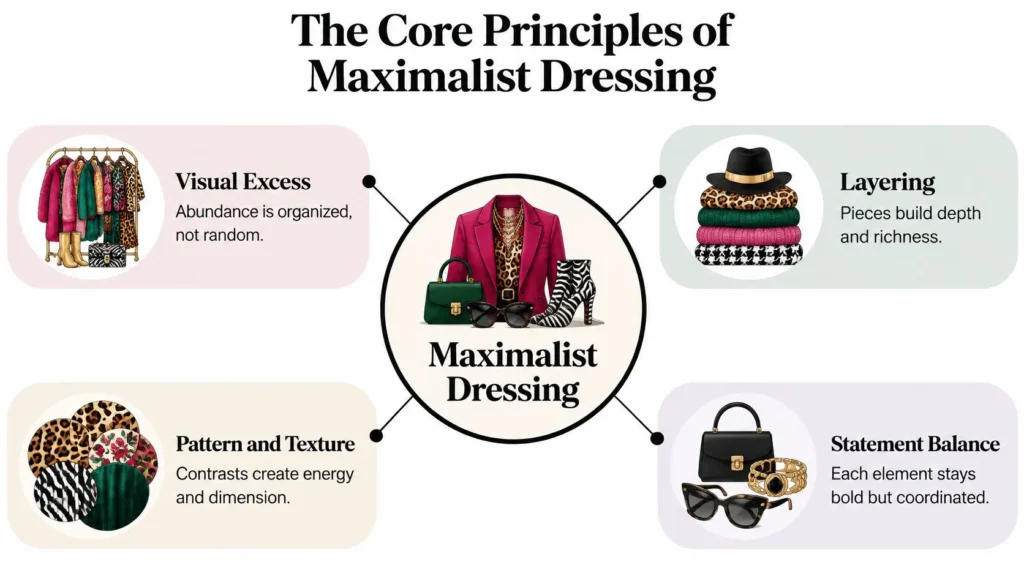
The Fashion Institute of Technology identifies maximalism’s core design variables as pattern, volume, and proportion, supported in practice by color contrast, surface texture, and historical or cultural reference. Those five variables create visual mass, meaning how heavy and attention-grabbing a garment appears. A puff sleeve has more visual mass than a flat sleeve. A large floral has more than a pin dot.
How Visual Mass Builds
Increase one variable and the garment gets louder. Add a voluminous skirt in emerald satin and you have expanded silhouette plus saturated color plus shine. That’s already three dials up. If you then add a large-scale geometric top, a chunky necklace, and platform boots, you’ve created competition instead of hierarchy.
Hierarchy solves that confusion. Pick one primary anchor and let everything else support it at a lower intensity.
- Anchor by silhouette: Wear the emerald voluminous skirt with a fitted black knit top, small gold hoops, and a sleek shoe. The skirt leads.
- Anchor by print: Wear a bold Versace-style baroque shirt, then keep trousers solid navy and shoes plain leather. The print leads.
- Anchor by accessory: Wear charcoal tailoring, then add a scarlet sculptural shoe and repeat scarlet in a lip or a small bag charm. The accessory leads.
Notice what’s happening in each version. You’re not removing personality. You’re deciding which element gets the largest share of attention.
Practical rule: Make one element obviously dominant, one element clearly secondary, and keep the rest quiet enough to let both read.
Coherence doesn’t require matching sets. It comes from repeating a controlled attribute, such as a shared color family, a similar material finish, or a repeated geometric motif. A vintage brooch, a modern blazer, and a pleated skirt from another era can work together if brass tones or sharp tailoring lines repeat across them. That’s how maximalist fashion style synthesizes disparate references without looking random. You’re building a system, not stacking decorations.
When an outfit feels “too much,” don’t automatically remove a piece. First check whether two anchors are fighting. Often you only need to shrink one scale, darken one color, or smooth one texture to restore order.
How to Mix Prints and Textures Without Looking Chaotic
Pattern mixing confuses people because they’re told to be fearless, then blamed when the result looks fragmented. Fearlessness isn’t a method. Scale, color, and sequence are.
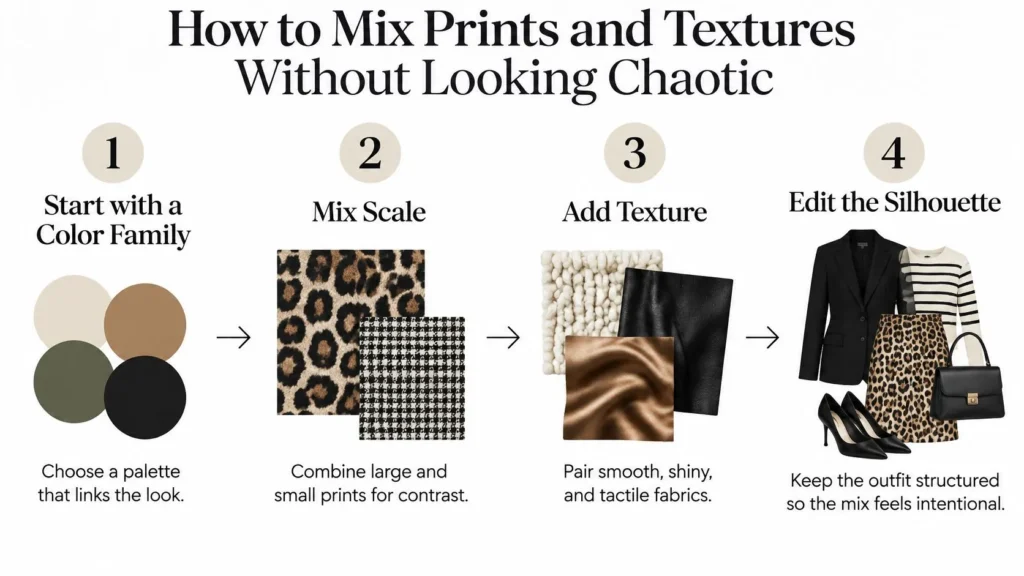
Research on maximalist design categorizes its expression through colorful palettes, multiple patterns, exaggerated volume, decorative layering, style fusion, and combinations of unlike materials. Complexity comes from how pattern density, motif scale, directional structure, and fabric surface interact, not from how many prints you count. Two prints can clash badly. Four can harmonize if they share a parameter.
A Four Step Sequence You Can Repeat
1. Start with a base color. Choose the color that will repeat and stabilize the outfit. For example, pick ink navy as your base if you’re wearing a navy and cream striped trouser. That navy will reappear somewhere else.
2. Add the dominant print. Make this the largest or boldest motif, such as an oversized floral blouse in navy, cream, and rust. It should be readable from across a room. Everything after this is subordinate.
3. Add the secondary print at a different scale. Pair that large floral with the smaller, tighter stripe in the trouser. The motifs differ, floral versus geometric, but the dominant hue and value range align, and the scale difference creates hierarchy. Pairing two large, high-contrast prints with no shared hue is what usually creates fragmentation.
4. Layer texture or an accessory last. Add rust suede shoes or a woven bag that repeats the rust in the blouse. Texture now reinforces the color story instead of introducing a new argument.
Another wearable version works for cooler weather. Start with black as the base, wear a large houndstooth coat as the dominant print, then add a fine polka dot scarf in black and white as the secondary print. Finish with patent leather boots for shine. Scale changes, color doesn’t, so the mix feels intentional.
Material contrast follows the same logic. Velvet with denim, silk with tweed, or sequin with matte wool creates richness because the surfaces catch light differently. Keep one surface dominant, though. If your top is sequined and your skirt is heavily fringed and your bag is beaded, the eye gets no resting place.
When you’re unsure, photograph the outfit and squint. If you can’t tell which print is dominant within two seconds, reduce the secondary print’s scale or contrast. That quick test catches most chaotic mixes before you leave the house.
Maximalist vs Minimalist Fashion Compared
Minimalism isn’t maximalism’s enemy. They’re alternating tools, and many strong wardrobes use both depending on setting, weather, and energy. You might choose maximalist fashion style for a gallery opening and a stripped-back look for a long travel day, and that’s strategy, not inconsistency.
The practical differences show up in daily decisions. Minimalist dressing reduces variables, so getting dressed is faster and outfits repeat invisibly. Maximalist dressing increases variables, so a single piece can transform basics you already own, but it asks for more editing.
| Criterion | Maximalist | Minimalist |
|---|---|---|
| Visual impact | High and immediate, one anchor can define the whole outfit | Low key and gradual, quality shows up close in cut and fabric |
| Versatility | Statement pieces restyle differently with different supports | Neutral pieces combine easily with almost everything |
| Cost per wear | Strong when an anchor is repeated often, weak if bought for one event | Strong through frequent, unnoticed repetition |
| Maintenance | Sequins, beading, and delicate vintage need gentler care | Simpler surfaces are usually easier to wash and repair |
| Workplace fit | Works selectively, such as tailoring plus one vivid accessory | Fits conservative settings with little adjustment |
| Hot climates | Works through color, print, and jewelry rather than heavy layers | Works through breathable, simple silhouettes |
Choosing by Situation, Not by Label
Ask three questions before you commit to either mode that day.
- Setting: Does this room reward being memorable, or does it reward blending in? A client pitch in a conservative office might call for charcoal suiting with one saturated brooch. A creative studio might welcome a full print mix.
- Comfort and climate: If it’s humid, skip layered jackets and build intensity with a printed wide-leg trouser, a sleeveless top, and stacked bangles. You get density without heat.
- Repetition: Will you wear this anchor again next week in a different combination? If yes, maximalism can be economical. If no, borrow, rent, or shop secondhand first.
People also worry that maximalism only suits certain body types. It doesn’t. Proportion is adjustable for everyone. If you love volume, place it where you want attention and keep the adjacent piece closer to the body, such as a voluminous sleeve with a straight trouser. The label matters less than where you’ve placed the visual mass.
Designers and Street Style That Shaped Maximalism
Runway maximalism can look unwearable until you translate it into proportions you recognize. Street style does that translation in public, which is why it’s such a useful teacher.
The image below shows the runway version of that bold, print-led approach before it’s edited for daily life.
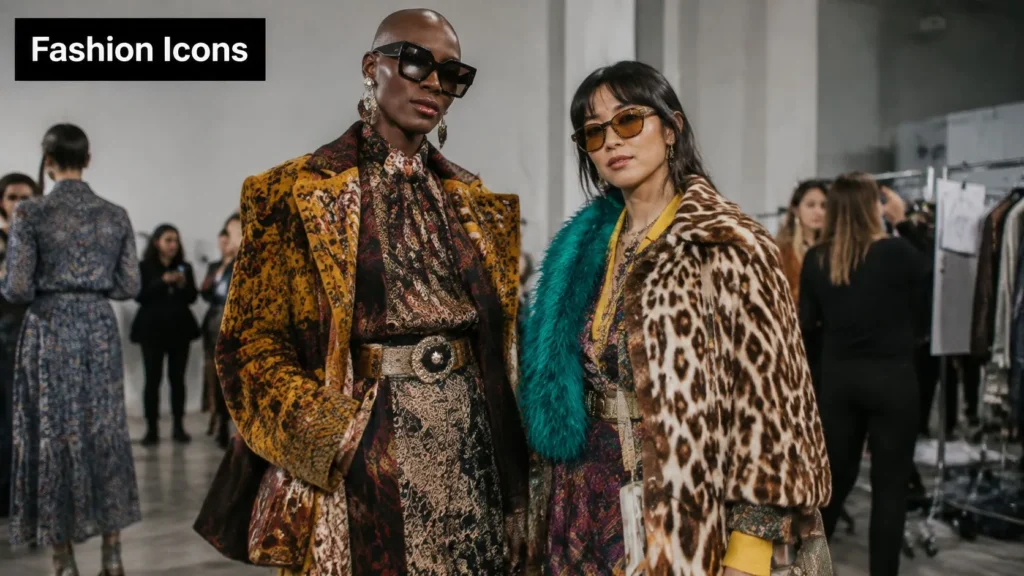
In the 1980s, Mugler’s sharp, exaggerated tailoring and Versace’s vivid prints and strong visual identity made power dressing theatrical. The wearable lesson isn’t to copy a full runway look. It’s to borrow one element, such as a defined shoulder, a gold-buttoned blazer, or a saturated print scarf, and pair it with familiar basics. A strong-shouldered black blazer over jeans and a printed silk top gives you the reference without the costume.
Contemporary street style has shifted toward selective maximalism. Recent trend reporting says searches for “maximalist accessories” reportedly rose 105%, while “heirloom jewelry” rose 45%. The examples are deliberately modest in scope: pairing one vivid item with neutrals, combining vintage jewelry with contemporary tailoring, or personalizing a familiar bag with charms and scarves.
Watch how those combinations work as you look through current fashion trends for women and street photos from fashion weeks. You’ll notice the same editing pattern repeated. A plain trench gets a brocade bag. A white shirt gets layered heirloom necklaces. A neutral suit gets a fuchsia shoe. One dial goes up, the others stay steady.
The video below is useful for seeing that movement and proportion in real time, rather than judging a look from a single still image.
Treat street style as a laboratory, not a shopping list. Screenshot looks you like, then name the anchor in each one. If you can’t name it, the outfit is probably relying on novelty rather than structure, and it’ll be harder to recreate with your own clothes.
Building a Maximalist Wardrobe on Any Budget
You don’t need more clothes to dress with more intensity. That’s the contrarian core of a modular approach. A single sculptural shoe, archival print, brooch, or saturated accessory can carry neutrals you already own, and accessories let you dial a look up for evening or down for work without changing garments.
Many guides fail readers here. They ignore budget, workplace, climate, and comfort, then wonder why people try maximalist fashion style once and quit. A better framework starts with visual intensity, repetition, cost per wear, and setting.
A Decision Framework That Travels
- Shop your existing anchors first: Pull out your boldest skirt, brightest shoe, largest earring, and most patterned scarf. Build three outfits around each using only basics you own. You’ll often discover you need nothing new.
- Buy the repeatable anchor, not the one-off novelty: A leopard coat you wear over black, denim, and red dresses earns its place. A heavily embellished top that only pairs with one skirt doesn’t.
- Adjust for climate with surface, not layers: In heat, use print, saturated color, metallic sandals, and jewelry. In cold weather, add texture through tweed, velvet, and knit.
- Use secondhand as your first stop: Vintage and resale offer distinctive prints and jewelry at lower cost, and older pieces often have the ornament fast fashion copies poorly.
Sustainability belongs in this conversation, and what sustainable fashion means in practice helps frame the distinction. Spring/Summer 2026 data cited by Lectra Retviews showed sequins up 40% and fringe up 34% across collections, while reporting also connects decoration’s return with resale and vintage. Decoration itself isn’t the problem. Durable maximalism, meaning repairable garments, inherited jewelry, vintage textiles, local craft, and repeated styling, differs sharply from trend-driven accumulation that you discard quickly.
More expressive should replace more purchases, or maximalism becomes just another form of overconsumption.
Cultural responsibility needs the same practical clarity. Before wearing a motif you don’t know, identify its origin and meaning, credit makers where you can, and don’t wear sacred or ceremonial designs as costume. Prefer authentic secondhand or artisan-made pieces over mass-produced imitations of culturally significant patterns. That research takes minutes and prevents a bold outfit from becoming a careless one.
Visually distinctive pieces can support longevity when they stay personally meaningful and get restyled repeatedly. The inherited necklace you wear weekly is more maximalist, and more sustainable, than a bag of disposable novelty items.
Your First Maximalist Outfit and Where to Go Next
Start small enough that you’ll leave the house. Confidence builds through successful repetition, not through one dramatic debut.
Build One Outfit This Week
- Choose one anchor you already like. Pick a printed skirt, a scarlet shoe, a brocade blazer, or layered gold necklaces. Don’t buy anything yet.
- Repeat one color or material. If the anchor is a rust and navy floral skirt, repeat navy in your top and rust in your bag or shoe. Repetition is your safety net.
- Control volume in the supporting pieces. If the skirt is full, keep the top fitted. If the blazer has strong shoulders, keep trousers straight and simple.
- Use accessories to set intensity. Add earrings for a dinner version. Remove them and switch to a plain tote for a work version. Same outfit, different dial setting.
Test that outfit in a familiar, low-stakes setting first, such as coffee with a friend, before wearing a bolder version to an event. Photograph it in daylight and note what you’d change. That habit does more for your eye than saving hundreds of inspiration images, and it’s central to how to develop a fashion sense over time.
From there, expand one variable at a time. Next week, keep the same anchor and introduce a secondary print at a smaller scale. The week after, keep the prints and change the texture. You’ll learn which dials you enjoy turning up and which feel like noise on your body and in your life.
Maximalism is a skill built through editing and repetition, not a personality trait you either have or lack. You aren’t behind if your first version is just tailoring plus heirloom jewelry. That’s selective maximalism working exactly as intended, and it’s a legitimate place to stay if it suits you.
If you’re building your first maximalist outfits and want more grounded fashion writing to learn from, maxijournal.com publishes daily articles across fashion, arts, and culture, and welcomes contributors who want to share their own styling perspectives. Visit to keep exploring bold dressing ideas, discover fresh voices, and consider submitting your own take on maximalist style.
Discover more from Maxi Journal
Subscribe to get the latest posts sent to your email.