Players once bought game advice in numbers associated with bestselling books: Ken Uston’s Mastering Pac-Man reportedly sold 1.7 million copies, according to the history of commercial strategy guides. The format has changed, but the underlying problem hasn’t. Players still need help distinguishing a productive next move from another frustrating attempt.
The best game strategy guides do more than reveal the next step. They reduce uncertainty, preserve your choices, and help you spend more time playing and less time searching. But a walkthrough, a systems reference, an achievement checklist, and a build recommendation solve different problems.
Before choosing a resource, identify what’s blocking you:
- Progression: You need a route through a quest, puzzle, or boss encounter.
- Understanding: You need an explanation of mechanics, equipment, or character interactions.
- Completion: You need to track missing objectives without replaying finished content.
Specificity matters. If you want to browse Dire Maul dungeon bosses, start with encounter-level information rather than a general class guide. The same principle applies to the resources below: choose by game, platform, version, and immediate need, not reputation alone.
1. IGN Guides
Best fit: mainstream releases when you want visual help alongside written instructions. IGN Guides organizes its game help into title-specific hubs, with walkthroughs, collectible locations, puzzle solutions, boss advice, maps, and videos available depending on the game.
That combination makes IGN a practical starting point when describing your obstacle is harder than recognizing it. A screenshot can help confirm that you’re standing at the correct doorway, while written instructions explain what to do next. Related reviews and news provide broader context, although they aren’t substitutes for checking the walkthrough itself.
Coverage is title-dependent. Finding a game hub doesn’t establish that every optional quest, collectible, or late-game encounter has been documented. Open the relevant subsection before committing to IGN as your main reference.
Check the Destination Before Following the Route
For story-driven games, search for the specific objective rather than reading continuously through the campaign. Step-by-step instructions can expose later locations or plot developments before you intended to discover them.
- Presentation: Choose screenshots for spatial problems and text for sequences you’ll need to repeat.
- Maintenance: Check whether the relevant page acknowledges your release, expansion, or changed mechanics.
- Limitations: Advertising and embedded media can make the page busier than a focused reference document.
For a planning problem rather than a blocked quest, targeted reading such as Stardew Valley tips may be a better complement than a campaign-style walkthrough.
My recommendation: Use IGN to orient yourself quickly, then verify the exact subsection’s completeness. Its broad editorial setting is convenient, but your decision should depend on the instructions you need.
2. GameFAQs
An obscure item name or an old console release calls for a different search strategy. GameFAQs offers player-contributed FAQs and guides across many systems, including older games, with walkthroughs, maps, character references, charts, cheats, and secrets.
Its strongest use case is precise retrieval. A detailed text guide can let you search directly for an enemy, location, or quest term without following a video timeline. Community questions and message boards offer another place to investigate problems that the main walkthrough doesn’t address.
The trade-off is that contributors choose different formats and levels of detail. One author may explain every prerequisite, while another assumes you already understand the game’s systems. Treat authorship, revision notes, and platform labels as part of the guide, not administrative clutter.
Practical rule: Search for the mechanic and the game version together. A convincing explanation can still be wrong for your release.
Read the Header Before the Answer
Before following an archived route, inspect its platform, scope, and update information. A remaster, regional release, or altered edition may require different instructions even when names look familiar.
This is particularly important for systems-heavy topics. When comparing advice with an explanation of how to EV train, establish which game’s mechanics the instructions address before transferring the method elsewhere.
Maintenance is the central limitation: an old guide may remain excellent for an unchanged release, but age alone can’t establish compatibility with a newer edition. My recommendation is to choose GameFAQs for deep text references and retro research, then cross-check version-sensitive details rather than dismissing or trusting a guide solely because it’s old.
3. Gamepressure
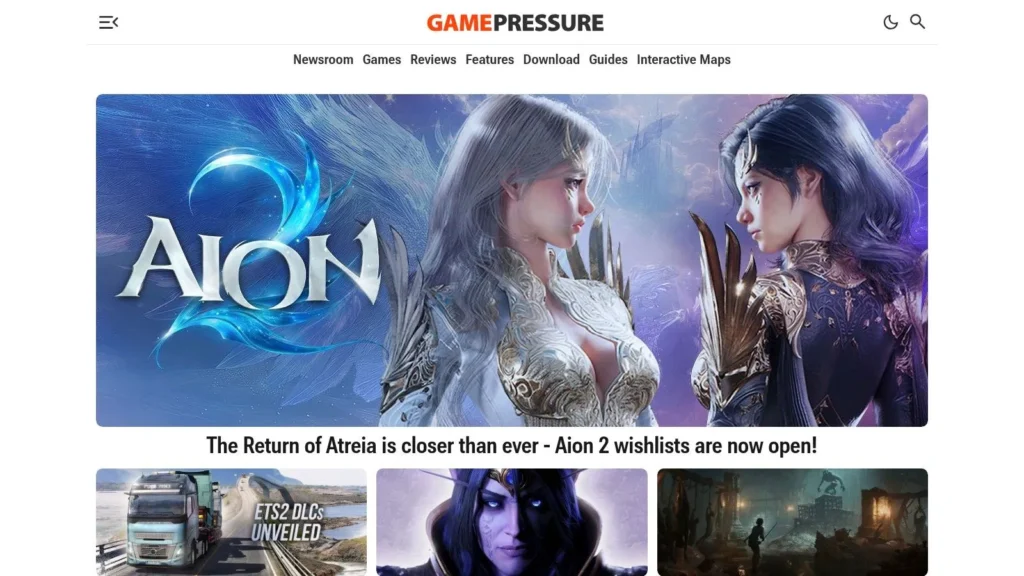
A large game needs navigable documentation, not just a long answer. Gamepressure combines editorial guides with reviews, news, and features. Depending on the title, its guide material includes walkthroughs, beginner advice, collectibles, maps, and explanations of choices or endings.
The supplied screenshot offers a visual reference for the site.
For story-driven or open-world games, I’d evaluate Gamepressure by how well its guide separates different tasks. You may need a main-quest route today and a collectible reference later. Those needs shouldn’t force you to read through ending explanations along the way.
Evaluate the Guide as a Navigation System
Start by opening its contents and following the path to your current objective. Check whether the relevant page states prerequisites, identifies the location clearly, and distinguishes required progress from optional exploration.
- Coverage: Confirm that the guide includes your expansion or release, not just the base campaign.
- Presentation: Prefer clearly separated routes, maps, and decision explanations over undifferentiated instructions.
- Maintenance: Look for update information relevant to the actual advice, especially after patches or downloadable content.
Advertising and surrounding editorial content may add distractions, and depth varies by game. A well-organized hub is useful only if its destination pages contain enough detail to act on.
If you’re still choosing a title, games to play on PC addresses that earlier decision. Once you’ve chosen, Gamepressure is worth considering for structured progression help, particularly when you expect to return to the same guide repeatedly rather than resolve a single question.
4. Neoseeker
Missing an achievement after finishing a campaign is a different problem from being unable to finish it. Neoseeker provides walkthroughs, FAQs, achievement guides, and game-specific community pages, making it a candidate for both progression and completion-focused help.
Its collection combines older author-submitted text guides with newer walkthroughs and specialty material. Written instructions sit alongside some video help, while forums and community-editable walkthroughs provide additional formats. That variety is useful, but it makes page-level evaluation essential.
For a completionist, the key question isn’t whether a guide lists an achievement. It’s whether the instructions explain prerequisites and warn you before a decision could prevent completion.
- Before starting: Check whether the guide identifies missable objectives and relevant difficulty conditions.
- During play: Confirm that collectible directions match your current area and available abilities.
- Before replaying: Verify that the proposed solution addresses your missing requirement rather than a similarly named objective.
Judge Completeness by the Difficult Parts
Inspect a late-game section, optional objective, or complicated achievement before adopting the whole guide. An extensive introduction doesn’t prove that the author completed the sections you’ll eventually need.
Presentation can vary between pages, and some material may be unfinished or dated. Community participation also shouldn’t be mistaken for evidence that every instruction has been retested.
My recommendation: Use Neoseeker when you want written, game-specific help, especially for achievements or titles with limited coverage elsewhere. Keep a second reference available for irreversible choices, and record your own completed objectives separately if the page doesn’t provide a suitable tracking method.
5. Game8
Build advice needs more scrutiny than a door-opening instruction. A route can work as described while a character recommendation depends on equipment, teammates, encounter conditions, and balance changes.
Game8 is a relevant starting point for supported live-service and mobile games, including Genshin Impact and Honkai: Star Rail. Its game hubs can include character builds, tier lists, maps, quests, events, and beginner advice, alongside walkthroughs for console and PC titles.
The useful distinction is between reference information and recommendations. An item location answers where to go. A build ranking makes a conditional judgment about what you should invest in, which requires more context.
A build recommendation is useful only when you understand the conditions under which it works.
Check the Assumptions Behind the Ranking
Before spending resources, compare the suggested setup with what you own. Check whether the recommendation assumes particular teammates, equipment upgrades, combat execution, or access to time-limited content.
The guide’s presentation should help you distinguish an ideal configuration from a practical alternative. If it lists substitutions, read the explanation of what changes rather than assuming every replacement performs identically.
Maintenance matters most on the decision page itself. A recently updated game hub doesn’t establish that every linked build reflects the same patch. Look for version references and explanations of changes, not just a fresh date.
Game8’s coverage and depth vary by title, and advertising may affect browsing comfort. My recommendation is to use it for quick reference within supported ongoing games, while treating tier lists as starting hypotheses. Test affordable changes before committing scarce upgrade materials to a recommendation whose assumptions don’t match your account.
6. Prima Games eGuides
Prima’s appeal is structured, published guide material rather than an endless stream of updates. The Prima Games eGuides library provides access to strategy-guide material, including official guides, walkthroughs, maps, and collectible checklists for supported games.
That format has a substantial publishing history. Marketplace’s report on the strategy-guide business put annual industry revenue at approximately $100 million in 2006. The useful lesson isn’t that a commercial guide must be accurate, but that these resources were developed as companion publications rather than isolated answers.
For readers, a coherent structure can make it easier to plan a full playthrough. Where available, maps and checklists can help connect individual discoveries to a broader completion route.
Sample the Material Before Committing
Access conditions vary, so inspect the available preview and account or purchase requirements for your chosen guide. If you previously purchased an eGuide, check the current platform’s access process rather than assuming that any similarly titled edition is interchangeable.
- Coverage: Confirm the exact game and edition in the catalog.
- Presentation: Test whether maps, navigation, and checklists work comfortably on your device.
- Maintenance: Compare the guide’s original scope with later patches, expansions, or revised releases.
Official doesn’t mean permanently current. A formally produced guide may accurately document the release it accompanied while omitting later changes.
I’d choose Prima for a deliberate, completion-oriented playthrough when the available guide closely matches the game being played. I wouldn’t make an archived publication my sole authority for a substantially changed live-service system or a newly released expansion.
7. StrategyWiki
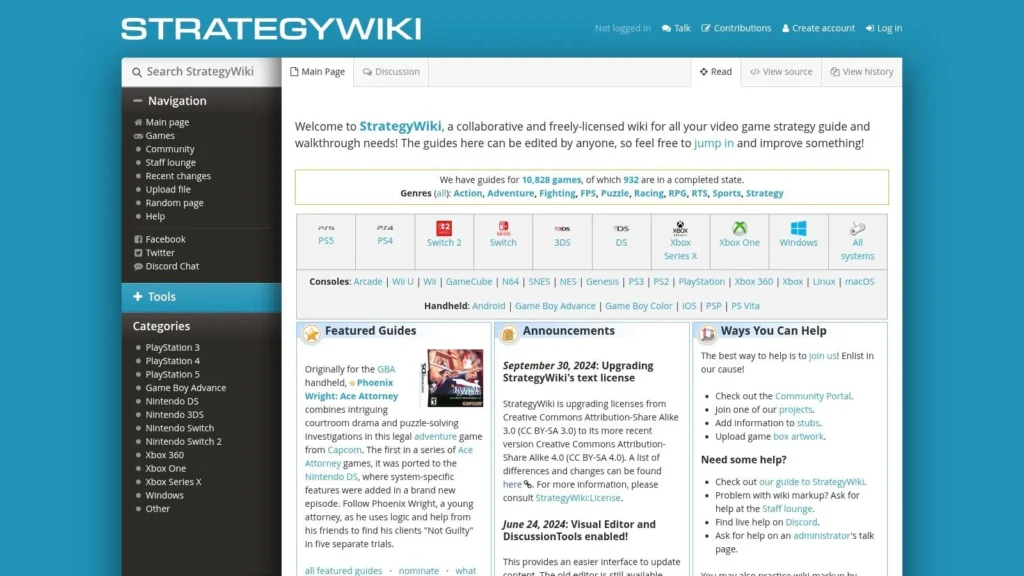
A collaborative guide can remain open to improvement without being complete today. That distinction should shape how you use StrategyWiki, a free wiki focused on game strategy guides and walkthroughs.
Its pages may cover campaign progression, characters, items, puzzles, and platform-specific details across different genres. Contributors can expand guides with text, tables, and images, but the existence of a game page doesn’t guarantee a finished route.
The supplied homepage screenshot provides a visual reference.
Best fit: a supplementary reference, particularly when editorial coverage is limited. It can also serve as a main walkthrough when the relevant material is sufficiently developed, but make that judgment by inspecting the pages you’ll need.
Distinguish an Outline From a Finished Guide
Open sections beyond the beginning. Check whether later chapters contain actionable instructions, whether item tables explain their terms, and whether platform differences are documented rather than merely mentioned.
Open editing offers a mechanism for maintenance, not a guarantee of recent testing. Where page history or revision information is available, use it to investigate what changed, then verify consequential advice against your game.
Before an irreversible choice: Confirm both the instruction and its prerequisites. A correct destination won’t help if you’ve already missed the required condition.
Sparse pages can still answer narrow questions, so incompleteness doesn’t make the entire resource useless. It changes the appropriate use case.
My recommendation is to use StrategyWiki selectively: trust a well-supported explanation for the question it resolves, avoid assuming neighboring sections have equal depth, and keep another reference available when a missing step could force a restart.
Comparison of 7 Game Strategy Guide Platforms
| Resource | Coverage | Guide Formats | Key Advantages | Ideal Use Cases |
|---|---|---|---|---|
| IGN Guides | Popular new releases and major console and PC games | Walkthroughs, maps, puzzle and boss help, images, and videos | Visual guides plus related reviews and news | Mainstream games and visual help for puzzles or collectibles |
| GameFAQs | Broad platform range, including older and retro games | Text FAQs, walkthroughs, maps, charts, cheats, and message boards | Large searchable archive with community support | Finding specific details or help with classic games |
| Gamepressure | PC, console, and Nintendo games; especially story-driven and open-world titles | Walkthroughs, tips, interactive maps, and choice guidance | Organized guides with editorial context | Navigating large games, collectibles, or branching storylines |
| Neoseeker | Broad platform and genre coverage, including classic and recent games | Walkthroughs, FAQs, achievement guides, videos, and forums | May offer detailed written guides for older titles | Finding text-based walkthroughs or achievement help |
| Game8 | Strong focus on mobile and live-service games, plus console and PC titles | Builds, character guides, tier lists, event information, and walkthroughs | Quick-reference pages for supported ongoing games | Checking builds, events, and game-specific tips; verify after updates |
| Prima Games eGuides | Published guides, many for games released between 2007 and 2018 | Official walkthroughs, interactive maps, and collectible checklists | Curated, structured guides for supported titles | Completionist help or games with limited current guide coverage |
| StrategyWiki | More than 10,000 games across many genres; completeness varies | Collaborative walkthroughs and reference pages with tables and images | Free, open editing and coverage of less-served games | Checking community-maintained game help, after confirming page completeness |
Choose Once, Then Play Smarter
The right guide is the one that resolves your current uncertainty without creating a larger problem. Choose IGN for visual orientation, GameFAQs for detailed text archives, Gamepressure for organized progression, Neoseeker for completion-focused research, Game8 for supported live-service references, Prima for structured published material, and StrategyWiki for collaborative documentation. These are starting recommendations, not guarantees about every game page.
Before following advice, confirm the platform, edition, difficulty, and relevant update. Treat damage figures, build rankings, and collectible requirements as information that may depend on those conditions. When resources disagree, compare their assumptions before deciding that either author is wrong.
Test Usefulness, Not Just Authority
Try the smallest reversible action that could confirm the advice. Check a landmark before following an entire route, test a control adjustment before rebuilding your playstyle, or inspect an item requirement before spending upgrade materials.
Accessibility belongs in that evaluation. The Google-hosted games-industry report identifies adjustable text size, difficulty, camera comfort, and subtitles among valued accessibility features. A tactically sound recommendation still isn’t a good fit if you can’t comfortably read its cues or execute its inputs.
- For players: Save the exact useful page, note its version, and return to the game once your immediate question is answered.
- For writers: Test every instruction, label platform-specific steps, record update dates, and explain when an alternative approach is preferable.
- For contributors: Pitch a specific reader problem with a concise sample and evidence that you solved it firsthand.
A strong guide preserves choices by explaining consequences before commitment. It also distinguishes tested instructions from conditional recommendations and marks uncertainty instead of disguising it.
For broader reading, MaxiJournal’s editorial scope connects games with technology, culture, and everyday life. Whether you’re choosing your next resource or preparing a guide of your own, keep the standard practical: can a reader reproduce the result under clearly stated conditions?
MaxiJournal publishes gaming guidance alongside approachable writing on technology, entertainment, and other areas of everyday life. Visit maxijournal.com to explore its game-related articles, compare their advice with your current needs, or develop a focused guide proposal grounded in firsthand play.
Discover more from Maxi Journal
Subscribe to get the latest posts sent to your email.