A physicist points a laser, cools a cloud of atoms, and watches matter behave in a way no kitchen-table object ever does. Elsewhere, another team sends a quantum state across open air and confirms that something once discussed as pure theory can now be handled like an experimental signal.
Quantum physics isn’t a finished chapter from the early twentieth century. New discoveries in quantum physics are arriving as lab-built realities, and their importance lies in a simple question: so what changes because of them?
Beyond Schrödinger’s Cat The New Quantum Era
A century ago, quantum physics entered public culture as a gallery of riddles. A cat that is somehow alive and dead. Light that behaves like a wave and a particle. Distant objects linked in ways that seem to ignore common sense. Those images are memorable, but they leave out the most important change. Quantum physics has shifted from a theory that mainly shocked us to a field that increasingly lets researchers build, test, and control strange forms of matter.
That shift matters because the stakes are no longer purely intellectual. Each new quantum discovery asks a practical question. What can this phenomenon do if scientists learn to reproduce it on demand?
One example came from Brown University physicists, who in 2025 reported the first experimental observation of fractional excitons, a new kind of quantum excitation with no overall charge and unusual statistical behavior. The finding matters less as a curiosity than as a sign that researchers are finding new pieces in nature’s quantum toolbox.
Why the field feels different now
For a long time, quantum mechanics reached the public as a theory of limits. You cannot know every property of a particle at once. You cannot predict the exact outcome of a single event. You cannot measure a system without affecting it.
Those statements are still true. The difference is that labs now treat them the way an aircraft designer treats turbulence or a chip engineer treats heat. They are constraints to work with, not reasons to stop.
Researchers now build cleaner experimental environments, create more precise measurements, and search for quantum effects that can be stabilized instead of washed away. In other words, they are not only asking what reality allows. They are learning which odd behaviors can become reliable components.
That is why a resource like Maeve’s overview of AI-powered quantum theory insights can help. It gives non-specialists a clearer map of the ideas behind discoveries that might otherwise sound like a pile of exotic jargon.
New discoveries in quantum physics matter because they turn quantum behavior into something closer to a usable toolkit.
The Deeper Story of Control
The headline usually focuses on the strange object itself. A new particle-like excitation. A new state of matter. A new measurement result. The more important story is what each one adds to human control.
A useful analogy is chemistry before the periodic table became practical. Elements were not just curiosities to name. Once chemists learned their patterns, they could make dyes, fertilizers, batteries, and medicines. Quantum physics is entering a similar phase. New excitations can serve as probes. New quantum states can act as platforms for devices. New detection methods can become hardware techniques.
So the new quantum era is not defined by mystery alone. It is defined by growing capability, and by a bigger question than Schrödinger’s cat ever raised. If we can identify and shape these fragile quantum effects, what kinds of computers, sensors, materials, and even new ideas about reality become possible?
The Quantum Engine Driving New Discoveries
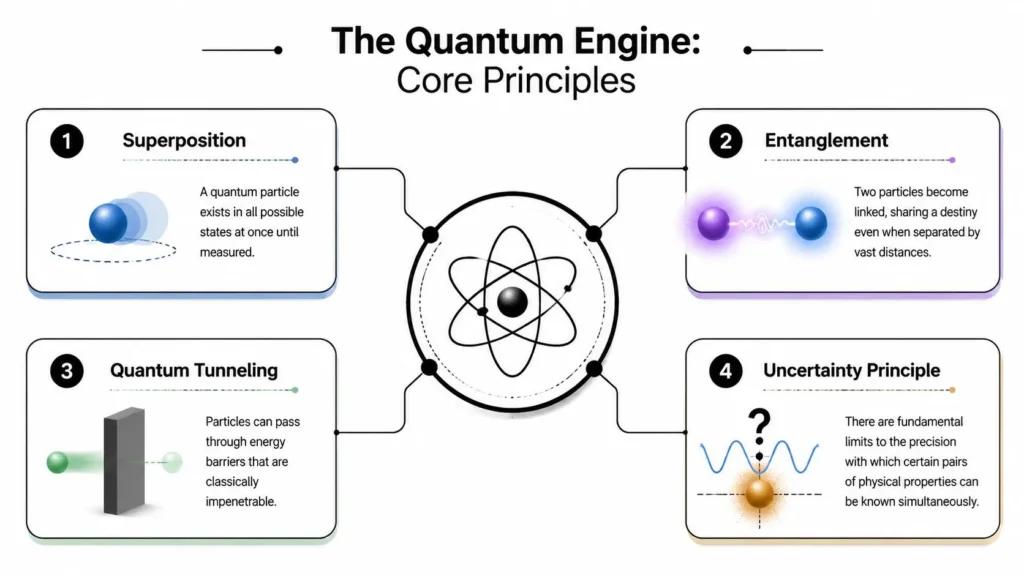
Quantum discoveries don’t come from magic. They come from a small set of ideas that are counterintuitive but experimentally powerful.
Superposition is possibility made physical
A useful analogy is a spinning coin. While it spins, it isn’t just heads or tails in the ordinary sense. It carries the potential for either outcome. Superposition is more than that analogy, but the image helps: a quantum object can exist in multiple possible states at once until a measurement forces a specific result.
That idea is easy to say and hard to feel. Readers often get stuck here because it sounds like scientists are claiming an object is doing contradictory things. A better way to think about it is this: the quantum system stores possibilities in a form that can interfere, combine, and evolve before measurement pins anything down.
Entanglement links outcomes
Now take a pair of “magic gloves.” You put one in one box and the other in another box. Open one box and instantly you know what’s in the other. That still isn’t quite entanglement, because real quantum entanglement is stronger and stranger than hidden matching.
With entanglement, two particles can share a single quantum description. Measure one, and the possible outcomes for the other are constrained in a way classical objects don’t imitate well. This is one reason quantum information is so powerful and so delicate.
Why these ideas became useful only later
The deepest concepts in physics often arrive long before the tools needed to exploit them. A clear historical example comes from Bose-Einstein condensation. In 1924, Albert Einstein predicted it, but it was only experimentally realized in 2001, when Eric Cornell, Wolfgang Ketterle, and Carl Wieman won the Nobel Prize in Physics for creating it, as described in this account of quantum breakthroughs from theory to technology. That mattered because it showed atoms can occupy the same quantum ground state, creating a new state of matter.
The lesson is bigger than BEC itself.
| Quantum idea | Early role | Later role |
|---|---|---|
| Superposition | A puzzling theoretical principle | A working resource in quantum devices |
| Entanglement | A philosophical headache | A basis for quantum information |
| Laser cooling | A precision lab method | A prerequisite for quantum computing and simulation |
The engine behind today’s momentum
Today’s burst of new discoveries in quantum physics is happening because old ideas have matured into tools. Physicists can cool, trap, drive, measure, and connect quantum systems with growing precision.
Practical rule: In quantum physics, a strange effect becomes transformative only after researchers learn to prepare it reliably and read it out cleanly.
That’s the engine. Not just theory, not just hardware, but the marriage of both.
Unveiling New Quantum States and Particles
The most exciting recent work in quantum physics often involves a phrase that can sound disappointingly bland: a new state. But a new quantum state can change what matter is capable of doing.
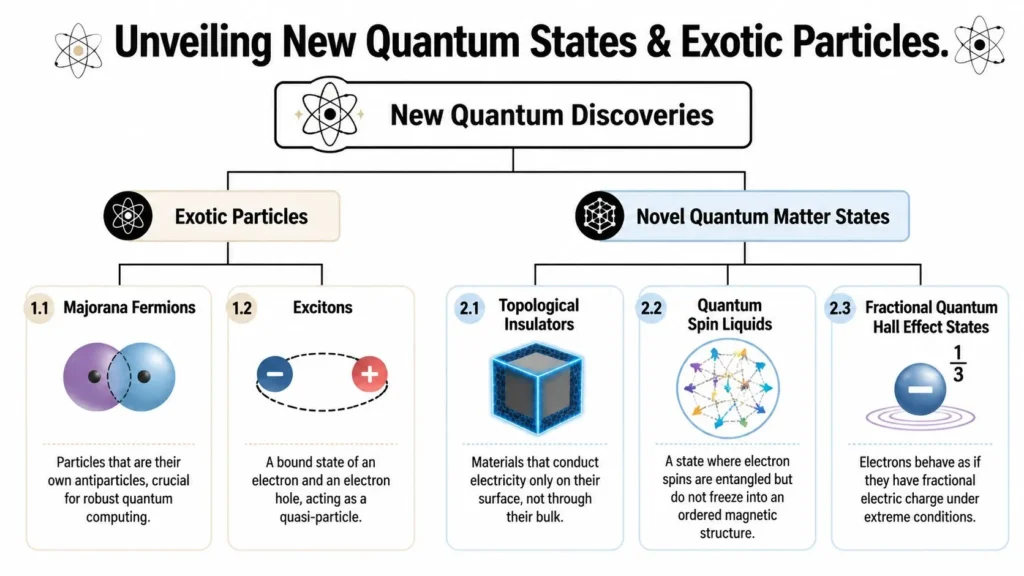
A familiar solid, liquid, or gas is defined by how many particles arrange themselves and move together. A quantum state of matter is defined more subtly. It depends on how particles correlate, how electrons organize, and whether the system’s collective behavior has special protections or symmetries.
When interactions create something unexpected
A striking example comes from researchers at Rice University and TU Wien, who modeled materials at a quantum critical point where strong electron-electron interactions generate an emergent topological semimetal, according to Rice’s report on this new quantum state and future technologies.
That sentence is dense, so let’s unpack it.
A quantum critical point is a kind of boundary between phases of matter. Near that boundary, fluctuations become intense and ordinary descriptions can break down. A topological semimetal is a material whose electronic behavior is shaped by topology, meaning certain large-scale structural features remain stable even if you disturb the system.
The big surprise in this work is that strong interactions do not merely destroy useful order. They can help create it.
Why that matters outside a theory paper
Many readers assume strong interactions only make a material harder to understand. Often they do. But here they also point toward a route for engineering stable topological behavior in strongly correlated systems.
That matters because resilient behavior is gold in quantum technology. If a property survives imperfections, it becomes more realistic to build devices around it.
- For computing, stable topological features may help preserve quantum information.
- For sensing, unusual collective responses can amplify subtle signals.
- For materials engineering, the result broadens the search beyond simple band-structure design.
If you want a broader particle-physics backdrop for how modern matter emerges from more basic ingredients, this primer on quarks and gluons offers a useful neighboring perspective.
A better way to think about exotic quantum matter
Don’t imagine a new quantum state as a weird substance in a beaker labeled “science.” Think of it as a new organizational rule for matter.
Some discoveries tell us what particles are. Others tell us what collections of particles can become when they interact intensely enough.
That shift is philosophical as much as technical. It suggests nature has more ways to organize itself than our textbook categories captured.
Mastering Quantum Systems and Information
Discovery alone isn’t enough. The central problem in quantum technology is control.
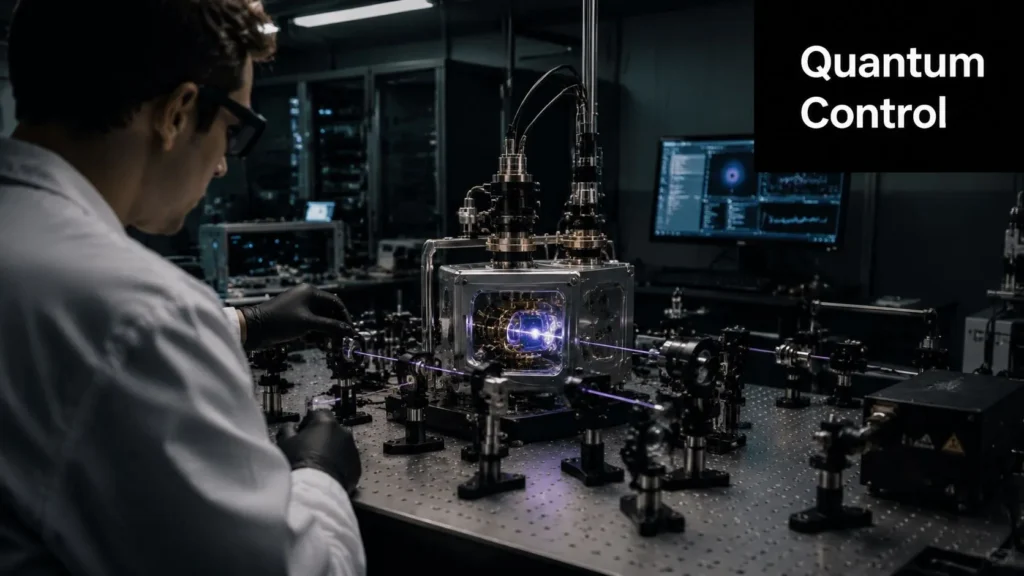
A quantum state is fragile. Noise from the environment, stray interactions, and imperfect operations can scramble the very behavior you want. That’s why so much of the frontier isn’t just “find something quantum.” It’s “keep it useful long enough to do something with it.”
Why fragility is the main engineering problem
A classical bit can be a sturdy switch. A quantum bit, or any delicate quantum state, is closer to a whisper in a crowded room. The information is there, but the world keeps trying to overwrite it.
Recent work holds particular significance. A 2026 result reported that time-periodic magnetic driving can create driven quantum phases with no static counterpart, and that periodically changing a magnetic field can produce more stable, error-resistant exotic quantum states, as described in this report on driven quantum phases.
The basic idea is elegant. Instead of treating the material as fixed and asking what phase it naturally has, researchers treat the control pattern itself as part of the design.
The waveform becomes a tool
That approach belongs to a family sometimes called Floquet engineering. The name sounds technical, but the intuition is simple. If you rhythmically drive a system, you may create behavior that doesn’t exist when the system is left alone.
Think of pushing a child on a swing. The timing matters as much as the swing. In quantum systems, the timing and form of the applied field can help stabilize rare and useful states.
For readers who want a gentler foundation before diving into these hardware ideas, this guide to quantum computing explained simply is a good companion.
Why this changes the conversation
Earlier waves of quantum research often emphasized observation. This newer phase emphasizes shaping.
- Prepare a quantum system under carefully controlled conditions.
- Drive it over time with a designed magnetic pattern.
- Create a phase that may be more resistant to noise than a static version.
- Use that stability as a practical advantage in future hardware.
Here’s a short visual explainer before going further.
What “more stable” really buys us
Stability is not a glamorous word, but it’s the difference between a lab curiosity and a machine. If researchers can make exotic quantum states less vulnerable to noise, they improve the odds that those states can support computing, simulation, or precision measurement.
One way to read recent new discoveries in quantum physics is this: scientists are learning that controlling time can be as important as controlling matter.
That’s a major conceptual upgrade. The hardware of the future may be defined not only by what it’s made of, but by how it’s driven.
How These Discoveries Will Shape Our Future
A century ago, quantum physics sounded like a set of riddles told by theorists. Now parts of it are starting to behave more like engineering. That shift matters because engineering changes daily life. It turns strange effects in the lab into sensors, networks, and devices that do useful work.
The pace is showing up in real devices
One sign of progress is simple. Researchers are no longer talking only about what quantum systems might do. They are building experiments that prepare unusual states, detect them more cleanly, and send fragile information across meaningful distances.
That change is easy to miss if you only watch headlines about quantum computers. The broader story is that many pieces of the quantum toolkit are improving at once.
ScienceDaily described a method for identifying elusive quantum W states more directly in a 2026 report on detecting multipartite entanglement more efficiently. In a separate 2026 report, ScienceDaily also covered photon-state teleportation between quantum dots across an open-air link. You do not need every technical detail to see why that matters. It means scientists are getting better at handling quantum information outside idealized thought experiments.
A good analogy is aviation. Early flight was about proving that a machine could leave the ground at all. Mature flight required navigation, stability, communication, and repeatability. Quantum technology is entering that second phase.
The benefits spread well beyond computing
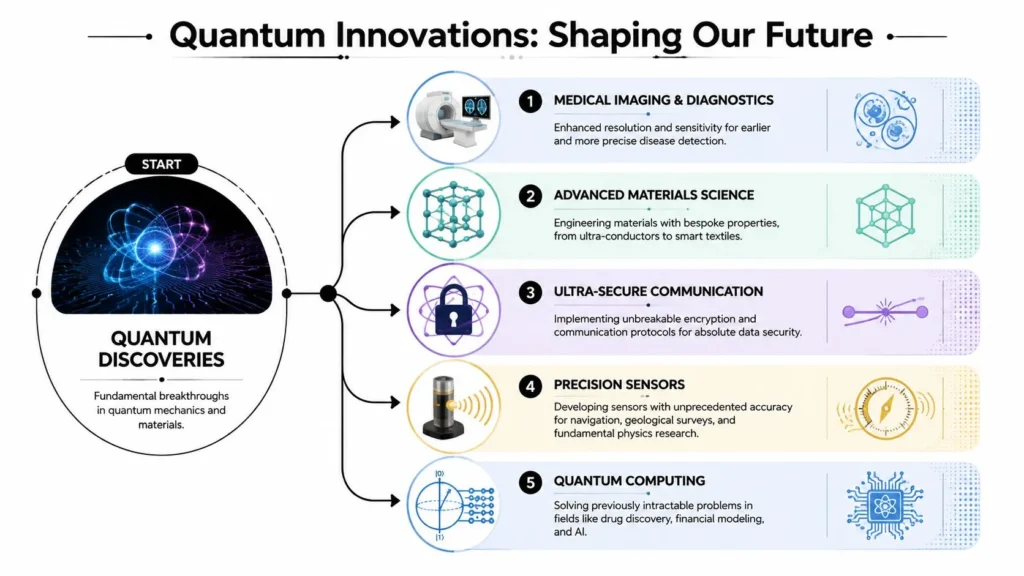
The practical payoff will likely arrive through many channels, not one headline machine.
- Medical imaging and diagnostics could improve as quantum sensors become better at spotting tiny magnetic or electrical changes inside complex environments.
- Materials science could move faster because researchers can probe matter with finer control, then design compounds with unusual electronic or magnetic behavior.
- Secure communication could get stronger as laboratories improve the transfer and verification of delicate quantum states across longer distances.
- Precision measurement could sharpen tools used in timing, navigation, and fundamental tests of physics.
- Computing still matters, but often as one part of a larger stack that includes sensing, simulation, and communication.
That distinction highlights the “so what?” Quantum research is unlikely to arrive all at once as a magical replacement for today’s electronics. It is more likely to seep into existing industries the way lasers did. First they looked exotic. Then they ended up in surgery, fiber optics, barcode scanners, and factory tools.
What changes first, and what changes later
The first wave will probably be quiet. Better clocks. Better sensors. Better ways to test materials. Better secure links between specialized devices.
The later wave is more dramatic. If researchers keep improving control over noisy quantum systems, they could build machines that simulate molecules, optimize hard industrial problems, or model physical processes that ordinary computers struggle to track efficiently.
That future also reaches into philosophy. Each new experiment that prepares, protects, or transfers a delicate quantum state makes an old question feel less abstract: what kind of world allows information to behave like this? Readers who enjoy that bigger question may like this exploration of whether our universe could be a simulation.
Why this should matter to everyone
Quantum physics is often presented as a club for specialists. The consequences will not stay there.
More sensitive detectors can change medicine. More precise measurement can change navigation and infrastructure. Better quantum communication can change cybersecurity. New ways of describing matter can change manufacturing and energy research.
The deeper lesson is easy to state and hard to absorb. Recent discoveries suggest that nature’s strangest rules are not just limits we must accept. They are also tools we can learn to use, carefully, one reliable capability at a time.
The Great Unsolved Mysteries in Physics
For all the progress, the deepest questions haven’t gone away. In some ways, new discoveries in quantum physics make those questions sharper.
The measurement problem still haunts the subject
Quantum mechanics gives astonishingly accurate predictions, yet it still leaves an uncomfortable question: what exactly happens when a measurement occurs?
Physicists can calculate outcomes with great success. What remains contested is the meaning. Does the wave-like description represent reality itself, or only our knowledge of it? Does measurement reveal a property, or help create the result we see?
Those aren’t just philosophical decorations. They shape how researchers think about information, observation, and the boundary between the quantum and classical worlds.
Quantum gravity remains unfinished
Another giant puzzle is how quantum physics fits with gravity. Quantum theory governs the very small. General relativity governs gravity and the large-scale structure of spacetime. Both work brilliantly in their domains, but they don’t yet merge into one complete framework.
That’s not a niche technical issue. It sits at the heart of black holes, the early universe, and the fundamental architecture of reality.
Dark matter and hidden sectors stay open
Physicists still don’t know what dark matter is. Quantum tools may help by improving detectors, sharpening measurements, or inspiring new theoretical models of unseen particles and fields.
The key point is that recent breakthroughs aren’t answers to these cosmic riddles. They’re better instruments for asking them.
| Mystery | Why it matters | How quantum advances help |
|---|---|---|
| Measurement | Clarifies what observation means | Gives cleaner control over quantum states |
| Quantum gravity | Unifies core theories of nature | Sharpens theoretical and experimental tools |
| Dark matter | Explains missing mass in the universe | Improves sensing and model building |
If you enjoy the more speculative edge of these questions, this discussion of whether our universe is a simulation touches the wider philosophical territory these debates often spill into.
The healthy response is not certainty
A common assumption says that mature sciences should have fewer mysteries. Physics shows the opposite. As tools improve, the unknown often becomes more detailed.
We understand enough to build astonishing experiments. We still don’t understand enough to say the final word on what quantum reality is.
That tension is why the field remains alive.
Frequently Asked Questions About Quantum Physics
Will quantum technology affect daily life soon
Probably, but often indirectly before directly. There won’t be a single “quantum day” when everything changes. Instead, quantum advances are more likely to feed into better sensors, stronger communication methods, improved materials, and specialized computing tools that influence medicine, logistics, and research infrastructure behind the scenes.
What’s the best way for a non-scientist to learn more
Start with the core ideas, not the hype. Learn the plain-language meanings of superposition, entanglement, measurement, and noise. After that, read specific experimental stories. They’re easier to understand because they show what physicists did, not just what quantum mechanics supposedly means in the abstract.
A practical learning path looks like this:
- Build vocabulary first so the jargon stops feeling opaque.
- Read one experiment at a time and ask what changed technically.
- Focus on the “so what” for sensing, communication, or computing.
- Accept partial understanding at first. Even experts don’t agree on every interpretation.
Does quantum mechanics mean reality isn’t real
No. It means ordinary intuition isn’t enough to describe reality at very small scales. Quantum mechanics doesn’t say the world is fake. It says the world behaves in ways that resist simple classical pictures.
That distinction matters. “Reality is unreal” is catchy, but sloppy. A better statement is that reality may be structured differently from how our everyday senses trained us to expect.
Why are new quantum particles and states such a big deal
Because each new particle-like excitation or state of matter can become a new capability. In science, discovery and usefulness often travel together slowly. A phenomenon first appears as a curiosity, then as a probe, then as a platform.
That’s why recent new discoveries in quantum physics deserve attention. They don’t just expand theory. They expand the menu of things humans may eventually control.
If you enjoy clear, approachable writing on science, technology, health, culture, and more, explore maxijournal.com. It’s an independent online magazine publishing fresh daily commentary for curious readers and prospective contributors alike.
Discover more from Maxi Journal
Subscribe to get the latest posts sent to your email.