The familiar schoolbook story about matter is too small. Solids, liquids, gases, and plasma describe the world at everyday scales, but nature has more ways to organize particles than those four labels suggest.
Physicists proved that point dramatically in the 1990s, when they created a Bose-Einstein condensate by cooling atoms until they stopped behaving like a crowd of individuals and began acting like one shared quantum wave. That result mattered for more than its novelty. It showed that a “state of matter” is not just a category based on shape or flow. It is a distinct pattern of collective behavior.
Some of the strangest examples show up only under extreme conditions, from ultracold atomic clouds to the dense, violent environment associated with quark-gluon matter. The settings differ, but the scientific challenge is the same. Researchers must show that the material follows a new set of rules, not merely a more exotic version of an old one.
That is the core mystery at the heart of this topic.
How do scientists know they have found a new state of matter? How do they separate a genuine discovery from a measurement artifact, a temporary effect, or an overenthusiastic name? Those questions turn the subject from a list of impressive terms into a story about prediction, experiment, and verification.
Beyond Solid, Liquid, and Gas
Grade-school categories describe matter by how it behaves in everyday life. A solid holds its shape. A liquid flows but keeps its volume. A gas expands to fill a container. Plasma adds a high-energy case where atoms are stripped into charged particles.
Useful, yes. Complete, no.
Matter can organize itself in ways that don’t fit those classroom boxes, especially when temperature, quantum effects, and particle interactions become extreme. In that regime, physicists stop asking only, “Is it rigid or flowing?” They ask more revealing questions. Do the particles move independently, or as one collective object? Does the material conduct in an ordinary way, or does it produce a protected edge behavior? Does a new pattern emerge that wasn’t present before?
Everyday categories versus quantum categories
A helpful shift is to stop thinking of a state of matter as a substance label and start thinking of it as a pattern label. Ice and liquid water are made of the same H₂O molecules, but they’re arranged differently. That difference in arrangement is what makes one a solid and the other a liquid.
Quantum matter extends the same logic into stranger territory. The particles may share a single quantum state, respond through collective rules, or develop forms of order that only appear at ultralow temperatures. Some of these states exist only under carefully engineered laboratory conditions, but that doesn’t make them less real. It makes them harder won.
New states of matter aren’t rare because nature lacks imagination. They’re rare because detecting the right pattern takes extraordinary control.
This broader view also helps connect familiar physics to more extreme forms, including the particle-rich environments discussed in this overview of quarks and gluons. The common thread is that matter changes character when the underlying interactions change.
Why the old list still matters
The traditional states aren’t wrong. They’re the first chapter. What modern physics adds is the realization that matter has many more chapters, especially when collective behavior becomes more important than individual particles.
That’s why the phrase new state of matter matters. It doesn’t mean scientists keep inventing trendy names. It means they keep uncovering new ways that many particles can act together.
The Rules for Discovering a New State
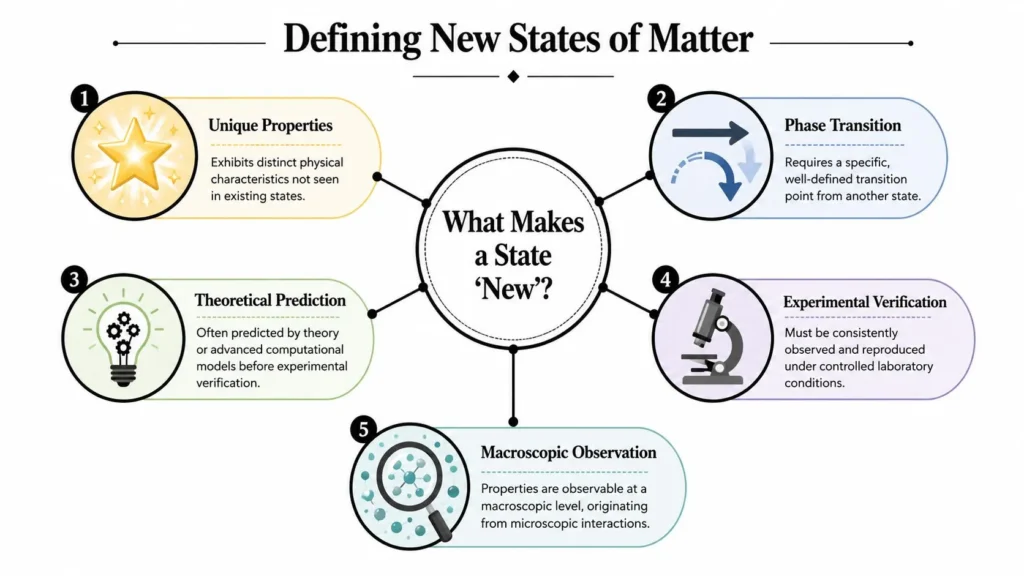
A true new state of matter is not a catchy label for something strange. It is a verdict earned through evidence. Physicists have to show that a material has entered a distinct phase with its own organizing rules, and that other researchers can recognize the same phase independently.
Order is the first clue
Order is the starting point because phases are defined less by ingredients than by arrangement. Carbon can form soft graphite or hard diamond. The atoms are the same. The pattern is different, so the behavior changes.
The same logic guides the search for exotic matter. In an unfamiliar quantum system, researchers ask a basic question first: are the particles acting as though they belong to a new collective pattern? If the answer is yes, that is the first signal that they may be looking at a new phase rather than an ordinary material under unusual conditions.
A crystal offers a simple picture. Its atoms occupy repeating positions, like seats on a perfectly tiled floor. A gas has no such map.
Symmetry shows what changed
Finding order is not enough. Scientists also want to know what changed between the old phase and the new one, and symmetry often provides that answer.
In physics, a symmetry means that some transformation leaves the system effectively unchanged. Shift your attention from one part of an ideal gas to another, and the gas looks much the same. A crystal breaks that symmetry because certain positions become special. The material now has a built-in pattern.
That sounds abstract at first, but it gives researchers a precise language for discovery. If a proposed new state breaks a symmetry, preserves one in an unusual way, or develops a more subtle kind of quantum order, scientists can test that claim. They are no longer saying only that the sample looks odd. They are identifying the rule that separates one phase from another.
Practical rule: A new state needs a clear difference in organization, not just a surprising measurement.
A phase transition needs a measurable fingerprint
The next question is how that organizational change reveals itself in the lab. A phase transition should leave a fingerprint: a repeatable shift in conductivity, magnetism, heat capacity, light scattering, or some other measurable property.
The process becomes detective work. Theory suggests what kind of order might exist and what signatures it should produce. Experimentalists then build conditions where that order could appear, often with extraordinary control over temperature, pressure, electromagnetic fields, or atomic interactions. If the predicted fingerprint appears, that strengthens the case. If multiple fingerprints line up, the case becomes much stronger.
Bose-Einstein condensates are a good example. As noted earlier, they require remarkable experimental control near absolute zero. What convinced the field was not only that atoms were cooled to an extreme temperature. Researchers observed a distinct collective quantum behavior that matched theoretical expectations for a condensate.
Replication is the final test
A result becomes persuasive when other groups can reproduce it, probe it with different tools, and still arrive at the same conclusion. That standard matters even more in quantum matter, where delicate setups can produce misleading signals if the interpretation is rushed.
For that reason, discovering a new state is usually a long process rather than a dramatic single moment. One team may report an unusual signature. Another may test whether it survives under slightly different conditions. A third may show that a competing explanation fits the data better, or fails. Over time, confidence grows because the proposed phase keeps passing harder tests.
The logic is the same one used in good science teaching. If you want a simple, accessible version of hypothesis, test, and repeat, this resource on foster kids’ scientific curiosity captures the method clearly.
That is how scientists know they have found something real. The claim survives theory, measurement, and repetition.
A Gallery of Exotic Matter
A new state of matter earns its place in physics because it behaves by a different set of collective rules. The examples below matter for a deeper reason. Each one gave researchers a specific pattern to test, argue over, and finally accept or reject.
Bose-Einstein condensates and the shift from discovery to control
A Bose-Einstein condensate, or BEC, appears when a dilute gas of atoms is cooled so far that the atoms stop acting like distinct individuals and begin occupying one shared quantum state. A useful comparison is a choir locking onto one note so perfectly that you stop hearing separate voices and hear one coherent sound.
That was already a major conceptual break from everyday matter. Later work on dipolar condensates pushed the story further. Instead of asking only whether a condensate can exist, researchers began asking whether they could design one with built-in interactions that ordinary condensates do not have.
Dipolar condensates are interesting because the atoms or molecules interact with direction-dependent forces. In plain language, the particles do not just notice how far apart they are. They also notice how they are oriented relative to one another. That added structure makes the condensate less like a featureless fog and more like a quantum material with an internal architecture. The result is a platform for studying droplets, patterned phases, and other forms of collective behavior that do not show up in simpler gases.
Topological superconductors and why edges matter
Topology sounds abstract at first, but the core idea is simple. Some properties depend on fine details, while others survive bending, stretching, and small imperfections. In quantum materials, a topological phase has features that remain stable even when the sample is not perfectly clean.
A topological superconductor is exciting because its most unusual behavior may live at its boundaries. The interior can be gapped, while the edges or ends host special excitations called Majorana zero modes. Physicists care about those modes because they are predicted to store quantum information in a way that is harder for ordinary local disturbances to corrupt. The reported topological quantum processor developed by Microsoft and UC Santa Barbara drew attention for exactly that reason, not because the label sounded exotic, but because the proposed state would produce a distinctive and protected boundary signature (University of California report on the topological quantum processor).
If that sounds unfamiliar, compare it with heat in a metal rod. In an ordinary material, the interesting behavior usually fills the bulk. In a topological material, some of the most important physics can be confined to the surface or edge.
Quantum materials that reveal themselves through a strange response
Some candidates for new matter are identified less by what they look like than by how they respond when probed. A recent example came from a quantum material studied near absolute zero that showed a spontaneous Hall effect without an applied magnetic field.
That response matters because the Hall effect usually appears when a magnetic field pushes moving charges sideways. If the sideways signal appears on its own, physicists have to ask what hidden organization inside the material is producing it. The proposed answer was a topological state emerging from strong interactions in a regime where the usual picture of well-behaved, particle-like electrons starts to fail. This is the kind of result that makes the discovery process so interesting. The material announces itself through a fingerprint before anyone can point to a simple everyday analogy for what it is.
The same logic appears in other extreme-physics settings. In how nuclear fusion generates energy inside stars and reactors, scientists also infer invisible microscopic processes from clear macroscopic signatures such as emitted energy and reaction products.
A quick guide to a few exotic states
| State of Matter | Key Characteristic | Why scientists took it seriously |
|---|---|---|
| Bose-Einstein condensate | Many particles occupy one quantum state near absolute zero | It showed coherent collective behavior predicted by quantum statistics |
| Dipolar Bose-Einstein condensate | Condensate with directional, long-range interactions | It opened a route to engineered quantum phases rather than simple condensation alone |
| Topological superconductor | Boundary regions may host Majorana zero modes | The claimed phase has an observable edge signature tied to topological protection |
| Interaction-driven topological quantum state | Unusual Hall response appears without an external magnetic field | The transport signal points to a qualitatively different internal order |
For readers who teach these ideas, visuals help because many of the key differences are patterns of response rather than changes you could photograph directly. A guide to animating complex scientific visuals can help turn those hidden patterns into something students can see.
How Scientists Create and Verify New States
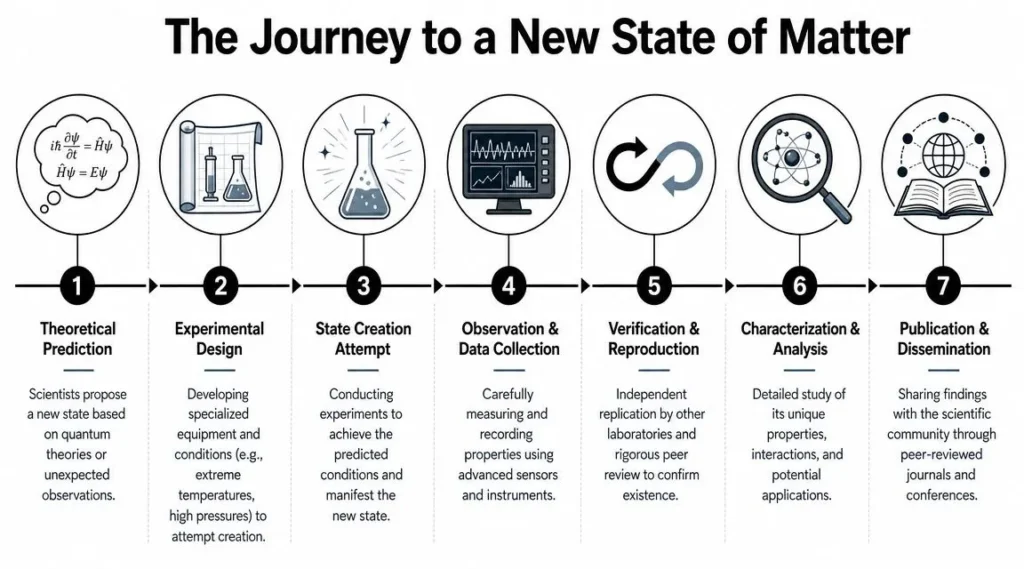
Finding a new state of matter is a high bar. Physicists are not just looking for something unusual. They need evidence that a system has entered a genuinely different collective mode, with rules of behavior that cannot be explained as a minor variation of an old one.
Stage one, the prediction
The process usually starts with theory. Researchers write down how particles interact, then ask what the whole system should do when those interactions compete, reinforce one another, or become dominant under extreme conditions.
Sometimes the calculation points to a clean new phase. Sometimes the clue is stranger. A familiar model fails to match what a material does, and that failure hints that some hidden organizing principle is missing from the description.
This step matters because experiments at the frontiers of low-temperature or quantum materials physics are hard to set up and harder to interpret. A good prediction gives scientists a target.
Stage two, the recipe
Next comes preparation. The new state will not appear unless the experimental conditions are right, and “right” can mean extraordinarily precise control. Researchers may cool a sample close to absolute zero, remove disorder from the material, apply carefully tuned fields, or trap atoms so gently that their quantum behavior stays coherent long enough to observe.
A useful analogy is tuning a radio. If you are slightly off the station, you do not hear a new song. You hear static mixed with fragments of the old one. Quantum phases behave similarly. If temperature, purity, geometry, or interactions are even a little off, the sought-after state may never fully emerge.
A similar logic appears in extreme plasma research, where scientists must create tightly controlled conditions before a distinctive physical regime appears. The machinery differs, but the reasoning is close to what happens in how nuclear fusion generates energy inside stars and reactors.
Stage three, the fingerprint
Preparation alone does not prove discovery. Verification depends on a fingerprint, a measurable feature that the proposed state should have and ordinary states should lack.
That fingerprint varies by system. It might be an unusual electrical response, a sharply changed pattern of light absorption, a special edge signal, or a collective oscillation that appears only when particles are acting as a new whole rather than as independent pieces.
At this juncture, many exciting claims become cautious papers. A measurement can be striking without being unique. Scientists ask a stricter question: could any known effect imitate this signal?
As noted earlier, one recent example involved a topological quantum state identified through a spontaneous Hall response without an applied magnetic field. The importance of that result was not just that the signal looked odd. It matched a theoretically expected signature closely enough to make the new phase a serious candidate rather than a loose speculation.
Why replication is required
A single experiment rarely settles the matter. Other groups try to reproduce the same signature with comparable samples and methods. They also test rival explanations, including impurities, instrument artifacts, and more familiar phases that can mimic part of the effect.
That skepticism is how the field protects itself from false discoveries.
A good claim survives pressure from every side. If the signal appears only in one device, only after selective data processing, or only under conditions no one else can reproduce, confidence drops quickly. If the effect persists across labs and matches multiple independent measurements, the case becomes much stronger.
Verification in physics asks a simple question. Does the claimed new state keep its identity after every ordinary explanation has had a chance to break it?
Potential Applications in Quantum Technology
A new state of matter matters most when it does something ordinary matter cannot do.
In quantum technology, the attraction is not novelty for its own sake. Researchers care because some exotic phases organize particles into collective patterns that are unusually stable, unusually sensitive, or unusually controllable. Those are the three qualities engineers keep chasing.
Why physicists care about protected behavior
Quantum information is fragile. Stray heat, vibrations, and electromagnetic noise can disturb it, much the way a whispered message gets garbled in a noisy room. Some proposed states of matter reduce that fragility by storing information in global features of the system rather than in one easily disturbed particle.
That is why topological phases draw so much attention. In the best case, the protection comes from the material’s overall quantum structure. Engineers then have less work to do to keep the information intact. For a non-technical companion on the computing side, see quantum computing explained simply.
Matter as something scientists can design
Another promise is more practical and, in some ways, more exciting. Exotic matter can act like a test bench for quantum engineering.
As noted earlier, dipolar Bose-Einstein condensates show how this works. Researchers cool atoms until the whole cloud behaves coherently, then use interactions between the atoms to encourage new collective arrangements. The result is not just a strange low-temperature phase. It is a tunable system where scientists can ask a sharp question: if we adjust the interactions, the geometry, or the fields, what new behavior appears?
That shift is important. The lab is no longer only a place to find rare phenomena. It becomes a place to build and verify materials with properties chosen for a task.
Here’s a good visual primer before going further.
Where useful effects may appear first
Some likely applications are already clear enough to sketch.
- Quantum computing: States with protected excitations, including candidate Majorana modes, may store quantum information in ways that better resist local noise.
- Quantum simulation: Ultracold gases and other engineered phases let researchers recreate the physics of harder-to-study materials and watch the behavior develop under controlled conditions.
- Precision sensing: Certain quantum phases react strongly to tiny changes in fields, forces, or motion, which can make them useful for measurement.
- Materials discovery: By tuning collective order in the lab, scientists can test whether a proposed phase has transport, magnetic, or optical properties worth pursuing in future devices.
The deeper lesson connects back to the discovery process that runs through this article. A phase becomes technologically interesting only after scientists can create it reliably, test its signatures from several angles, and show that its special behavior survives outside one dramatic experiment.
That is how a curiosity becomes a platform.
Common Questions About States of Matter
How many states of matter are there
There isn’t one final number. The familiar school list gives the everyday cases. Modern physics identifies additional states and phases under special conditions, especially in quantum systems. So the honest answer is that the count depends on how broadly and precisely you classify matter.
Is plasma a new state of matter
Plasma is a distinct state of matter, but it isn’t “new” in the modern research sense. Scientists have known about it for a long time. When people talk about a new state of matter today, they usually mean a newly identified phase with unusual collective behavior, often in condensed matter or ultracold systems.
Is a phase the same thing as a state
In many contexts, people use the terms almost interchangeably. But physicists can be more careful. “Phase” often emphasizes the underlying pattern of order and the transition between patterns. “State of matter” is broader and more conversational. In an article like this, the overlap is large enough that the distinction usually doesn’t cause trouble.
Why do so many of these states appear near absolute zero
At ordinary temperatures, thermal motion shakes particles around so strongly that delicate quantum organization gets washed out. Cooling reduces that agitation. Then subtle interactions can dominate, and collective quantum patterns become visible.
The cold doesn’t create magic. It removes noise so the deeper rules can show themselves.
Does every unusual material qualify as a new state of matter
No. Unusual behavior alone isn’t enough. Scientists need evidence of a distinct form of organization and a reliable experimental signature. If the effect can be explained as a variant of a known phase, it usually won’t earn a new category.
Why are topological states discussed so often
Because topology offers a way for physical behavior to become resilient. That resilience is scientifically interesting and technologically promising. It gives researchers a path toward quantum phenomena that don’t fall apart as easily under imperfections.
Are these discoveries settled forever once announced
Not immediately. A claim becomes solid only after scrutiny, replication, and sustained agreement in the field. Physics is conservative in the best sense here. The bar for “new state of matter” is high because the label should mean something real.
What should a student remember most
Remember this: scientists identify a new state of matter by finding a new organized pattern, a clear measurable fingerprint, and evidence that survives repeated testing. The strange names come later. The proof comes first.
If you enjoy clear, approachable science writing, maxijournal.com is worth exploring. It publishes accessible commentary across science, technology, education, health, arts, travel, and more, making it a good place to keep learning after the curiosity from this article kicks in.
Discover more from Maxi Journal
Subscribe to get the latest posts sent to your email.