You’re walking somewhere unfamiliar, checking your phone at every junction, when you wonder whether your jacket could tap your wrist before a turn. Then the practical questions arrive: would it look like something you’d wear, could you wash it, and what happens when the battery or app stops working? Those questions matter just as much as the clever feature.
What Wearable Tech Fashion Is and Where It Began
A jacket that gives navigation cues is a useful way to understand wearable tech fashion: garments, shoes, glasses, rings, and watches that sense, display, or react to the wearer while still doing a style job. Think of a pocket that became a screen, then moved computing onto the body itself.
The distinction is functional, not visual. A metallic jacket can look futuristic without containing electronics. A plain-looking sleeve can qualify as wearable technology if its conductive threads register touch and send a command.
From concealed computers to everyday accessories
Wearable computing began with attempts to make computers portable enough to accompany a person. The MIT Media Lab’s wearable-computing timeline describes the milestones below, including Thorp and Shannon’s concealed roulette-prediction computer in 1966.
Milestones in wearable computing and tech fashion
| Year | Milestone | Why It Mattered |
|---|---|---|
| 1966 | Thorp and Shannon demonstrate a concealed roulette-prediction computer | Early proof that a body-worn computer was possible |
| 1966 | Ivan Sutherland creates an early head-mounted display | Foundation for later smart glasses and mixed-reality headsets |
| 1972 | Hamilton Pulsar digital watch | Electronic timekeeping becomes a visible wrist accessory |
| 1991 | Doug Platt introduces the 286-based Hip-PC | Wearable computing becomes buildable for practitioners |
| 1993 | Thad Starner begins wearing a computer built on the Hip-PC design | Continuous everyday wear is tested |
| 1993 | BBN Pathfinder combines wearable computing with GPS and radiation detection | Specialized, practical wearables appear |
| 2008 | Fitbit launches fitness tracking | Body data becomes a consumer product goal |
| 2013 | Google Glass | Wearable displays move toward public use |
| 2015 | Apple Watch | Computing becomes part of a recognizable fashion accessory |
The progression is easier to understand as a change in where the computer lives.
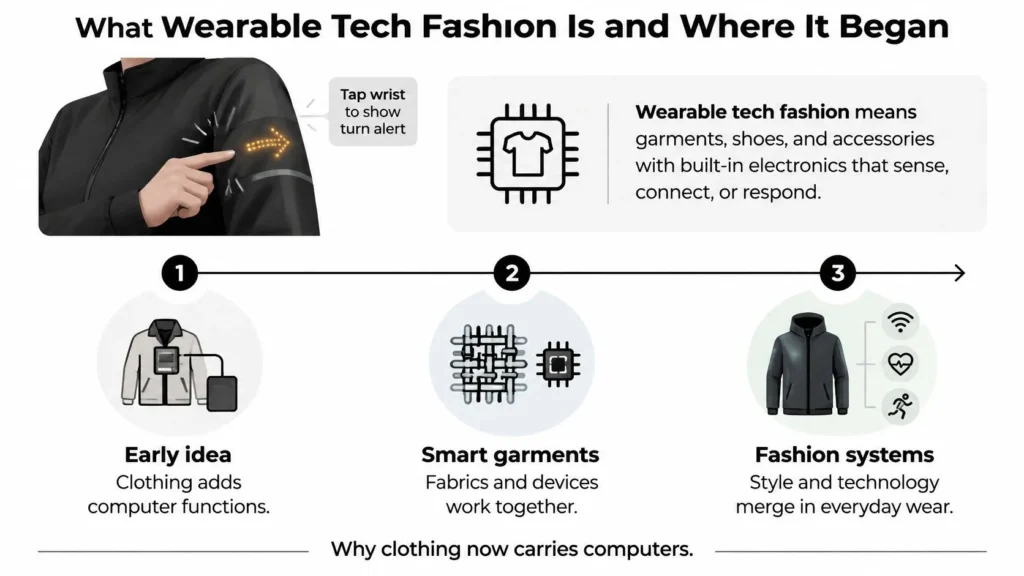
Early developers concentrated on making computing possible away from a desk. Fashion designers face a different challenge: making the wearer want that computing on their body, alongside the clothes they already own.
A watch illustrates the shift. Its strap, case, finish, and proportions affect whether you’ll wear it to work or dinner, even when its software remains unchanged. With a smart garment, the same judgment extends to drape, seams, stretch, and how the electronics feel against your skin.
Wearability isn’t just portability. You can carry an awkward device in a bag; clothing has to cooperate with your movements and your sense of identity.
Five Core Technologies and What Each One Does
Core technologies in wearable tech fashion
| Technology | What It Does | Typical Example | Main Limit |
|---|---|---|---|
| E-textiles | Conductive yarns and fabric circuits carry signals through a garment | Conductive-yarn sleeves, heated jackets, touch-sensitive woven cuffs | Washing, bending, and abrasion can damage conductive paths |
| Sensors | Measure movement, temperature, breathing, pressure, or physiological signals | Heart-rate shirts, posture-monitoring garments, smart insoles | Readings depend on placement, fit, and contact |
| Augmented reality | Adds digital information to the wearer’s view | Smart glasses and AR visors | Battery weight, heat, and social acceptance |
| Smartwatches | Provide wrist-based computing and controls | Apple Watch, Samsung Galaxy Watch, Garmin watches | Charging demands and limited screen space |
| Haptics | Deliver vibration or pressure feedback | Vibrating wristbands, navigation vests, tactile sleeves | Cues can be too subtle or intrusive |
| Energy harvesting | Converts movement or other available energy into electrical output | Piezoelectric and triboelectric textile prototypes | Small, intermittent output requires storage |
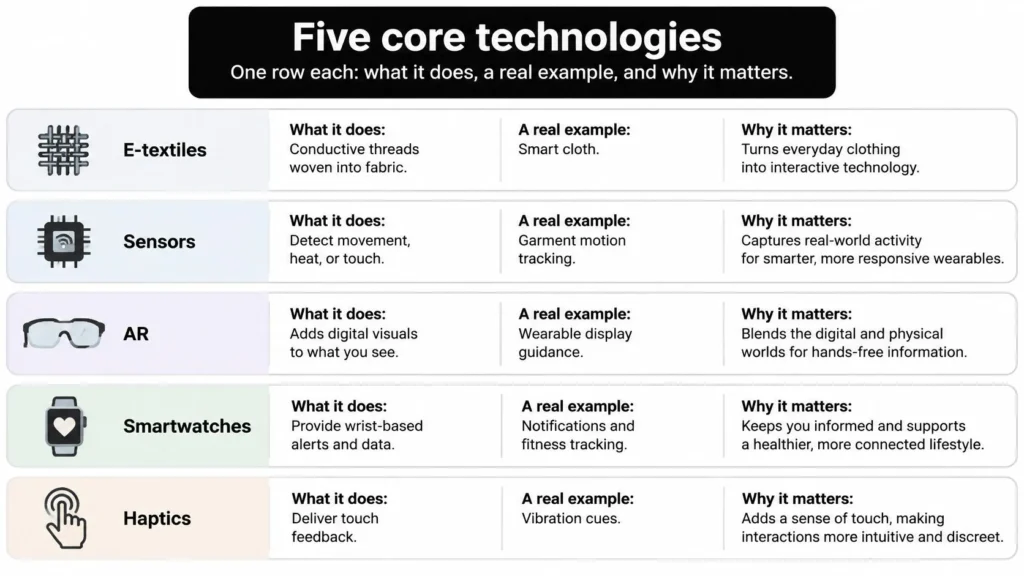
These aren’t interchangeable categories. E-textiles, sensors, augmented reality, smartwatch interfaces, and haptics describe different ways to build or experience wearable technology. Energy harvesting is an additional enabling technology, rather than another kind of notification or display.
The visual below summarizes the core functions.
How the layers work together
Think of a connected garment as a building. Conductive fabric provides wiring, sensors act like thermostats, and a microcontroller, a small programmable processor, serves as the control room. The phone app is the front desk where the wearer changes settings or reviews information.
Say a sleeve responds to a double tap. A touch-sensitive area detects the gesture, the processor decides whether it matches a command, and a wireless connection passes that command to the phone. A small vibration can confirm success without making the wearer look down.
The system doesn’t need every technology in the table. A heated jacket needs a power source, heating elements, and controls, but not necessarily an app. Adding connectivity makes sense only if it improves something the wearer does.
Augmented reality also needs careful labeling. Glasses that capture video aren’t automatically AR glasses; an AR display must add digital information to the wearer’s view. Likewise, a smartwatch is a complete wearable computer, not a textile component.
Why harvesting energy doesn’t eliminate charging
A review of textile energy-harvesting systems in Energies describes PVDF piezoelectric films demonstrated for breathing detection, footstep recognition, and powering low-power demonstration electronics, alongside triboelectric textiles for pulse and respiratory monitoring. These are useful demonstrations, but they don’t establish that ordinary movement can power a continuously running garment computer.
A piezoelectric material generates electrical output when mechanically deformed. A triboelectric system uses contact and separation between materials. Both require designers to work with the energy available, rather than assume that a measurable voltage means dependable power.
A practical architecture needs a rectifier to manage the harvested electrical output, storage to save it, a low-power processor, and a radio that wakes only when necessary. This favors occasional sensing or short transmissions over constant computation.
Practical rule: Treat a self-powered claim as a question about the complete system. Ask what operates, under what movement conditions, and whether a separate battery is still required.
Engineering Limits Behind Smart Garments
A smart textile can remain visibly intact while its electrical behavior deteriorates. The review of robust wearable electronic textiles reports the laboratory results below, which demonstrate progress without establishing a universal lifetime for finished garments.
Durability results for smart textiles
| Test | Reported Result | What It Means for Design |
|---|---|---|
| 100 repeated 180-degree bends, modified conductive yarn | Under 10% resistance change | Carefully selected conductive paths can tolerate repeated flexing |
| Abrasion testing, conductive yarn | Survives up to 400 cycles | Rubbing at seams and cuffs deserves separate testing |
| Eight wash cycles, conductive yarn | Resistance ratio below 1.3 | Washing must be included in electrical qualification |
| 20 wash cycles, advanced fabric electrode | 2.1% resistance increase | Some electrode constructions retain electrical stability through laundering |
| 10,000 charge-discharge cycles, graphene and silver-nanowire supercapacitor | 86% of capacitance retained | Textile storage can demonstrate sustained electrochemical performance |
| Washing test, same supercapacitor | Washable up to 100 cycles; resistance up to 40% higher during part of the test | Washability doesn’t mean electrical properties remain unchanged |
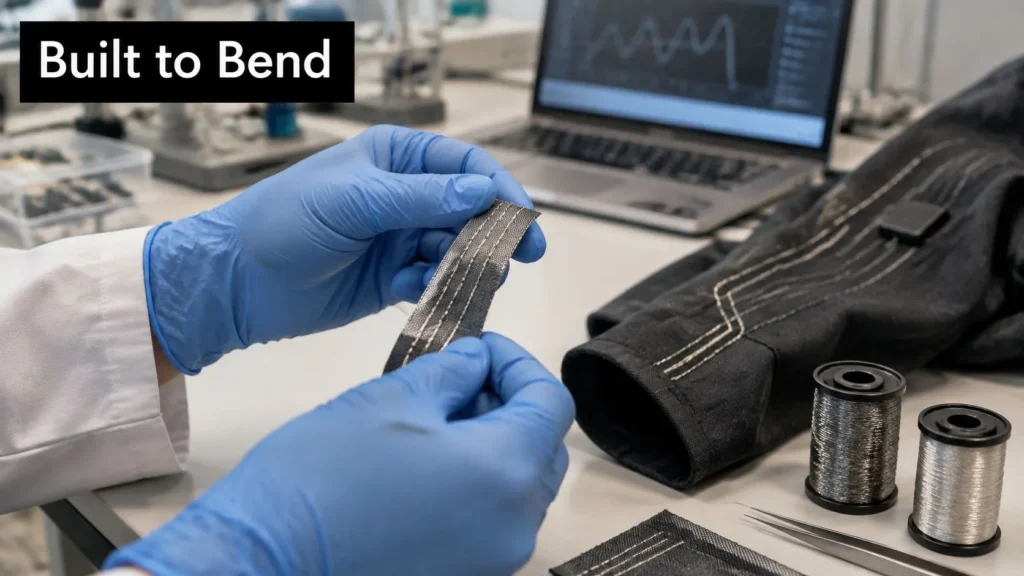
Flexible fabric electronics need evaluation as both textiles and circuits.
What those results mean in your wardrobe
Resistance describes opposition to electrical current. If it changes, the garment may still look fine while a sensing circuit needs recalibration or a heating element behaves differently. Capacitance describes an energy-storage property, so retaining it doesn’t prove that every connector and conductive track has survived equally well.
Bending, rubbing, and laundering therefore need separate pass criteria. A durable energy-storage material doesn’t automatically produce a washable jacket, and a wash-tested electrode doesn’t establish that the finished seams or detachable connectors will last.
Designers must match the conductive material with its polymer binder, protective encapsulation, and garment construction. Protection that keeps detergent away from a circuit may also make a panel stiffer; placing a connection away from a high-flex area may improve comfort and reliability together.
Ask about the finished product
Ask whether a durability claim describes a material sample, a complete garment, or the actual product being sold. Also ask what counted as failure: visible damage alone is a weaker test than retaining the intended electrical function.
For wrist-worn devices, myhalo’s guide to extending the life of your smartwatch offers a separate ownership perspective. For clothing, insist on equally concrete care and maintenance instructions rather than assuming that a familiar fabric guarantees familiar washing.
Designers and Projects Setting the Pace
A light-up dress, a touch-sensitive cuff, and a sculptural couture piece can all appear in a fashion-technology conversation. They prove different things, however, and a runway demonstration isn’t the same as a supported retail product.
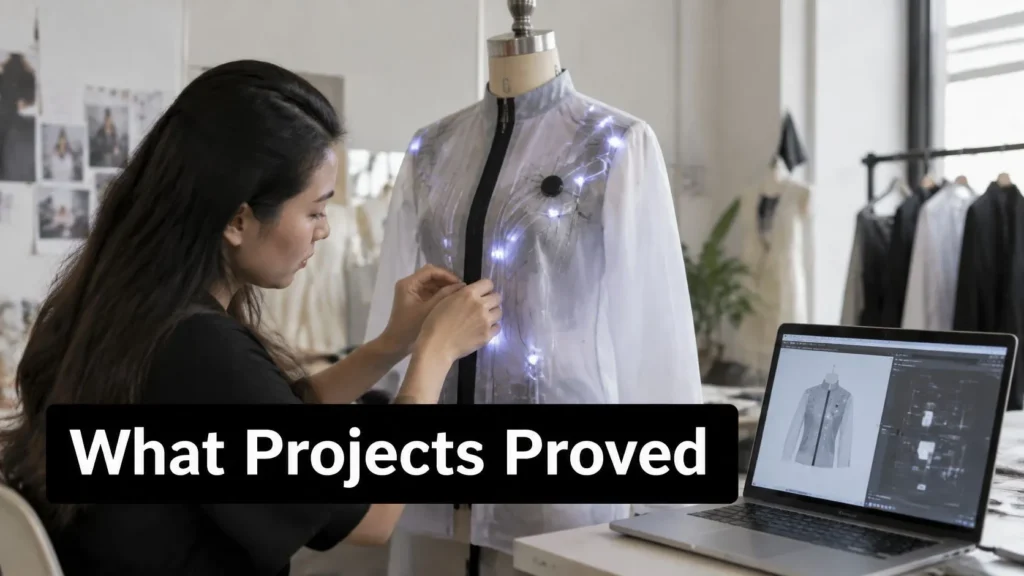
This studio illustration represents the design work involved, rather than documenting a particular designer’s workshop.
Connection, control, and movement
CuteCircuit makes a useful starting point because its Hug Shirt concept treats clothing as communication. Rather than presenting another screen, the idea translates a remote interaction into something felt on the body. Its illuminated fashion work belongs to a different use case: expressive, event-oriented clothing where visibility is the benefit.
Treat such pieces as specialist fashion projects, not evidence that every connected garment is ready for everyday laundering. A custom illuminated gown can succeed brilliantly at an event without meeting the requirements of a commuting jacket.
Google’s Jacquard collaboration with Levi’s approached the everyday problem more directly. The Commuter trucker jacket used a touch-sensitive woven interface to control a phone. Its significance lies in the historically commercial product format: a recognizable jacket with a discreet control surface, rather than a garment designed chiefly to display machinery.
Hussein Chalayan’s moving garments belong primarily to the runway-experiment category. Mechanics and motion become part of the silhouette itself. That’s a different achievement from fitness tracking, and it should be judged as expressive design rather than assumed to be a practical clothing interface.
The embedded video provides another visual reference for considering technology on the body.
New fabrication isn’t always electronics
Iris van Herpen’s 3D-printed couture demonstrates how fabrication methods can create unfamiliar structures and forms. It’s an important boundary case: digitally manufactured clothing isn’t automatically electronic, connected, or capable of sensing anything.
Pauline van Dongen’s solar-powered work explores the garment as an energy-harvesting surface. Treat that work as experimental design, not a promise that any solar-integrated piece will replace your usual charging routine.
These classifications describe the projects’ roles, not current stock availability or support. Before treating any designer example as a shopping option, establish whether you’re looking at a commission, an experimental piece, or an actively maintained product.
Use these judging criteria:
- Survival: Does the complete piece retain its function after its specified care routine?
- Benefit: Does the wearer gain a useful capability or a deliberate expressive effect?
- Ownership: Who repairs, updates, and maintains it after launch?
Health, Performance and Style Use Cases Compared
Use cases, product types and what to verify
| Use Case | Typical Product | What to Verify |
|---|---|---|
| Health monitoring | Heart-rate shirts, smart rings, ECG-sensing garments | Skin contact during activity and validation for the claimed purpose |
| Performance training | Compression tops with motion or muscle sensors | Data export options and fit under load |
| Safety and accessibility | GPS-enabled adaptive apparel for older or disabled users | Offline function, battery life, and ease of use |
| Thermal comfort | Heated jackets, cooling or thermoregulating garments | Battery runtime at the setting you actually use |
| Everyday style | Smart jackets with touch panels, subtle LED accents, smart rings | Washing instructions, repairability, and whether the technology can be switched off |
| Stage and events | LED gowns and light-up costumes | Battery-swap access and weight |
The right comparison starts with the task, not the amount of technology. A performer needs accessible power controls during a costume change; a runner needs a garment that stays comfortable and correctly positioned while moving.
Match the test to the activity
For a heart-rate shirt, try the movements you expect to make. Lift your arms, bend, and jog in place where appropriate. A comfortable standing fit doesn’t establish that an electrode will stay in contact during exercise.
A training garment deserves a software check as well as a fitting. Ask whether you can export the measurements in a usable format and whether the export includes the information your coach needs. Attractive charts don’t help if the underlying records remain inaccessible.
For a wrist-based alternative, Tinymoose’s discussion of smartwatch metrics for everyday health can help you frame which measurements you want. Keep a distinction between observing a personal trend and making a medical decision.
Test the failure mode, not just the feature
A location-enabled garment needs more scrutiny than whether it shows a map. Find out whether location can be calculated without a connection, whether it can be transmitted without one, and what the wearer or caregiver sees when communication fails. Those are different capabilities.
With a heated jacket, request runtime information for your intended heat setting and conditions. Try the battery position while sitting and wearing your normal outer layers. A pocket that feels unobtrusive standing up may press against your body on a train.
Buy the solution to a recurring problem, not a collection of measurements you don’t know how to use.
Medical-sounding claims require evidence matched to the intended use. Ask what was validated, against which reference, and for whom; don’t interpret a wellness score as a diagnosis. The broader distinction between consumer tools and clinical applications also matters when reading about healthcare technology innovations.
Privacy, Resale and Sustainability Questions
A reused smart shirt can create a problem ordinary secondhand clothing doesn’t: information about its previous wearer may remain accessible. A 2026 ACM study of reused smart shirts found that participants initially overlooked biometric-disclosure risks and became more concerned after recognizing the surveillance implications.
Physical ownership and data ownership need separate handovers. Deleting an app from your phone doesn’t establish that embedded memory, an online account, and cloud history have all been cleared.
Prepare the data before the handover
Keep account access available until the process is complete. Manufacturers may require a particular reset order, so use their product-specific instructions while checking each of these tasks.
- Unpair and release ownership. Remove the garment from the app and account, checking whether an ownership lock must also be released.
- Delete cloud history. Use the service’s deletion controls, not just the app’s uninstall function. Distinguish deleting records from merely hiding them.
- Run the manufacturer’s reset. Confirm which local settings and records it erases. Reconnect only as instructed to verify the result.
- Separate removable electronics. For a clothing-only donation, remove modules and batteries that the recipient hasn’t agreed to accept. Route them separately.
- Record anything unverified. Tell the recipient if deletion couldn’t be confirmed. Don’t sell the piece as securely wiped when you can’t establish that.
A buyer should ask where records are stored, whether the previous account has been released, and whether a verifiable wipe exists. Successful pairing to a new phone alone isn’t proof that old cloud records were deleted.
Different handovers need different safeguards
Resale requires transferring control without transferring personal history. Donation also requires checking whether the organization accepts electronic garments at all. A charity prepared to handle textiles may not be equipped to test a battery-powered shirt.
During repair, ask whether the technician needs access to stored measurements or only the hardware. Back up what you need, limit unnecessary account access, and remove detachable storage or modules when the repair permits.
For recycling, erase accessible records before surrendering the electronics. Use an appropriate electronics or battery collection route rather than placing a connected garment indiscriminately in a textile bin.
A garment isn’t ready for its next owner until its previous wearer’s information has been dealt with.
Manufacturers should provide reset instructions, clear storage maps, removable modules, and understandable confirmation that deletion succeeded. Privacy labels could make these responsibilities easier to compare.
A whole-life approach to sustainable fashion therefore needs more than a durable outer fabric. Repair, safe battery handling, usable secondhand ownership, and data deletion all belong in the product’s end-of-life plan.
Industry Challenges, Ethics and Future Trends
Large shipment totals don’t establish that smart clothing has solved everyday ownership. IDC reported global wearable-device shipments of 113.1 million units in the first quarter of 2024, an 8.8% year-over-year increase, but that category is broader than electronic garments.
The difficult commercial question is whether a manufacturer can support fabric and electronics together. Customers need help with sizing, laundering, connectors, batteries, firmware, and accounts, potentially through different service teams.
Barriers manufacturers must address
Price should be judged against usable life, not novelty. An expensive garment with an irreplaceable power module is a different proposition from one whose electronics can move into a replacement shell.
Software dependency needs equal attention. Before selling an app-dependent garment, a manufacturer should explain what remains functional if its service closes and whether another organization can maintain the hardware.
- Brands should publish support terms. State repair routes, replaceable components, and the consequences of discontinued software.
- Procurement teams should examine both supply chains. Textile assembly and electronics production deserve scrutiny for labor conditions.
- Institutions should preserve meaningful consent. A worker, athlete, or care recipient should understand what a required garment collects and who can inspect it.
Promising directions still need proof
Washable conductive yarns need finished-product qualification, not just material demonstrations. Manufacturers must publish test conditions and electrical pass criteria so buyers can judge the claim.
On-garment energy harvesting needs dependable operation during realistic wear, including inactivity. Designers must show the complete power budget rather than a striking voltage reading.
Local processing could reduce unnecessary transmission by sending summaries instead of continuous raw measurements. Developers would still need to explain what stays on the garment, what leaves it, and how either can be deleted.
Medical and sports applications need validation for the actual wearer and task. Regulators, standards bodies, and purchasers can help by demanding clear claims and understandable privacy information, while recyclers need practical ways to accept separated modules and batteries.
The strongest buying signal isn’t a dramatic launch video. It’s a manufacturer willing to publish test results, explain limitations, and maintain the product after the first sale.
Buying Checklist and Styling Rules
The barrier buyers miss is often the work of ownership. A 2026 study of 194 consumers in Design and Policy found interest in biometric tracking, thermal regulation, and effortless integration, while identifying data security, high prices, and durability as major obstacles; respondents valued mobility, convenience, and ease of use over novelty.
Use that distinction to shop: the garment must improve your routine without creating a maintenance routine you won’t follow.
Run the buy-or-skip check
- Name the problem. Write a plain reason you’d use the feature. If sleep is your concern, you could explore Oura Ring sleep tracking through The Sleep Consultant before deciding whether a ring suits the task.
- Move in it. Check fit, pressure points, contact, and controls during your normal activity, not just in a mirror.
- Confirm usable runtime. Match the stated conditions to your intended settings and time away from a charger.
- Read care and repair instructions. Identify removable parts, drying restrictions, replacement modules, and the repair contact.
- Check access requirements. Establish offline capability, supported languages, usable controls, and evidence relevant to your skin tone or mobility needs.
- Calculate ownership cost. Include subscriptions, chargers, replacement batteries, and proprietary accessories.
- Plan the handover. Find the account-release and data-erasure instructions before paying.
Skip the purchase if there’s no clear care instruction, it can’t meet an essential offline requirement, or personal records can’t be reliably erased. For adaptive apparel, prioritize the wearer’s independence and ability to operate the controls over a caregiver’s preference for more tracking.
Make the technology fit your wardrobe
Choose a dominant function rather than demanding that every garment track, heat, signal, and entertain. Position bulky modules where they won’t collide with waistbands, backpack straps, or a seated posture.
Neutral colors and familiar silhouettes can make functional layers easier to combine, but discreet styling isn’t compulsory. An illuminated accent can be intentional; the important question is whether you can switch it off when the setting changes.
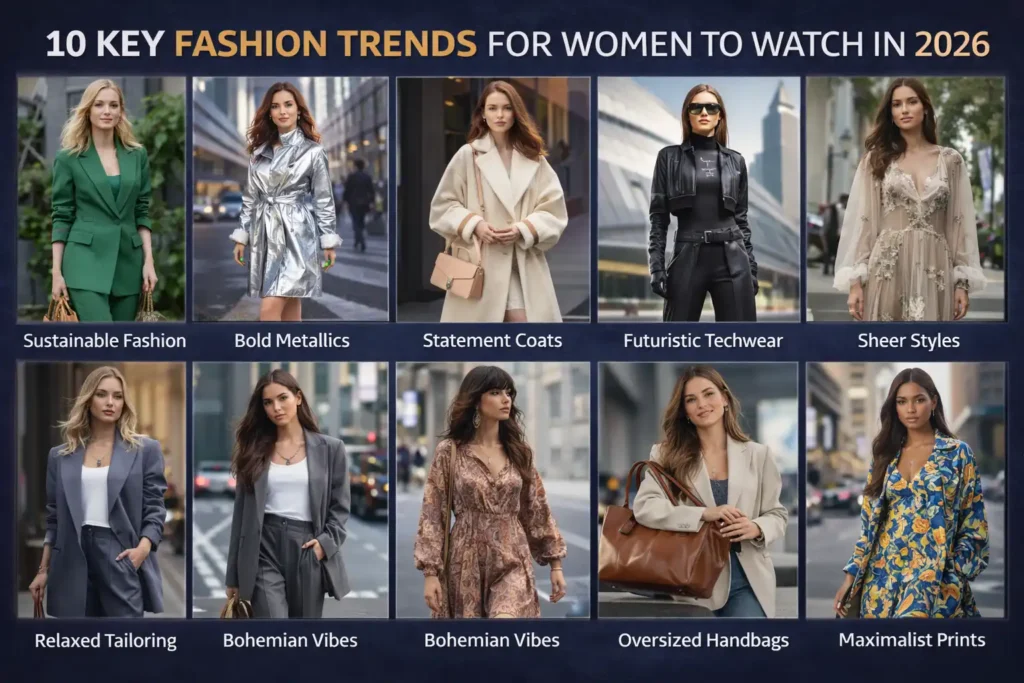
Use broader fashion trends for women as styling context rather than a requirement to replace serviceable technology. A different strap or outer layer may suit a new outfit without creating another connected device to maintain.
Choose a use case from the comparison table and trial a single piece before expanding your wardrobe. Keep brief notes on comfort, usefulness, charging, and care, then buy more only if the feature earns its place.
Maxi Journal connects fashion with approachable coverage of technology, health, science, and everyday innovation. Visit maxijournal.com to explore those connections and use this checklist when comparing your next connected garment or accessory.
Discover more from Maxi Journal
Subscribe to get the latest posts sent to your email.