Short sleep isn’t rare or trivial. In a 2016 analysis of 444,306 U.S. adults, 35.0% reported sleeping fewer than 7 hours in a 24-hour period, according to the CDC analysis of short sleep duration. That pattern represented about 83.6 million U.S. adults. The useful question isn’t whether tiredness feels bad. It’s which sleep deprivation effects on the body appear after one poor night, which build after repeated short nights, and which are only long-term associations. Your sleep pattern, not a single number, determines where you should start.
Effects on Each Body System at a Glance
That same 2016 distribution included 11.8% sleeping 5 hours or less and 23.0% sleeping 6 hours. Short sleep was associated with greater likelihoods of obesity, diabetes, high blood pressure, coronary heart disease, stroke, frequent mental distress, and death. Those associations show scale and seriousness, yet they arrive bundled with diet, illness, work schedules and medication, so they cannot pin any single disease on sleep alone.
Read the table in two parts. The middle columns describe measured changes in physiology or performance: things researchers can observe within days. The final column describes long-term associations, which help you weigh risk without diagnosing any one person. For a broader plain-language overview of how inadequate sleep disrupts recovery, read it alongside this pattern-based view rather than treating every bad night as identical.
Effects of Sleep Loss by Body System
| Body system | After one poor night | After repeated short sleep | Long-term associations |
|---|---|---|---|
| Brain and thinking | Slower reaction time, reduced attention | Impaired concentration, memory and learning | Frequent mental distress, anxiety |
| Glucose and insulin | Reduced insulin sensitivity after 24 hours awake | Glucose effectiveness and acute insulin response each down about 30% after six nights at 4 hours in bed | Obesity, type 2 diabetes |
| Heart and blood pressure | Raised heart rate and blood pressure after several nights at about 4 hours | Lower heart-rate variability, sustained sympathetic activation | Hypertension, coronary heart disease, stroke |
| Inflammation | Rise in inflammatory markers under restriction | Higher C-reactive protein and interleukin-6 | Cardiovascular and metabolic disease associations |
| Stress hormones | Evening cortisol rise after restricted nights | Sustained sympathetic nervous-system activity | Hypertension and metabolic disturbance |
| Muscle and performance | Reduced strength, power or endurance in some studies | Not established as a consistent effect | No established long-term disease association |
At the population level, adults reporting short sleep tend to show higher rates of coronary heart disease and stroke than longer sleepers. Read that as a signal about groups, not a forecast about you.
The immediate safety issue is sharper. Insufficient sleep impairs cognition, memory, concentration, and learning, and daytime sleepiness slows reaction time. Behind a steering wheel, the same lapse that makes you reread an email can mean missing a stopped car, which is why drowsy driving counts as a recognized road hazard.
Match your own pattern to the column that fits. An occasional short night mainly threatens alertness and performance, so protect those first. When short nights repeat, measurable body systems begin to shift, and persistent patterns are where the disease associations become more relevant.
How Sleep Loss Clouds Thinking and Mood
Think of sleep as the brain’s nightly maintenance shift. During the day you take in information, make decisions and react to other people. At night the brain consolidates what matters, clears metabolic waste and resets systems that keep attention steady. Skipping that shift is like running a computer without its overnight cleanup. It still turns on, but it lags, misfiles things and freezes at awkward moments.
The first signs are ordinary, which is why people miss them.

- Attention lapses: You reread the same email three times or miss a turn you drive every day.
- Slower responses: Answers in conversation feel delayed, and braking or catching a mistake takes longer.
- Working memory slips: You walk into a room and forget why, or lose a name mid-sentence.
- Physical signals: Heavy eyelids, yawning in meetings and a growing need for caffeine to stay on task.
Memory Depends on the Night After Learning
A student can study until 2 a.m., feel wired on caffeine, and still retain less by exam time. That’s not a motivation problem. New learning needs sleep afterward to stabilize, so cutting the night after studying can weaken recall even when the study session itself felt productive.
The same principle applies at work. Say a nurse near the end of a long sequence of shifts misreads a dosage or has to double-check a familiar routine. The error doesn’t mean she lacks skill. Sleep loss narrows attention, and narrow attention is exactly what safety-sensitive work can’t afford.
Mood Changes Are Part of the Same Picture
After short sleep, many people react more strongly to negative events and settle more slowly afterward. A minor criticism lands harder. Traffic feels personal. That emotional reactivity can look like irritability, anxiety or low mood, especially when several short nights stack together.
This video gives a useful visual walkthrough of how tiredness affects daily functioning.
People also underestimate their own impairment. You may feel you’ve adapted because the sharp sleepiness fades, while concentration and reaction time remain below your normal baseline. That’s why self-checks beat a vague sense of coping.
Ask three questions over several days. Does your focus reliably drop mid-afternoon? Do you need caffeine to complete routine work? Does irritability persist even on calmer days? If yes, look at your sleep pattern before blaming willpower. Practical mental health self-care tips can support mood, but they don’t replace the sleep your brain uses to regulate it.
Blood Sugar, Appetite and Weight Gain
Sleep restriction can create measurable insulin resistance in otherwise healthy adults. That’s a stronger claim than saying tired people crave snacks, and it comes from controlled conditions rather than lifestyle surveys alone.
In a controlled study summarized in the NIH review of sleep and metabolic function, six consecutive nights with only 4 hours in bed increased sympathetic nervous-system activity and evening cortisol while reducing both glucose effectiveness and the acute insulin response by approximately 30% each. Glucose effectiveness means your body’s ability to dispose of glucose independently of insulin. When it falls, glucose from a meal clears more slowly.
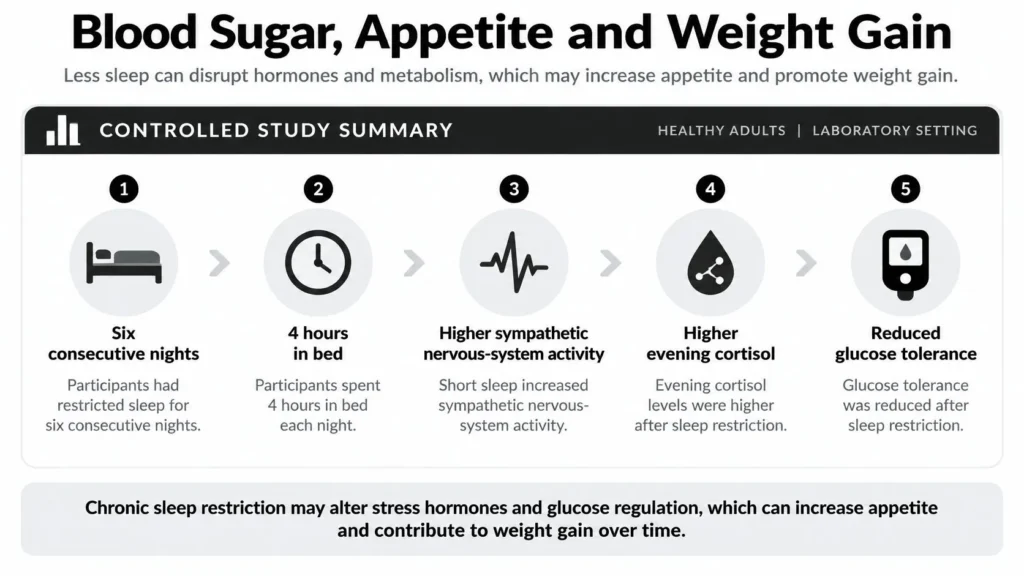
A separate randomized trial in that review found 24 hours of total sleep deprivation significantly reduced insulin sensitivity, with steady-state glucose rising from 5.7 ± 2.1 to 6.7 ± 2.2 mmol/L during an insulin-sensitivity test. A normally sleeping control group showed no comparable change. One all-nighter won’t diagnose diabetes, but it can temporarily make glucose handling less efficient.
What That Means at Breakfast
Picture the same bowl of oatmeal, fruit and coffee after a full night and after several short nights. The food hasn’t changed. Your insulin response and glucose disposal have. Blood sugar may stay higher for longer after eating, and repeating that pattern gives metabolic strain more opportunities to accumulate.
This matters most if you already have obesity, prediabetes or diabetes, because you’re starting with less metabolic margin. Fragmented sleep can complicate the picture too, which is why understanding the apnea and diabetes connection is relevant if loud snoring or witnessed breathing pauses are part of your nights.
Appetite Pushes in the Same Direction
Short sleep also makes energy-dense food harder to resist. You’re awake longer, your self-control is thinner, and quick calories promise immediate energy. That behavioral pathway helps explain population patterns without pretending every extra pound comes from hormones alone.
In CDC data from 2004 to 2006 reported in the CDC analysis of insufficient sleep and daily activities, adults sleeping fewer than 6 hours had an obesity prevalence of 33%, compared with 22% among those sleeping 7 to 8 hours. Again, that’s an association, not proof that sleep alone caused the difference.
Practical rule: Treat regular sleep duration as a metabolic habit, not only a rest habit.
You don’t need a perfect night to benefit. Avoiding repeated all-nighters and keeping weeknight sleep from collapsing protects post-meal glucose handling before problems become clinically obvious. If your schedule forces short nights, regular meals, daylight activity and a consistent wake time still help, but they don’t fully substitute for sleep itself.
Heart Strain and Chronic Inflammation
Your sympathetic nervous system works like an accelerator. It raises heart rate, tightens blood vessels and prepares you to act. Your parasympathetic system is the brake, slowing the heart and allowing recovery. Sleep is when the accelerator is supposed to ease off for hours at a time.
Cut sleep short and that balance shifts. The accelerator stays partly pressed into the next day, so resting heart rate and blood pressure run higher than they should. Repeated across weeks, that’s daily cardiovascular stress, not just a groggy feeling.
The Accelerator and Brake in Plain Terms
Heart-rate variability describes the small variation in timing between heartbeats. Healthy hearts aren’t metronomes. They adjust constantly. Lower variability can signal reduced parasympathetic control, meaning the brake isn’t engaging as flexibly.
Experimental evidence in a peer-reviewed review of sleep loss and cardiovascular regulation indicates several nights restricted to roughly 4 hours of sleep can raise resting heart rate and blood pressure, reduce heart-rate variability and increase inflammatory biomarkers such as C-reactive protein and interleukin-6. Each hour of sleep lost was associated with an 8.1% increase in C-reactive protein and a 4.5% increase in interleukin-6 in epidemiological data summarized there.
Laboratory protocols make the direction clearer. 88 hours of continuous wakefulness or 4.2 hours of sleep nightly for 10 days increased high-sensitivity C-reactive protein, and sleep restriction increased systolic blood pressure and heart rate. Those are extreme protocols, but they show mechanism, not just correlation.
Why Low-Grade Inflammation Matters
Inflammation is useful when it’s brief and targeted, such as after an injury. It becomes a problem when alarm signals stay mildly raised for days without a clear job to do. That persistent signalling adds stress to blood vessel walls and interacts with blood pressure, glucose and cholesterol risks.
Say a commuter sleeps about four hours on workdays for two weeks during a project deadline. She may notice a faster resting pulse and higher evening readings even though her diet hasn’t changed. The readings may settle when regular sleep returns. If they don’t, the pattern deserves clinical attention rather than another month of waiting.
A Monitoring Routine You Can Start Today
- Use the same times: Measure home blood pressure morning and evening, seated after resting.
- Record sleep beside it: Note bedtime, wake time and any unusually short nights.
- Look for patterns: Compare several short-sleep days with several regular-sleep days.
- Bring the log: A week or two of paired readings helps a clinician more than one alarming number.
Don’t chase single readings after coffee, arguments or rushing upstairs. You’re looking for a repeatable response to sleep restriction. If readings stay high after sleep improves, book a review. Sleep may be one contributor, but it shouldn’t become the only explanation you accept.
Immune Defence, Hormones and Physical Output
Your immune system works like a border patrol on a set schedule. Immune cells and chemical signals rise and fall across the day and night, and short or poorly timed sleep scrambles that coordination. The patrol keeps working. It just loses some of its timing.
One caveat helps you read this evidence correctly. Sleep restriction studies track inflammatory markers, signals that immune regulation has been disturbed. Those signals sit several steps removed from proving you will catch a specific infection or respond poorly to a vaccine after short nights, so treat them as an early warning light rather than a diagnosis.
Hormones Run on a Clock
Cortisol follows a daily rhythm, higher around waking and lower in the evening. After restricted nights, evening cortisol can run higher than usual, a sign the stress system stays active later than it should. Because cortisol interacts with appetite, blood sugar, blood pressure and recovery from training or illness, that shift touches several systems at once.
If you’re trying to make sense of test results, interpreting cortisol levels alongside sleep patterns can help you avoid reading one number without context. Timing matters here. A value that looks ordinary in the morning can carry a different meaning late in the day.
Sleep also provides windows for other hormone release tied to repair and growth. Cutting sleep shortens those windows without shutting production off entirely, which is why claims that one bad night destroys your recovery go too far.
Strength and Endurance Don’t Fall Uniformly
Some studies find that sleep loss reduces muscle strength, power, and muscular endurance, while others find no significant change after a single sleepless night. That mixed result is useful. It warns against assuming every workout after poor sleep will collapse, and against assuming you’re unaffected because you finished it.
Say a runner attempts a personal best after a fragmented night. The early pace may feel normal, then the final sprint fades sooner. Or take a warehouse worker doing repetitive lifting after several short nights: the first hour may hold up, while grip, pacing and attention to technique deteriorate later in the shift.
Judge the task, the duration and your recent pattern, not just whether you slept badly last night.
Short, familiar efforts tend to hold up better than prolonged endurance, complex coordination or work where a lapse causes injury. If you’re sleep deprived, reduce load, extend rest periods and skip maximal lifts or personal records. Save high-risk training for a day when reaction time and muscular endurance are more reliable.
Acute Sleep Loss Versus Chronic Sleep Debt
A common misconception sounds like this. You pulled one all-nighter, so you’ve raised your long-term risk of diabetes, hypertension and heart disease in a lasting way. The evidence draws a line between acute sleep loss and chronic sleep debt, two different patterns with different consequences.
A PubMed summary of sleep deprivation and physical performance frames the questions that matter: which body systems are temporarily impaired, how large the impairment is, and how quickly it reverses. Popular coverage often skips those questions and lists chronic diseases beside one-night effects. Use the table as a decision tool instead. Find the row that matches your usual pattern, then read across.
Sleep Loss Patterns and What Each One Does
| Pattern | Typical example | Documented short-term effects | Long-term risk evidence |
|---|---|---|---|
| Single sleepless night | All-nighter before an exam | Reduced reaction capacity, some muscle strength and endurance losses in some studies | Not established from one night alone |
| Repeated short nights | Under 7 hours most weeknights | Reduced insulin sensitivity, raised heart rate and blood pressure | Associated with obesity, type 2 diabetes, hypertension, stroke |
| Persistent short sleep | Years of 5 to 6 hours a night | Daytime sleepiness, difficulty concentrating and remembering | Associated with coronary heart disease and stroke |
| Circadian misalignment | Rotating shifts or irregular schedules | Disrupted sleep quality, autonomic and metabolic disturbance | Linked to cardiometabolic risk, with no single established effect size |
Place Yourself in a Row
Say you’re a student who stays up all night once before an exam. Your main risks the next day are slower reactions, weaker recall and unsafe driving. Sleep the following night, avoid making it a weekly strategy, and don’t treat that one night as proof of permanent damage.
Say you’re a nurse on rotating shifts who averages five hours on workdays for months. You sit in two rows at once: repeated short sleep and misalignment. The concern is the cumulative load on glucose, blood pressure, mood and reaction capacity that builds across months of short, mistimed sleep. Travel across time zones creates a shorter version of misalignment, so strategies for how to overcome jet lag fast draw on the same timing principles.
Circadian misalignment deserves separate attention because you can spend enough hours in bed at the wrong biological time and still wake unrefreshed. A worker who sleeps a full stretch in daylight after a night shift can still land in this row. Timing affects autonomic balance, inflammation, blood vessel function and metabolism, not only subjective tiredness.
Reversal timing is the honest unknown. Research doesn’t yet show how quickly one recovery night restores insulin sensitivity, blood pressure and inflammation after weeks of restriction, so don’t assume a fast reset. Track how alertness, mood, training performance and home readings respond as regular sleep returns, and let that pattern guide your next step.
Protect Your Body With a Regular Sleep Schedule
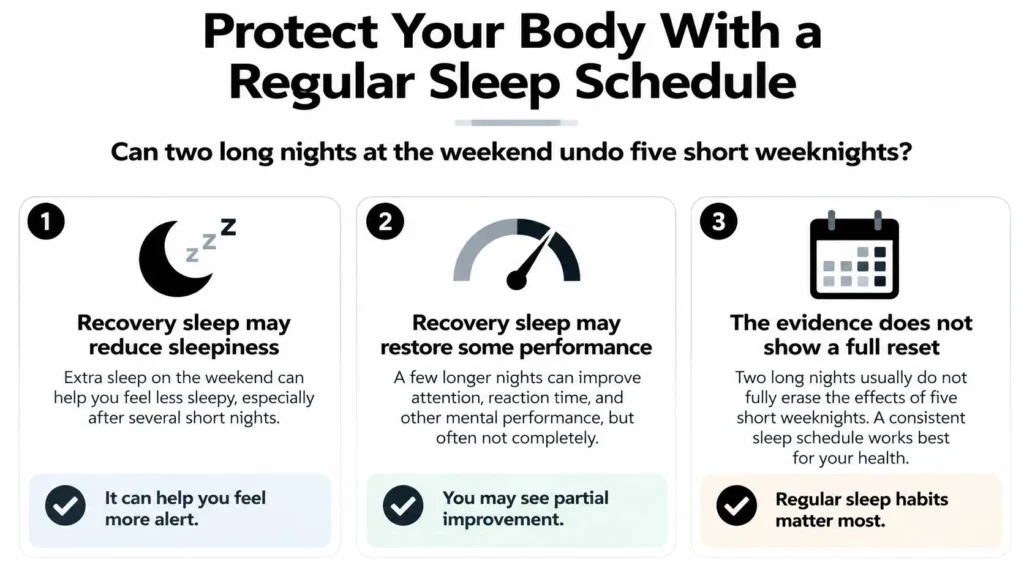
Can two long weekend nights undo five short weeknights? Partly, but not reliably. Recovery sleep may reduce sleepiness and restore some performance. It shouldn’t be presented as a guaranteed reset for repeated weekly restriction.
A Cigna Healthcare summary of sleep deprivation effects links insufficient sleep with hypertension, stroke, coronary disease, obesity, type 2 diabetes, anxiety, and impaired emotional regulation, while also showing why different patterns shouldn’t be merged. Acute deprivation, chronic short sleep, fragmented sleep and circadian misalignment aren’t interchangeable. Treat sleep debt as a pattern-dependent risk, not an hour-for-hour bank account where Saturday deposits erase weekday withdrawals.
Start With Your Row, Then Use the Routine
First identify whether your problem is a single late night, repeated weeknight restriction, persistent short sleep or a shifting schedule. Then apply the steps that fit. A rotating-shift worker may need anchor sleep and light timing most urgently. A student may need a fixed wake time and earlier caffeine cutoff.
- Keep a fixed wake time seven days a week. This anchors your body clock more reliably than forcing an early bedtime when you aren’t sleepy.
- Get bright light within an hour of waking. Outdoor light works best. Open curtains and take a short walk if your schedule allows.
- Stop caffeine early enough to protect the night. If afternoons are your weak point, use light, movement or a brief break before another coffee.
- Use a consistent bedtime window. Go to bed when sleepy within that window, and keep the room cool, dark and quiet.
- Log blood pressure with sleep duration. Do this especially after several short nights, and look for patterns across days.
- Book a clinical review when warning signs persist. Seek help if readings stay high, sleepiness affects driving or work, or a partner reports breathing pauses.
For practical ways to put several of these habits together, see this guide on how to improve sleep quality. Don’t overhaul everything at once. Pick the step that matches your pattern and repeat it until it’s boring.
Prevention and regularity are more reliable than rescue sleep.
Weekend catch-up still has a place. Sleeping longer after a short week is better than staying restricted, and feeling less sleepy is a real benefit. Just don’t use two long nights to justify five short ones indefinitely. Your glucose handling, blood pressure and attention respond to the pattern you repeat most often.
Your next action is simple. Identify your row in the pattern table tonight, choose the first routine step that applies, and start tomorrow morning with a fixed wake time. Small regularity, repeated daily, protects more systems than occasional heroic recovery.
For clear, approachable writing on health, science, technology and everyday wellbeing, visit maxijournal.com and explore its daily magazine articles and practical guides. If sleep is your current focus, start with one pattern change from this article, then keep reading there to build a routine you can sustain.
Discover more from Maxi Journal
Subscribe to get the latest posts sent to your email.